
Context: Urban Flooding in India
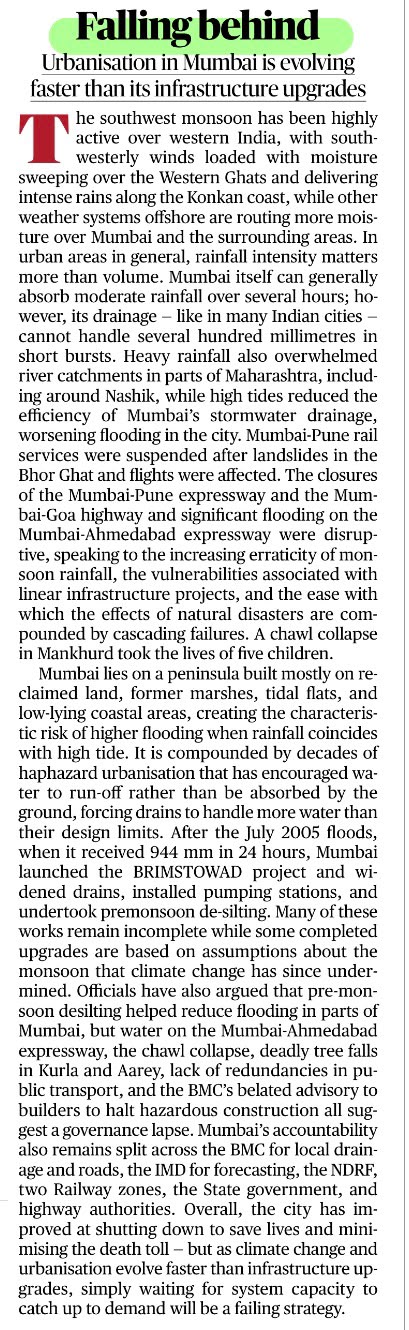
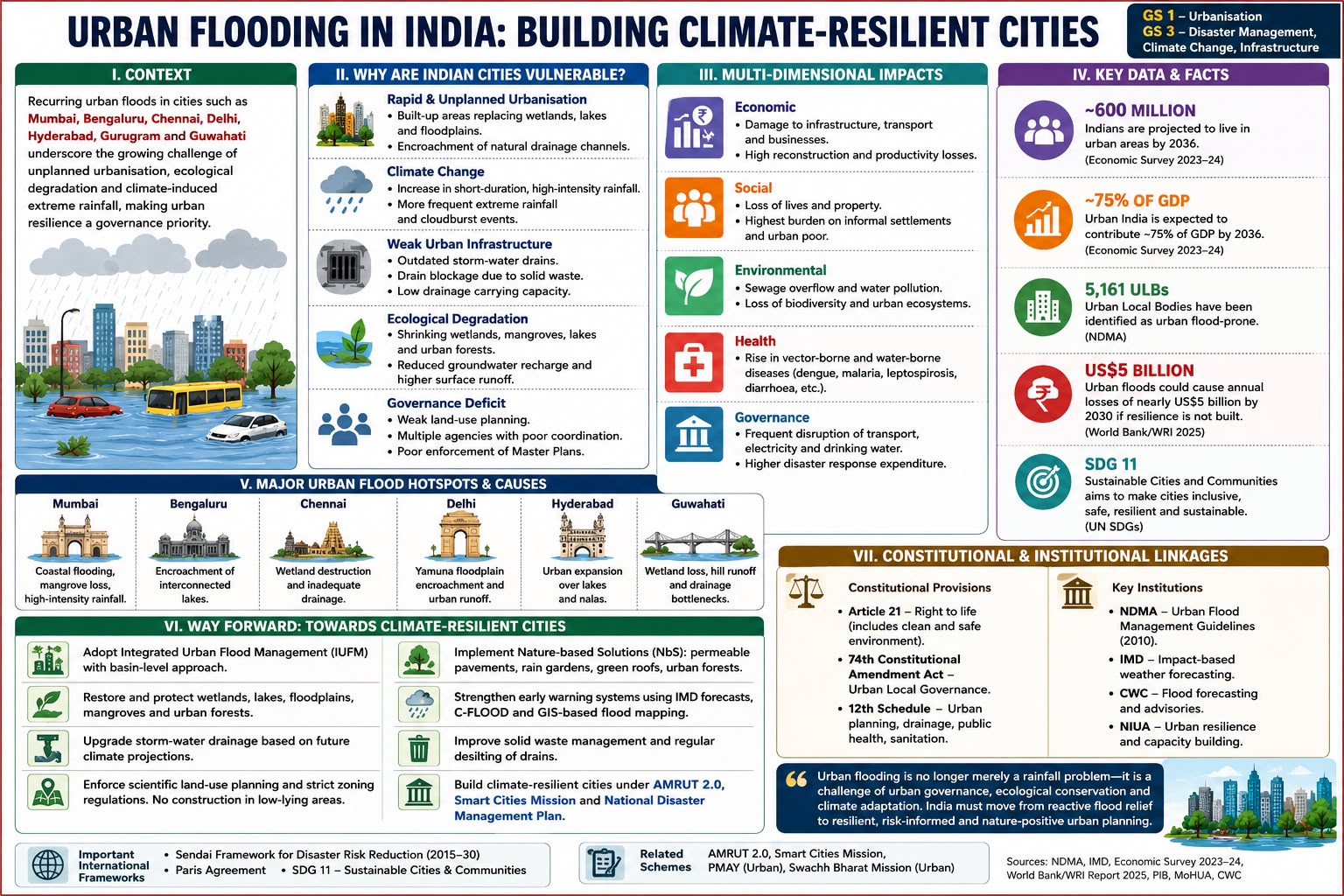
The article discusses recurring urban flooding in Indian cities such as Mumbai, Bengaluru, Chennai, Delhi, Hyderabad, Gurugram and Guwahati.
It argues that urban flooding is not merely a rainfall problem. It is a governance, planning, drainage and climate-resilience failure.
Why Indian Cities Are Vulnerable
1. Rapid and Unplanned Urbanisation
Cities have expanded over:
- Floodplains
- Lakes
- Wetlands
- Drains
- Low-lying areas
This reduces natural drainage and increases flood risk.
2. Climate Change
High-intensity rainfall events are becoming more frequent.
Short-duration extreme rainfall overwhelms urban drainage systems.
3. Weak Urban Infrastructure
Cities suffer from:
- Outdated storm-water drains
- Poor drainage capacity
- Encroached drains
- Clogged drains
- Weak solid waste management
4. Ecological Degradation
Loss of wetlands, lakes and urban forests reduces natural water absorption.
5. Governance Deficit
Urban flooding worsens due to:
- Fragmented municipal governance
- Poor coordination among agencies
- Weak enforcement of master plans
- Poor maintenance of drainage infrastructure
Impacts of Urban Flooding
Economic Impact
- Damage to infrastructure
- Transport disruption
- Business losses
- Higher reconstruction costs
Social Impact
- Loss of lives
- Displacement
- Damage to homes
- Greater impact on slum dwellers and urban poor
Environmental Impact
- Sewage overflow
- Water pollution
- Solid waste spread
- Loss of biodiversity
Health Impact
Urban flooding increases risk of:
- Vector-borne diseases
- Water-borne diseases
- Mental stress
- Poor sanitation
Governance Impact
It exposes weak urban planning and poor disaster preparedness.
Key Data
- Around 600 million Indians are projected to live in urban areas by 2036.
- Urban India contributes nearly 75% of India’s GDP.
- Urban local bodies have often identified large urban flood-prone areas across cities.
- Urban floods can cause huge economic losses and disrupt productivity.
Constitutional and Institutional Linkages
Article 21
Right to life includes clean and safe environment.
74th Constitutional Amendment
Provides for urban local governance.
12th Schedule
Includes urban planning, public health and sanitation.
Important Institutions
- National Disaster Management Authority
- India Meteorological Department
- Central Water Commission
- Urban local bodies
- State disaster management authorities
Way Forward
1. Adopt Integrated Urban Flood Management
Cities must combine drainage, land-use planning, climate adaptation and disaster management.
2. Restore Natural Drainage
Protect:
- Lakes
- Wetlands
- Floodplains
- Storm-water drains
- Urban green spaces
3. Upgrade Storm-Water Drainage
Drainage systems must be redesigned for future climate projections, not past rainfall averages.
4. Improve Early Warning Systems
Use:
- IMD forecasts
- Doppler radar
- GIS mapping
- AI-based flood modelling
5. Strengthen Solid Waste Management
Blocked drains due to waste are a major cause of flooding.
6. Build Climate-Resilient Cities
Cities must integrate:
- AMRUT 2.0
- Smart Cities Mission
- National Disaster Management Plan
- Climate-resilient urban planning
Key Takeaway
Urban flooding is no longer merely a natural disaster. It is a failure of urban governance, ecological conservation and climate adaptation.









Great content! Keep up the good work!
Thank you! We’re glad you found the content useful. Keep learning with US!