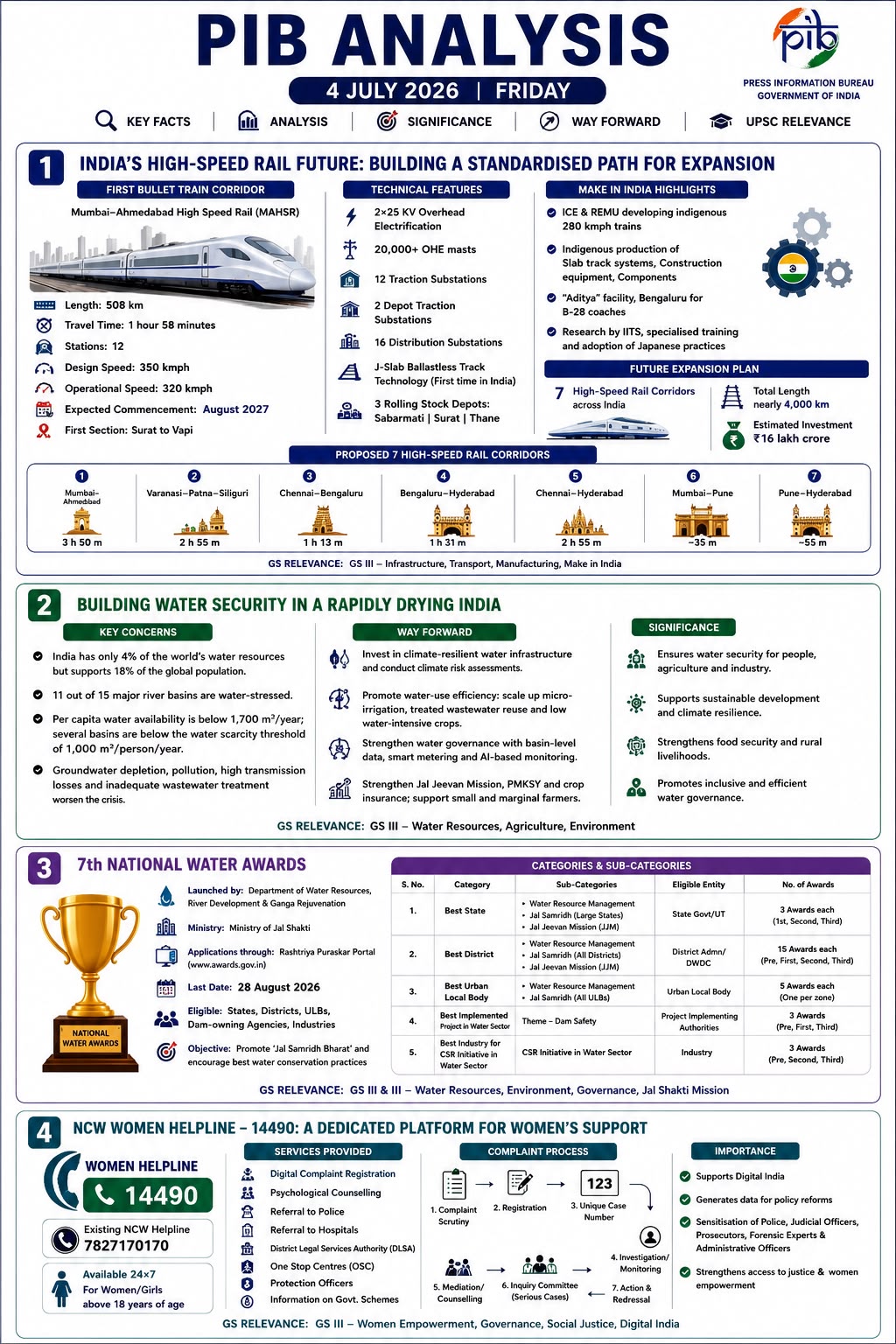
Context: Water Security in India
The PIB analysis reinforces the need for climate-resilient water security, given rising water stress, groundwater depletion and increasing climate variability.
Key Facts
- India has only 4% of the world’s freshwater resources.
- India supports nearly 18% of the global population.
- 11 out of 15 major river basins are water-stressed.
- Water availability is declining due to climate change, pollution and overuse.
Major Concerns
- Falling groundwater levels
- Urban water stress
- Poor wastewater treatment
- High transmission losses
- Irrigation inefficiency
- Climate-induced rainfall variability
- River-basin level data gaps
Water Security Strategy
1. Demand Management
Reduce excessive water use through:
- Efficient irrigation
- Water pricing reforms
- Smart metering
- Public awareness
2. Supply Augmentation
Improve:
- Rainwater harvesting
- Watershed development
- Aquifer recharge
- Storage systems
- Local water bodies
3. Wastewater Reuse
Promote treated wastewater use in:
- Industry
- Agriculture
- Urban landscaping
- Construction
4. Climate-Resilient Agriculture
Promote:
- Crop diversification
- Drought-resistant crops
- Micro-irrigation
- Soil moisture conservation
5. Technology Use
Use:
- AI-based water monitoring
- GIS mapping
- Remote sensing
- Smart water grids
- Digital water accounting
Government Schemes
Jal Jeevan Mission
Provides functional household tap connections.
Pradhan Mantri Krishi Sinchayee Yojana
Promotes irrigation efficiency and “Har Khet Ko Pani.”
Atal Bhujal Yojana
Focuses on community-led groundwater management.
Jal Shakti Abhiyan
Promotes water conservation and rainwater harvesting.
Key Takeaway
India’s water crisis is not only about scarcity. It is also about governance, efficiency, infrastructure and climate resilience.