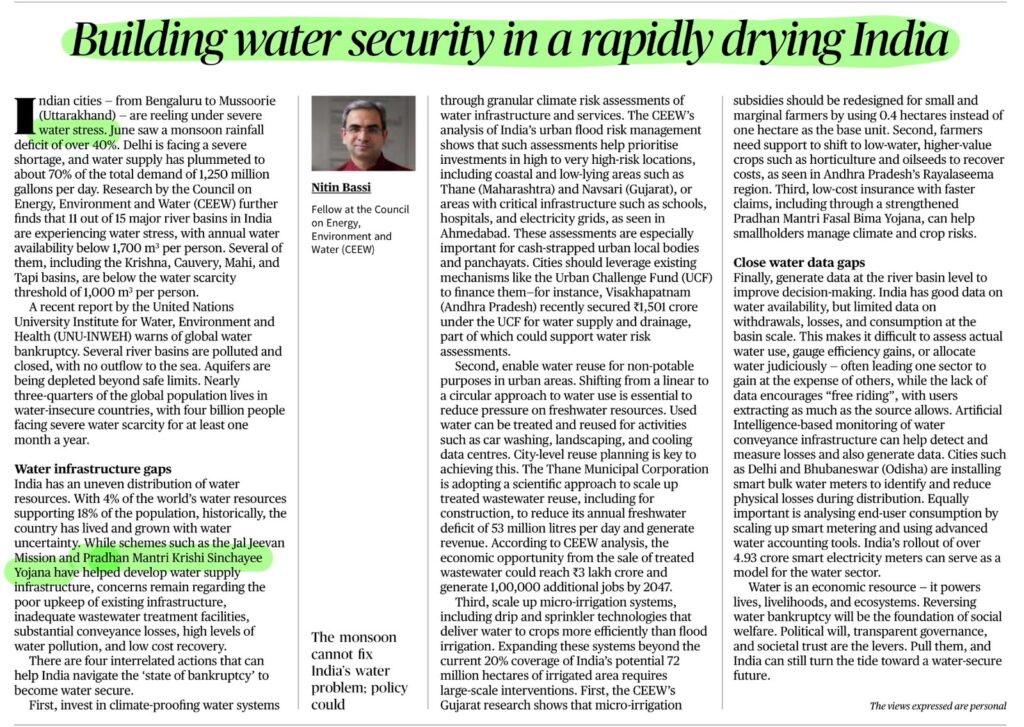
Context: Water Security in India
Increasing water stress, declining per capita water availability and climate variability have highlighted the need for climate-resilient water governance.
India has only 4% of the world’s freshwater resources but supports nearly 18% of the global population.
Also, 11 of India’s 15 major river basins are already water-stressed.
Water Security
Water security means reliable access to adequate quantity and quality of water for:
- Drinking
- Agriculture
- Industry
- Ecosystems
- Livelihoods
- Disaster resilience
Key Challenges
1. Rising Water Stress
Several river basins have annual per capita water availability below 1,700 cubic metres, making them water-stressed.
Some basins have already crossed the water scarcity threshold of below 1,000 cubic metres per person per year.
2. Groundwater Depletion
Over-extraction of groundwater for irrigation, urban use and industry is worsening water insecurity.
3. Pollution
Industrial waste, sewage discharge and agricultural runoff reduce usable water availability.
4. Erratic Rainfall
Climate change has made rainfall more unpredictable, increasing both drought and flood risks.
5. Infrastructure Gaps
India faces issues such as:
- High transmission losses
- Poor maintenance of water infrastructure
- Inadequate wastewater treatment
- Weak storage and distribution systems
6. Governance Gaps
Limited river-basin level data on water use, withdrawals and losses leads to inefficient allocation.
Way Forward
1. Build Climate-Resilient Water Infrastructure
- Conduct climate-risk assessment of water projects.
- Strengthen urban water systems.
- Improve drainage and flood-water management.
- Build resilient storage and distribution networks.
2. Improve Water-Use Efficiency
Scale up:
- Drip irrigation
- Sprinkler irrigation
- Treated wastewater reuse
- Low water-intensive crops
- Efficient industrial water use
3. Strengthen Water Governance
Use:
- AI-enabled monitoring
- Smart water metering
- River-basin water accounting
- Real-time data systems
- Evidence-based planning
4. Strengthen Flagship Schemes
Improve implementation of:
- Jal Jeevan Mission
- Pradhan Mantri Krishi Sinchayee Yojana
- Climate-resilient agriculture initiatives
5. Promote Crop Diversification
Shift from water-intensive crops to climate-suitable and less water-intensive crops.
6. Reuse and Recycle Wastewater
Treated wastewater can be used for:
- Industry
- Construction
- Landscaping
- Agriculture where safe
Significance
- Supports drinking water security.
- Reduces agricultural vulnerability.
- Helps climate adaptation.
- Protects groundwater.
- Improves urban resilience.
- Strengthens food and livelihood security.