WHO cancer treatment inequities for UPSC Explained

Context:
The World Health Organization’s Global Status Report on Cancer 2026 highlights widening inequities in access to cancer care, treatment and survival outcomes.

Key Data

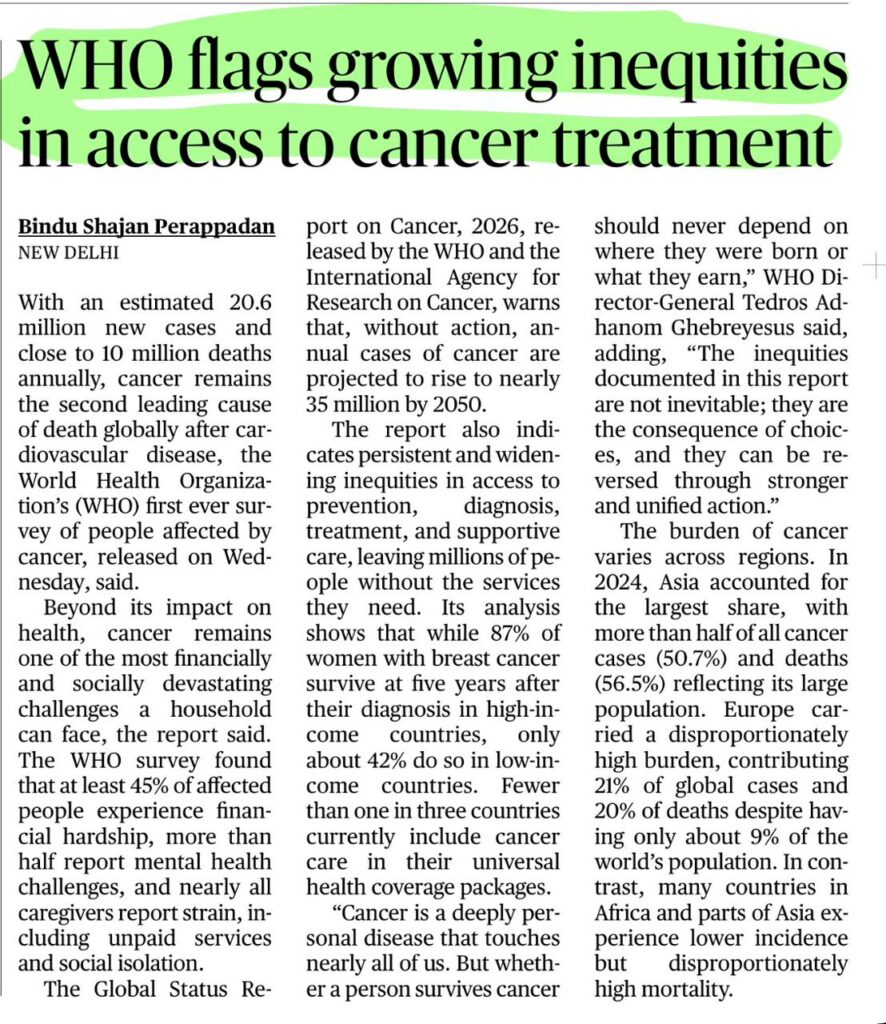
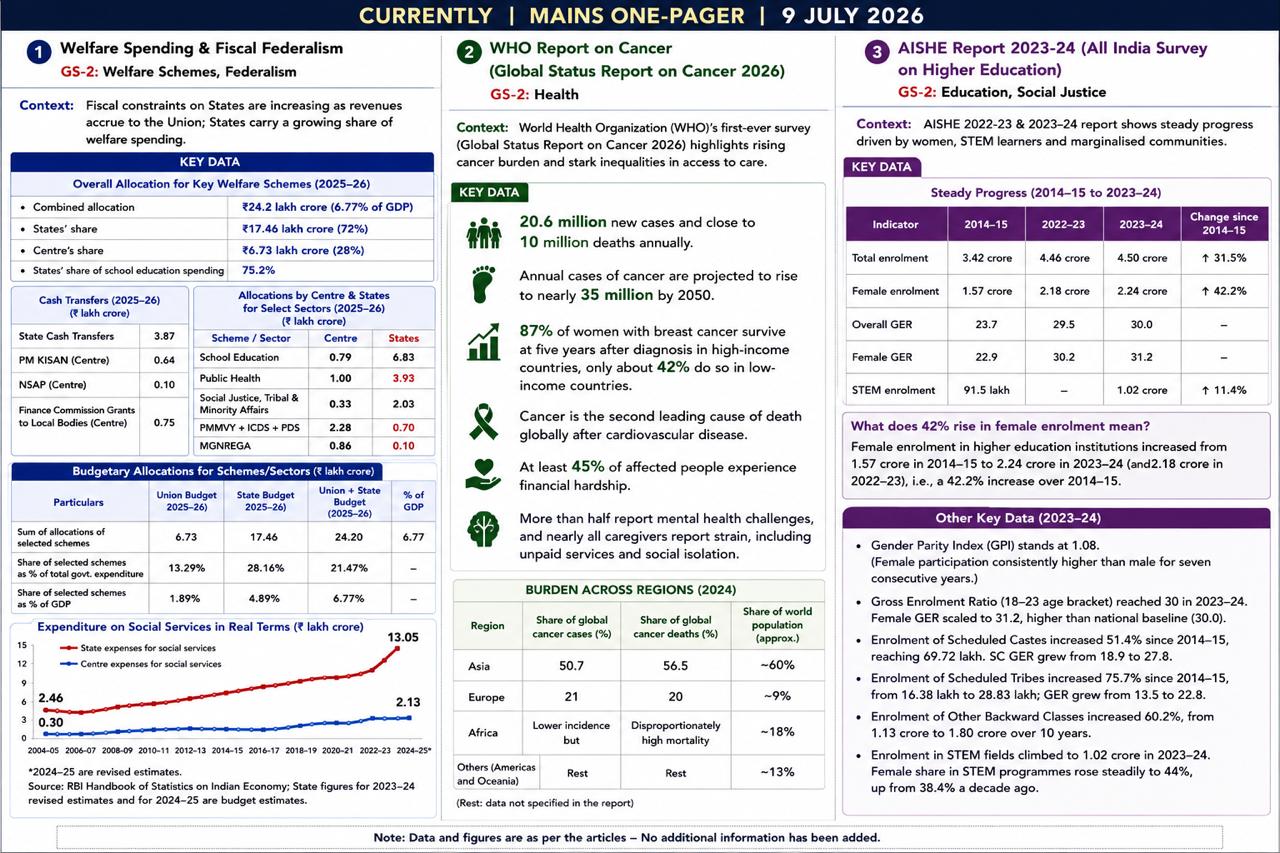
  • Around 20.6 million new cancer cases are estimated globally.
  • Nearly 10 million deaths occur annually due to cancer.
  • Annual cancer cases are projected to reach nearly 35 million by 2050.

Cancer Inequality

Cancer treatment outcomes differ sharply between high-income and low-income countries.

Key Finding

About 87% of women with breast cancer survive five years after diagnosis in high-income countries.

This falls to only about 42% in low-income countries.

Why Inequality Exists

Cancer care inequality is caused by:

  • Late diagnosis
  • Poor screening coverage
  • Limited treatment infrastructure
  • High cost of medicines
  • Shortage of oncologists
  • Lack of radiotherapy centres
  • Limited insurance coverage
  • Weak palliative care
  • Poor public health systems

Burden on Households

Cancer is one of the most financially devastating diseases.

It can lead to:

  • Out-of-pocket expenditure
  • Debt
  • Loss of income
  • Mental health stress
  • Caregiver burden
  • Social isolation

Regional Burden

Asia

Asia accounts for the largest share of global cancer cases and deaths because of its large population.

Africa

Africa and parts of Asia face lower incidence but disproportionately high mortality due to poor access to diagnosis and treatment.

Why It Matters for India

India needs stronger:

  • Cancer screening
  • Early diagnosis
  • Affordable treatment
  • Public cancer hospitals
  • Palliative care
  • Health insurance coverage
  • Cancer registries
  • Awareness campaigns

Link with Universal Health Coverage

Cancer care should not depend on ability to pay.

Equitable access to cancer treatment is essential for achieving Universal Health Coverage.

Way Forward

  • Expand screening for breast, cervical and oral cancers.
  • Strengthen district-level cancer care.
  • Improve access to radiotherapy.
  • Make essential cancer medicines affordable.
  • Expand insurance coverage.
  • Strengthen palliative care.
  • Improve cancer registries and surveillance.
  • Promote preventive measures against tobacco, alcohol and unhealthy diets.

Key Takeaway

Cancer is not only a medical issue. It is also a social justice issue because survival depends heavily on income, geography and access to healthcare.
Subscribe
Notify of
guest
0 Comments
Oldest
Newest Most Voted

WHO cancer treatment inequities for UPSC Explained

Got a question? We're here to help!

Our dedicated Student Support team is ready to assist you and guide you every step of the way.
Reach out to us, and let’s tackle your queries together!

About the UPSC Civil Services Examination (UPSC CSE)

The UPSC Civil Services Examination (CSE) is one of the most competitive and esteemed examinations in India, conducted by the Union Public Service Commission to recruit officers for services such as the Indian Administrative Service (IAS), Indian Police Service (IPS), Indian Foreign Service (IFS), and others. The exam comprises three stages — Prelims, Mains, and the Personality Test (Interview) — designed to test a candidate’s knowledge, aptitude, decision-making, and leadership skills.


How to Prepare Effectively for UPSC CSE

Cracking the UPSC CSE requires a deep understanding of the syllabus, consistent revision, structured answer writing, and smart test-taking strategies. The Prelims test analytical and conceptual clarity, the Mains focuses on critical thinking, articulation, and subject mastery, while the Interview assesses presence of mind, ethical judgment, and personality traits relevant to public service.

At UnderStand UPSC, we empower aspirants with a personalized and focused approach to each stage of the exam.


Why Choose UnderStand UPSC?

UnderStand UPSC is a mentorship-driven platform offering a clear, clutter-free strategy to tackle the Civil Services Examination. Our programs like Transform (for beginners and intermediate learners) and Conquer (for advanced mains preparation) provide structured study plans, syllabus-wise video content, interactive live sessions, and answer writing support.

We emphasize:

  • Concept clarity through topic-wise lectures

  • Test series designed around real UPSC standards

  • Personalized mentorship in small groups

  • Regular performance tracking and peer benchmarking

  • Doubt-clearing sessions, current affairs analysis, and monthly magazines


Join the UnderStand UPSC Learning Community

Our mission is to make UPSC preparation less overwhelming and more strategic. We combine mentorship, discipline, and academic rigor to help you clear CSE with confidence. Whether you’re preparing from Delhi, Mumbai, Bangalore, or a remote village — our online-first model ensures quality guidance reaches every corner of India.

Join the thousands of aspirants who trust UnderStand UPSC to guide their journey toward becoming civil servants.

Stay connected with us through our Telegram, YouTube, and Instagram channels for daily tips, strategies, and updates.

Copyright © 2026 USARAMBHA EDUCATION (UnderStand UPSC). All Rights Reserved.

Fill out the form for

Downloading the free Agriculture Short Notes


0
Would love your thoughts, please comment.x
()
x