Context:
The West Asia conflict and disruptions around the Strait of Hormuz raised concerns over global fertiliser supplies.
However, India avoided a fertiliser crisis because of proactive government intervention, diversified imports, higher domestic urea production and subdued domestic demand.
Why Fertiliser Security Matters
Fertilisers are essential for Indian agriculture.
Any disruption in fertiliser supply can affect:
- Crop production
- Farmer income
- Food security
- Input costs
- Subsidy burden
- Inflation
India depends on imports for several fertiliser inputs and raw materials, making fertiliser security strategically important.
Why India Avoided a Crisis
Diversified Imports
India reduced dependence on Qatar and the UAE by sourcing LNG and fertilisers from countries such as:
- United States
- Oman
- Nigeria
- Angola
- Norway
- Indonesia
This reduced exposure to West Asian disruptions.
Proactive Government Action
The government used timely import tenders, higher domestic urea production and supply-side management to ensure availability.
This helped prevent shortage despite global uncertainty.
Subdued Demand
Deficient monsoon and lower kharif acreage reduced fertiliser consumption.
This eased pressure on domestic fertiliser supply.
Key Data
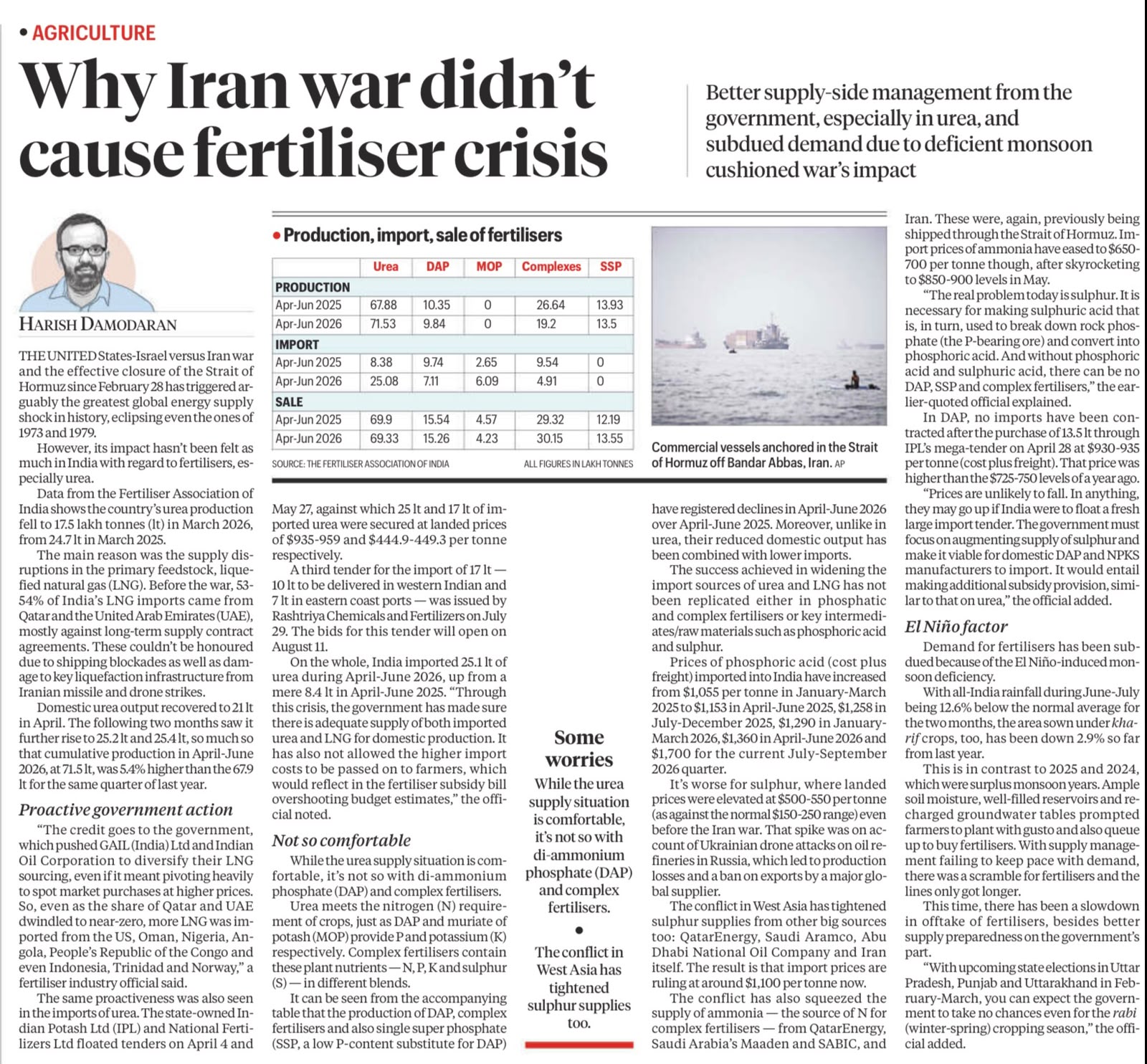
Domestic urea production increased from 67.9 lakh tonnes during April–June 2025 to 71.5 lakh tonnes during April–June 2026.
Urea imports increased from 8.4 lakh tonnes to 25.1 lakh tonnes.
Overall urea sales remained stable at around 69 lakh tonnes.
This shows that India managed supply without major disruption.
Vulnerability in Phosphatic Fertilisers
DAP and complex fertilisers remain more vulnerable than urea.
This is because India depends on imported raw materials such as:
- Phosphoric acid
- Sulphur
- Ammonia
Sulphur prices rose to around US$1,100 per tonne, increasing production costs.
This can raise the fertiliser subsidy burden.
Way Forward
India should diversify fertiliser and raw material import sources.
Domestic production of DAP, NPK and phosphatic fertilisers must be strengthened.
India should secure long-term overseas supply agreements.
Strategic fertiliser reserves should be created.
Balanced fertilisation, nutrient-use efficiency and nano-fertilisers should be promoted.
Digital monitoring of fertiliser supply chains should continue.
Key Takeaway
India avoided a fertiliser crisis through diversified imports, timely intervention and better supply management, but dependence on imported phosphatic fertiliser inputs remains a strategic vulnerability.