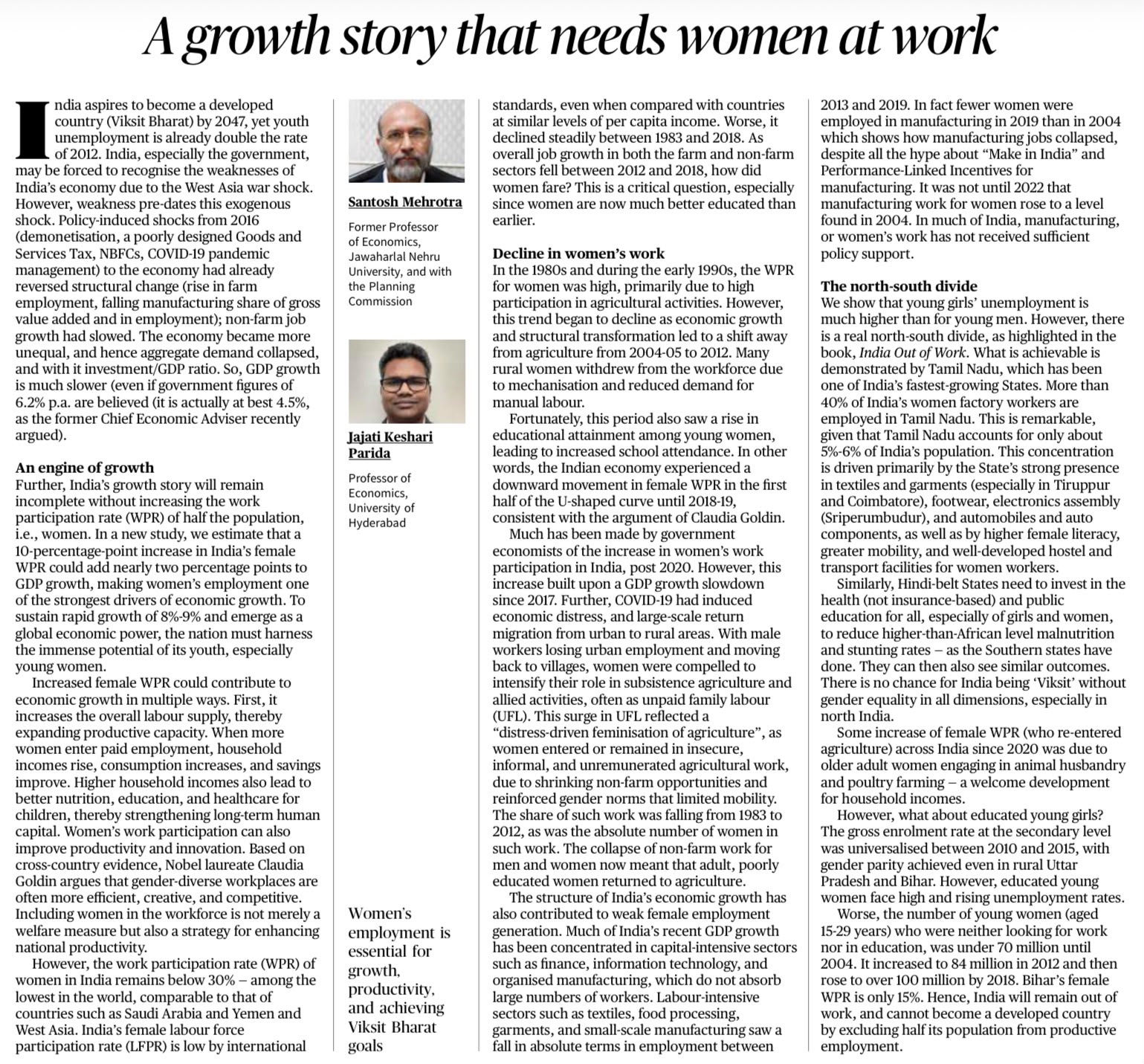
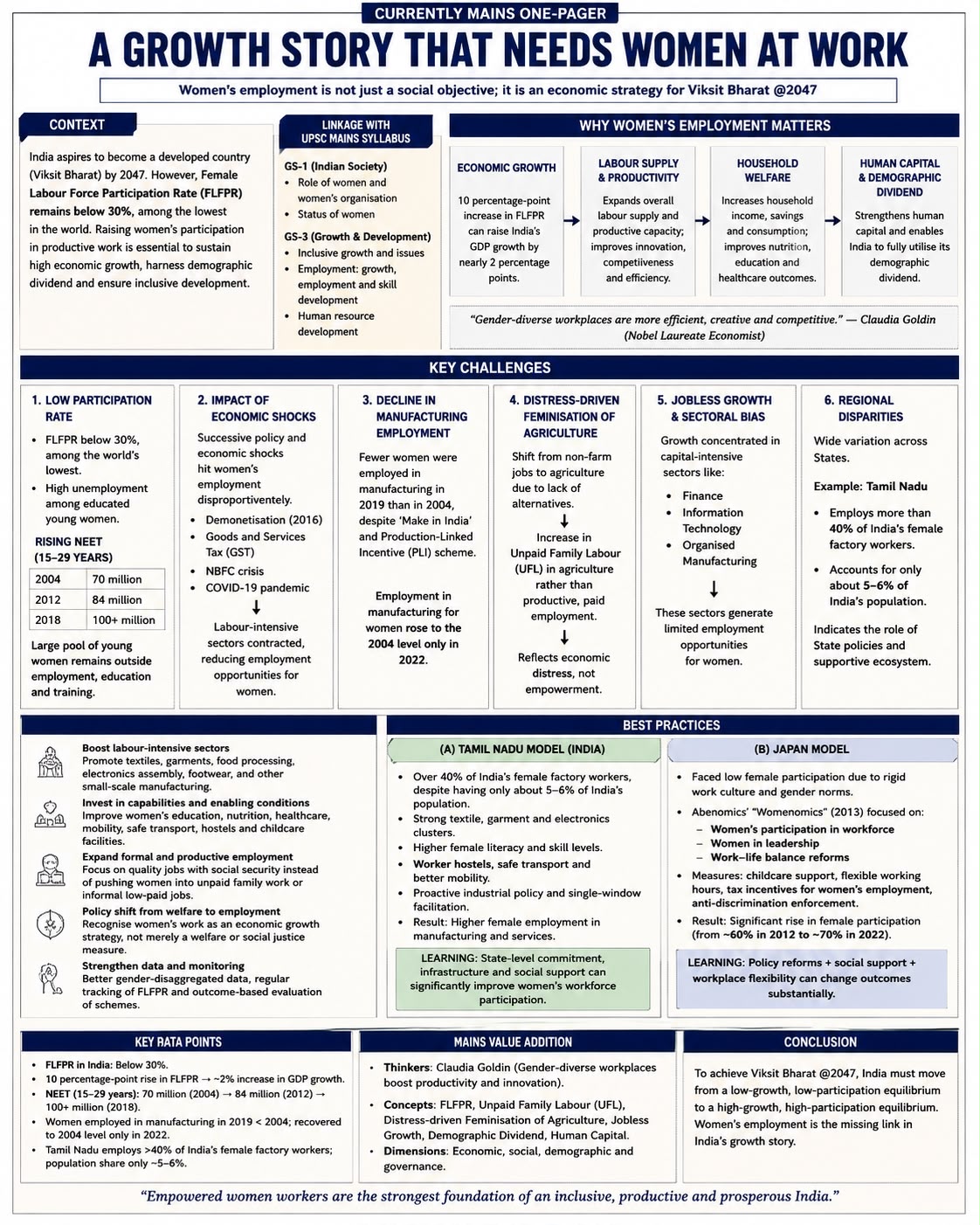
Context: Women Employment and Economic Growth
The article argues that India’s growth story cannot become complete without higher women’s participation in the workforce.
India aspires to become Viksit Bharat by 2047, but women’s employment remains low, limiting growth, productivity and inclusive development.
Core Argument
Women’s employment is not only a social objective.
It is an economic strategy for India’s long-term growth.
Higher women’s participation can expand labour supply, increase household income, improve human capital and help India use its demographic dividend better.
Female Labour Force Participation
India’s Female Labour Force Participation Rate remains below 30%, among the lowest globally.
This means a large share of working-age women are outside paid employment.
Why Women’s Employment Matters
A 10 percentage-point increase in female labour force participation can raise GDP growth by nearly 2 percentage points.
Women’s employment also improves:
- Household income
- Savings
- Consumption
- Nutrition
- Education outcomes
- Healthcare access
- Children’s human capital
Key Challenges
1. Low Participation Rate
Women’s participation in productive work remains low despite improvement in education.
Educated young women also face high unemployment.
2. Impact of Economic Shocks
Successive shocks such as demonetisation, GST, NBFC crisis and COVID-19 affected women’s employment disproportionately.
Labour-intensive sectors that employed women were hit badly.
3. Decline in Manufacturing Employment
Fewer women were employed in manufacturing in 2019 than in 2004.
This shows that manufacturing did not absorb women workers at the required scale.
4. Distress-Driven Feminisation of Agriculture
Some women entered agriculture not because of better opportunities but because of lack of alternatives.
This increase in unpaid family labour reflects economic distress rather than real empowerment.
5. Jobless Growth in Services
Growth has been concentrated in capital-intensive and formal service sectors like finance, information technology and organised manufacturing.
These sectors generate fewer employment opportunities for women at scale.
6. Regional Disparities
There are major regional differences.
Tamil Nadu is a positive example because it employs more than 40% of India’s female factory workers, despite having only around 5–6% of India’s population.
Its textile, garment, electronics and manufacturing ecosystem has helped women enter the workforce.
Best Practices
Tamil Nadu Model
Tamil Nadu shows that State-level policy support, industrial clusters, worker hostels, safe transport and better mobility can improve women’s workforce participation.
Japan Model
Japan improved female participation through policy reforms, childcare support, flexible working hours, tax incentives and anti-discrimination measures.
Way Forward
India must promote labour-intensive sectors such as textiles, garments, food processing, electronics assembly and footwear.
It must invest in women’s education, nutrition, healthcare, safe transport, childcare and hostels.
Policy must shift from welfare-only thinking to employment-led empowerment.
Better gender-disaggregated data and regular monitoring of female labour force participation are also needed.
Key Takeaway
Women’s employment is the missing link in India’s growth story. Without bringing more women into productive and paid work, India’s demographic dividend will remain underused.