14 August 2026 | UPSC Daily Current Affairs

14 August 2026 | UPSC Daily Current Affairs

Kuril Islands dispute: Putin Visit and Japan-Russia Tensions

Context: Kuril Islands dispute
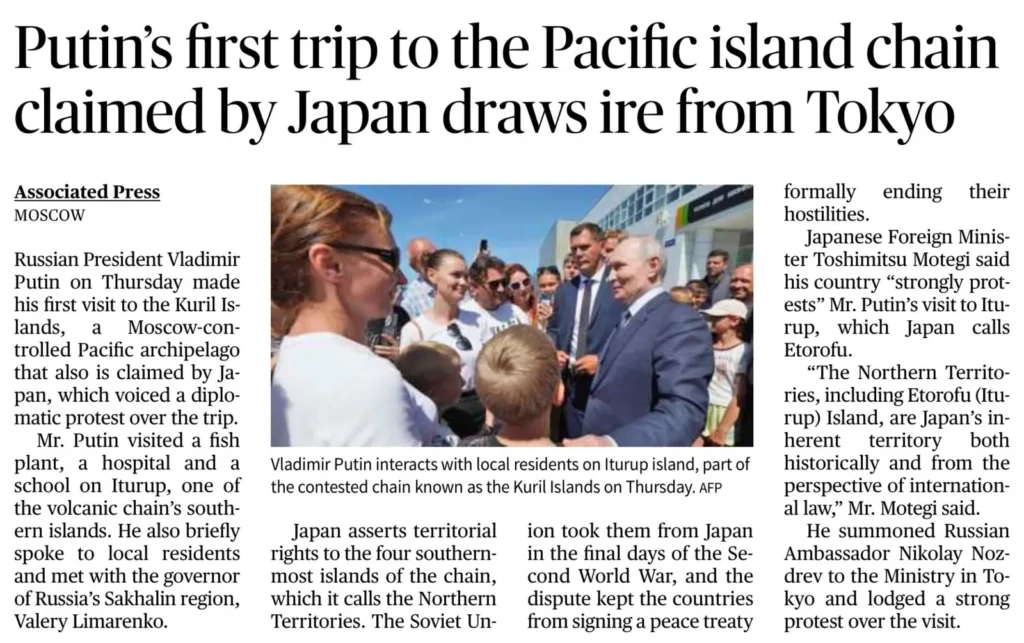
Russian President Vladimir Putin visited Iturup, called Etorofu in Japan, in the Kuril Islands for the first time. This triggered a strong protest from Japan and revived the long-running Russia–Japan territorial dispute. The dispute has remained a major obstacle to a formal post-World War II peace treaty between the two countries.

Where is the dispute?

Kuril Islands

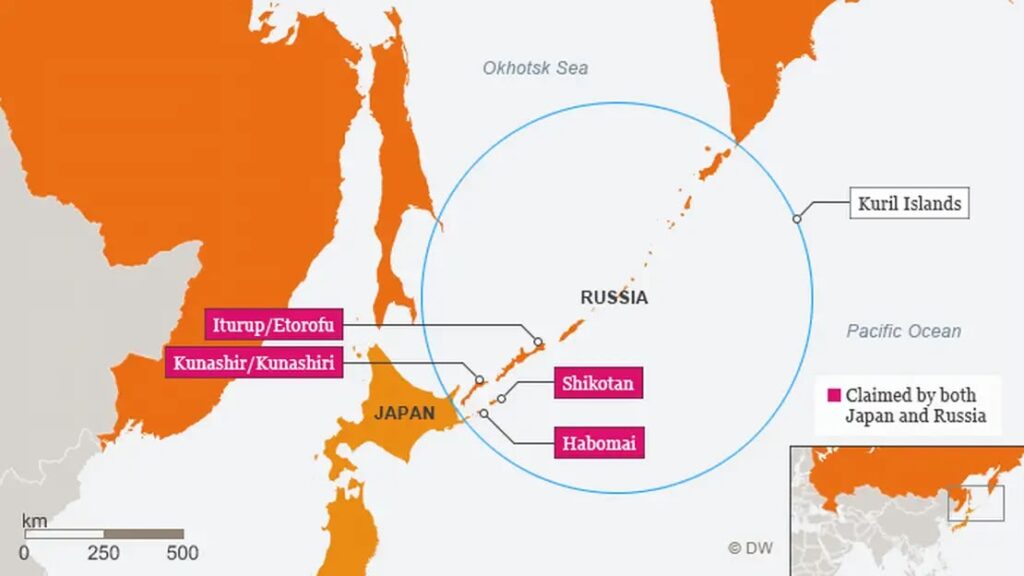
The Kuril Islands are a volcanic island chain located between Japan’s Hokkaido and Russia’s Kamchatka Peninsula.

They strategically connect the Sea of Okhotsk with the Pacific Ocean.

Four disputed southern islands

The four disputed islands are:

  • Iturup, called Etorofu in Japan
  • Kunashir, called Kunashiri in Japan
  • Shikotan
  • Habomai

Russia administers these islands as the Southern Kurils.

Japan calls them the Northern Territories and claims sovereignty over them.

Historical Background

The Soviet Union occupied the islands in the final days of World War II in 1945.

Japan disputes Russia’s sovereignty over the islands.

Japan maintains that the four islands are historically and legally Japanese territory.

The unresolved dispute has prevented Moscow and Tokyo from concluding a formal peace treaty despite decades of negotiations.

Why the dispute is important

Strategic Location

The islands provide Russia with important access and military positioning in the Pacific and Sea of Okhotsk.

Security Dimension

Russia has strengthened its military presence in the region.

The islands remain strategically significant amid wider tensions in the Indo-Pacific.

Diplomatic Impact

Japan’s relations with Russia have already deteriorated following the Ukraine conflict.

This makes settlement of the territorial dispute even more difficult.

Key Takeaway

Putin’s visit to Iturup has renewed tensions over the Kuril Islands dispute. The issue remains important because it combines territorial claims, post-war history, Indo-Pacific security and Russia–Japan diplomatic tensions.
Kuril Islands dispute

India SACU trade talks: PTA Negotiations Explained for UPSC

Context: India SACU trade talks
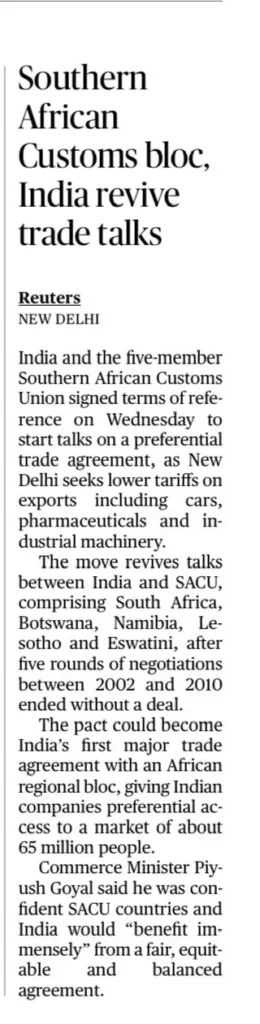
India and the Southern African Customs Union, or SACU, have signed Terms of Reference to begin negotiations for a Preferential Trade Agreement. This revives trade talks that remained inconclusive after five rounds of negotiations between 2002 and 2010.

What is SACU?

SACU is a customs union of five countries:

  • South Africa
  • Botswana
  • Namibia
  • Lesotho
  • Eswatini

As a customs union, member countries allow free or preferential movement of goods within the union.

They also maintain a common external tariff on imports from non-member countries.

SACU is the world’s oldest functioning customs union.

It was established in 1910.

What are Terms of Reference?

Terms of Reference, or ToR, form the basic framework for negotiations.

They define what areas will be negotiated and the broad scope of the proposed agreement.

Signing the ToR does not mean that the Preferential Trade Agreement has been concluded.

It only formally begins the negotiation process.

Why the PTA is important for India

Market Access

Preferential tariffs could improve Indian exports of:

  • Automobiles
  • Pharmaceuticals
  • Industrial machinery

Market Size

The SACU market covers around 65 million people.

Strategic Significance

A trade agreement can deepen India’s economic engagement with Southern Africa.

It can also help India diversify its trade partnerships.

Key Takeaway

India–SACU trade talks are important because they can expand India’s access to Southern African markets and strengthen India’s trade diversification strategy.

India SACU trade talks

India merchandise exports rise 19.6% in July 2026 for UPSC

Context: India merchandise exports
India’s merchandise exports recorded strong growth in July 2026 despite West Asian disruptions. This reflects diversification of India’s trade geography and shipping routes.

Key Data

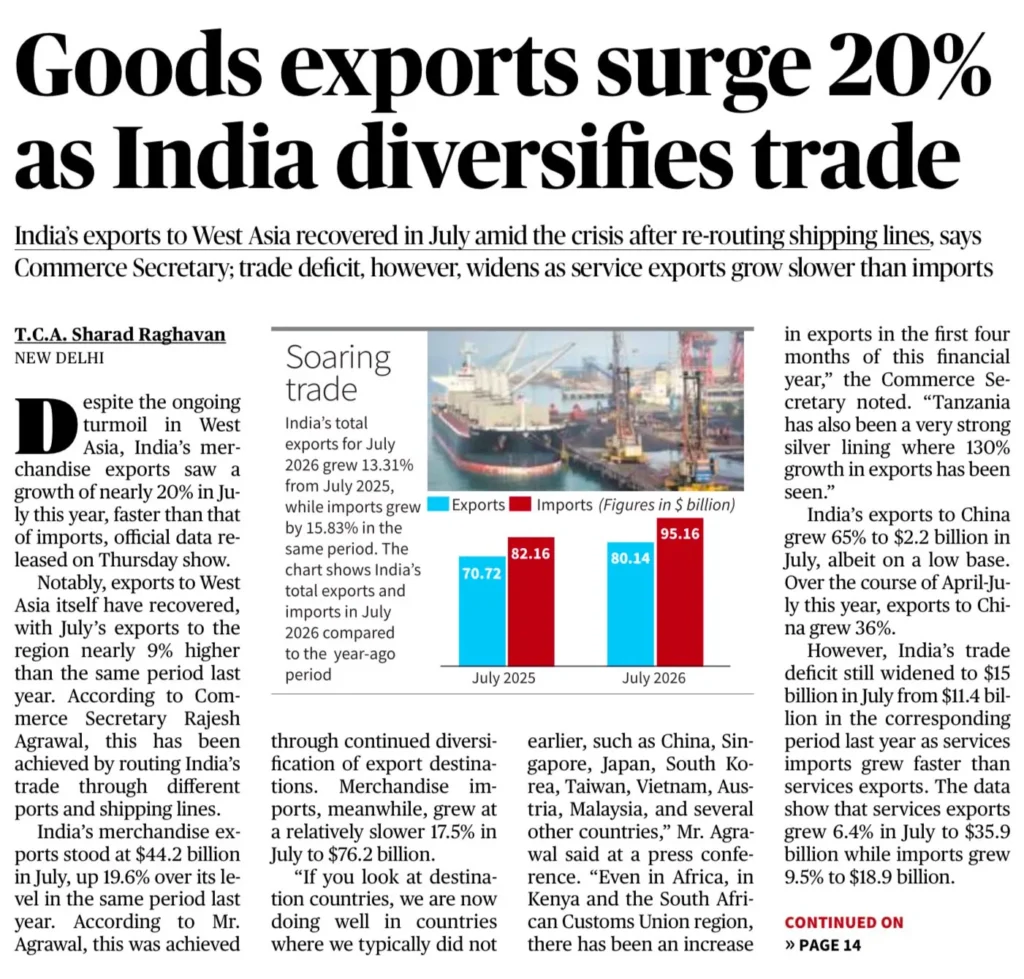
India’s merchandise exports stood at $44.2 billion, up 19.6% year-on-year.

Merchandise imports stood at $76.2 billion, up 17.5%.

Total exports stood at $80.14 billion, up 13.31%.

Total imports stood at $95.16 billion, up 15.83%.

The trade deficit widened to $15 billion, compared with $11.4 billion a year earlier.

Diversification of India’s Trade Geography

Changing Pattern

India is increasingly exporting to countries that traditionally served mainly as sources of imports.

This helps diversify India’s export markets and reduce dependence on conventional destinations.

China

India’s exports to China rose 65% to $2.2 billion in July.

During April–July, exports to China grew 36%.

West Asia

Exports to West Asia recovered by nearly 9% despite the ongoing crisis.

This was achieved through rerouting of shipments via alternative ports and shipping lines.

Africa

Exports to Tanzania rose 130%.

Kenya and the Southern African Customs Union region also recorded strong growth.

Key Takeaway

India’s export growth in July 2026 shows that trade diversification and alternative shipping routes helped absorb external disruptions. However, the widening trade deficit remains an important concern.

India merchandise exports

EU AI Act India opportunity: AI Compliance Services

Context: EU AI Act India opportunity
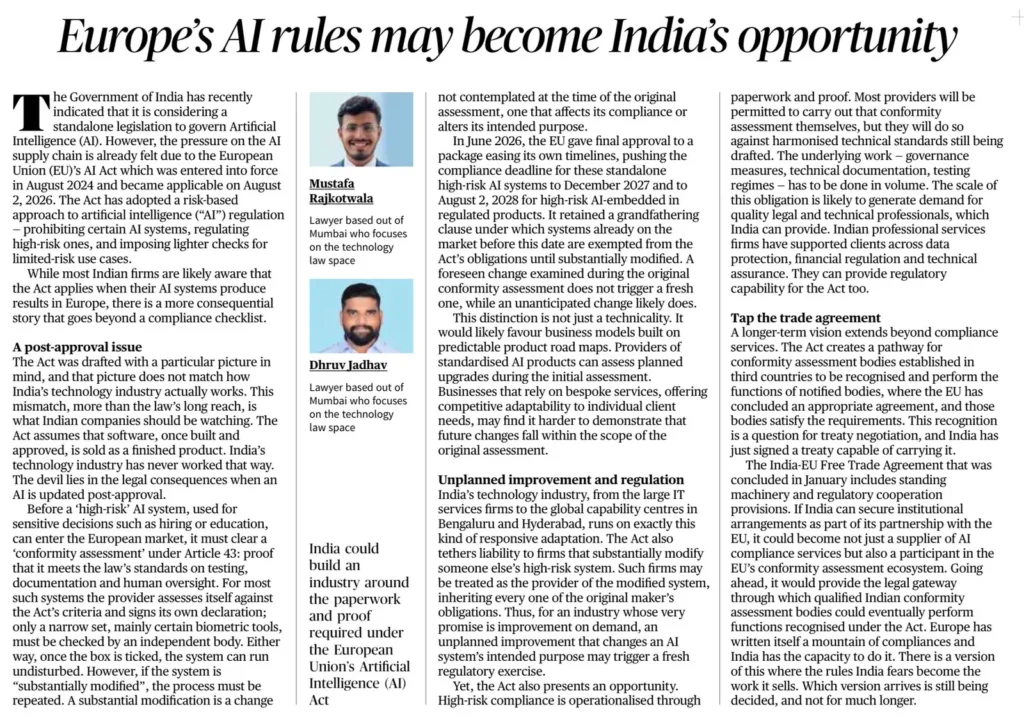
The European Union Artificial Intelligence Act is creating a new compliance ecosystem based on the risk level of AI systems. As India considers its own AI legislation, the EU framework could create an opportunity for India’s technology and professional-services sector.

What the EU AI Act changes

Risk-Based Regulation

The EU AI Act follows a risk-based approach.

Certain unacceptable AI practices are prohibited.

High-risk AI systems face stricter requirements.

Lower-risk AI applications face lighter obligations.

High-Risk Systems

Before entering the EU market, high-risk AI systems require conformity assessment.

This assessment covers:

  • Risk management
  • Data quality
  • Documentation
  • Traceability
  • Transparency
  • Human oversight
  • Accuracy
  • Cybersecurity

Post-Approval Changes

A major concern for Indian firms is substantial modification.

If an AI system or its intended purpose is substantially changed, a fresh conformity assessment may be required.

This is significant because Indian technology firms often continuously modify and improve software for individual clients.

Extended Timeline

The EU has extended the application of high-risk rules to:

  • December 2027 for stand-alone systems
  • August 2028 for AI embedded in products

This gives businesses more time to prepare.

Why this can become an opportunity for India

AI Compliance Services

Continuous regulatory requirements can create demand for:

  • Testing
  • Documentation
  • Risk assessment
  • Auditing
  • Cybersecurity
  • Technical assurance

India’s Existing Strength

India already has a large IT-services and professional-services ecosystem.

Major technology centres such as Bengaluru and Hyderabad can provide specialised AI-compliance services.

From Software Exporter to Compliance Hub

India can move beyond developing AI systems.

It can become a provider of:

  • AI governance services
  • Conformity assessment
  • Regulatory-compliance services
  • Technical assurance for global companies

Skilled Employment

This can create demand for professionals combining:

  • Artificial Intelligence
  • Law
  • Cybersecurity
  • Data governance
  • Technical auditing

India–EU Regulatory Opportunity

The India–EU Free Trade Agreement, whose negotiations concluded in January 2026, includes a Working Group on Conformity Assessment.

This creates a possible institutional route for cooperation on conformity-assessment procedures.

India could seek recognition of competent Indian bodies so that AI-compliance assessments performed in India can gain acceptance in European markets.

Key Takeaway

The EU AI Act may create a new services opportunity for India. Indian firms can move from software development to AI governance, conformity assessment, auditing and compliance services for global markets.

10 Marks | 150 Words
The European Union’s Artificial Intelligence Act can create new opportunities for India’s technology and professionalservices sector. Discuss.
यूरोपीय संघ का आर्टिफिशियल इंटेलिजेंस अधिनियम भारत के प्रौद्योगिकी और पेशेवर सेवा क्षेत्र केलिए नए अवसर पैदा कर सकता है। चर्चाकीजिए।

EU AI Act India opportunity

Constitutional limits on arrest: Articles 21 and 22

Context: Constitutional limits on arrest
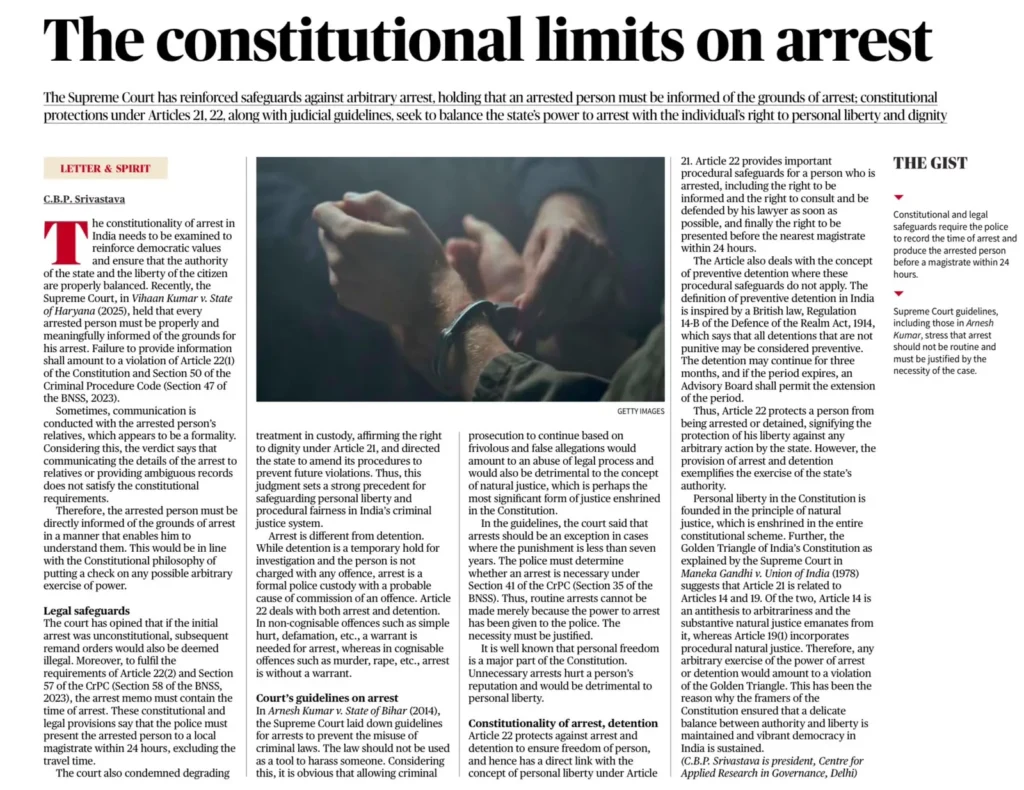
The Supreme Court has reinforced that the power to arrest is not absolute. It must be exercised according to constitutional and statutory safeguards that protect personal liberty, dignity and due process. This framework primarily rests on Articles 21 and 22 of the Constitution, read with the Bharatiya Nagarik Suraksha Sanhita, 2023.

Constitutional Safeguards

Article 21

No person can be deprived of life or personal liberty except according to a fair, just and lawful procedure.

Article 22(1)

An arrested person must be informed of the grounds of arrest.

The person also has the right to consult and be defended by a legal practitioner of choice.

Article 22(2)

The arrested person must be produced before the nearest Magistrate within 24 hours of arrest, excluding travel time.

Further detention requires judicial authority.

Important BNSS Provisions

Section 35

Police may arrest without warrant in specified circumstances.

However, the power is subject to statutory conditions of necessity and justification.

Section 47

The arrested person must be informed of the full particulars of the offence and other grounds of arrest.

This gives effect to the constitutional safeguard under Article 22(1).

Section 58

A person arrested without warrant cannot ordinarily be detained by police for more than 24 hours without a Magistrate’s special order.

Section 187

Where investigation cannot be completed within 24 hours, the accused must be produced before a Magistrate.

The Magistrate decides whether further police or judicial custody is justified.

Supreme Court: Vihaan Kumar v. State of Haryana, 2025

The Supreme Court held that communicating the grounds of arrest is a mandatory constitutional requirement.

It is not a mere procedural formality.

The grounds must be communicated effectively and in a manner that the arrested person can understand.

This enables the person to challenge the arrest and seek legal remedies.

Other Important Judicial Safeguards

D.K. Basu v. State of West Bengal, 1997

This case established safeguards against custodial violence and arbitrary arrest.

These include arrest documentation, informing relatives and medical examination.

Arnesh Kumar v. State of Bihar, 2014

This case held that arrest should not be routine.

Police must satisfy the statutory necessity conditions.

Magistrates must independently scrutinise the need for detention.

Maneka Gandhi v. Union of India, 1978

This case expanded Article 21.

It required that any procedure affecting personal liberty must be fair, just and reasonable.

Key Takeaway

The power to arrest is limited by constitutional safeguards, statutory requirements and judicial oversight. Arrest must not be routine, arbitrary or mechanical; it must be justified, necessary and communicated properly to the arrested person.

Constitutional limits on arrest

Legislative privilege and free speech: SC Seven-Judge Bench

Context: Legislative privilege and free speech
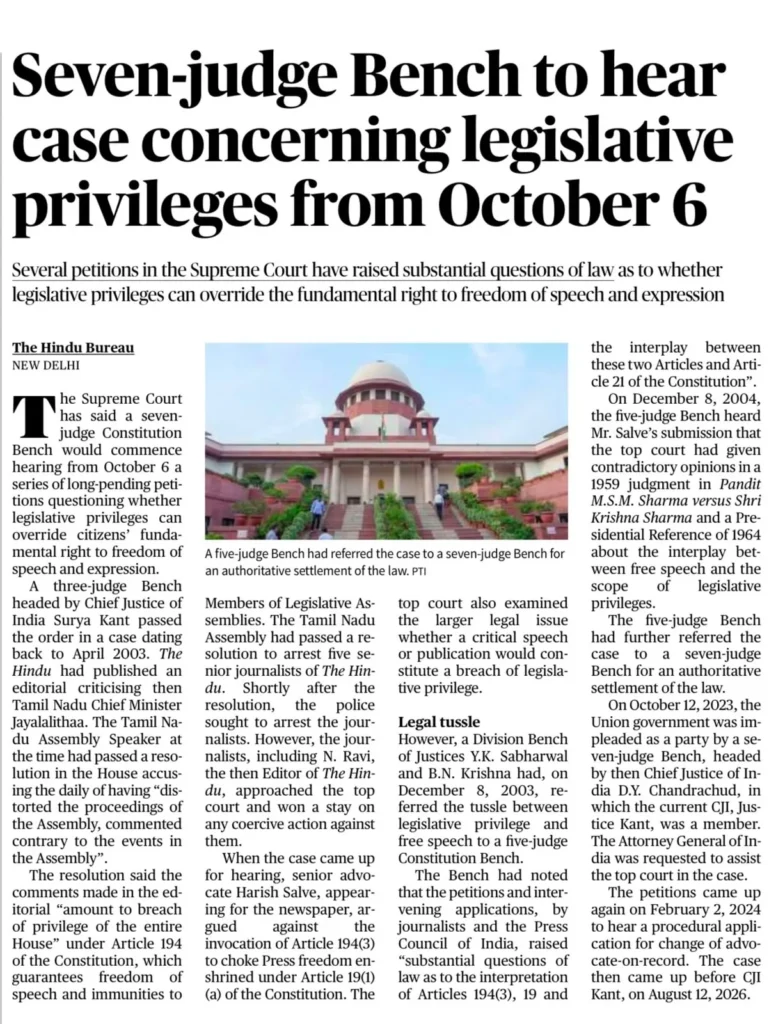
The Supreme Court will begin hearing from 6 October 2026 through a seven-judge Constitution Bench a long-pending constitutional question: Can legislative privilege under Article 194 override the fundamental right to freedom of speech and expression under Article 19(1)(a)?

The case arises from the 2003 Tamil Nadu Assembly action against The Hindu journalists.

Constitutional Provisions Involved

Article 19(1)(a)

Article 19(1)(a) guarantees freedom of speech and expression.

It forms the constitutional basis of press freedom.

Article 194

Article 194 provides powers, privileges and immunities of State Legislatures, their members and committees.

Article 194(3)

Article 194(3) deals with privileges other than those specifically provided in the Constitution.

Article 21

Article 21 becomes relevant where exercise of legislative privilege affects a person’s life or personal liberty.

How did the dispute arise?

In 2003, The Hindu published an editorial critical of the then Tamil Nadu Government and Assembly proceedings.

The Assembly treated the publication as a breach of privilege.

It passed a resolution seeking the arrest of senior journalists.

The journalists approached the Supreme Court.

They argued that legislative privilege could not be used to suppress freedom of speech and press freedom.

The Supreme Court stayed the arrests.

Why was it referred to seven judges?

The difficulty arises from the relationship between earlier Supreme Court decisions.

M.S.M. Sharma v. Sri Krishna Sinha, 1959 — Searchlight case

This case examined the conflict between legislative privilege and press freedom.

Special Reference No. 1 of 1964 — Keshav Singh case

This case considered the extent of legislative privilege and judicial scrutiny over its exercise.

Core Constitutional Issue

The main issue is the balance between:

  • Legislative privilege
  • Freedom of speech and expression
  • Press freedom
  • Judicial review
  • Personal liberty

Key Takeaway

The seven-judge Bench will examine whether legislative privilege can override fundamental rights such as free speech and press freedom. The decision may clarify the constitutional limits of legislative privilege in India.

Legislative privilege and free speech

Copyright © 2026 USARAMBHA EDUCATION (UnderStand UPSC). All Rights Reserved.

Inquiry form for
Takshila Residential Program