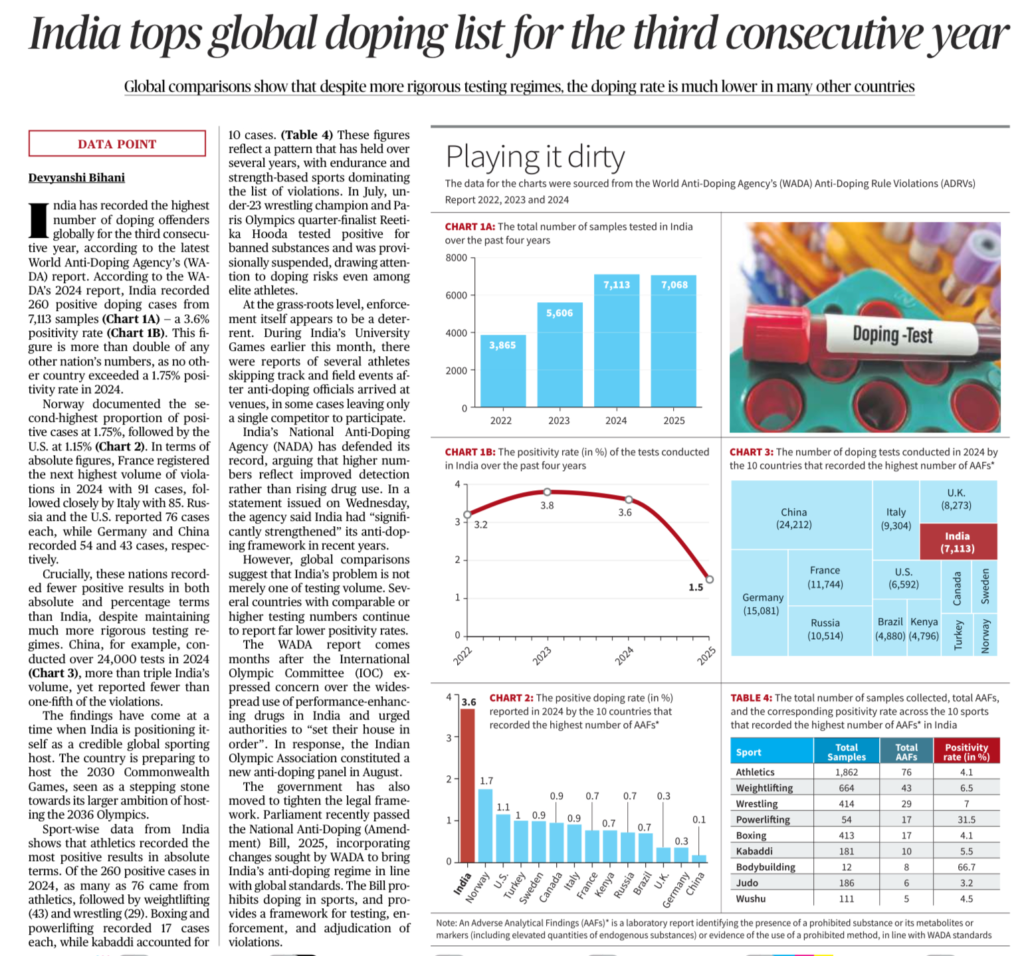
Context: The World Anti-Doping Agency (WADA) ADRVs Report 2024 shows India recorded the highest doping violations globally for the third consecutive year.
Crisp Facts (India): • Positive cases (2024): 260 (highest worldwide). • Samples tested: 7,113. • Positivity rate: 3.6% (well above global peers; most ≤ 1.75%). • Trend: 3.2% (2022) → 3.8% (2023) → 3.6% (2024); early 2025 ~1.5%. • Most affected sports: Athletics (76), Weightlifting (43), Wrestling (29), Boxing (17), Powerlifting (17). • Response: NADA cites improved detection; IOC flagged concerns; National Anti-Doping (Amendment) Bill, 2025 passed to align with WADA.
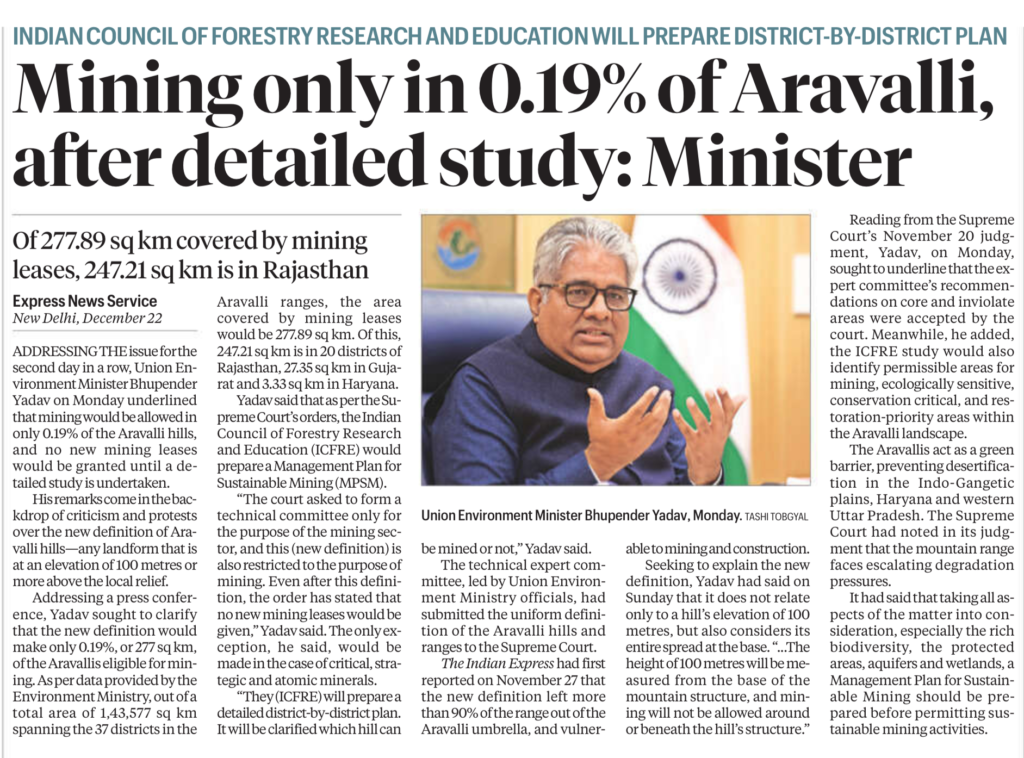
Context: Following concerns over environmental degradation and a recent Supreme Court of India judgment, the Union Environment Ministry clarified that mining in the Aravalli Range will be highly restricted and allowed only after a scientific, district-wise assessment by the Indian Council of Forestry Research and Education (ICFRE).
Summary • Mining cap: Only 0.19% of the Aravalli landscape (≈ 277.89 sq km) will be eligible for mining. • State-wise breakup: Of this mining area, 247.21 sq km in Rajasthan, 27.35 sq km in Gujarat, 3.33 sq km in Haryana. • No new leases: No fresh mining leases will be granted until a detailed study is completed. • Study mandate: ICFRE to prepare a district-by-district Management Plan for Sustainable Mining (MPSM). • Zonation approach: The study will demarcate permissible mining areas, ecologically sensitive and conservation-critical zones, and restoration-priority areas. • Supreme Court backing: Court accepted the expert committee’s recommendations on “core” and inviolable areas.
New definition clarified: • Aravalli hills defined not merely by 100-metre elevation, but by entire hill structure and spread. • Mining prohibited around or beneath hill structures. • Exception: Mining may be allowed only for critical, strategic and atomic minerals. • Environmental importance: Aravallis act as a green barrier against desertification in the Indo-Gangetic plains, Haryana and western Uttar Pradesh.
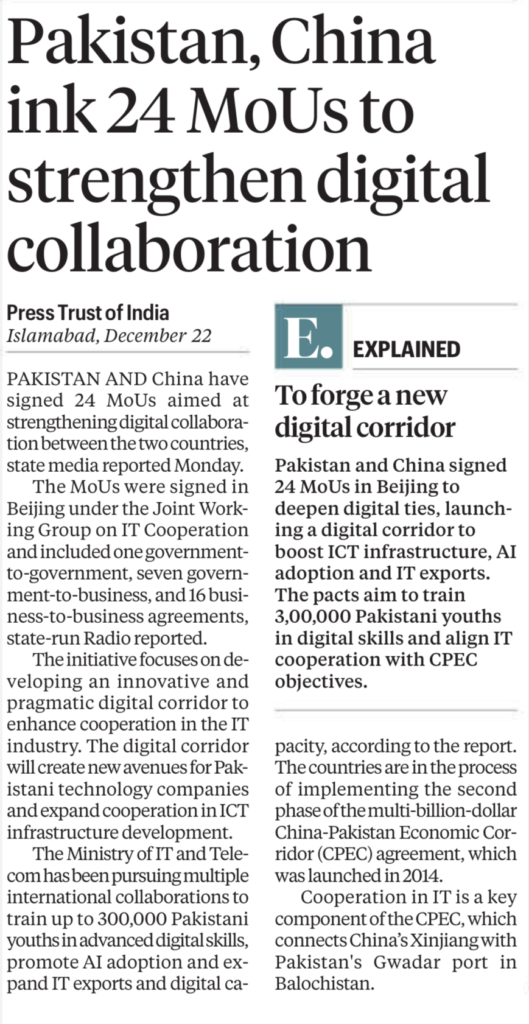
Context: Pakistan and China have signed 24 Memorandums of Understanding (MoUs) in Beijing to deepen digital and IT cooperation, aligned with the next phase of the China–Pakistan Economic Corridor (CPEC).
Summary • 24 MoUs signed under the Joint Working Group on IT Cooperation. • 1 government-to-government, 7 government-to-business, 16 business-to-business. • Objective: Create a “digital corridor” to strengthen ICT infrastructure, AI adoption, and IT exports. • Focus on innovation, digital capacity-building, and expanding opportunities for Pakistani tech firms. • Skill development: Target to train 3 lakh (300,000) Pakistani youth in advanced digital skills. • Strategic linkage: IT cooperation positioned as a core pillar of CPEC Phase-II. • CPEC context: Launched in 2014, connects Xinjiang with Gwadar Port, now expanding from physical to digital connectivity.
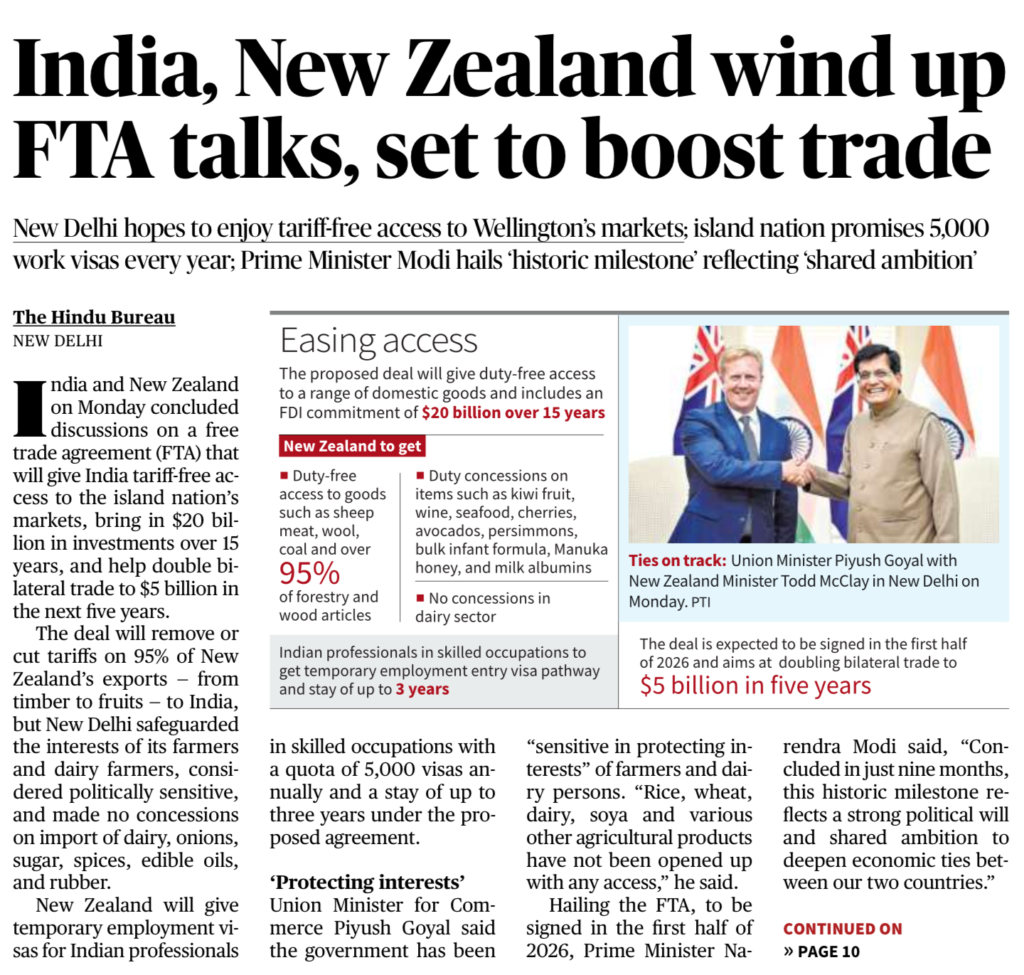
India and New Zealand concluded negotiations on a comprehensive Free Trade Agreement (FTA) after just nine months. The agreement, to be signed in H1 2026, aims to double bilateral trade to USD 5 billion within five years.
Core Highlights
Tariffs: • New Zealand to eliminate duties on 100% of Indian exports. • India to offer concessions on ~70% product lines, covering 95% of bilateral trade value.
Investment: • USD 20 billion FDI over 15 years from New Zealand into manufacturing, infrastructure, and innovation.
Mobility: • 5,000 annual work visas for skilled Indian professionals (IT, engineering, healthcare) with up to 3-year stay.
Education: • Post-study work visas extended to 3 years (STEM bachelor’s/master’s) and 4 years (PhD).
Traditional Medicine: • First-ever Health & Traditional Medicine annex, enabling trade in AYUSH (Ayurveda, Yoga, etc.).
Sensitive Sectors & Safeguards • Dairy fully excluded to protect Indian farmers. • No tariff cuts on sugar, edible oils, onions, wheat, rice. • Limited access for NZ apples, kiwifruit, honey via Tariff Rate Quotas (TRQs).
Context The Right to Disconnect Bill, introduced as a private member’s Bill, comes amid rapid digitalisation of work and India’s consolidation of labour laws into four labour codes. With work extending beyond physical workplaces and fixed hours, the Bill seeks to address constant digital connectivity.
Core Issue Indian labour law continues to define work through time-based and physical constructs. The Bill regulates after-hours communication but does not redefine “work” for the digital economy, creating a mismatch with existing labour codes.
Key Gaps in the Bill • Allows employees to ignore work-related calls/emails beyond working hours but does not clarify whether such digital engagement counts as “work”. • Not aligned with the Occupational Safety, Health and Working Conditions Code, 2020, which governs working time and overtime. • Regulates communication without integrating it into the legal framework of working time, making the right largely behavioural rather than enforceable. • Does not specify whether the right is a mandatory labour standard or a contractual right that can be modified by agreement.
Comparative International Practice • European Union: Employer control determines what qualifies as work, including on-call and standby time. • France: Clear demarcation between working time and rest time; digital communication regulated through collective bargaining. • Germany: Strict enforcement of working-hour limits and rest periods. • These systems embed digital communication within working-time regulation, unlike India.
Constitutional Dimension • The freedom to disconnect is closely linked to personal autonomy under Article 21. • The Bill does not clearly articulate this constitutional linkage or explain how autonomy is protected at the workplace. • Leaves ambiguity on whether the right is statutory or reflects a deeper constitutional guarantee.
Conclusion The Bill is an important starting point, but without redefining work in the digital age, aligning with labour codes, and clarifying its legal and constitutional status, it remains inadequate. Indian labour law continues to rely on a framework designed for physical workplaces, limiting the effectiveness of the right to disconnect.
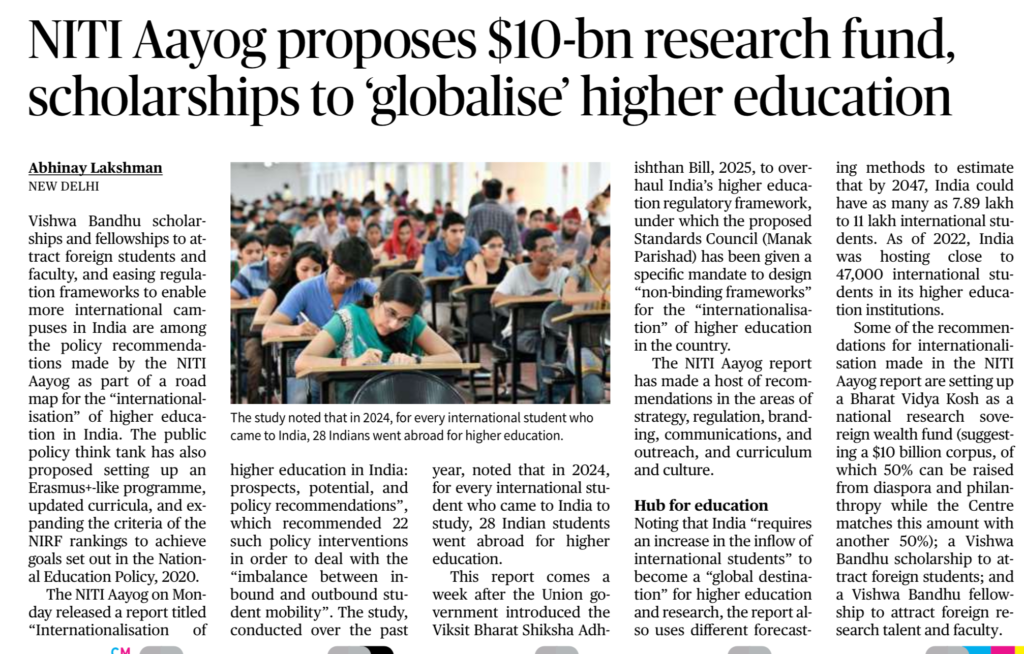
Context NITI Aayog released a roadmap to internationalise India’s higher education, addressing low foreign student inflow and high Indian student outflow, in line with National Education Policy (NEP) 2020.
Problem Identified • Severe mobility imbalance: In 2024, for every 1 foreign student in India, 28 Indians studied abroad. • Low inbound numbers: Only ~47,000 international students in India (2022).
Vision • Make India a global hub for higher education and research. • By 2047, host 7.9–11 lakh international students.
Key Proposals
Research funding: • Bharat Vidya Kosh — $10 billion research sovereign wealth fund. • 50% diaspora and philanthropy + 50% Centre.