23 March 2026 | Daily Current Affairs

Insurance Penetration: Meaning, Density and Underinsurance Issue in India for UPSC

Context

Insurance sector is often assessed using insurance penetration and insurance density, but these indicators can give a partial picture of actual financial protection.

Insurance Penetration

• Insurance premium as a percentage of GDP
• Shows size of insurance sector in the economy

Insurance Density

• Per capita premium (average premium per person)
• Shows average spending on insurance

What These Indicators Miss

• They measure premium collected, not risk coverage
• Higher values do not necessarily mean better protection

Core Concept

• Insurance = Risk protection, not just policy ownership
• Real measure should be → adequacy of sum assured

Key Issues in India

• Underinsurance
• Many people are insured but coverage amount is too low

• Insurance as investment
• Focus on returns/savings, not protection

• Misleading growth indicators
• Rising penetration/density ≠ improved financial security

• Low awareness of risk
• People underestimate required coverage

Data and Its Meaning

• Claims settled: ~1 crore annually
• Total payout: ~₹3.3 lakh crore
• Average payout: ~₹3.3 lakh per claim
• Claim settlement ratio: ~97%

Interpretation

• Even though claims are settled efficiently,
• ₹3–4 lakh is too small to replace long-term income
→ Shows inadequate insurance cover

Insurance Penetration

Cabinet Committee on Security: Role, Members and Functions for UPSC

Context

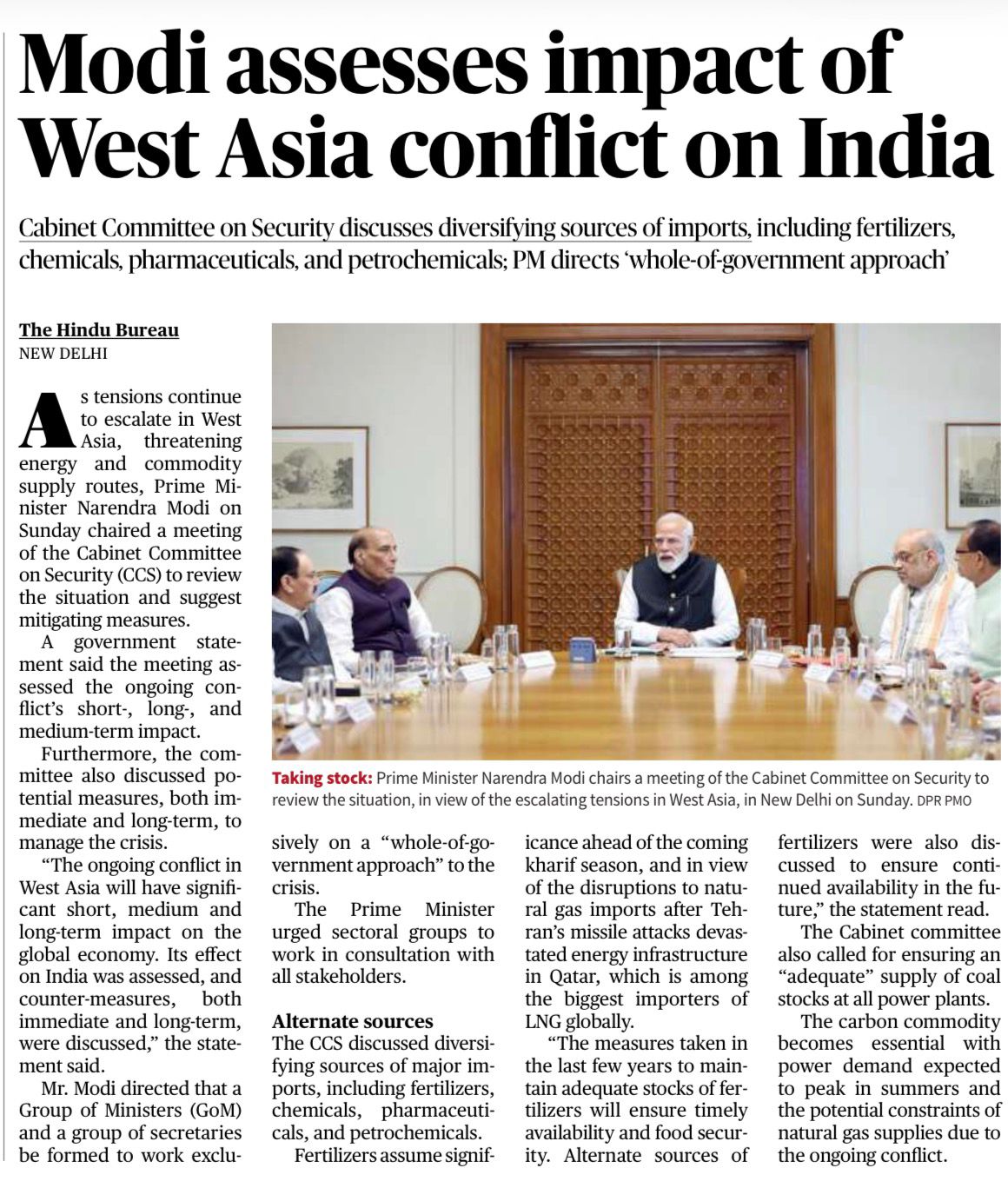
Due to West Asia conflict, the Cabinet Committee on Security (CCS) reviewed its impact on energy, fertilizers, and supply chains and discussed diversification + coordinated government response.

Cabinet Committee on Security (CCS)

• Chair: Prime Minister
• Members: Defence | Home | Finance | External Affairs

Core Role

• National security | Defence | Strategic issues

Cabinet Committees – Core Idea

• Small groups of ministers for quick decision-making
• Formed under Transaction of Business Rules
• Created/restructured by PM

Key Cabinet Committees

• CCS → Security → Chair: PM
• CCEA (Cabinet Committee on Economic Affairs) → Economy → Chair: PM
• CCPA (Cabinet Committee on Political Affairs) → Political issues → Chair: PM
• ACC (Appointments Committee of the Cabinet) → Top appointments → Chair: PM (+ Home Minister)
• CCPA-Parliamentary Affairs → Legislative business → Chair: Usually Defence Minister

Cabinet Committee on Security

Lokpal: Functions, Structure and Institutional Challenges in India for UPSC

Context

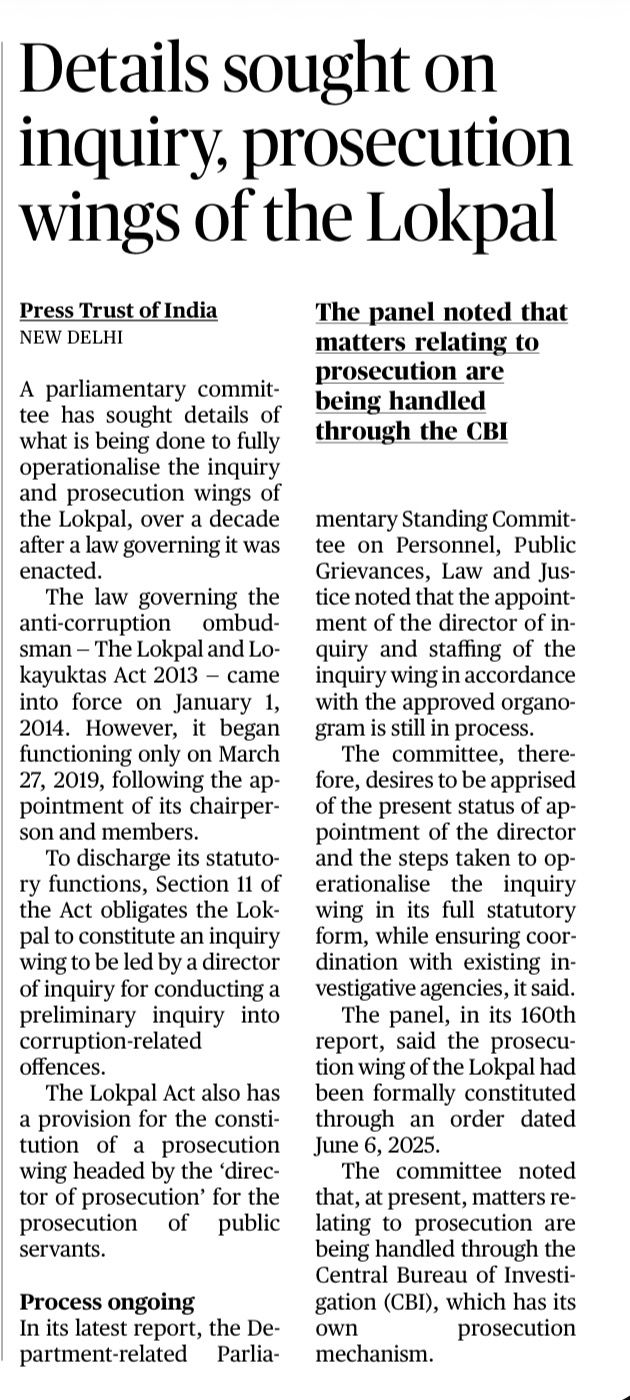
A Parliamentary Standing Committee has sought details on why the inquiry and prosecution wings of the Lokpal are not fully operational, even after the law has been in force for years; at present, prosecution work is largely handled by the CBI.

Lokpal – Basics

• Law: Lokpal and Lokayuktas Act, 2013 → in force (2014) → functional (2019)
• Nature: Statutory anti-corruption ombudsman at Union level

Composition and Eligibility

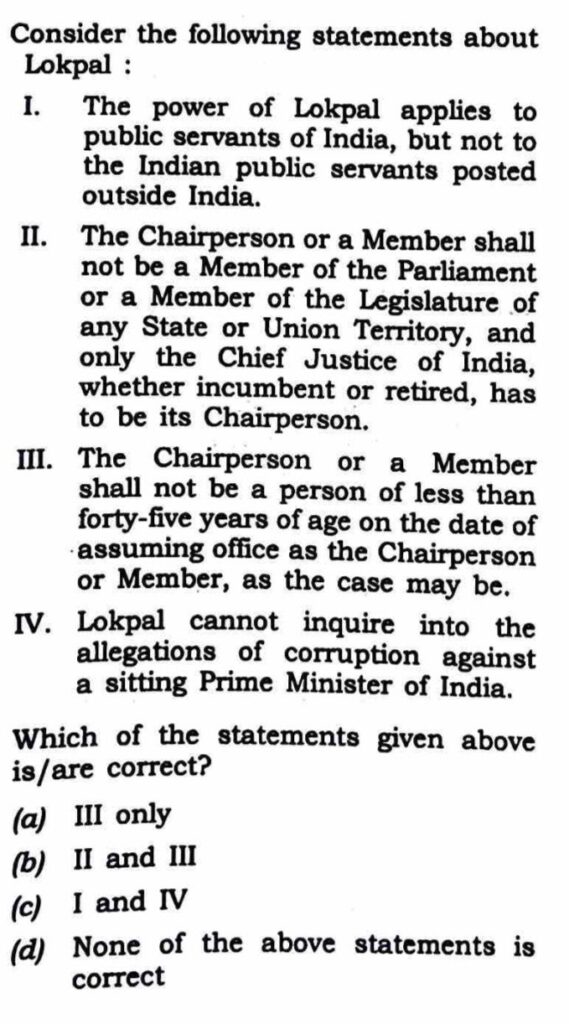
• Structure: Chairperson + up to 8 Members
• Reservation: 50% judicial + 50% from SC/ST/OBC/Women/Minorities
• Eligibility: Minimum age 45 years + integrity + expertise (law, governance, vigilance, finance)

Appointment

• Appointing Authority: President
• Selection Committee: PM + Speaker + LoP + CJI (or nominee) + Eminent Jurist

Jurisdiction

Covers corruption cases against:
PM (with restrictions) | Ministers | MPs | Central Govt officials (Group A–D) | PSUs | Autonomous bodies | NGOs receiving govt/foreign funds

Lokpal
Lokpal
PYQ – 2025, Ans – A

Compulsory Voting: Constitutional Validity, Supreme Court View and Issues for UPSC

Context

• Ahead of Assembly Elections (April–May 2026), the issue of compulsory voting came up in a Supreme Court-related discussion.
• Debate: Should India make voting mandatory to improve low voter turnout?

Constitutional Position of Voting

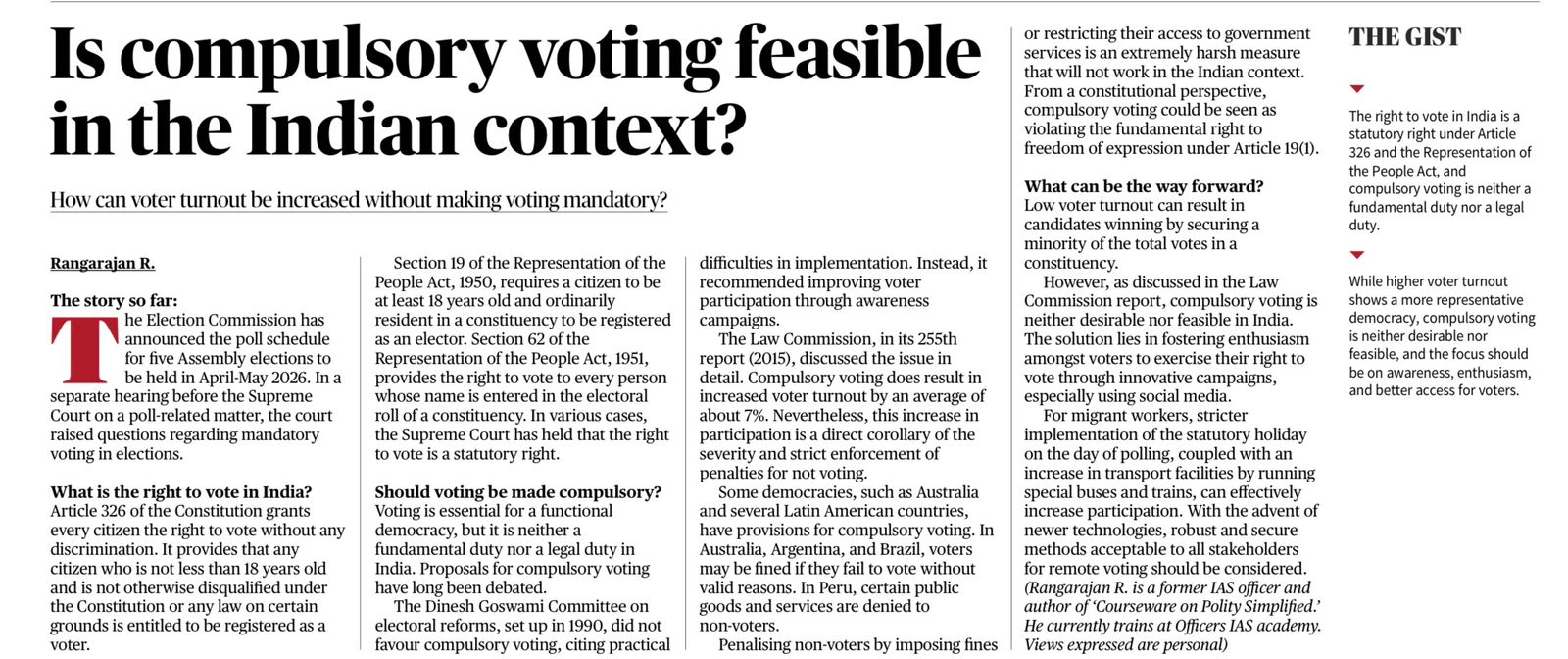
Article 326 → Provides universal adult suffrage (18+ citizens can vote)
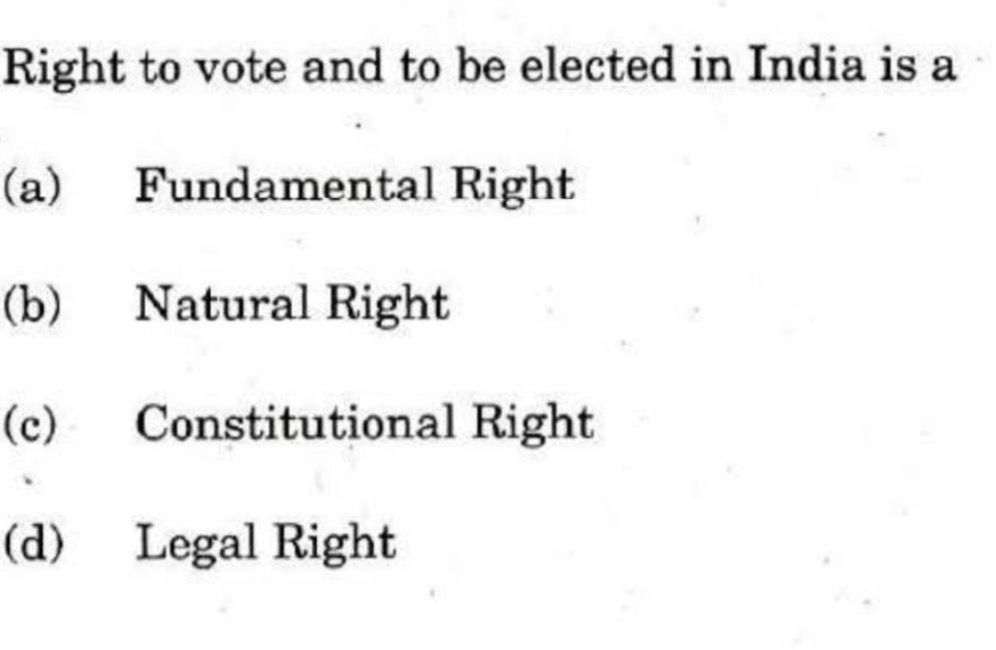
• Voting is not a Fundamental Right

It is a Statutory Right under:
Representation of the People Act, 1950 → voter registration
• Representation of the People Act, 1951 → right to vote
Supreme Court view: Voting = statutory right, not fundamental

Is Compulsory Voting Valid?

Constitutional Concern

• May violate Article 19(1)(a) → Freedom of expression
• Includes right to vote AND right not to vote

Committees / Reports Mentioned

  1. Dinesh Goswami Committee (1990)
    • Did not support compulsory voting
    • Reason: Practical difficulties in implementation
  2. Law Commission (255th Report, 2015)
    • Compulsory voting may increase turnout (~7%)
    • But not desirable or feasible in India
    • Emphasised awareness over coercion

Comparative Perspective

• Countries like Australia, Brazil, Argentina → compulsory voting with fines
• But enforcement is strict and costly, not suitable for India

Issues with Compulsory Voting

• Enforcement challenges (huge population)
• Risk of penalising poor/migrant voters
• Denial of services/fines → undemocratic & harsh
• May lead to forced or uninformed voting

Way Forward (Key Takeaways)

• Focus on voluntary participation
• Awareness campaigns (especially digital/social media)

Better access to polling:
• Transport facilities
• Holiday enforcement
• Explore remote voting technologies (for migrants)

Compulsory Voting
Compulsory Voting
PYQ – 2017, Ans – C

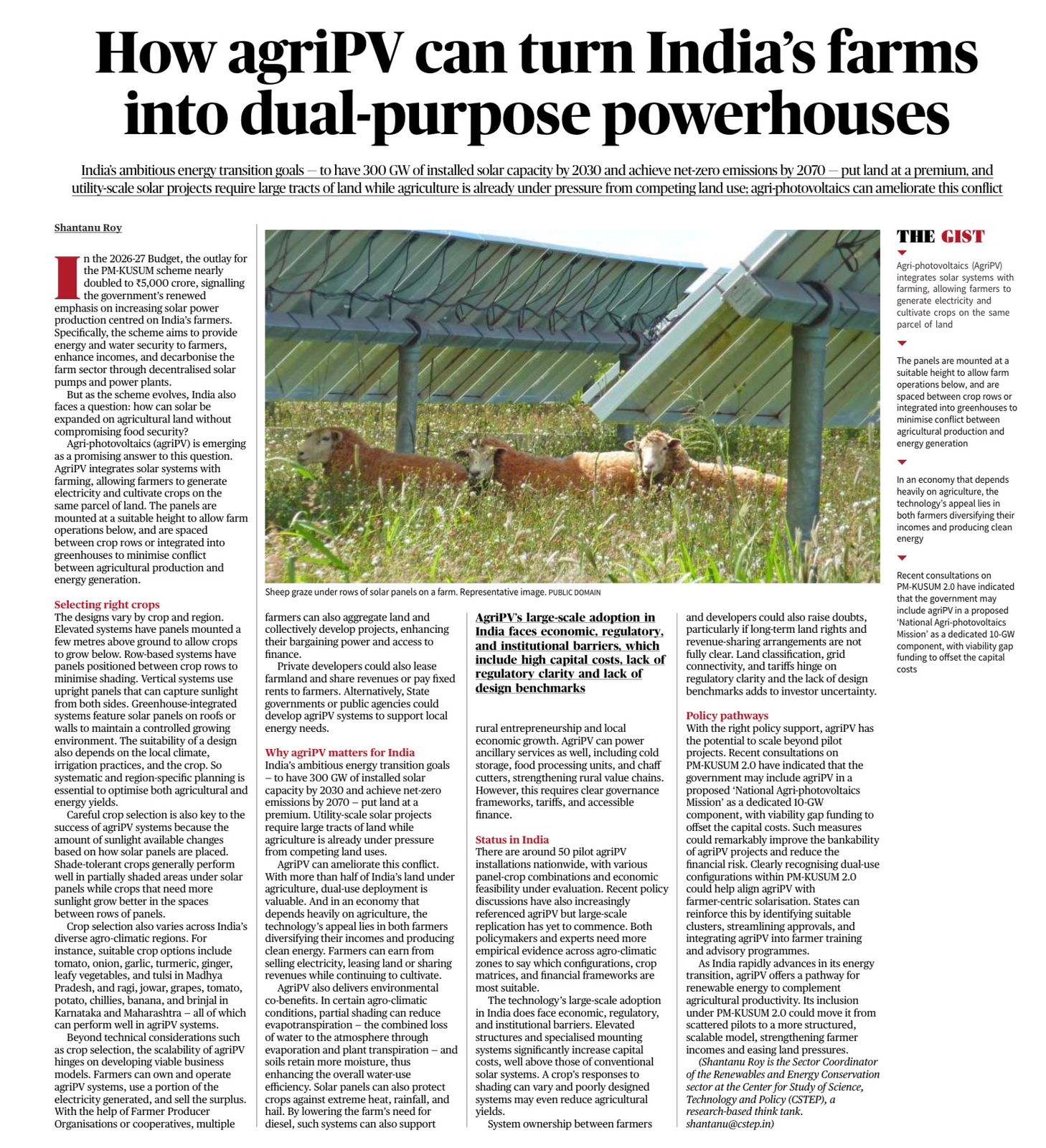
PM-KUSUM Scheme: Objectives, Components and AgriPV Integration for UPSC

Full Form: Pradhan Mantri Kisan Urja Suraksha evam Utthaan Mahabhiyan

• Launched: 2019
• Ministry: Ministry of New and Renewable Energy (MNRE)

Objective

• Provide solar energy for farmers
• Reduce diesel/grid dependence
• Increase farmer income

Components

• A: Decentralised solar plants (up to 2 MW)
• B: Standalone solar pumps
• C: Solarisation of grid-connected pumps

Key Idea

• Farmers can use solar power + sell surplus electricity

PM-KUSUM 2.0

• Upgraded version under discussion/recent policy push
• Focus on scaling up solarisation
• Includes Agri-Photovoltaics (AgriPV) integration
• Aim: move from pilot → large-scale implementation

Agri-Photovoltaics: Solar–Agriculture Integration, Benefits and Challenges for UPSC

Context

• In Budget 2026–27, allocation for PM-KUSUM (Pradhan Mantri Kisan Urja Suraksha evam Utthaan Mahabhiyan) increased to about ₹5,000 crore.
• It reflects focus on decentralised solar energy for farmers.
• This raises the issue of land use conflict between solar expansion and agriculture → leading to discussion on Agri-Photovoltaics (AgriPV).

Agri-Photovoltaics (AgriPV)

• Definition: Simultaneous use of same land for agriculture and solar energy generation.
• Mechanism: Solar panels installed above or between crops, allowing cultivation below.

Why AgriPV is Important

• Addresses land scarcity for solar projects
• Enables dual use of land
• Supports farmer income diversification
• Aligns with clean energy targets

Key Benefits

• Additional income from electricity
• Reduced water loss due to shading
• Protection of crops from extreme weather
• Efficient land utilisation

Major Challenges

• High capital cost
• Lack of regulatory clarity
• Absence of design standards
• Risk of lower crop yield if poorly designed

Status in India

• Around 50 pilot projects
• Still at a nascent stage

Agri-Photovoltaics
Agri-Photovoltaics
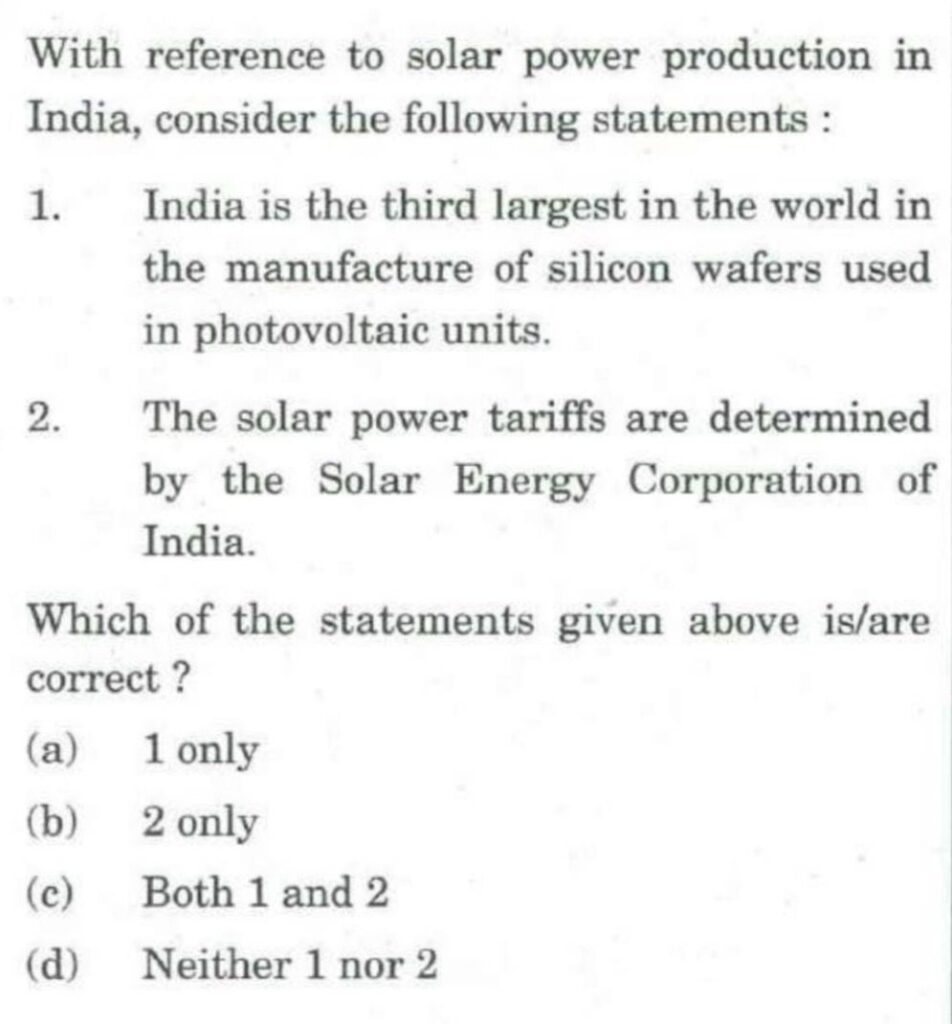
PYQ – 2018, Ans – D
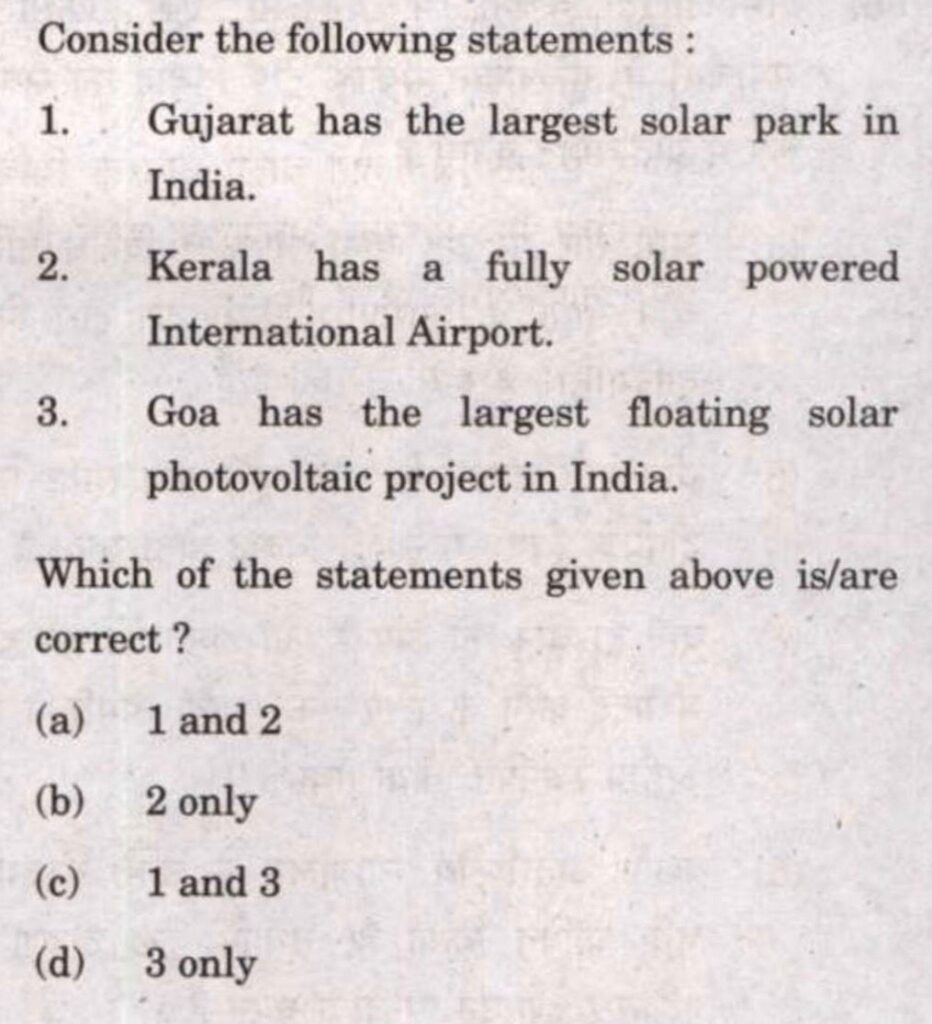
PYQ – 2022, Ans – B
About the UPSC Civil Services Examination (UPSC CSE)

The UPSC Civil Services Examination (CSE) is one of the most competitive and esteemed examinations in India, conducted by the Union Public Service Commission to recruit officers for services such as the Indian Administrative Service (IAS), Indian Police Service (IPS), Indian Foreign Service (IFS), and others. The exam comprises three stages — Prelims, Mains, and the Personality Test (Interview) — designed to test a candidate’s knowledge, aptitude, decision-making, and leadership skills.


How to Prepare Effectively for UPSC CSE

Cracking the UPSC CSE requires a deep understanding of the syllabus, consistent revision, structured answer writing, and smart test-taking strategies. The Prelims test analytical and conceptual clarity, the Mains focuses on critical thinking, articulation, and subject mastery, while the Interview assesses presence of mind, ethical judgment, and personality traits relevant to public service.

At UnderStand UPSC, we empower aspirants with a personalized and focused approach to each stage of the exam.


Why Choose UnderStand UPSC?

UnderStand UPSC is a mentorship-driven platform offering a clear, clutter-free strategy to tackle the Civil Services Examination. Our programs like Transform (for beginners and intermediate learners) and Conquer (for advanced mains preparation) provide structured study plans, syllabus-wise video content, interactive live sessions, and answer writing support.

We emphasize:

  • Concept clarity through topic-wise lectures

  • Test series designed around real UPSC standards

  • Personalized mentorship in small groups

  • Regular performance tracking and peer benchmarking

  • Doubt-clearing sessions, current affairs analysis, and monthly magazines


Join the UnderStand UPSC Learning Community

Our mission is to make UPSC preparation less overwhelming and more strategic. We combine mentorship, discipline, and academic rigor to help you clear CSE with confidence. Whether you’re preparing from Delhi, Mumbai, Bangalore, or a remote village — our online-first model ensures quality guidance reaches every corner of India.

Join the thousands of aspirants who trust UnderStand UPSC to guide their journey toward becoming civil servants.

Stay connected with us through our Telegram, YouTube, and Instagram channels for daily tips, strategies, and updates.

Copyright © 2026 USARAMBHA EDUCATION (UnderStand UPSC). All Rights Reserved.

Join the Success Journey!