25 & 26 June 2026 | Daily Current Affairs

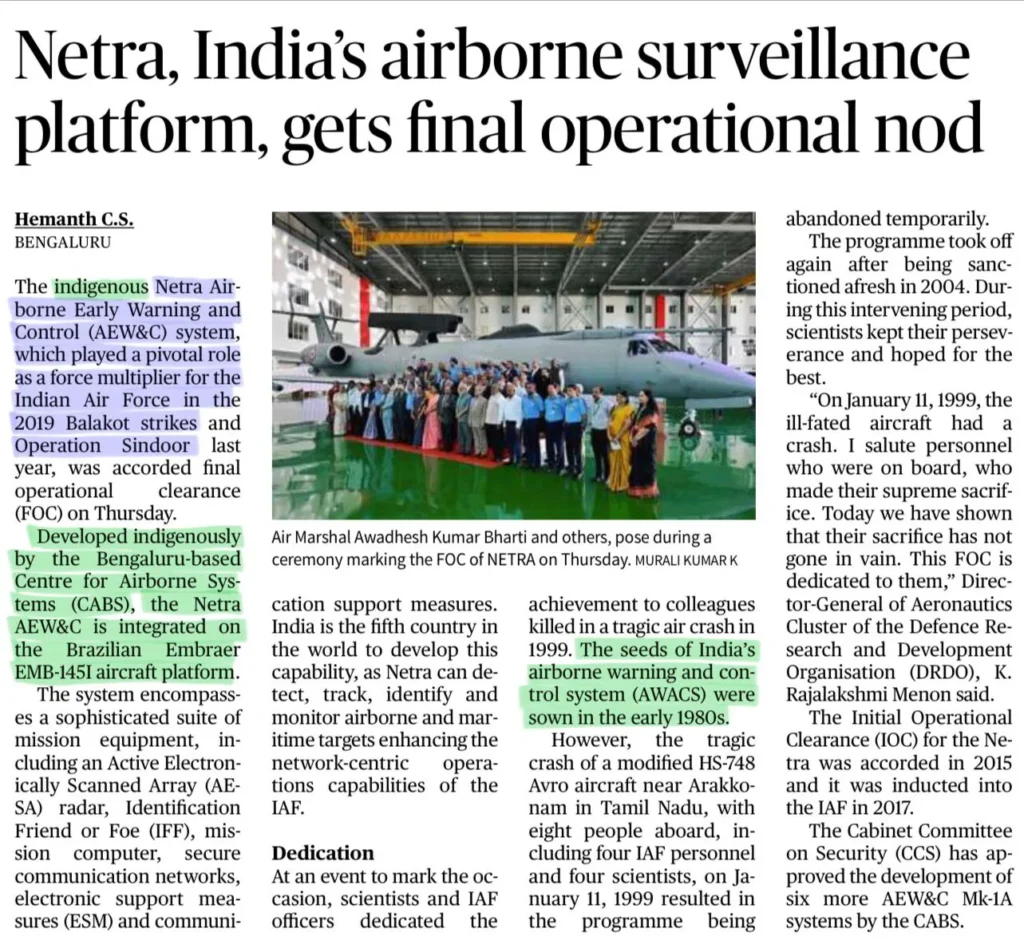
Netra AEW&C System India: DRDO Surveillance Platform

Context: Netra AEW&C System India
The indigenous Netra Airborne Early Warning and Control system, developed by DRDO, received Final Operational Clearance.

The Indian Air Force currently operates 2 Netra AEW&C aircraft, while the Cabinet Committee on Security has approved 6 Netra Mk-1A systems.

Airborne Early Warning and Control

AEW&C is a medium-range airborne surveillance and command system.

Airborne Warning and Control System

AWACS is a long-range airborne surveillance and command-and-control system.

AEW&C vs AWACS

AEW&C

  • Medium-range
  • Tactical surveillance
  • Smaller platform

AWACS

  • Long-range
  • Strategic surveillance
  • Larger platform
  • Command and control role

Indian Examples

AEW&C

  • Netra

AWACS

  • Phalcon on IL-76

Netra AEW&C

Developer

  • Centre for Airborne Systems
  • Defence Research and Development Organisation

Platform

  • Embraer EMB-145I aircraft

Role

Netra performs:

  • Early warning
  • Airspace surveillance
  • Battle management
  • Command and control

Capability

Netra can detect, track and identify:

  • Aircraft
  • Drones
  • Missiles
  • Maritime targets

It can detect targets beyond ground-based radar using Active Electronically Scanned Array radar.

Significance

  • Strengthens India’s airborne surveillance capability.
  • Improves early warning against aerial threats.
  • Supports network-centric warfare.
  • Enhances air defence readiness.
  • Reduces dependence on imported surveillance platforms.
  • Supports indigenous defence technology development.
  • Important for monitoring borders and maritime zones.
Solicitor General of India: Role, Powers and Tenure

Context: Solicitor General of India
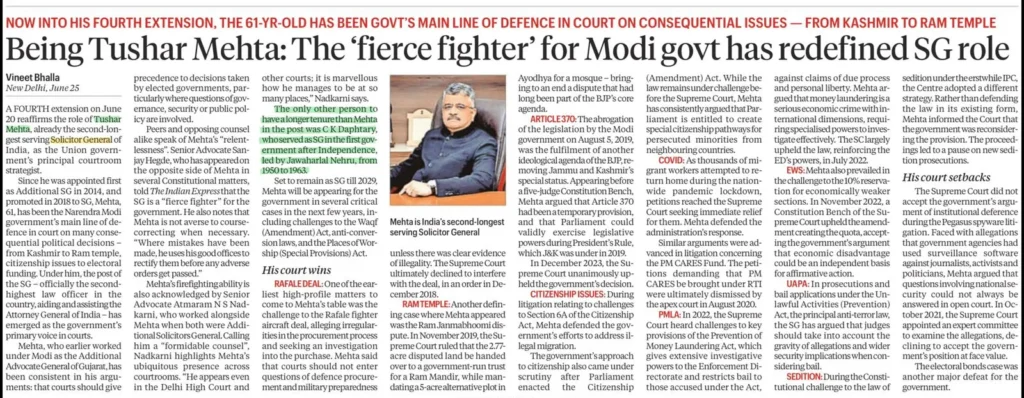
The Union Government granted a fourth extension to Solicitor General Tushar Mehta.

He was appointed Solicitor General in 2018 and has completed 8 years in office. With the fresh 3-year extension, he will complete 11 years by 2029, making him the second-longest serving Solicitor General of India after C.K. Daphtary, the first Solicitor General.

Attorney General of India

Article

  • Article 76

Status

  • Constitutional office

Position

  • Highest law officer of India

Solicitor General of India

Status

  • Non-constitutional post
  • Non-statutory post

Position

  • Second-highest law officer of India

Appointed By

  • Central Government

Role of Solicitor General

The Solicitor General:

  • Assists the Attorney General.
  • Represents the Union Government before the Supreme Court.
  • Represents the Union Government before High Courts.
  • Handles important constitutional and policy-related litigation.

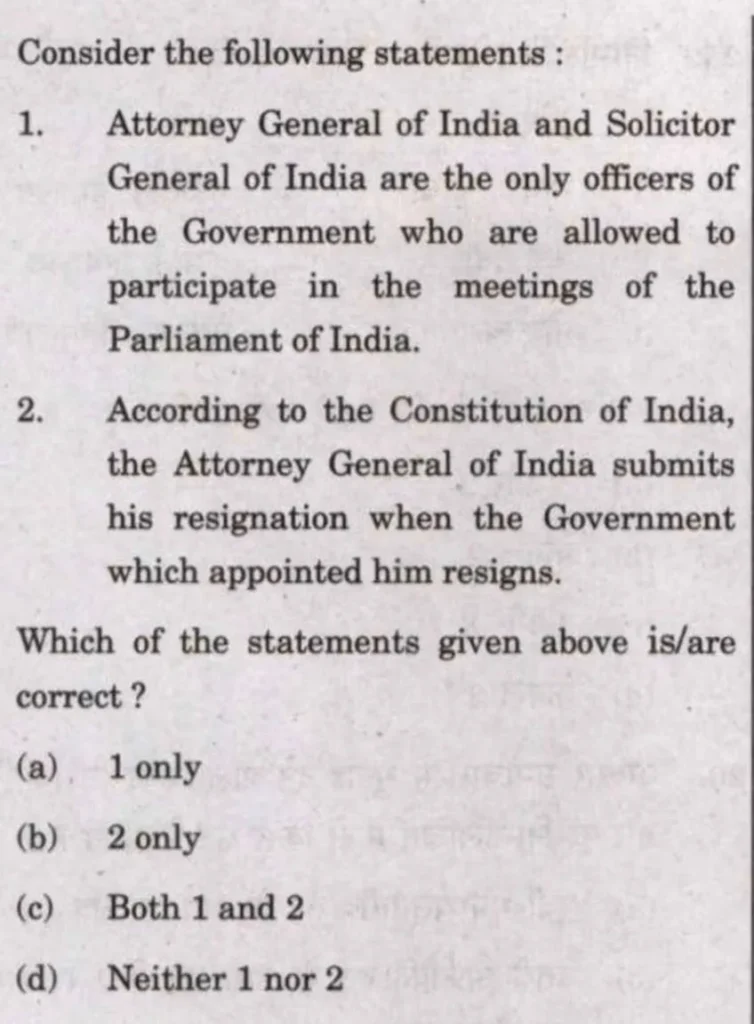
Parliament Participation

Attorney General

Under Article 88, the Attorney General can participate in the proceedings of Parliament.

However, the Attorney General cannot vote.

Solicitor General

The Solicitor General has no constitutional right to participate in Parliament.

Tenure

Both Attorney General and Solicitor General hold office during the pleasure of the Central Government.

Governing Rules

The Solicitor General is governed by:

  • Law Officers Conditions of Service Rules, 1987

UPSC Value Addition

Attorney General

  • Article 76
  • Constitutional office
  • Highest law officer
  • Can participate in Parliament under Article 88
  • No voting right

Solicitor General

  • Executive appointment
  • Not mentioned in the Constitution
  • Second-highest law officer
  • Assists Attorney General
  • No constitutional right to participate in Parliament

PYQ Link

Attorney General and Solicitor General are not both constitutional officers.

Only the Attorney General has constitutional recognition.

Indian Citizenship Proof Explained: Passport vs Citizenship

Context: Indian Citizenship Proof Explained
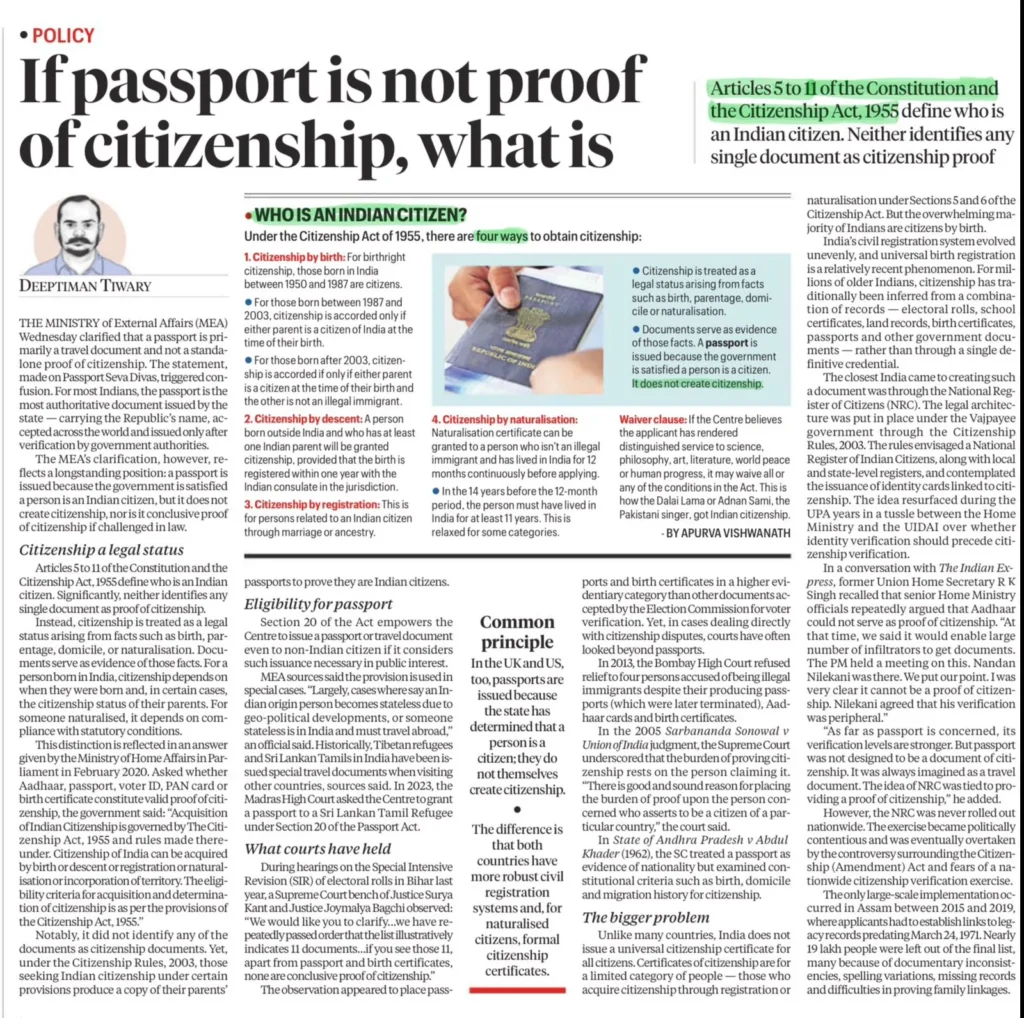
The Ministry of External Affairs clarified that a passport is primarily a travel document, not conclusive proof of Indian citizenship.

Citizenship is determined under the Constitution of India and the Citizenship Act, 1955, not by any single document.

Citizenship: Constitutional Basis

Articles 5–11

  • Provide the constitutional framework for citizenship.

Citizenship Act, 1955

The Citizenship Act governs:

  • Acquisition of citizenship
  • Termination of citizenship
  • Registration
  • Naturalisation

Core Principle

Citizenship is a legal status.

Documents are evidence of citizenship, but they are not the source of citizenship.

No Single Conclusive Document

No single document conclusively proves Indian citizenship, including:

  • Passport
  • Aadhaar
  • Voter ID
  • PAN
  • Ration card
  • Driving licence

How Citizenship Is Determined

In case of dispute, authorities or courts determine citizenship using a combination of evidence such as:

  • Birth records
  • Parentage
  • Domicile
  • Official records
  • Legal documents
  • Citizenship law provisions

Citizenship Certificate

A citizenship certificate is issued only to persons acquiring citizenship through:

  • Registration
  • Naturalisation

It is not issued to every citizen by birth.

Passport in Perspective

Passport

  • Issued under the Passports Act, 1967.
  • Used for international travel.
  • Not a citizenship certificate.

Comparative Perspective

India, like the United States and the United Kingdom, does not issue a universal citizenship document to every citizen.

Some countries with mandatory national identity systems issue identity cards that act as primary evidence of citizenship for most citizens.

Examples:

  • Pakistan — Computerised National Identity Card
  • Bangladesh — National Identity Card

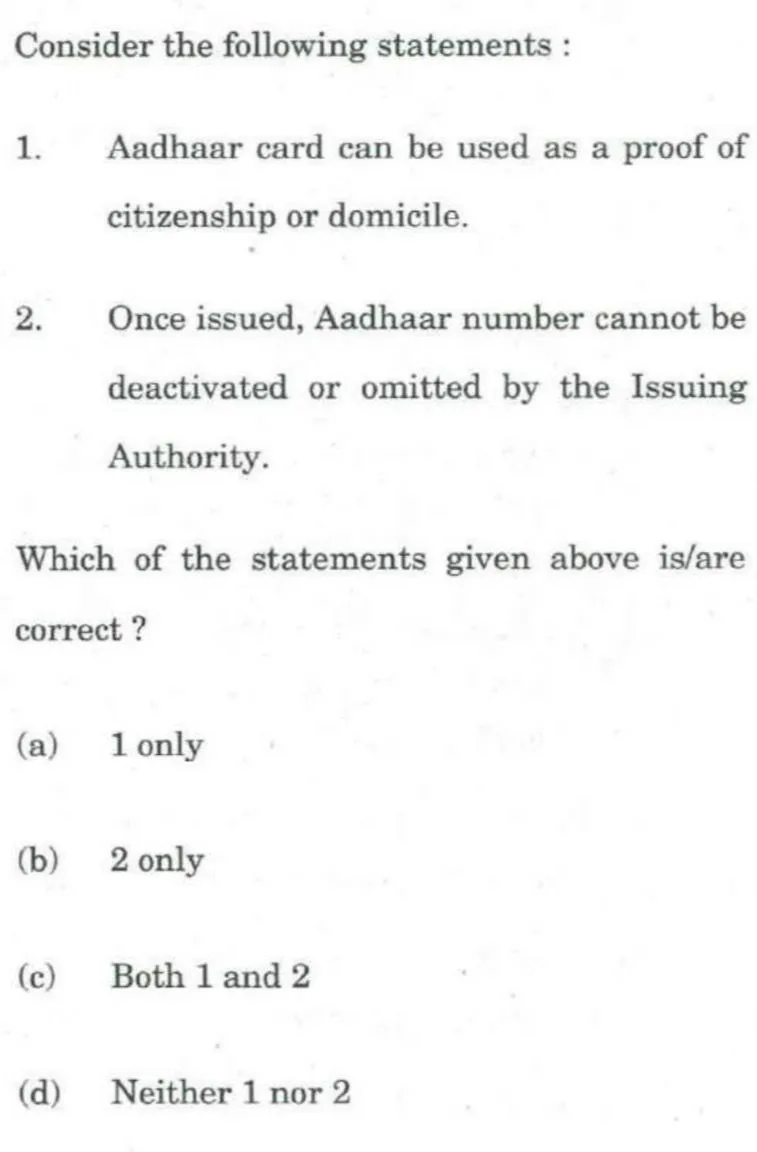
Aadhaar PYQ Link

  • Aadhaar is not proof of citizenship or domicile.
  • Aadhaar can be deactivated or omitted by the issuing authority under prescribed conditions.

Conclusion

Citizenship flows from law, not from documents.

Documents help establish citizenship, but no single document is legally conclusive in India.

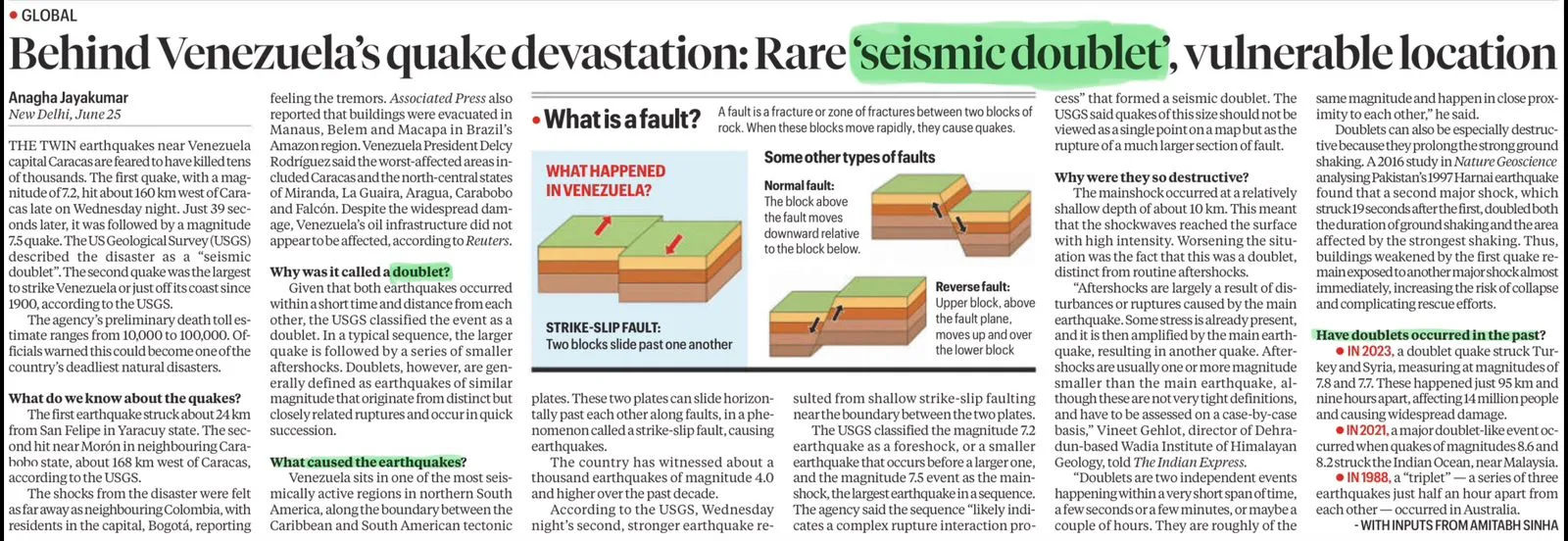
Venezuela Seismic Doublet Earthquake: Causes Explained

Context: Venezuela Seismic Doublet Earthquake
Two powerful earthquakes of magnitude 7.2 and 7.5 struck near Caracas, Venezuela, only 39 seconds apart, creating a rare seismic doublet. Shallow depth and strike-slip faulting amplified the destruction.

Earthquake Basics

Fault

A fault is a fracture in the Earth’s crust where tectonic plates move.

How an Earthquake Occurs

Sudden release of accumulated stress along a fault generates seismic waves.

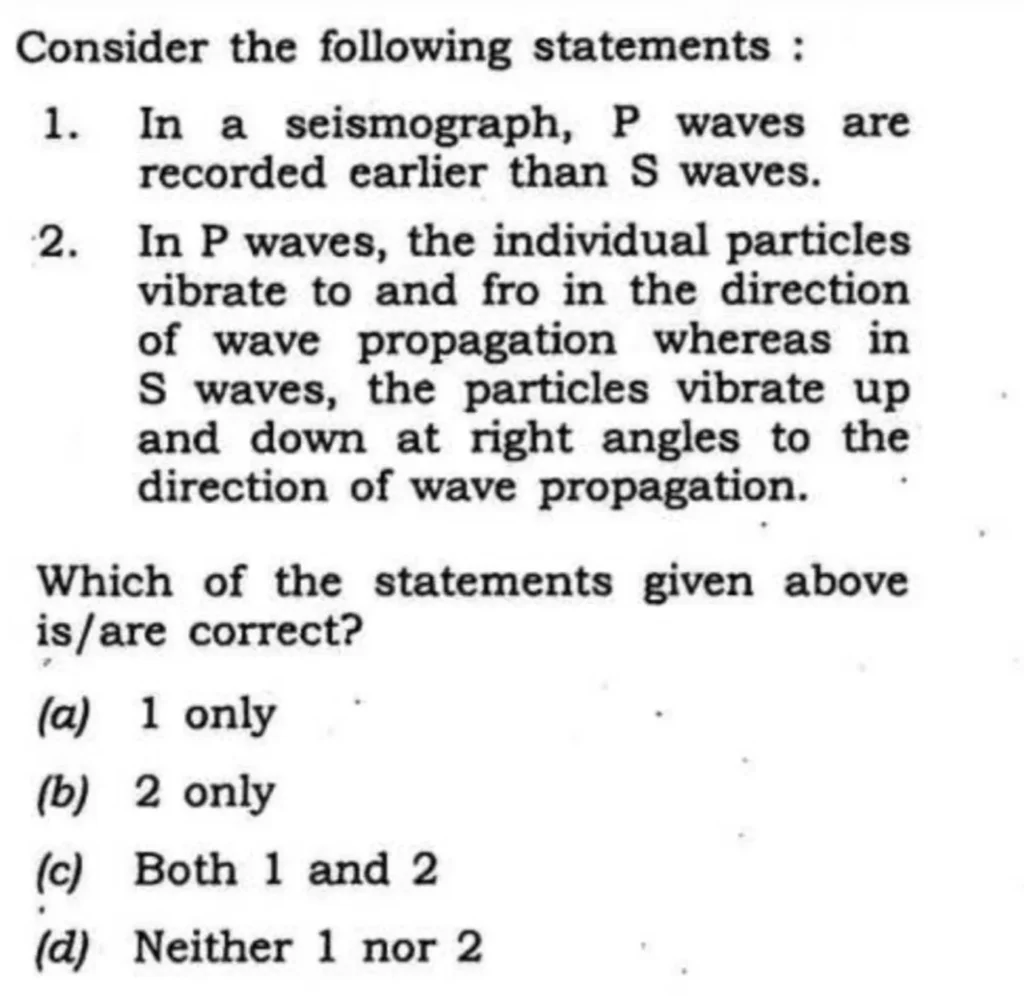
Types of Seismic Waves

P Waves — Primary Waves

  • Fastest seismic waves.
  • Longitudinal waves.
  • Travel through solids, liquids and gases.
  • Reach first on a seismograph.

S Waves — Secondary Waves

  • Slower than P waves.
  • Transverse waves.
  • Travel only through solids.
  • Cause stronger shaking than P waves.

Surface Waves / L Waves

  • Travel along the Earth’s surface.
  • Most destructive.
  • Cause maximum ground movement.

Seismic Doublet

A seismic doublet means two independent earthquakes of similar magnitude occurring close to each other within minutes to a few hours.

They are caused by closely related fault ruptures.

Seismic Doublet vs Aftershock

Seismic Doublet

  • Two major earthquakes.
  • Nearly equal magnitude.

Aftershock

  • Smaller earthquake.
  • Triggered by the main shock as the crust readjusts.

Why Seismic Doublets Are Dangerous

  • First earthquake weakens buildings and infrastructure.
  • Second earthquake strikes before recovery.
  • Ground shaking continues for longer.
  • Building collapse risk increases.
  • Casualties rise.
  • Rescue operations become difficult.

Why Venezuela Was Vulnerable

The destruction was worsened by:

  • Shallow earthquake depth
  • Strike-slip faulting
  • Dense population near affected areas
  • Vulnerable buildings
  • Limited time gap between two shocks

PYQ Link

  • P waves are recorded earlier than S waves.
  • In P waves, particles vibrate to and fro in the direction of wave propagation.
  • In S waves, particles vibrate at right angles to the direction of wave propagation.

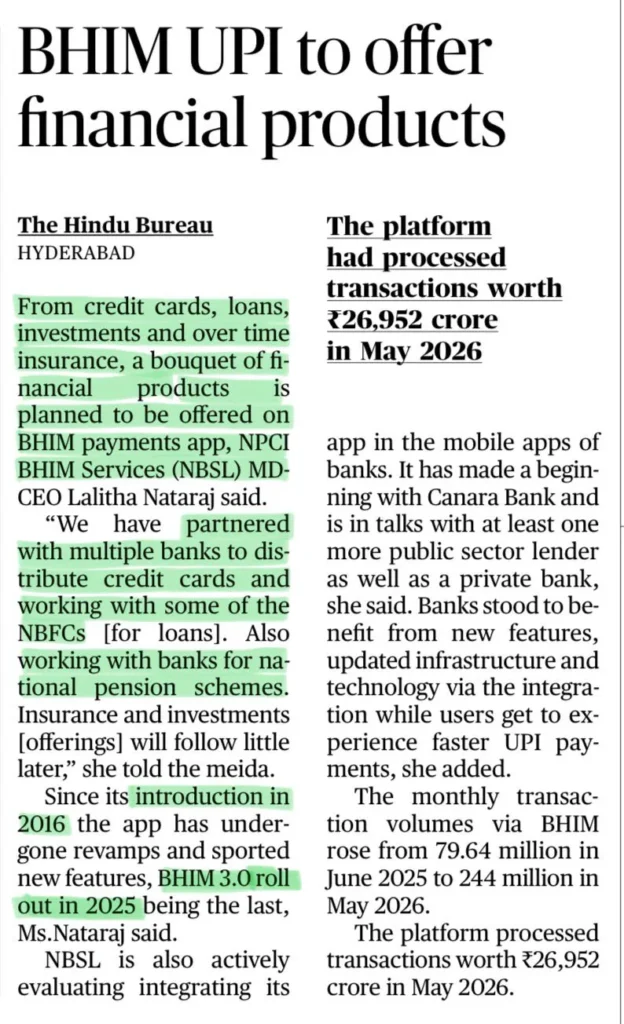
BHIM UPI Financial Products: NPCI Expands BHIM Services

Context:
National Payments Corporation of India, through NPCI BHIM Services Ltd., will expand the BHIM app beyond payments by offering credit cards, loans, National Pension System, investments and insurance through banks and NBFCs.

Unified Payments Interface

UPI is a real-time bank-to-bank payment system.

Launched

  • 2016

Developed By

  • National Payments Corporation of India

Regulated By

National Payments Corporation of India

NPCI is a non-profit umbrella organisation for retail payments.

Established

  • 2008

Set Up By

  • Reserve Bank of India
  • Indian Banks’ Association

Status

  • Not a statutory body

UPI Features

  • Virtual Payment Address
  • QR code-based payments
  • Mobile number-based payments
  • 24×7 settlement
  • Interoperability
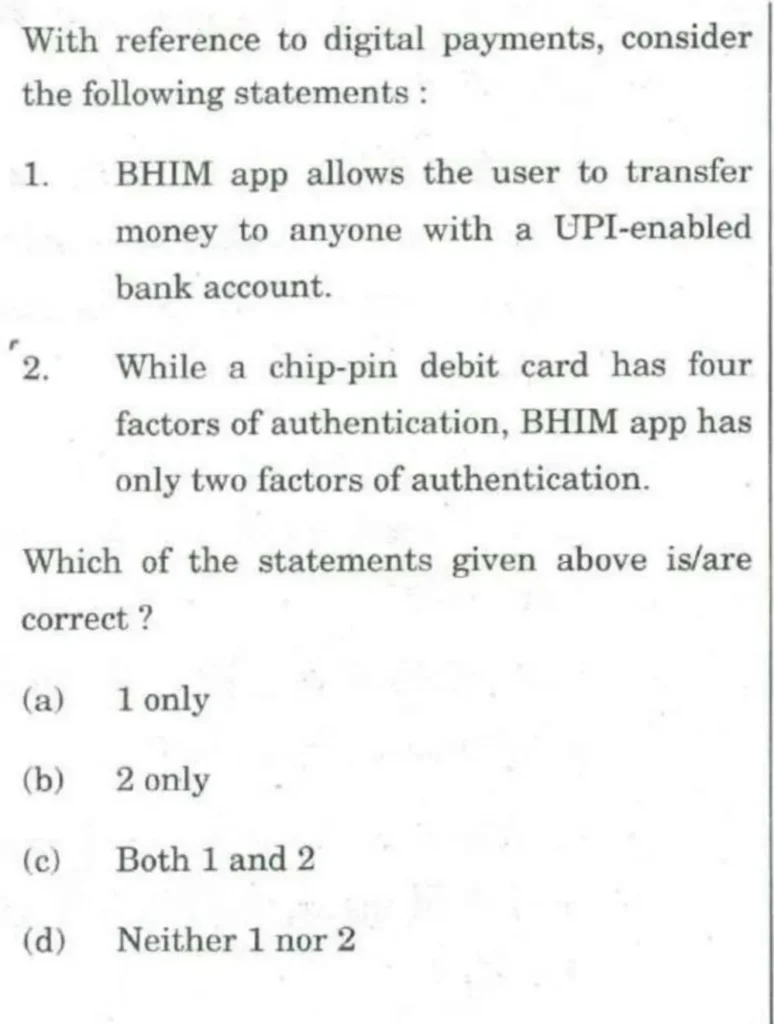
  • Two-factor authentication
  • Person-to-Person payments
  • Person-to-Merchant payments

BHIM App

BHIM means Bharat Interface for Money.

It enables users to transfer money to any UPI-enabled bank account.

Proposed Financial Products on BHIM

  • Credit cards
  • Loans
  • National Pension System
  • Investments
  • Insurance

Significance

  • Converts BHIM from a payment app into a broader financial services platform.
  • Improves digital financial inclusion.
  • Helps banks and NBFCs reach wider users.
  • Supports fintech-led credit and investment access.
  • Strengthens India’s digital public infrastructure ecosystem.

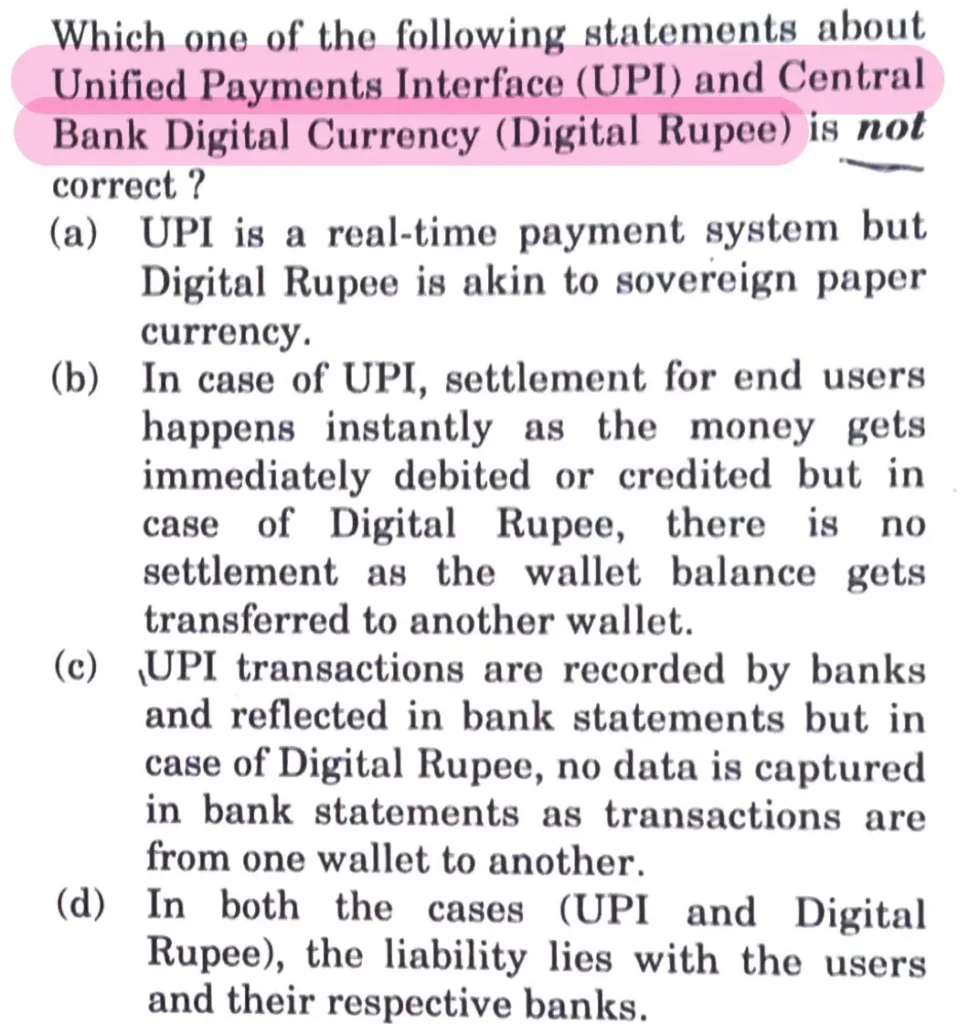
PYQ Integration

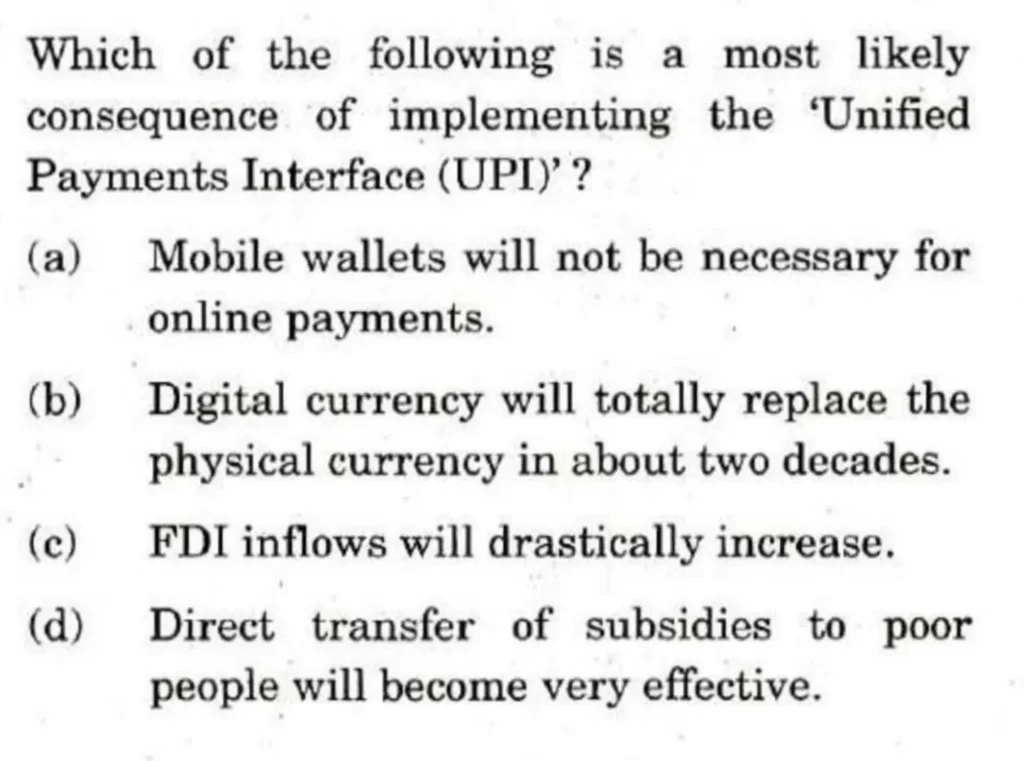
UPI vs Digital Rupee

  • UPI is a payment system.
  • Digital Rupee is digital legal tender issued by RBI.

UPI

  • Transfers bank deposits.
  • Money remains a commercial bank liability.

Digital Rupee

  • Direct liability of RBI.

Important Concepts to Differentiate

  • UPI
  • Digital Rupee / CBDC
  • Mobile Wallets
  • Bank Deposits

PYQ Facts

  • UPI strengthens Direct Benefit Transfer.
  • BHIM enables transfers to any UPI-enabled bank account using two-factor authentication.
  • UPI is not a digital currency.
About the UPSC Civil Services Examination (UPSC CSE)

The UPSC Civil Services Examination (CSE) is one of the most competitive and esteemed examinations in India, conducted by the Union Public Service Commission to recruit officers for services such as the Indian Administrative Service (IAS), Indian Police Service (IPS), Indian Foreign Service (IFS), and others. The exam comprises three stages — Prelims, Mains, and the Personality Test (Interview) — designed to test a candidate’s knowledge, aptitude, decision-making, and leadership skills.


How to Prepare Effectively for UPSC CSE

Cracking the UPSC CSE requires a deep understanding of the syllabus, consistent revision, structured answer writing, and smart test-taking strategies. The Prelims test analytical and conceptual clarity, the Mains focuses on critical thinking, articulation, and subject mastery, while the Interview assesses presence of mind, ethical judgment, and personality traits relevant to public service.

At UnderStand UPSC, we empower aspirants with a personalized and focused approach to each stage of the exam.


Why Choose UnderStand UPSC?

UnderStand UPSC is a mentorship-driven platform offering a clear, clutter-free strategy to tackle the Civil Services Examination. Our programs like Transform (for beginners and intermediate learners) and Conquer (for advanced mains preparation) provide structured study plans, syllabus-wise video content, interactive live sessions, and answer writing support.

We emphasize:

  • Concept clarity through topic-wise lectures

  • Test series designed around real UPSC standards

  • Personalized mentorship in small groups

  • Regular performance tracking and peer benchmarking

  • Doubt-clearing sessions, current affairs analysis, and monthly magazines


Join the UnderStand UPSC Learning Community

Our mission is to make UPSC preparation less overwhelming and more strategic. We combine mentorship, discipline, and academic rigor to help you clear CSE with confidence. Whether you’re preparing from Delhi, Mumbai, Bangalore, or a remote village — our online-first model ensures quality guidance reaches every corner of India.

Join the thousands of aspirants who trust UnderStand UPSC to guide their journey toward becoming civil servants.

Stay connected with us through our Telegram, YouTube, and Instagram channels for daily tips, strategies, and updates.

Copyright © 2026 USARAMBHA EDUCATION (UnderStand UPSC). All Rights Reserved.

Fill out the form for

Downloading the free Agriculture Short Notes


Fill out the form

If you have any queries related to
GS Foundation 2027/28