4 June 2026 | Daily Current Affairs

Dark Patterns: CCPA Action Against Misleading Digital Practices

Context: CCPA Acts Against Dark Patterns on Digital Platforms
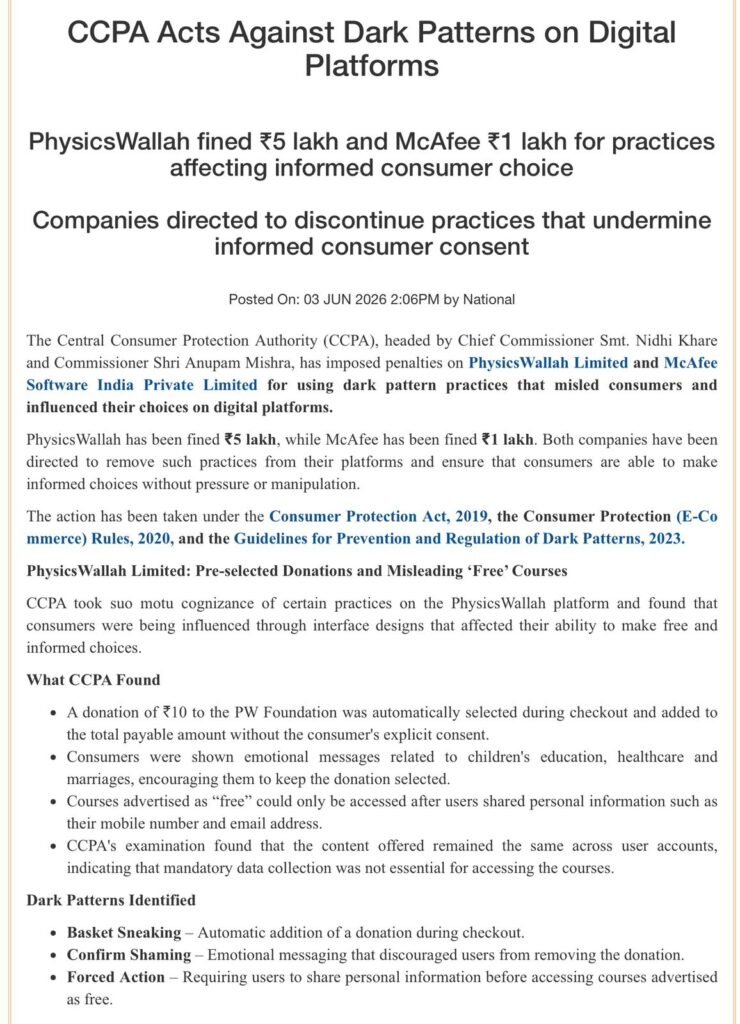
CCPA penalised PhysicsWallah and McAfee for using dark patterns, which are deceptive digital design practices that manipulate consumer behaviour, compromise informed consent, and undermine consumers’ Right to Information under Article 19(1)(a).

Dark Patterns: Key Terms

Dark Patterns

  • User-interface designs that mislead or manipulate consumers into making unintended choices.

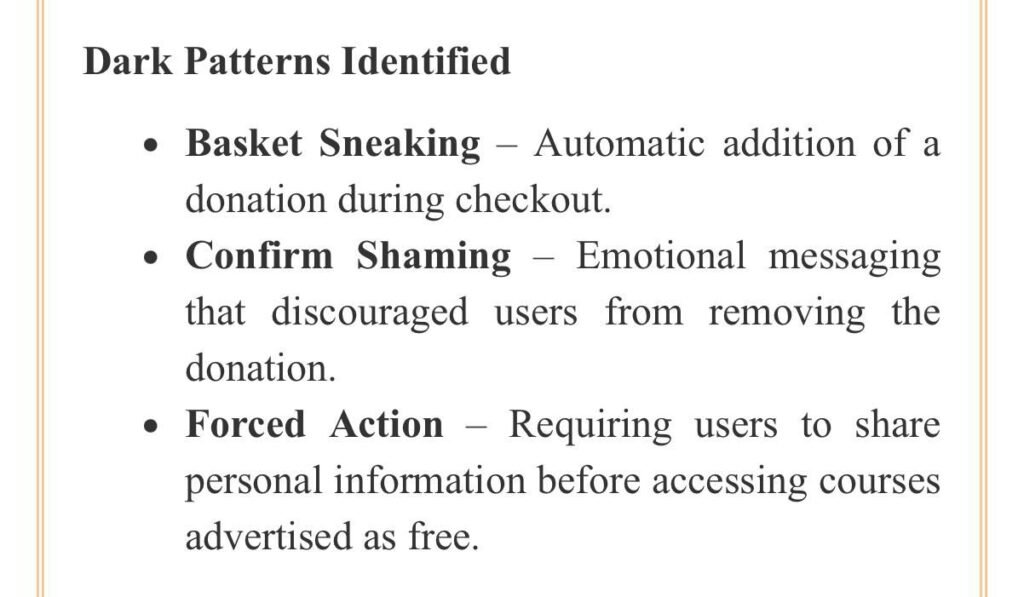
Basket Sneaking

  • Extra products or services are automatically added during checkout.
  • Example: ₹10 donation pre-selected.

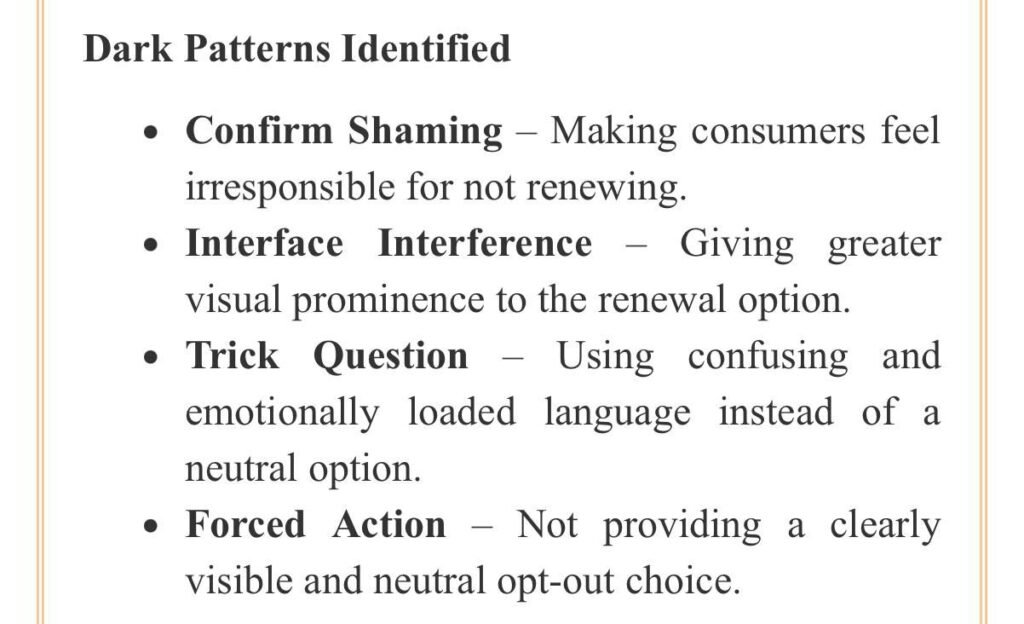
Confirm Shaming

  • Guilt or emotional pressure is used to discourage opting out.
  • Example: “Don’t you want to help children?”

Forced Action

  • User is compelled to share personal data or perform extra steps.
  • Example: Mobile number required for accessing a free course.

Interface Interference

  • One option is made visually dominant over another.
  • Example: Large “Renew” button and hidden “Cancel” option.

Trick Question

  • Confusing or misleading wording is used to obtain consent.
  • Example: Double-negative opt-out statement.

False Urgency

  • Artificial scarcity or time pressure is created.
  • Example: “Only 2 seats left.”

Subscription Trap

  • Subscription is easy, but cancellation is difficult.
  • Example: One-click sign-up but multi-step unsubscribe.

Central Consumer Protection Authority

Status

  • Statutory regulatory body under Section 10 of the Consumer Protection Act, 2019.

Composition

  • Chief Commissioner
  • Up to 2 Commissioners

Eligibility

Expertise in:

  • Consumer affairs
  • Law
  • Economics
  • Commerce
  • Industry
  • Public administration
  • Public affairs

Tenure

  • 5 years or 65 years, whichever is earlier.

Powers

  • Suo motu inquiry
  • Recall unsafe goods / services
  • Withdraw misleading advertisements
  • Impose penalties
  • Protect consumer interests
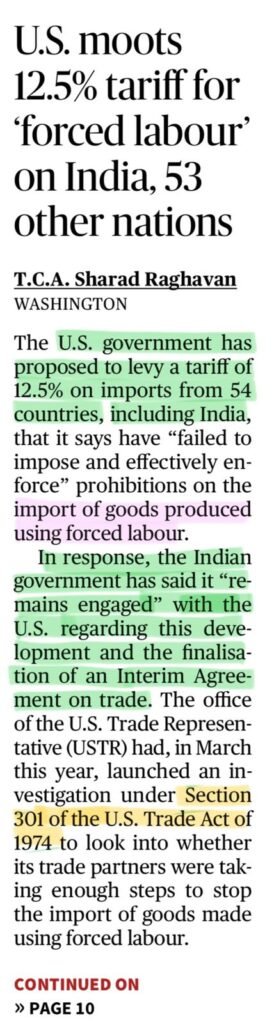
Forced Labour Tariff: U.S. Proposes 12.5% Duty on Indian Imports

Context: U.S. Moots 12.5% Tariff for ‘Forced Labour’ on India, 53 Other Nations
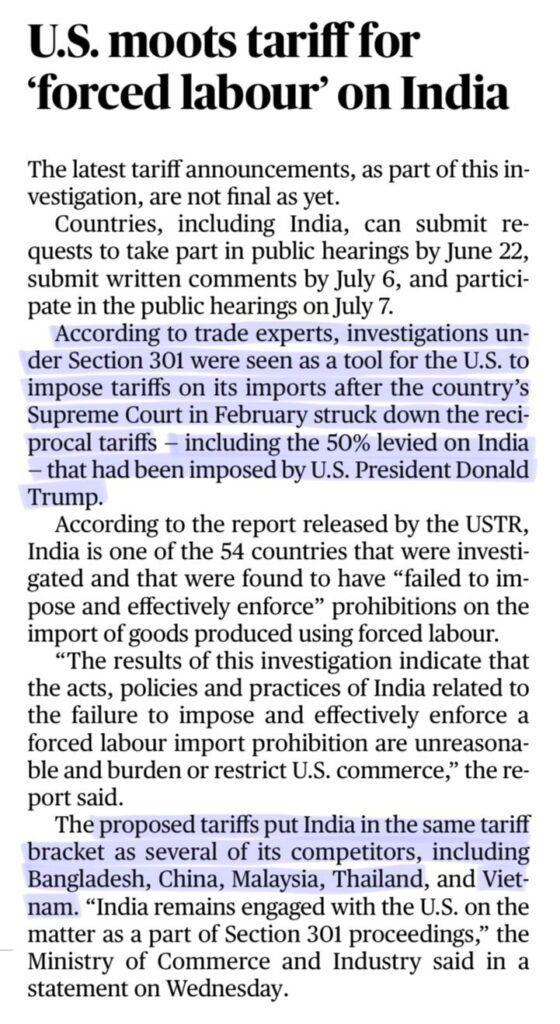
The U.S. Trade Representative has proposed a 12.5% tariff on imports from India and 53 other countries, alleging inadequate action against goods produced through forced labour. India is engaging with the U.S. while negotiating an interim trade agreement.

Section 301 of the U.S. Trade Act, 1974

Purpose

  • Allows the U.S. Trade Representative to investigate and act against trade practices considered unfair or harmful to U.S. commerce.

Actions

  • Tariffs
  • Import restrictions
  • Suspension of trade concessions

Grounds

  • Unfair trade practices
  • IPR violations
  • Market-access barriers
  • Labour-related concerns

India

  • India is currently under a Section 301 investigation.
  • Similar provisions were used extensively during the U.S.–China trade dispute.

WTO Angle

Issue

  • Section 301 is a unilateral trade measure, whereas WTO prefers disputes to be settled through its dispute-settlement system.

Possible WTO Concerns

  • Violation of Most-Favoured Nation principle under Article I of GATT 1994.
  • Violation of tariff commitments under WTO rules.

Startup India: Key Achievements and Growth of India’s Startup Ecosystem

Context: How India Scaled its Startup Industry from 2016 to 2025
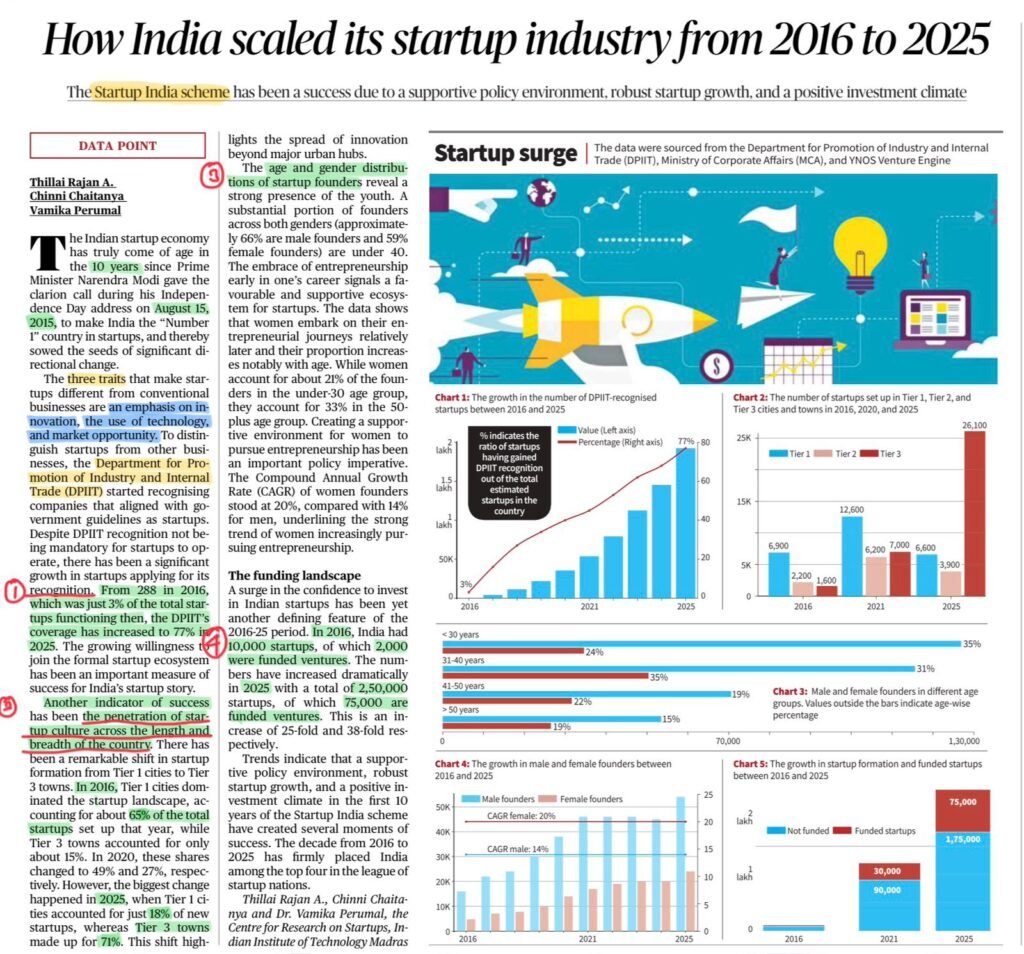
A decade after the launch of Startup India in 2016, India’s startup ecosystem has witnessed rapid growth driven by innovation, technology adoption, and market opportunity, supported by favourable policies, rising investments, and wider geographical penetration.

Startup India

Launch

  • 16 January 2016

Nodal Agency

Core Focus

  • Innovation
  • Technology-driven entrepreneurship
  • Market-based solutions

Objective

  • Promote startups
  • Generate employment
  • Attract investment
  • Build an innovation-led economy

Key Achievements

Recognition and Formalisation

  • DPIIT-recognised startups increased from 288 in 2016 to nearly 2 lakh in 2025.
  • Coverage rose from 3% to 77% of estimated startups.

Democratisation of Startups

  • Tier-1 cities’ share declined from 65% in 2016 to 18% in 2025.
  • Tier-3 cities’ share increased from 15% to 71%, showing entrepreneurship beyond metros.

Funding Ecosystem Deepened

  • Total startups rose from 10,000 to 2.5 lakh.
  • Funded startups increased from 2,000 to 75,000, reflecting stronger investor confidence.

Inclusive Entrepreneurship

  • Nearly two-thirds of founders are below 40 years.
  • Women founders recorded 20% CAGR compared to 14% for men, indicating growing gender diversity.

ATF Price Stabilisation Fund: Cabinet Approves ₹10,000 Crore Support

Context: Cabinet Approves ₹10,000 Crore ATF Price Stabilisation Fund
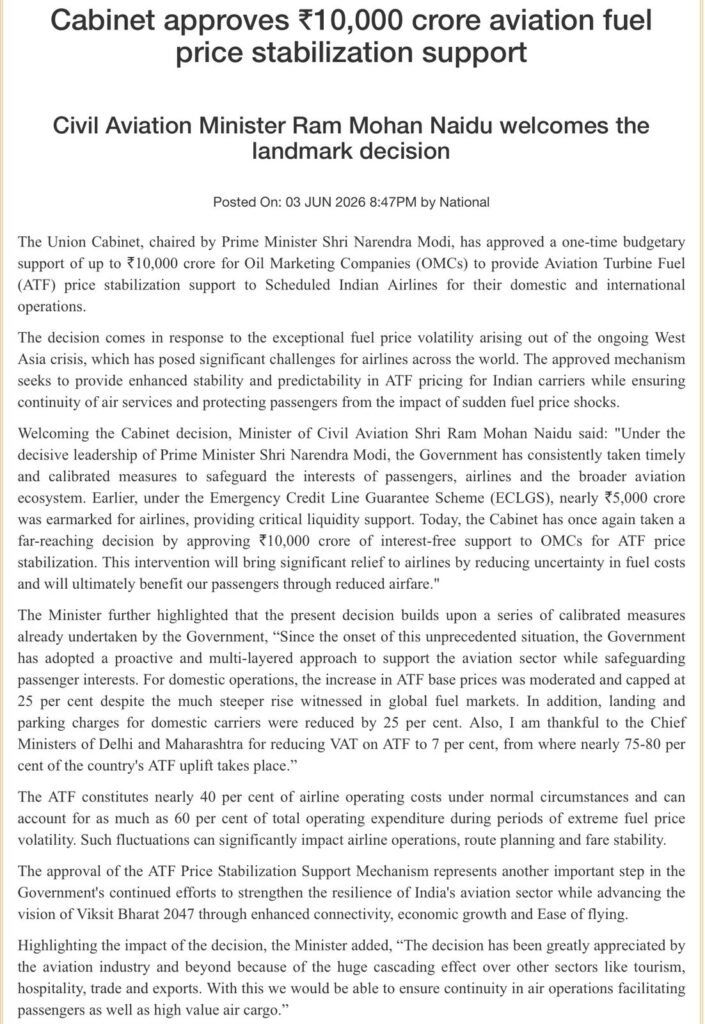
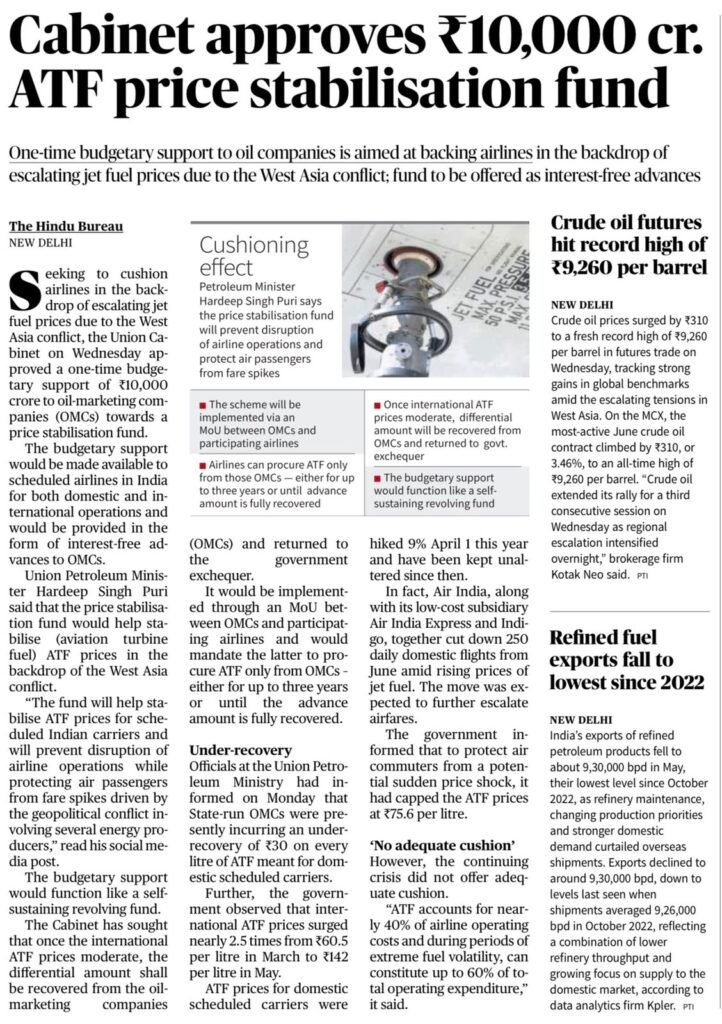
Amid the ongoing West Asia crisis, global crude oil and Aviation Turbine Fuel prices have surged sharply, increasing airline operating costs and raising the risk of fare hikes and service disruptions. To cushion airlines from these shocks, the Union Cabinet approved a ₹10,000 crore ATF Price Stabilisation Fund.

ATF Price Stabilisation Fund

Aviation Turbine Fuel

  • Jet fuel used by aircraft.
  • It is the single largest operating expense for airlines.
  • It accounts for nearly 40% of operating costs under normal conditions.
  • It can account for up to 60% of operating expenditure during periods of extreme price volatility.
  • Fluctuations in ATF prices directly affect airfares, airline profitability, route planning, and connectivity.

Fund Mechanism

  • ₹10,000 crore one-time budgetary support.
  • Interest-free advances to Oil Marketing Companies.
  • OMCs supply ATF at moderated prices to scheduled airlines.
  • Support is recovered after international fuel prices stabilise.
  • The fund works like a self-sustaining revolving fund.

Expected Benefits

  • Stabilises fuel costs.
  • Prevents fare spikes and flight disruptions.
  • Improves financial viability of airlines.
  • Protects passengers and cargo operations.
  • Strengthens resilience of India’s aviation sector.

Foreign Exchange Reserves: RBI Clarifies Gold Holdings Remain Stable

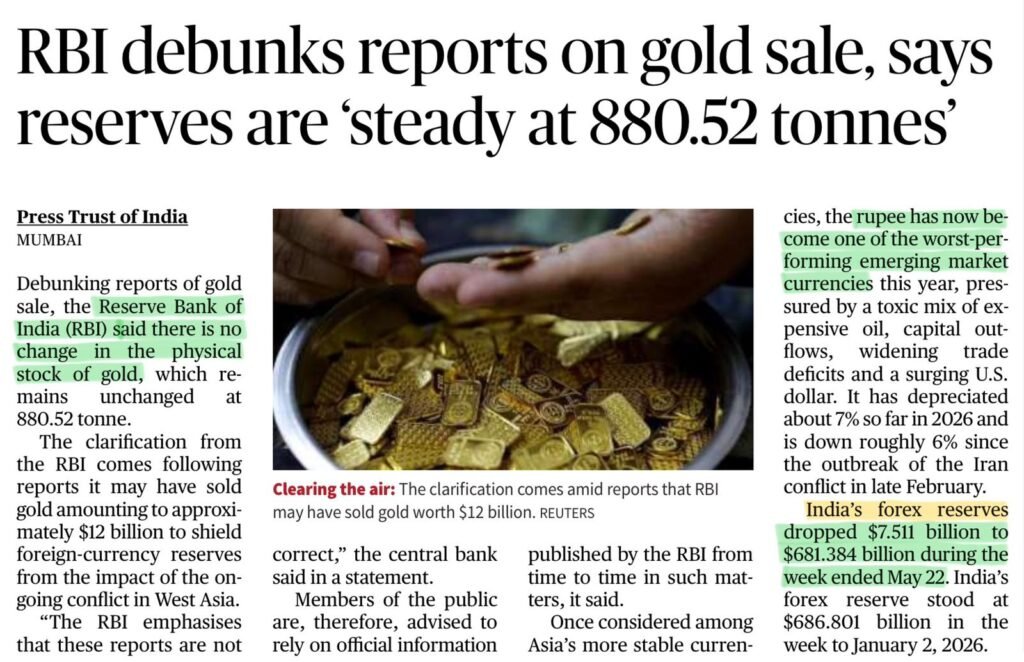
Context: RBI Debunks Reports on Gold Sale, Says Reserves Steady at 880.52 Tonnes
RBI clarified that it has not sold any gold reserves and that India’s gold holdings remain unchanged at 880.52 tonnes, dismissing reports that gold was being used to support the rupee amid global uncertainty.

Foreign Exchange Reserves

What are Forex Reserves?

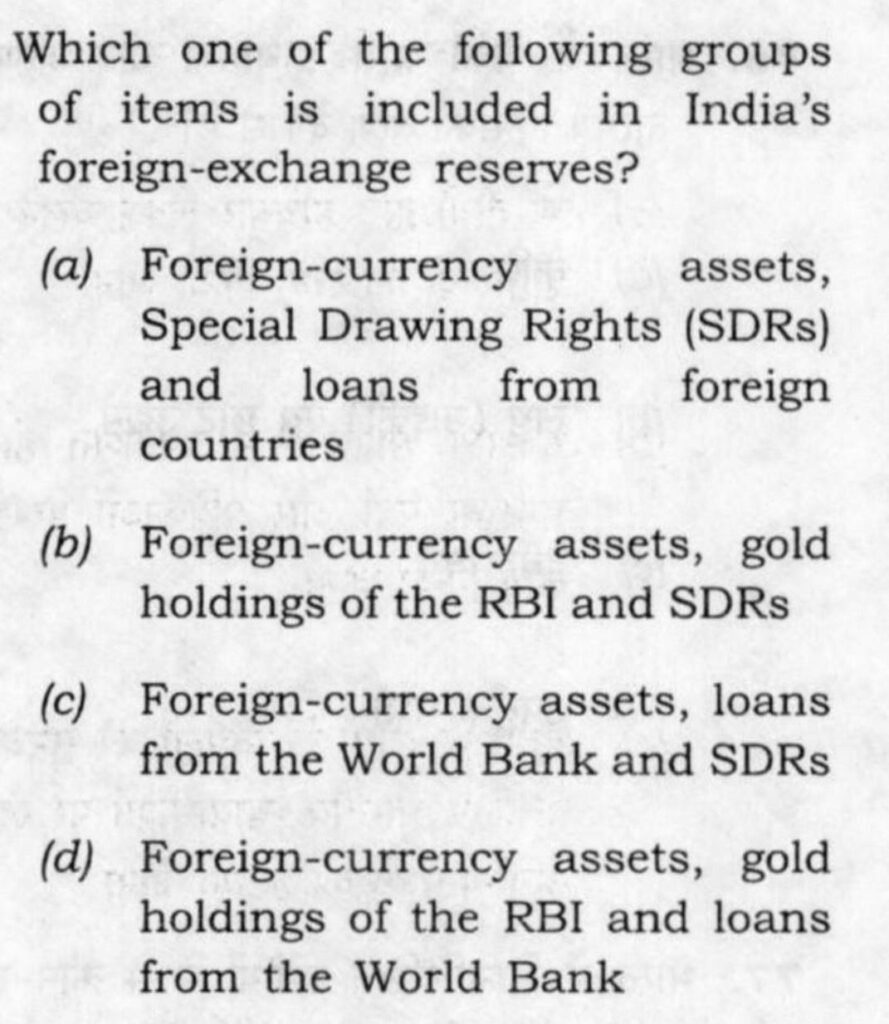
  • Foreign assets held by the RBI to meet external payment obligations, stabilise the rupee, and provide a buffer during economic crises.

Components of Forex Reserves

Foreign Currency Assets

  • Holdings of foreign currencies and foreign government securities.
  • Mainly U.S. Dollar, Euro, Pound and Yen.
  • Around 85–90% of forex reserves.

Gold Reserves

  • Physical gold held by RBI as a safe-haven asset and store of value.
  • Around 8–10% of forex reserves.
  • Current holdings: 880.52 tonnes.

Special Drawing Rights

Reserve Tranche Position

  • India’s reserve position with the IMF that can be accessed when required.
  • Less than 2% of forex reserves.

Significance

  • Supports rupee stability.
  • Provides import cover, especially for crude oil.
  • Enhances investor confidence.
  • Acts as a buffer during external shocks and financial crises.

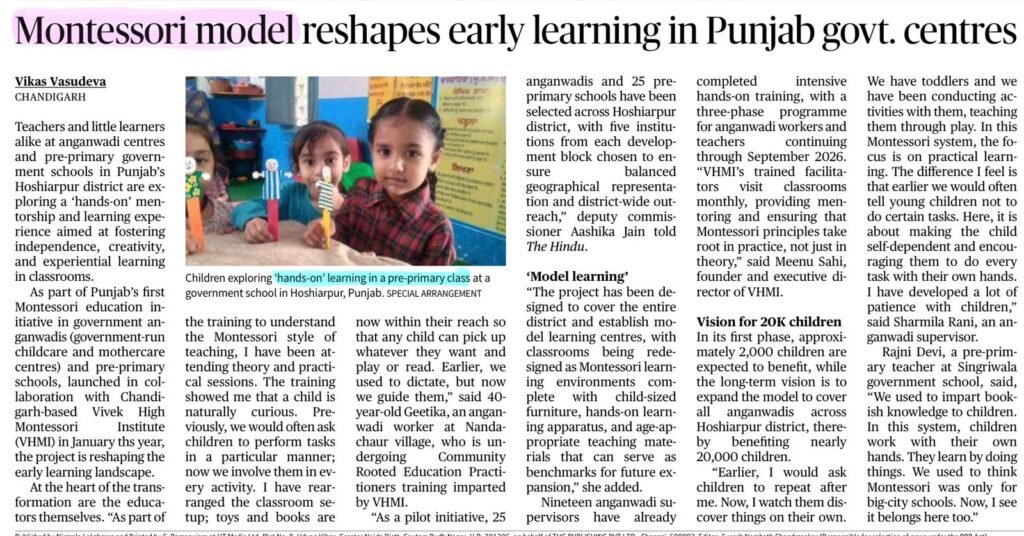
Montessori Method: Punjab Adopts Child-Centred Early Learning Model

Context: Montessori Model Reshapes Early Learning in Punjab Government Centres
Punjab has introduced the Montessori model in Anganwadis and pre-primary government schools in Hoshiarpur district, focusing on hands-on learning, self-directed activities, creativity, and experiential learning. The initiative is being implemented with support from the Vivek High Montessori Institute.

Montessori Method

Core Principle

  • Child-centred learning through exploration and experience rather than rote learning.

Key Features

  • Learning by doing
  • Self-directed learning
  • Activity-based education
  • Child-sized learning environment
  • Teacher as facilitator, not instructor
About the UPSC Civil Services Examination (UPSC CSE)

The UPSC Civil Services Examination (CSE) is one of the most competitive and esteemed examinations in India, conducted by the Union Public Service Commission to recruit officers for services such as the Indian Administrative Service (IAS), Indian Police Service (IPS), Indian Foreign Service (IFS), and others. The exam comprises three stages — Prelims, Mains, and the Personality Test (Interview) — designed to test a candidate’s knowledge, aptitude, decision-making, and leadership skills.


How to Prepare Effectively for UPSC CSE

Cracking the UPSC CSE requires a deep understanding of the syllabus, consistent revision, structured answer writing, and smart test-taking strategies. The Prelims test analytical and conceptual clarity, the Mains focuses on critical thinking, articulation, and subject mastery, while the Interview assesses presence of mind, ethical judgment, and personality traits relevant to public service.

At UnderStand UPSC, we empower aspirants with a personalized and focused approach to each stage of the exam.


Why Choose UnderStand UPSC?

UnderStand UPSC is a mentorship-driven platform offering a clear, clutter-free strategy to tackle the Civil Services Examination. Our programs like Transform (for beginners and intermediate learners) and Conquer (for advanced mains preparation) provide structured study plans, syllabus-wise video content, interactive live sessions, and answer writing support.

We emphasize:

  • Concept clarity through topic-wise lectures

  • Test series designed around real UPSC standards

  • Personalized mentorship in small groups

  • Regular performance tracking and peer benchmarking

  • Doubt-clearing sessions, current affairs analysis, and monthly magazines


Join the UnderStand UPSC Learning Community

Our mission is to make UPSC preparation less overwhelming and more strategic. We combine mentorship, discipline, and academic rigor to help you clear CSE with confidence. Whether you’re preparing from Delhi, Mumbai, Bangalore, or a remote village — our online-first model ensures quality guidance reaches every corner of India.

Join the thousands of aspirants who trust UnderStand UPSC to guide their journey toward becoming civil servants.

Stay connected with us through our Telegram, YouTube, and Instagram channels for daily tips, strategies, and updates.

Copyright © 2026 USARAMBHA EDUCATION (UnderStand UPSC). All Rights Reserved.

Fill the form

Our team will reach out to you soon