🚨 ONLY 2 DAYS LEFT! | FREE UPSC OFFLINE MEETUP 2028/29 REGISTER NOW →

6 Dec 2025

Cheaper loans likely as repo rate cut by 25 bps

Context

• RBI’s MPC cut the repo rate by 25 bps to 5.25%.
• Driven by strong GDP growth (8.2% in Q2) and sharp fall in inflation (1.7%).
• Indicates shift towards easing borrowing costs.

Reasons for Rate Cut

1. Inflation well below target
• Inflation down to 1.7%, below RBI’s 4% target.
• Allowed policy easing without risking stability.

2. Robust economic growth
• GDP at 8.2%, showing momentum.
• Rate cut to sustain growth and make loans cheaper.

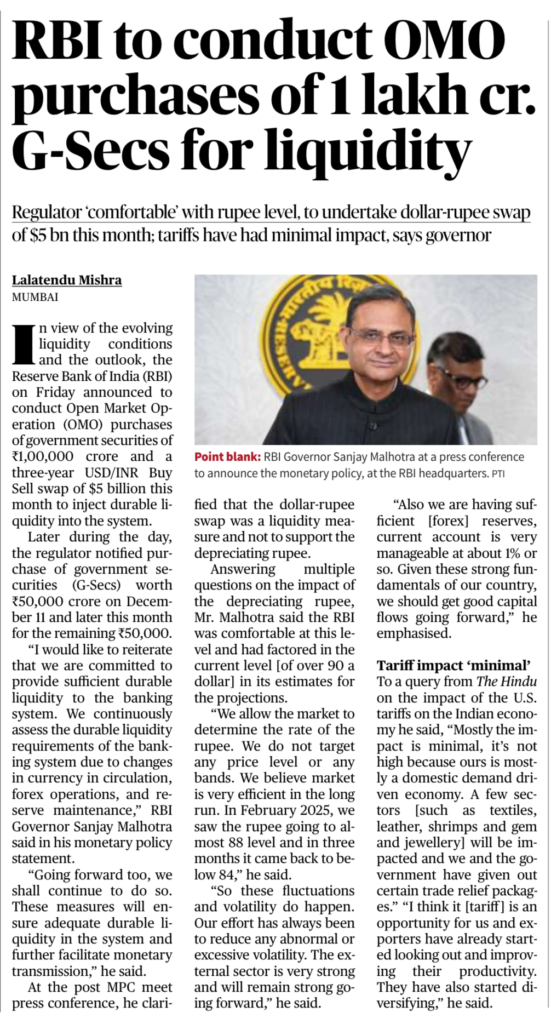
RBI to conduct OMO purchases of ₹1 lakh crore G-Secs

Context

RBI to conduct OMO purchases of ₹1 lakh crore + USD/INR buy–sell swap of $5 billion.
• Aim: inject liquidity, support monetary transmission, stabilise financial system.
• RBI clarified it is not intended to support rupee levels.

What are OMOs?

• Buying/selling of G-Secs by RBI.
• RBI buying G-Secs → liquidity increases.

Dollar–Rupee Swap

• RBI buys dollars now, sells later at maturity.
• Injects rupee liquidity without permanently raising money supply.

Screenshot 2025 12 06 at 05.22.37

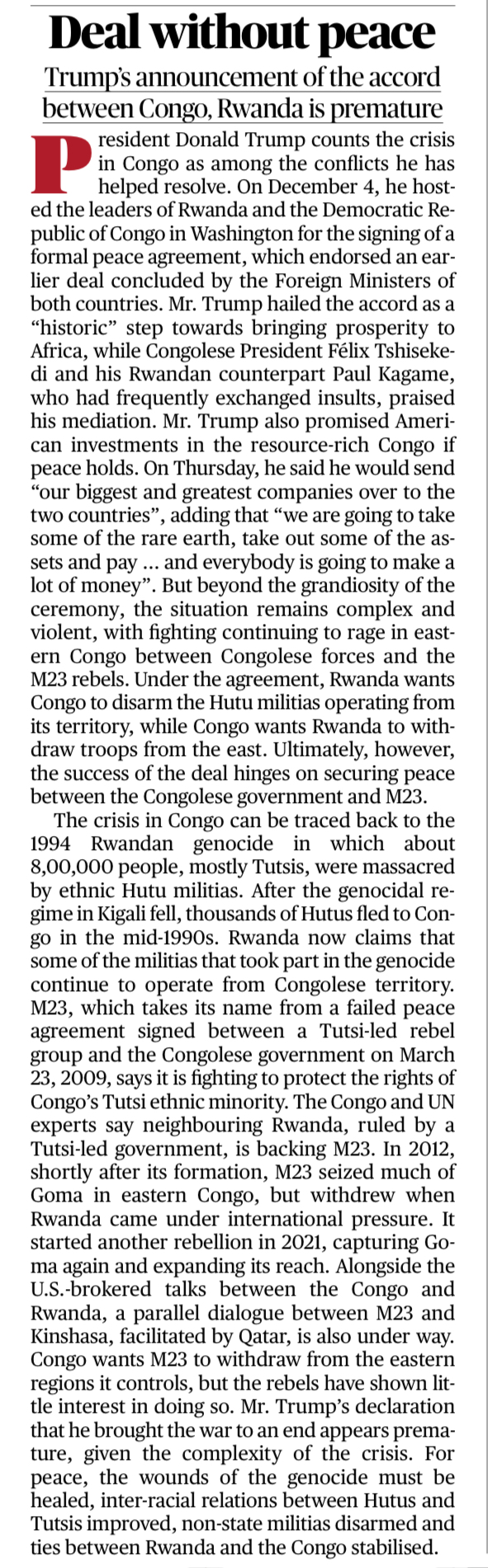
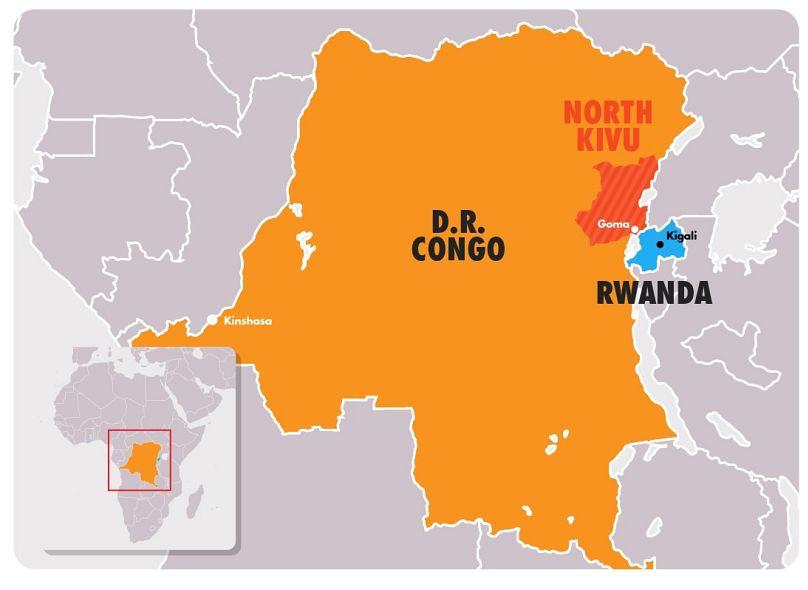
Deal without peace (Congo–Rwanda conflict)

Context

• U.S. announced a peace accord between Rwanda & Congo.
• But core conflict involving M23 rebel group remains unresolved.

Why Is the Announcement Premature?

  1. Fighting Continues — Violence ongoing.
  2. Ethnic Tensions Persist — Tutsi–Hutu tensions since 1994 genocide.
  3. Rebels Not Included — M23 not part of deal.
  4. Past Failures — Similar agreements collapsed earlier.
Screenshot 2025 12 06 at 05.17.21
WhatsApp Image 2025 12 06 at 12.07.22 PM

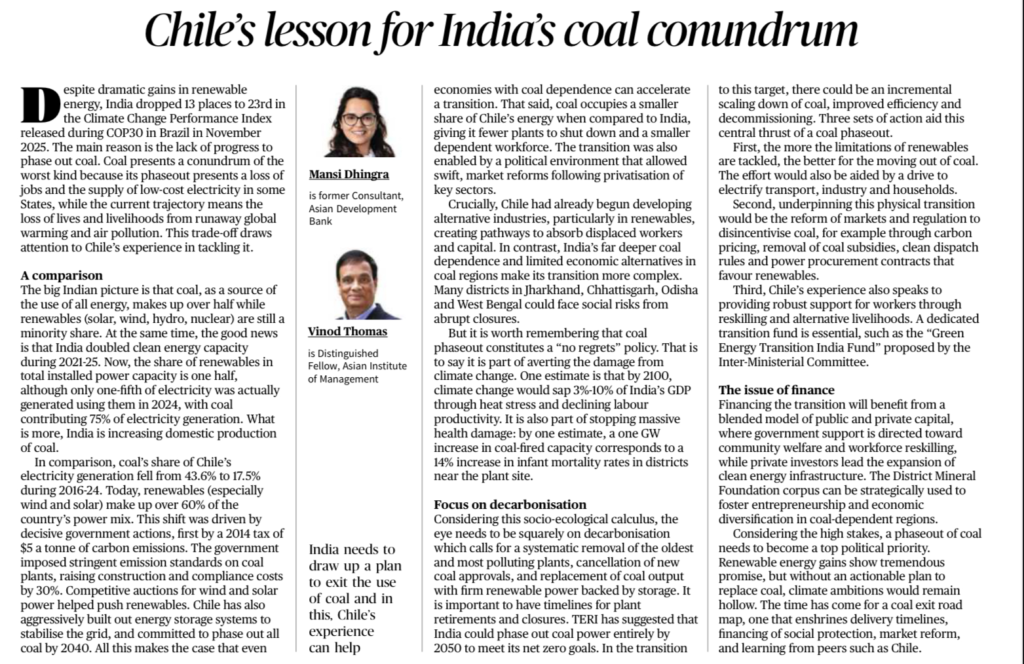
Chile’s lesson for India’s coal conundrum

Context

• India dropped 13 places to Rank 23 in CCPI 2025 (Climate Change Performance Index).
• Rank fell due to slow coal phase-down.

Summary

1. India’s Core Challenge: Coal Dependence

• Renewables rising, but coal = ¾ of electricity generation.
• Imbalance hurts climate performance.

2. Chile’s Transition Lessons

• Chile cut coal share 43.6% → 17.5% (2016–24).
• Tools used: carbon pricing, emission norms, renewable auctions, early grid planning.
• Target: phase out coal by 2040.

3. India’s Transition Harder

• Coal-dependent regions (Jharkhand, Chhattisgarh, Odisha, WB).
• Abrupt cuts cause socio-economic distress.

4. Benefits of Coal Exit

• Reduced climate risks (3–10% projected GDP loss by 2100).
• Cuts air pollution deaths.
• Improves energy security.

5. What India Must Do

• Time-bound coal exit roadmap.
• Retire old plants, stop new coal approvals.
• Expand renewables + storage.
• Reform pricing & subsidies.

6. Financing + Just Transition

• Blended finance model + “Green Energy Transition India Fund”.
• Reskilling + economic diversification of coal regions.

Screenshot 2025 12 06 at 05.18.56

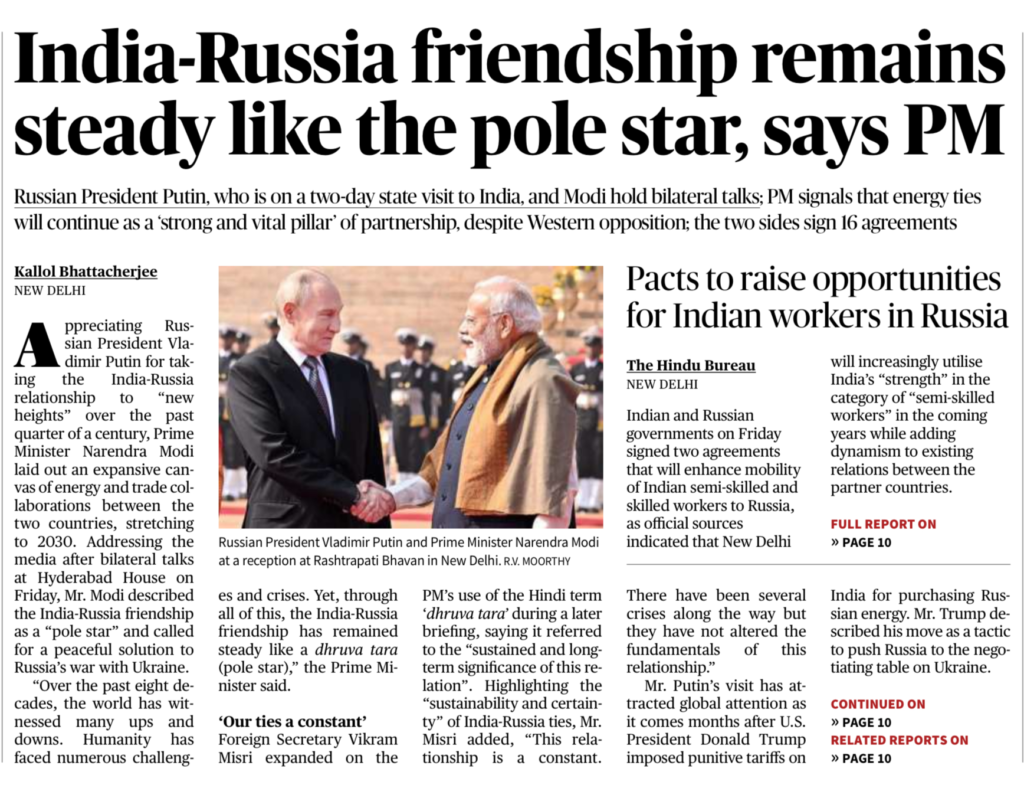
India Russia Defence Ties

1. Context

• 23rd Annual Summit held in New Delhi to reinforce a time-tested partnership amid the Ukraine war and global geopolitical pressure.

2. Strategic Stability

• PM calls the relationship “steady like the pole star,” signalling reliability, continuity, and strategic autonomy.

3. Labour Mobility

• Agreements to send Indian semi-skilled/skilled workers to Russia (demand ~5 lakh).
• Framework to ensure welfare and prevent irregular migration.

4. People-to-People

• 30-day e-tourist visa + group tourist visa for Russians.
• Strengthens tourism and social linkages.

5. Arctic Cooperation

• Pact to enhance consultations on Arctic issues—research, shipping routes, scientific exploration.

6. Nuclear Energy

• Russia delivers advanced fuel for Kudankulam Unit-3; reaffirmed cooperation on nuclear safety and reactor supply chain.

7. Energy Security

• India reiterates continuation of Russian crude imports and long-term energy ties despite Western pressures.

Additional Outcomes 

1. National Currency Trade

• Push for rupee–ruble settlement to bypass sanctions hurdles and reduce dollar dependence.
• Trade target reaffirmed: $100 billion by 2030.

2. Trade Balance

• India raises concern over widening deficit; both sides agree to remove logistics and market barriers.

3. Media & Academic

• MoUs in media, cultural exchange, academic collaboration.
• Launch of India edition of Russia Today (RT) magazine.

4. Defence Cooperation

• Continuity in long-term defence partnership — maintenance, spare parts, ongoing joint platforms.

5. Overall Outcome

• Partnership diversifies into labour mobility, energy, nuclear, Arctic, cultural, and financial sectors — strengthening a multidimensional relationship.

Why India–Russia Ties Matter 

• Historical trust + steady partnership (“Pole Star” analogy).
• Russia supports India in defence, nuclear, and energy sectors.
• Labour mobility → new cooperation dimension.
• Rupee–ruble trade → strategic autonomy.
• Arctic cooperation → future geo-economic relevance.
• Helps India maintain space between US and Russia rivalries.

Challenges

• Payment issues due to sanctions
• Over-dependence on Russian defence systems
• Balancing US partnership with Russia ties
• Ukraine war complicates diplomacy

TDF

“In light of the recent India–Russia summit, critically examine how the bilateral partnership is expanding beyond a traditional defence focus into broader strategic, economic, and people-centric domains.”

Screenshot 2025 12 06 at 06.59.12

Copyright © 2026 USARAMBHA EDUCATION (UnderStand UPSC). All Rights Reserved.

Offline Meetup

Reserve Your Meetup Seat