Removal of Lok Sabha Speaker: Constitutional Provisions and Process Explained for UPSC
Context:
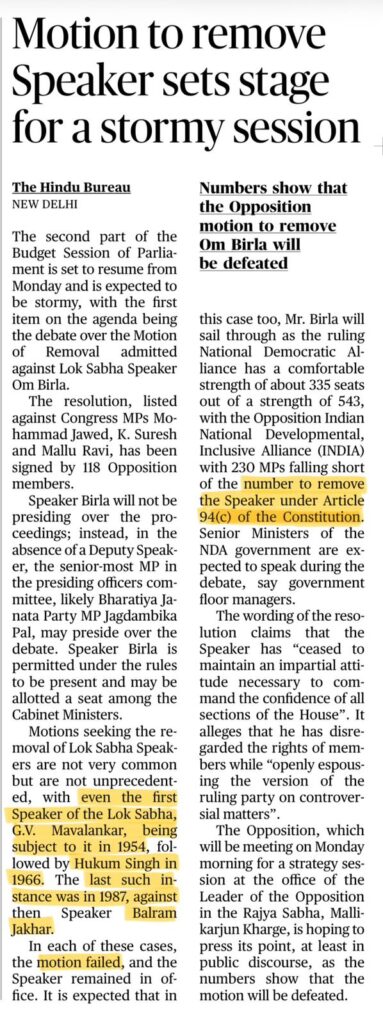
The Opposition moved a resolution to remove Lok Sabha Speaker Om Birla, leading to a major debate in the Budget Session.
1. Constitutional Provisions on Speaker
Article 93 — Election
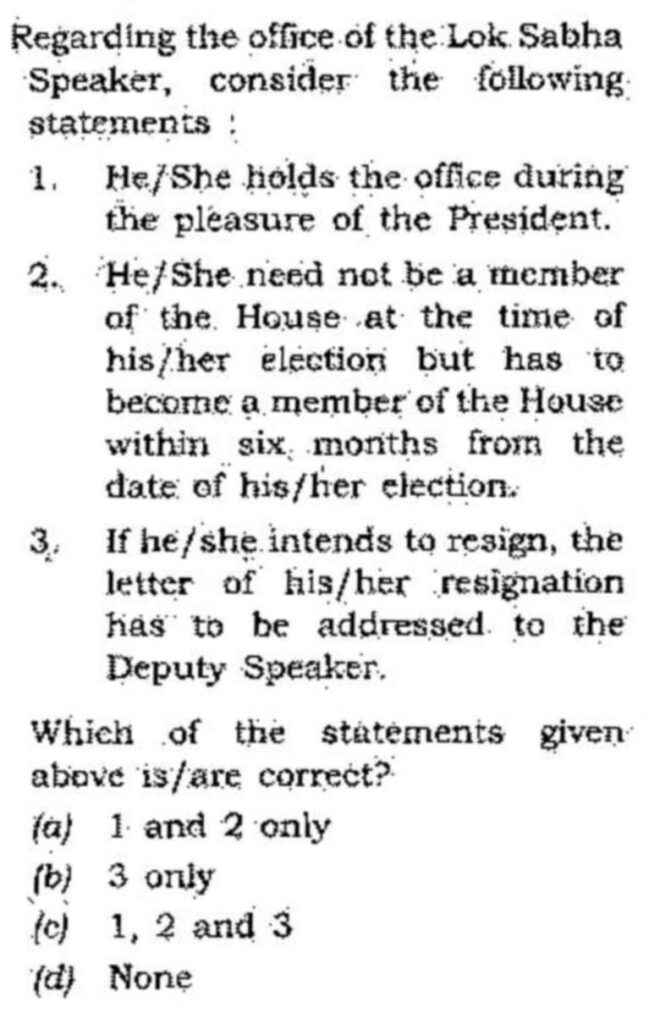
• Lok Sabha elects Speaker and Deputy Speaker from among its members.
Article 94 — Tenure & Removal
• Speaker vacates office if:
– Ceases to be MP
– Resigns (to Deputy Speaker)
– Removed by Lok Sabha (Art. 94(c)).
Article 95 — Acting Presiding Officer
• Deputy Speaker or another member presides if office vacant or Speaker absent.
Article 96 — During Removal Motion
• Speaker does not preside; may participate and vote as a member.
2. Who Admits the Removal Motion
• Motion must be given with 14 days’ notice under Lok Sabha Rules.
• It is admitted by the Secretary-General of Lok Sabha (as per Rules of Procedure) after verifying notice requirements.
• Debate presided over by Deputy Speaker or senior-most member.
• Passage requires majority of all the then members of Lok Sabha (Art. 94(c)).
3. Present Numbers
• Motion signed by 118 Opposition Members of Parliament (MPs).
• Ruling alliance (~335/543) indicates defeat likely.
4. Motions earlier moved against
– G.V. Mavalankar (1954)
– Hukam Singh (1966)
– Balram Jakhar (1987)
• All failed; Speakers continued.