
Context: School Management Committee Guidelines 2026
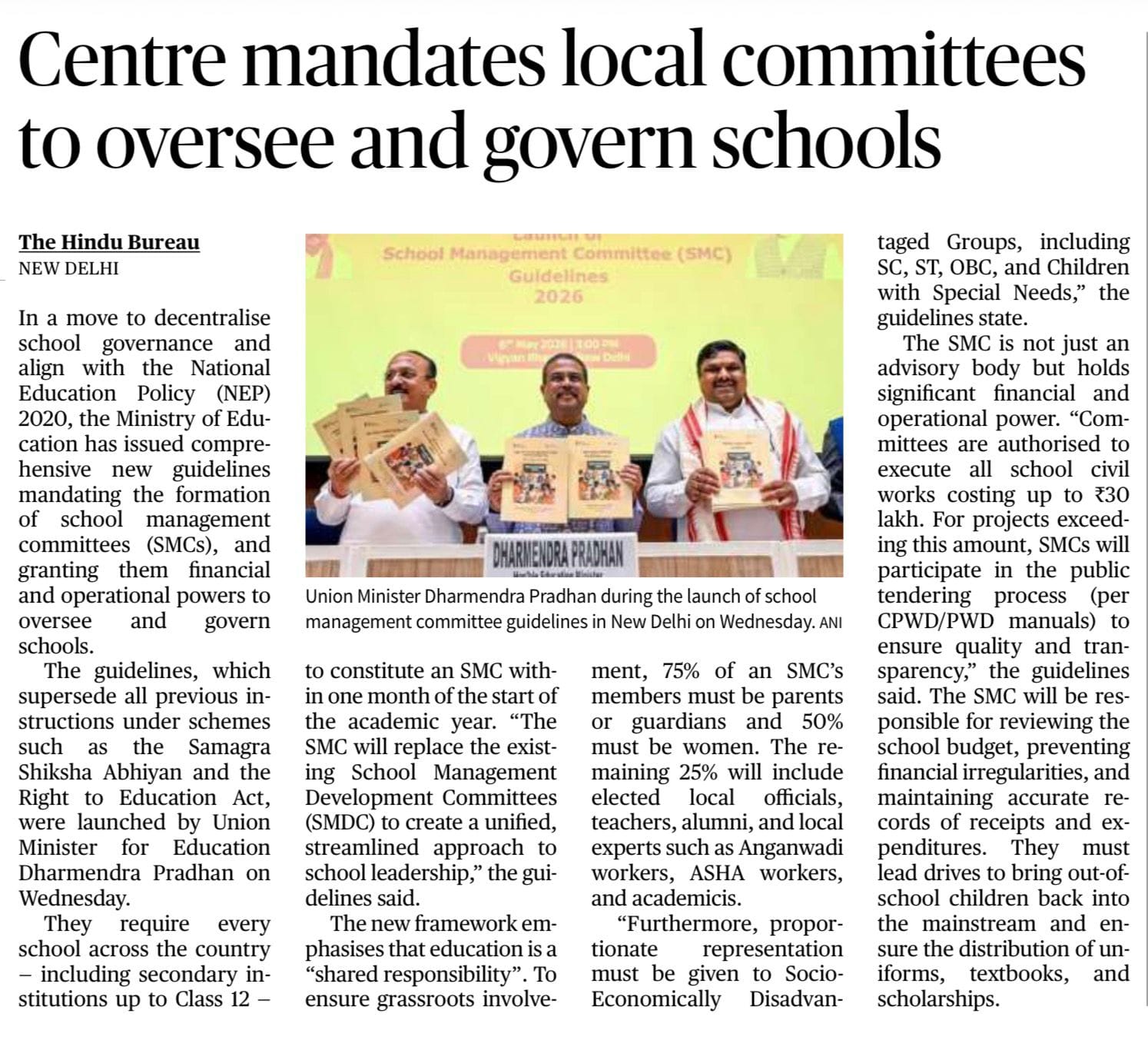
The Ministry of Education released the School Management Committee (SMC) Guidelines, 2026 to decentralise school governance in line with NEP 2020 and give local committees financial and operational powers over schools.
What are School Management Committees (SMCs)?
Community-based school governance bodies under:
- Right to Education (RTE) Act, 2009
- Samagra Shiksha
Aim
Improve local participation, accountability and monitoring of schools
Key Features of New Guidelines
- Mandatory SMCs in schools up to Class 12
- SMCs replace School Management Development Committees (SMDCs)
- 75% members must be parents/guardians
- 50% representation for women
- Representation for SC, ST, OBC & Children with Special Needs
- SMCs can execute school civil works up to ₹30 lakh
Issues Faced by Schools
- Teacher shortages — over 10 lakh teacher posts vacant across school education sector — UDISE+/Parliament data
- Poor infrastructure — ~11% schools without electricity; ~30% without internet — UDISE+ 2023-24
- High dropout rates — Secondary dropout rate ~14%; higher among girls in some States — UDISE+ 2023-24
- Learning gaps — ASER 2024: many Class V students unable to read Class II-level text
- Digital divide — computer availability limited in many rural government schools — UDISE+
Importance
- Strengthens decentralised school governance
- Enhances transparency and local accountability
- Increases parent/community participation
- Improves implementation of NEP 2020
- Helps monitor utilisation of school funds







