28 & 29 June 2026 | Daily Current Affairs

Asiatic Elephant Conservation and Forest Carbon Gains

Context: Asiatic Elephant Conservation
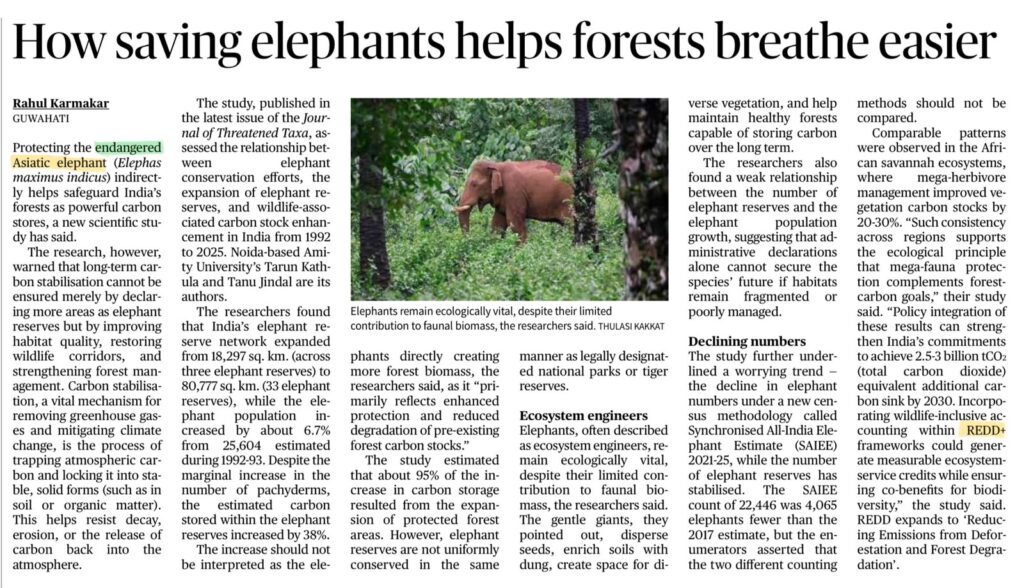
A recent study shows that conserving the Endangered Asiatic Elephant strengthens forest carbon sinks, biodiversity and India’s climate commitments.

Asiatic Elephant

Scientific Name

  • Elephas maximus indicus

Conservation Status

IUCN

  • Endangered

CITES

  • Appendix I

Wildlife Protection Act, 1972

  • Schedule I

Distribution

Found in:

  • India
  • Nepal
  • Bhutan
  • Bangladesh
  • Myanmar

India’s Share

India supports around 60% of the global wild population.

Key Facts

  • Largest Asian land mammal.
  • Herbivore.
  • Gestation period: 20–22 months.
  • Keystone species.
  • Ecosystem engineer.

Ecological Role

Elephants support forests through:

  • Seed dispersal
  • Soil enrichment
  • Forest regeneration
  • Carbon sequestration
  • Maintenance of wildlife corridors

Key Findings

  • Elephant reserves expanded from 18,297 sq km in 1992 to 80,777 sq km in 2025.
  • Elephant population increased by 6.7%.
  • Forest carbon storage increased by 38%.
  • 95% of carbon gains came from better habitat protection, not merely increasing elephant numbers.
  • Habitat quality and wildlife corridors are more important than expanding reserves alone.

REDD and REDD+

REDD

Reducing Emissions from Deforestation and Forest Degradation

  • Proposed at COP-11, Montreal, 2005 under UNFCCC.

REDD+

Adopted at COP-13, Bali, 2007.

It expands REDD by adding:

  • Forest conservation
  • Sustainable forest management
  • Enhancement of forest carbon stocks

PYQ Link

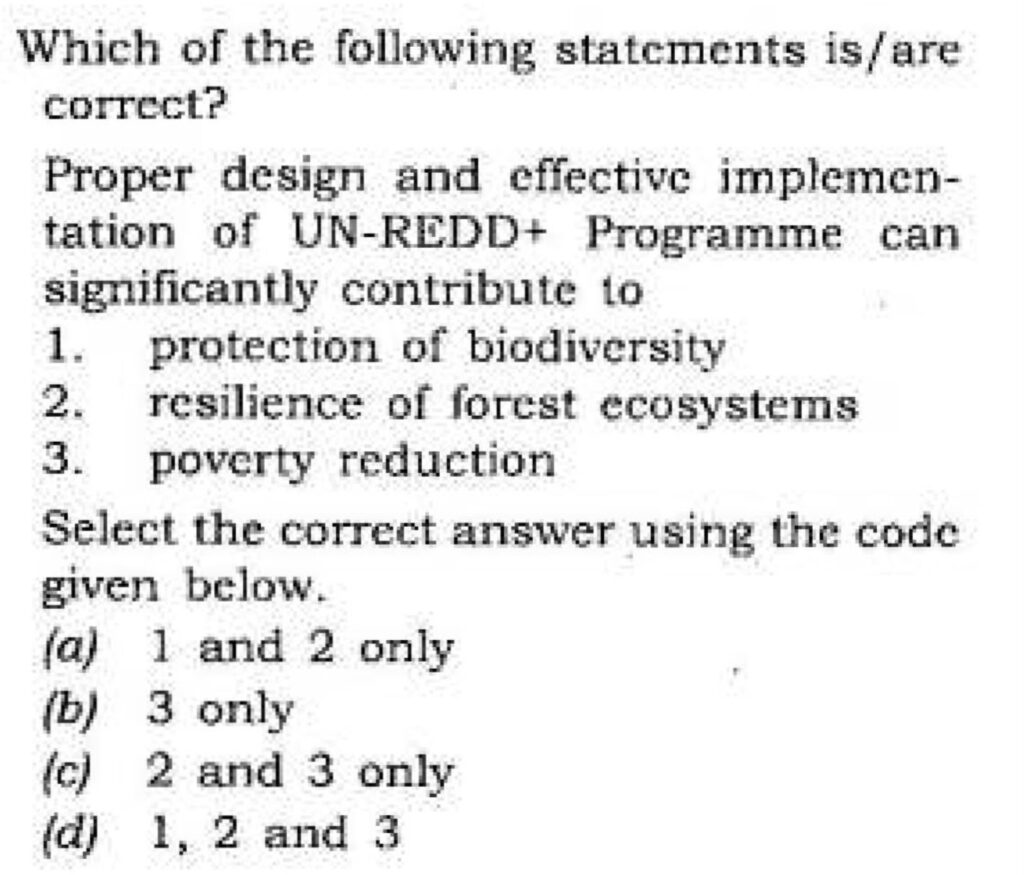
Proper design and implementation of the UN-REDD+ Programme can contribute to:

  • Protection of biodiversity
  • Resilience of forest ecosystems
  • Poverty reduction

Significance

  • Elephant conservation supports biodiversity.
  • Protects forest carbon sinks.
  • Strengthens India’s climate commitments.
  • Helps forest regeneration.
  • Supports local livelihoods through ecosystem conservation.
  • Shows that wildlife protection and climate action can work together.
Asiatic Elephant Conservation

India Seychelles Relations 2026: Key Visit Outcomes

Context: India Seychelles Relations 2026
During his State Visit to Seychelles, the Prime Minister was conferred the “Guardian of the Blue Horizon” Presidential Distinction by President Dr. Patrick Herminie.

The honour recognised his contribution to:

  • Blue Economy
  • Climate action
  • Sustainable ocean governance
  • Interests of Small Island Developing States

It was the first conferment of this honour.

Seychelles: Basic Profile

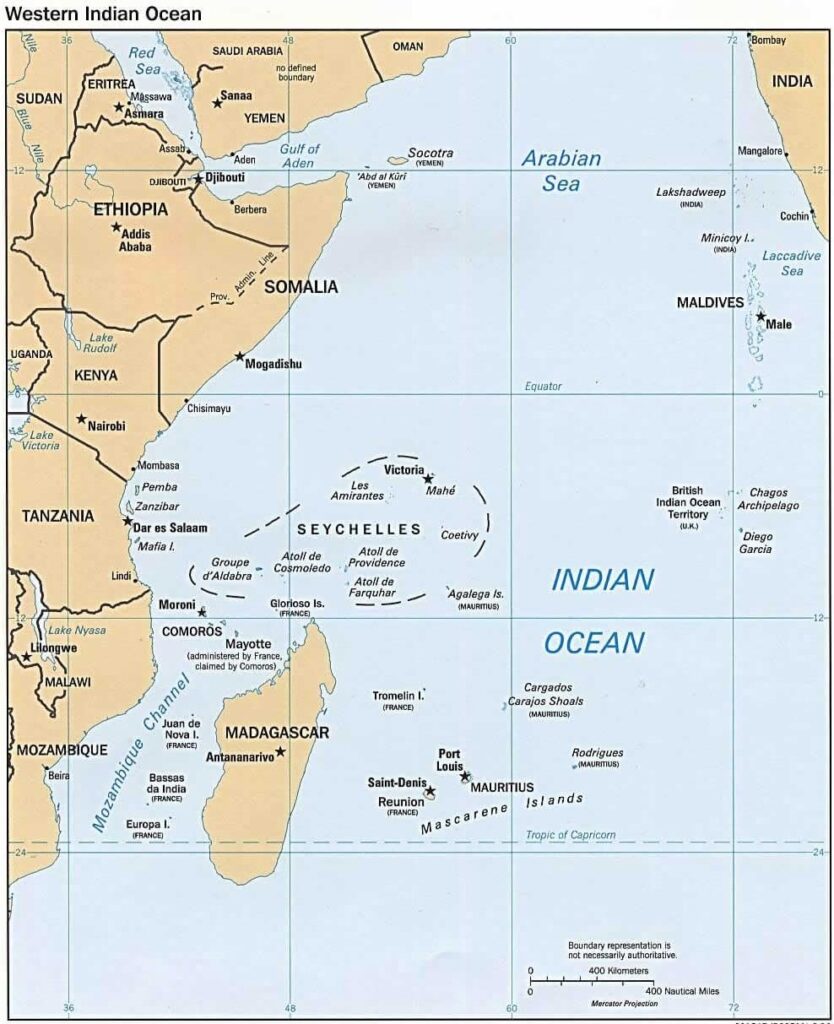
  • Island nation in the Western Indian Ocean.
  • Located off the east coast of Africa.
  • Member of the African Union.
  • Member of the Indian Ocean Commission.
  • Comprises 115 islands.
  • 43 granitic Inner Islands.
  • 72 coralline Outer Islands.

Capital

  • Victoria

Largest Island

  • Mahé

Other Major Islands

  • Praslin
  • La Digue

Independence

  • Former British colony.
  • Became independent in 1976.

India–Seychelles Relations

Strategic Importance

Seychelles is located near key Sea Lines of Communication.

It is a vital maritime partner under India’s MAHASAGAR vision in the Indian Ocean Region.

MAHASAGAR

Mutual and Holistic Advancement for Security and Growth Across Regions

Milestone

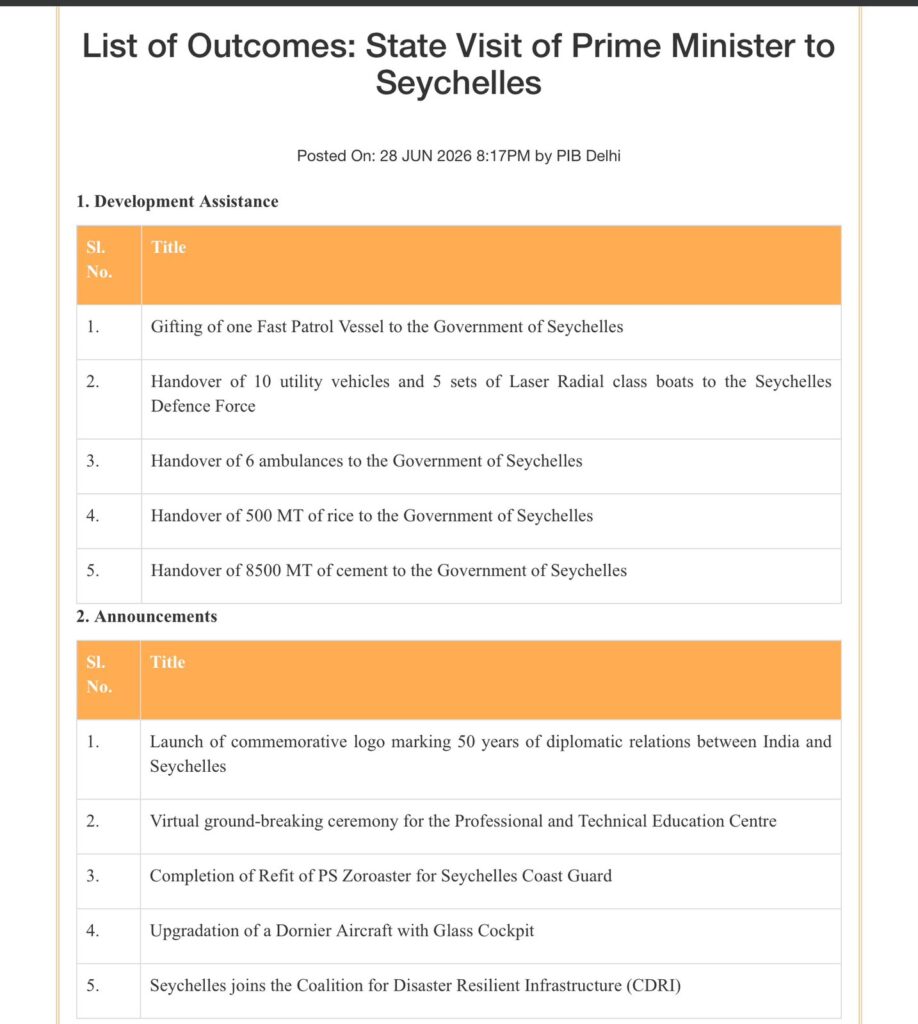
  • 2026 marks 50 years of diplomatic relations.

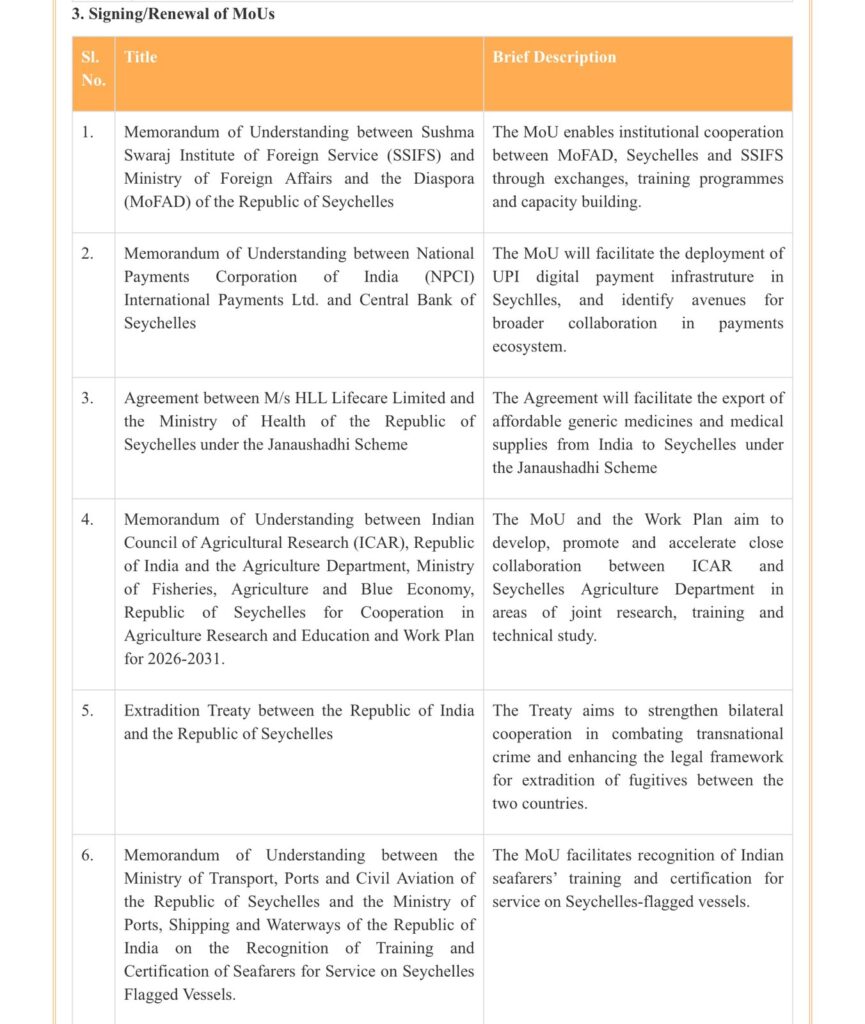
Key MoUs and Outcomes

1. NPCI International

  • Deployment of Unified Payments Interface.

2. Indian Council of Agricultural Research

  • Agriculture and Blue Economy cooperation.

3. Health

  • Pradhan Mantri Bhartiya Janaushadhi Pariyojana medicines.

4. Space

  • Satellite applications and capacity building.

5. Extradition Treaty

  • Cooperation in legal and criminal matters.

6. Seafarer Certification

  • Recognition of Indian seafarers’ training and certification.

7. EXIM Bank

  • Line of Credit.
  • National Hospital support.
  • Diplomatic training.

Challenges

  • Growing Chinese presence in the Indian Ocean Region.
  • Piracy.
  • Illegal, Unreported and Unregulated fishing.
  • Maritime crime.
  • Climate vulnerability of Small Island Developing States.
  • Limited trade, investment and connectivity.

Way Forward

  • Deepen maritime security.
  • Improve Maritime Domain Awareness.
  • Expand Digital Public Infrastructure through UPI and fintech.
  • Strengthen Blue Economy cooperation.
  • Enhance climate resilience.
  • Improve disaster cooperation.
  • Strengthen trade, tourism, healthcare and capacity building.

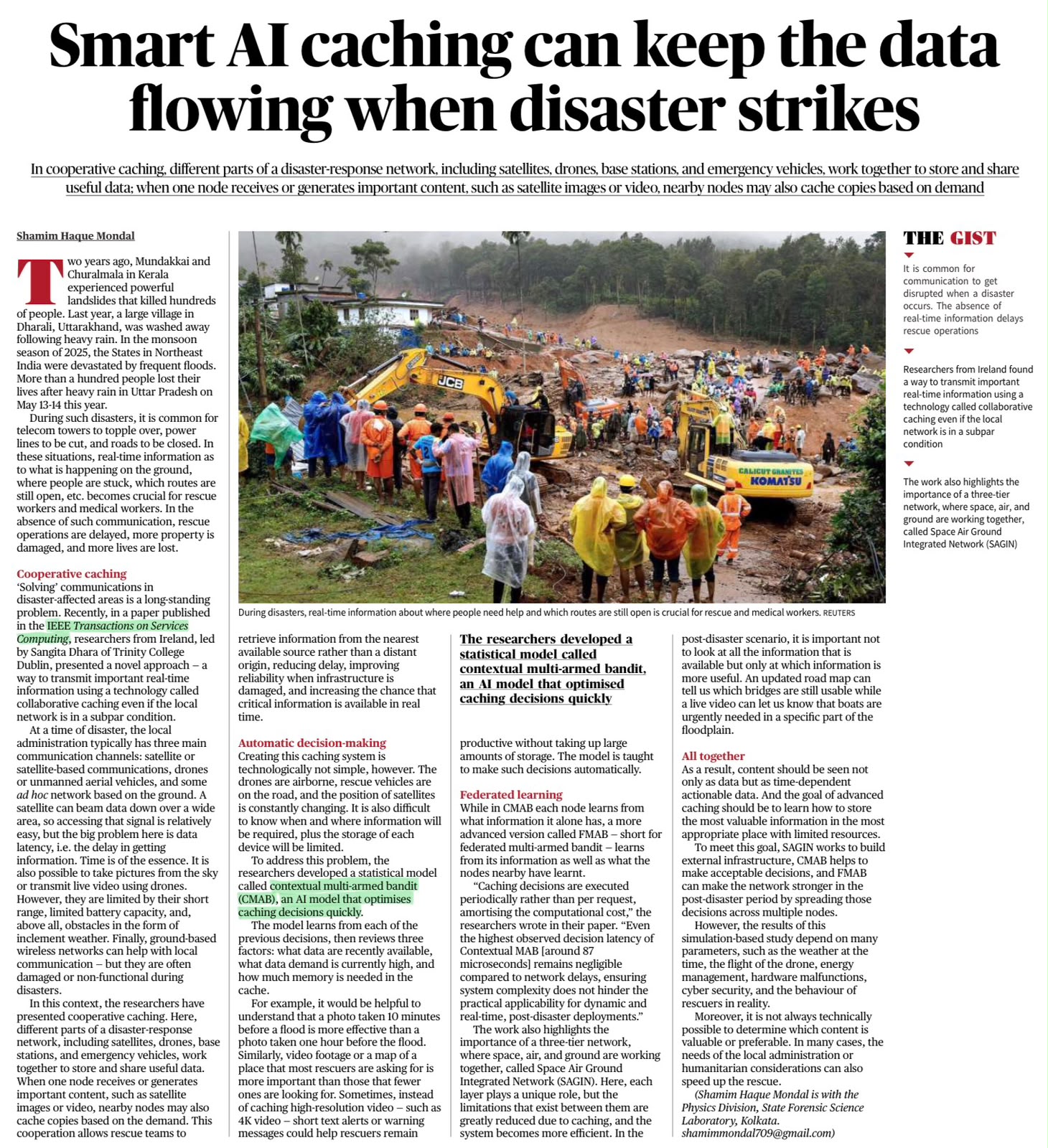
AI Cooperative Caching System for Disaster Communication

Context: AI Cooperative Caching System
Researchers have developed an Artificial Intelligence-enabled Cooperative Caching system to maintain real-time communication during disasters.

Communication Challenges During Disasters

Space Networks

  • Satellites face high latency and limited bandwidth.

Air Networks

  • Drones have short battery life.
  • Drones have limited range and payload.

Ground Networks

Often affected due to damage to:

  • Telecom towers
  • Fibre cables
  • Power supply

Impact

Disaster response suffers due to:

  • Delayed rescue
  • Poor coordination
  • Lack of real-time situational awareness
  • Communication breakdown

AI-Enabled Cooperative Caching

Meaning

Instead of repeatedly downloading data from distant servers, different network nodes locally store and share critical information.

These nodes may include:

  • Satellites
  • Drones
  • Base stations
  • Emergency vehicles

Role of AI

AI decides:

  • What information should be stored
  • Where it should be stored
  • When it should be updated

This decision is based on:

  • Demand
  • Available storage
  • Network conditions

AI Models Used

Contextual Multi-Armed Bandit

  • Selects the most useful data for each location.

Federated Multi-Armed Bandit

  • Enables devices to learn from each other without sending all raw data.

Network Used

Space-Air-Ground Integrated Network

SAGIN integrates:

  • Satellites
  • Drones
  • Terrestrial networks

into one resilient communication system.

Significance

  • Faster access to maps, satellite images and rescue alerts.
  • Maintains communication even if one network fails.
  • Reduces bandwidth use.
  • Reduces communication delay.
  • Improves disaster response.
  • Supports search and rescue.
  • Helps emergency healthcare coordination.

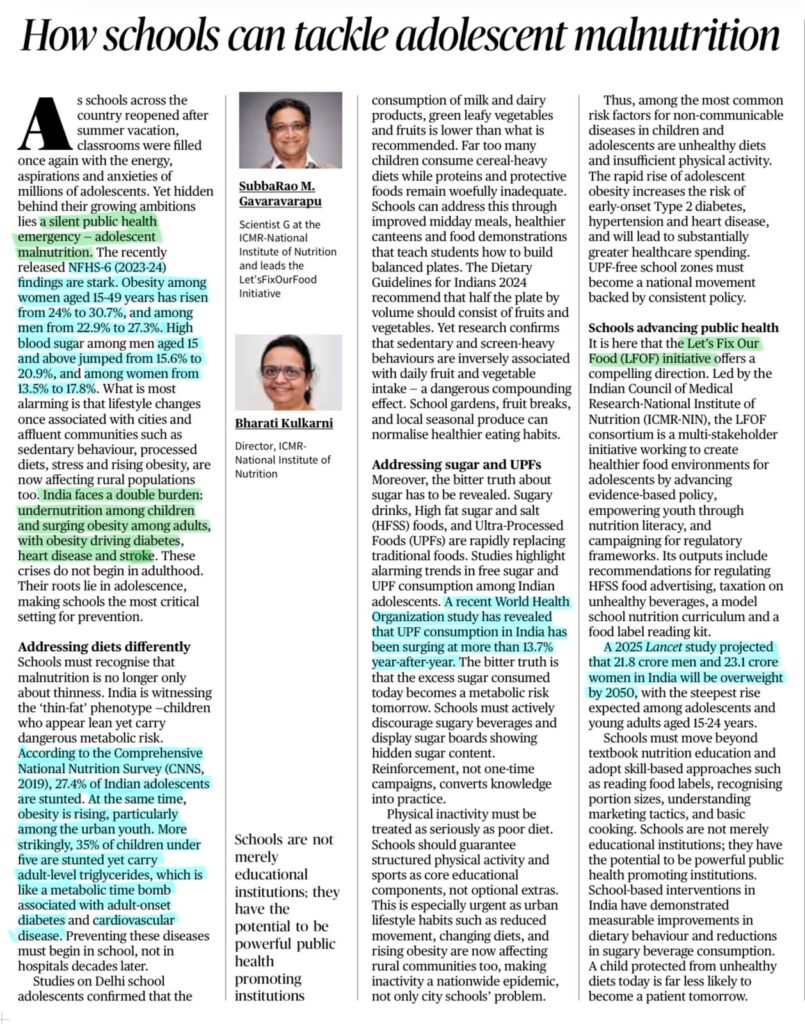
Adolescent Malnutrition in India: Schools’ Role Explained

Context: Adolescent Malnutrition in India
Rising adolescent malnutrition and obesity call for school-based interventions to promote healthy dietary habits and prevent future lifestyle diseases.

Adolescent Malnutrition

Adolescent malnutrition refers to malnutrition among children aged 10–19 years.

It includes:

  • Undernutrition
  • Stunting
  • Anaemia
  • Micronutrient deficiency
  • Overweight
  • Obesity

Double Burden of Malnutrition

India faces both:

  • Undernutrition
  • Rising obesity

This increases the risk of:

  • Type-2 diabetes
  • Hypertension
  • Cardiovascular diseases
  • Poor productivity
  • Long-term health burden

Why Schools Matter

Schools are one of the most effective platforms for:

  • Lifelong nutrition education
  • Healthy food habits
  • Physical activity
  • Early screening
  • Behavioural change
  • Preventive healthcare

Key Data

Comprehensive National Nutrition Survey, 2019

  • 27.4% adolescents are stunted.

NFHS-6, 2023–24

Obesity

  • Women: 24% → 30.7%
  • Men: 22.9% → 27.3%

High Blood Sugar

  • Women: 13.5% → 17.8%
  • Men: 15.6% → 20.9%

WHO

  • Ultra-Processed Food consumption in India is increasing by more than 13.7% annually.

Lancet, 2025 Projection

By 2050:

  • 23.1 crore women projected to be overweight.
  • 21.8 crore men projected to be overweight.

Way Forward

1. Nutrition Education

Integrate nutrition education into the school curriculum.

2. Healthy School Meals

Ensure healthy meals in schools and improve dietary diversity.

3. Restrict HFSS and UPF Foods

Restrict:

  • High Fat, Sugar and Salt foods
  • Ultra-Processed Foods

in and around schools.

4. Physical Activity

Promote daily physical activity, sports and fitness routines.

5. Screening and Counselling

Regularly conduct:

  • BMI checks
  • Nutrition screening
  • Counselling
  • Parental awareness sessions

UPSC Mains Question

“The double burden of adolescent malnutrition threatens India’s demographic dividend. Discuss the role of schools in promoting nutrition, healthy lifestyles and preventive healthcare.”
10 marks, 150 words

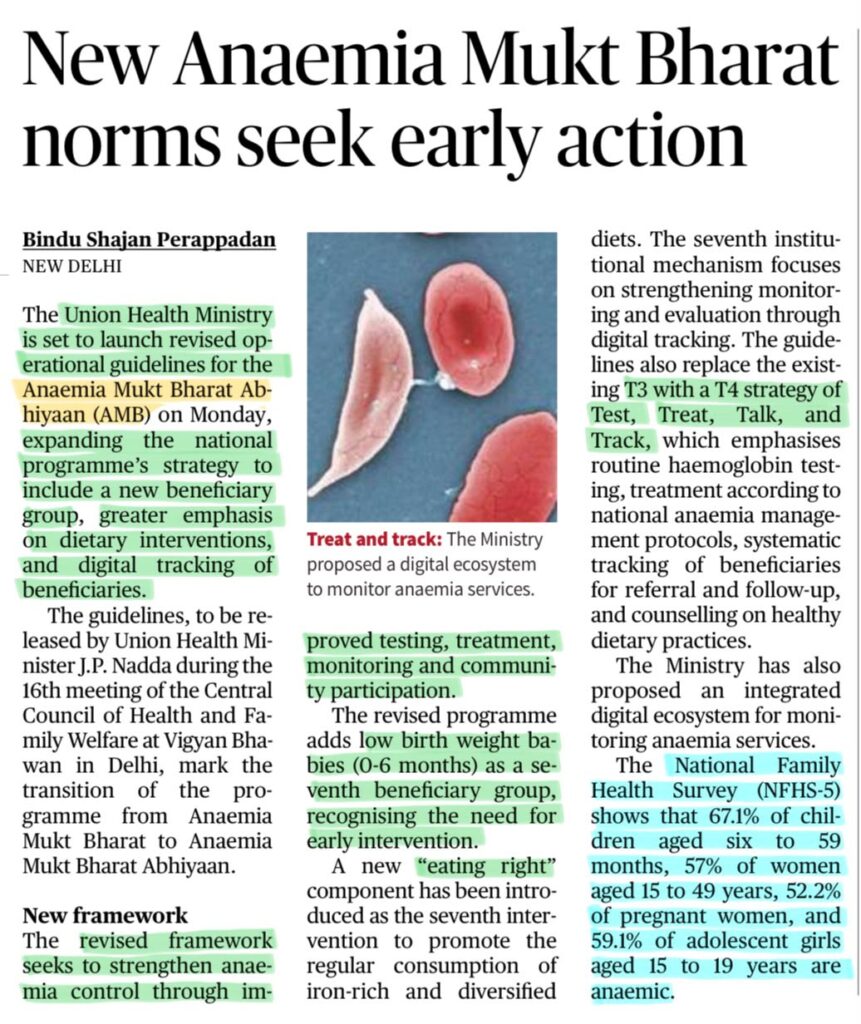
Anaemia Mukt Bharat Guidelines: New T4 Strategy Explained

Context: Anaemia Mukt Bharat Guidelines
The Union Ministry of Health and Family Welfare revised the Anaemia Mukt Bharat guidelines to strengthen early detection, treatment, nutrition counselling and digital monitoring of anaemia.

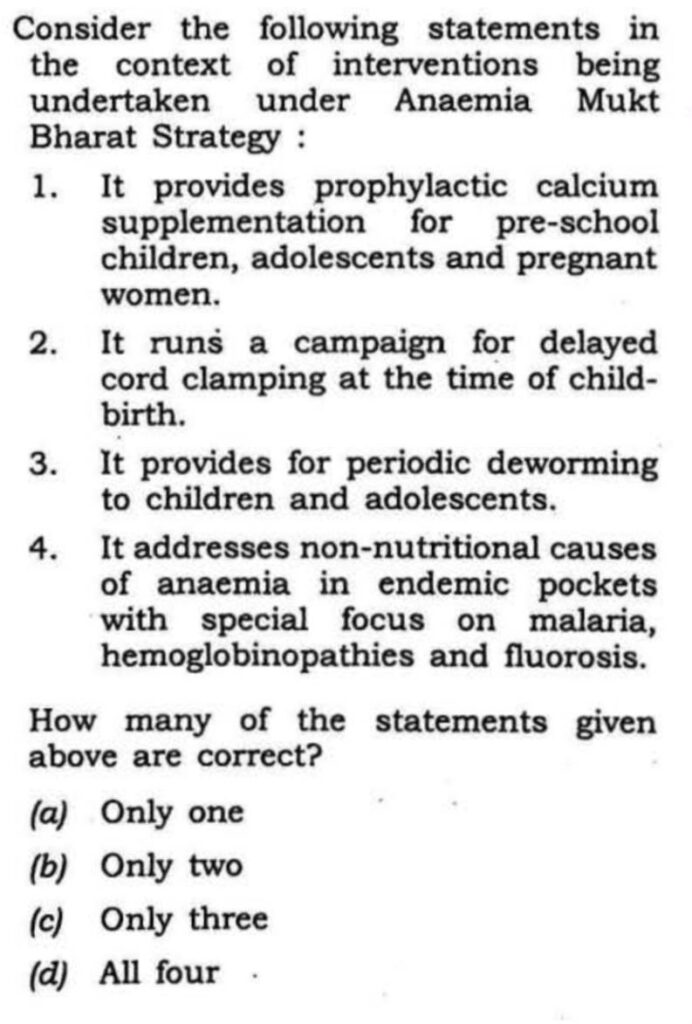
Anaemia Mukt Bharat

Launched

  • 2018

Under

  • POSHAN Abhiyaan

Objective

To reduce anaemia through a life-cycle approach.

Revised Guidelines

New Beneficiary Group

  • Low Birth Weight infants aged 0–6 months.

T3 to T4 Strategy

Earlier strategy was T3.

Now it has been expanded to T4:

Test

  • Haemoglobin screening.

Treat

  • Protocol-based treatment.

Talk

  • Nutrition and dietary counselling.

Track

  • Digital follow-up and beneficiary monitoring.

Additional Focus

  • Iron-rich diversified diets.
  • Early intervention.
  • Digital beneficiary tracking.
  • Community-based counselling.
  • Routine haemoglobin testing.

NFHS-5: Life-cycle Burden of Anaemia

Children aged 6–59 months

  • 67.1%

Adolescent Girls aged 15–19 years

  • 59.1%

Women aged 15–49 years

  • 57.0%

Pregnant Women

  • 52.2%

Significance

  • Promotes preventive healthcare.
  • Targets anaemia early in life.
  • Strengthens maternal and child health.
  • Supports nutrition security.
  • Improves tracking and accountability through digital systems.

Defence Indigenisation in India: Key June 2026 Milestones

Context: Defence Indigenisation in India
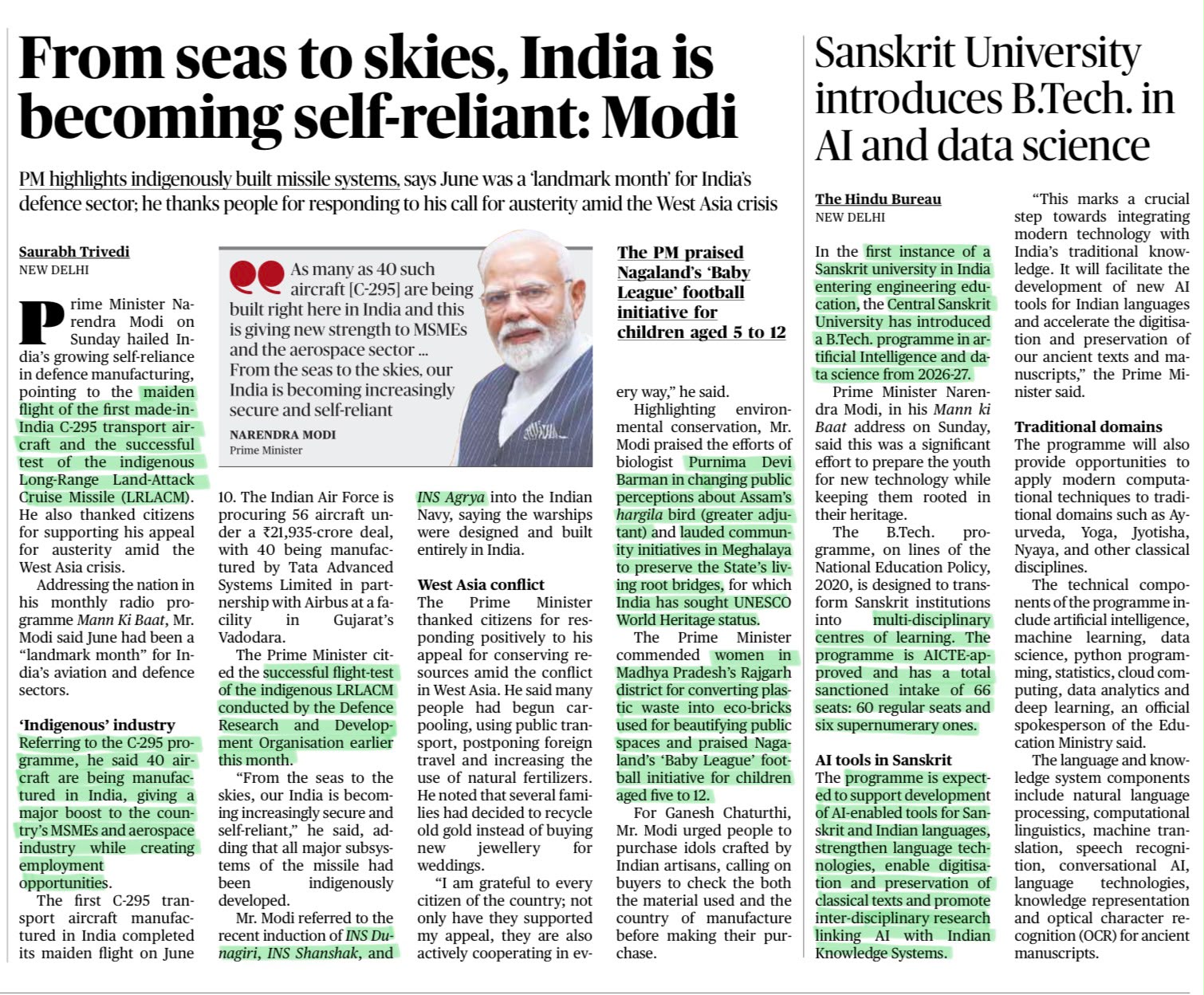
Prime Minister Narendra Modi highlighted June 2026 as a landmark month for defence indigenisation, community-led conservation, children’s sports and the integration of Sanskrit with Artificial Intelligence.

Defence: GS3

C-295 Aircraft

  • First Made-in-India transport aircraft completed its maiden flight.
  • 40 out of 56 aircraft will be manufactured in India under the Tata-Airbus partnership.

Long-Range Land Attack Cruise Missile

  • DRDO successfully flight-tested the indigenous Long-Range Land Attack Cruise Missile.
  • It strengthens India’s indigenous missile capability.

Indian Navy Inductions

The Indian Navy inducted:

Significance

  • Strengthens Aatmanirbhar Bharat in defence.
  • Reduces dependence on imports.
  • Improves indigenous manufacturing capability.
  • Supports private-sector participation in defence production.
  • Enhances India’s military preparedness across land, sea and air.

Environment: GS3

Purnima Devi Barman and Hargila Army

  • Purnima Devi Barman led the Hargila Army.
  • The movement changed public perception of the Greater Adjutant Stork through women-led conservation.

Meghalaya Living Root Bridges

  • Community-led conservation of Living Root Bridges was highlighted.
  • These bridges have been nominated for UNESCO World Heritage status.

Rajgarh, Madhya Pradesh

  • Plastic waste is being converted into eco-bricks.

GS4 Value Addition

Purnima Devi Barman

  • Behavioural change
  • Attitudinal change
  • Community leadership
  • Women-led conservation
  • Environmental ethics

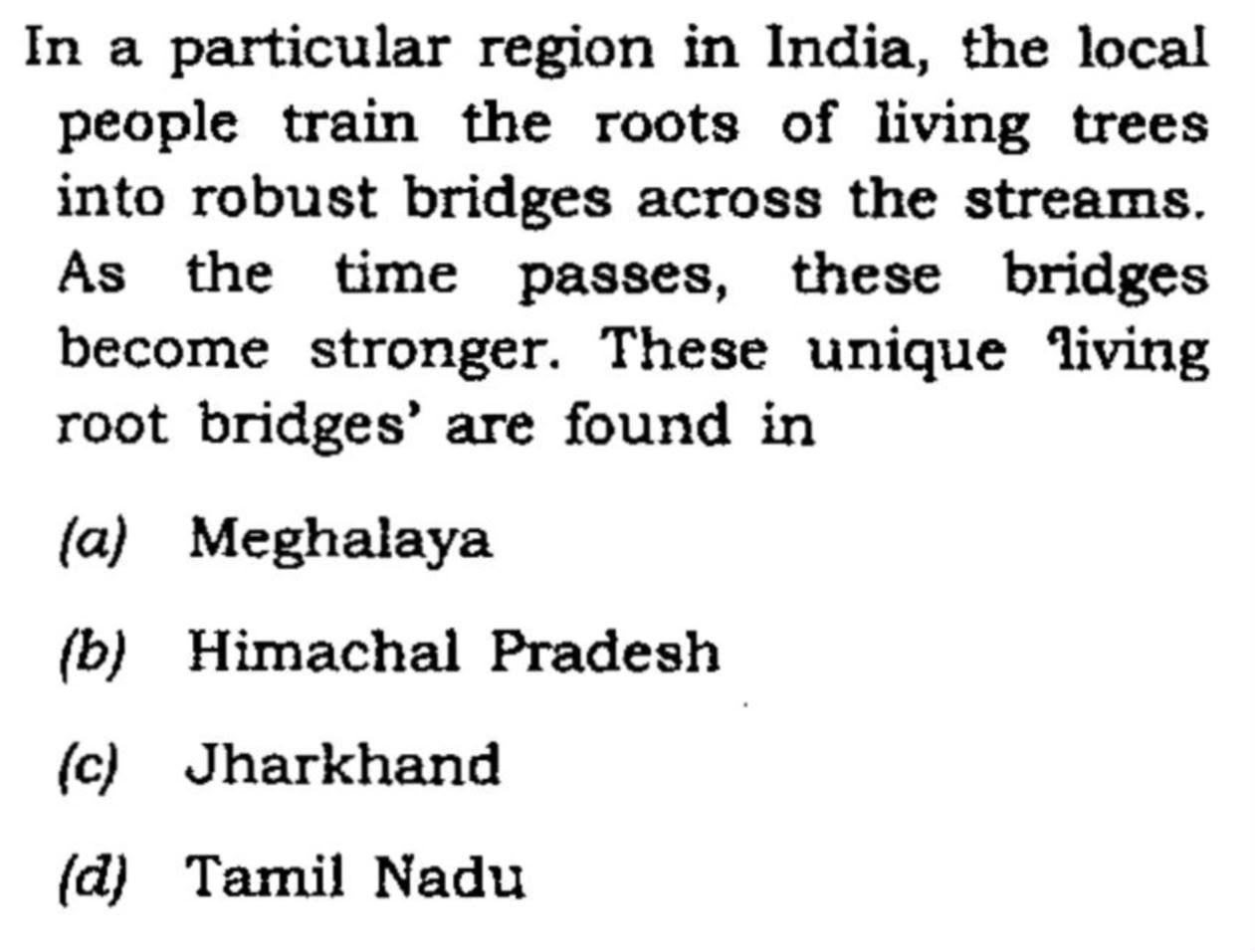
PYQ Link

Living Root Bridges are found in Meghalaya.


Children: GS2

Nagaland’s Baby League

  • Football programme for children aged 5–12 years.
  • Promotes fitness, discipline and grassroots sports talent.

Significance

  • Encourages early sports culture.
  • Builds discipline and teamwork.
  • Supports health and fitness among children.
  • Can contribute to long-term talent identification.

Sanskrit University and AI: GS3

Context

Central Sanskrit University launched India’s first B.Tech. in Artificial Intelligence and Data Science for the 2026–27 session.

Key Features

  • AICTE-approved programme.
  • 66 seats.
  • Integrates:
    • Artificial Intelligence
    • Machine Learning
    • Natural Language Processing
    • Indian Knowledge Systems

Significance

  • Bridges traditional knowledge and modern technology.
  • Supports AI research in Indian languages.
  • Strengthens digital education.
  • Promotes interdisciplinary learning.
About the UPSC Civil Services Examination (UPSC CSE)

The UPSC Civil Services Examination (CSE) is one of the most competitive and esteemed examinations in India, conducted by the Union Public Service Commission to recruit officers for services such as the Indian Administrative Service (IAS), Indian Police Service (IPS), Indian Foreign Service (IFS), and others. The exam comprises three stages — Prelims, Mains, and the Personality Test (Interview) — designed to test a candidate’s knowledge, aptitude, decision-making, and leadership skills.


How to Prepare Effectively for UPSC CSE

Cracking the UPSC CSE requires a deep understanding of the syllabus, consistent revision, structured answer writing, and smart test-taking strategies. The Prelims test analytical and conceptual clarity, the Mains focuses on critical thinking, articulation, and subject mastery, while the Interview assesses presence of mind, ethical judgment, and personality traits relevant to public service.

At UnderStand UPSC, we empower aspirants with a personalized and focused approach to each stage of the exam.


Why Choose UnderStand UPSC?

UnderStand UPSC is a mentorship-driven platform offering a clear, clutter-free strategy to tackle the Civil Services Examination. Our programs like Transform (for beginners and intermediate learners) and Conquer (for advanced mains preparation) provide structured study plans, syllabus-wise video content, interactive live sessions, and answer writing support.

We emphasize:

  • Concept clarity through topic-wise lectures

  • Test series designed around real UPSC standards

  • Personalized mentorship in small groups

  • Regular performance tracking and peer benchmarking

  • Doubt-clearing sessions, current affairs analysis, and monthly magazines


Join the UnderStand UPSC Learning Community

Our mission is to make UPSC preparation less overwhelming and more strategic. We combine mentorship, discipline, and academic rigor to help you clear CSE with confidence. Whether you’re preparing from Delhi, Mumbai, Bangalore, or a remote village — our online-first model ensures quality guidance reaches every corner of India.

Join the thousands of aspirants who trust UnderStand UPSC to guide their journey toward becoming civil servants.

Stay connected with us through our Telegram, YouTube, and Instagram channels for daily tips, strategies, and updates.

Copyright © 2026 USARAMBHA EDUCATION (UnderStand UPSC). All Rights Reserved.

Fill out the form for

Downloading the free Agriculture Short Notes


Fill out the form

If you have any queries related to
GS Foundation 2027/28