Emerging Global Terrorism Threats for UPSC Explained

Context: Emerging Global Terrorism Threats
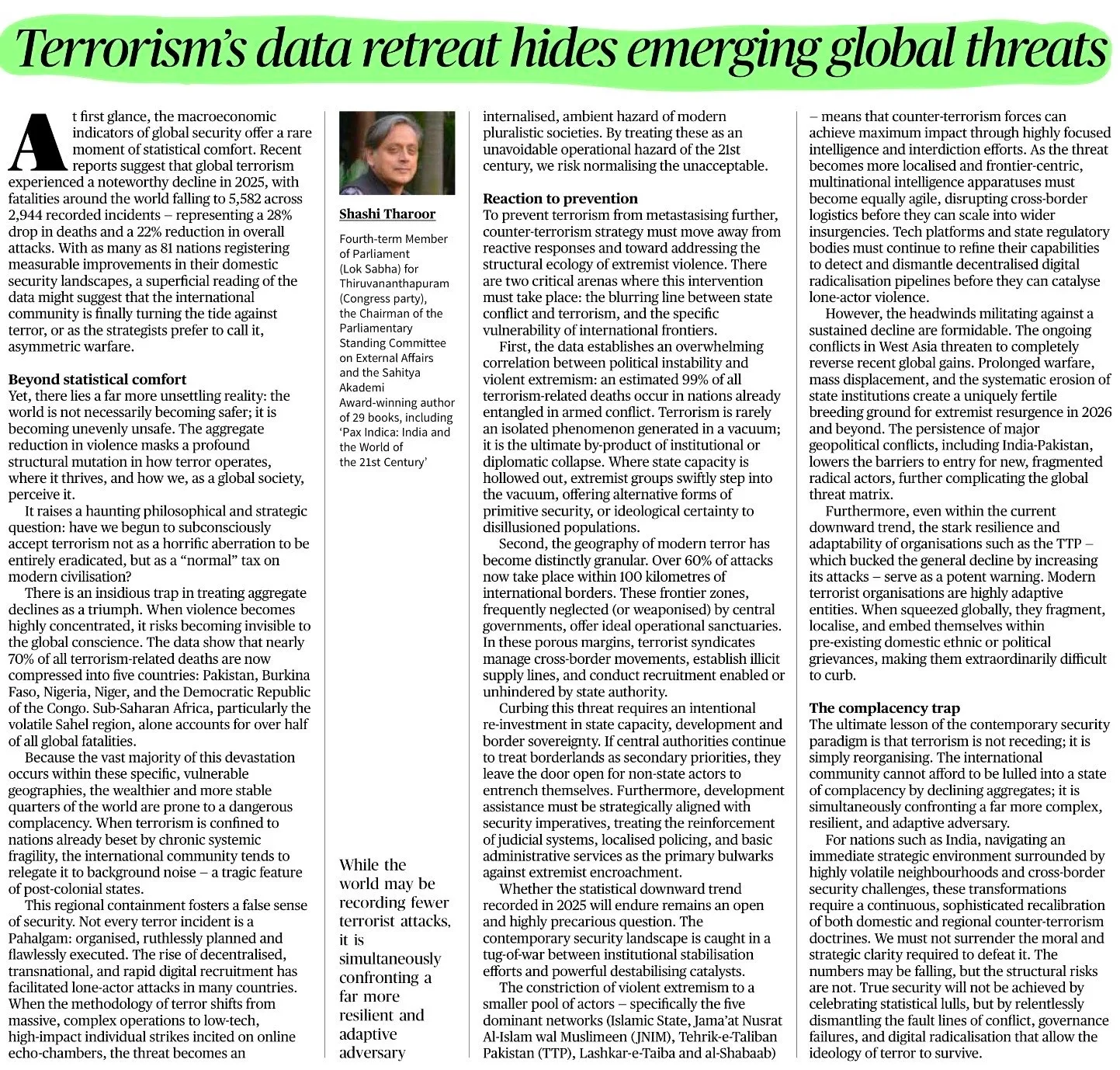
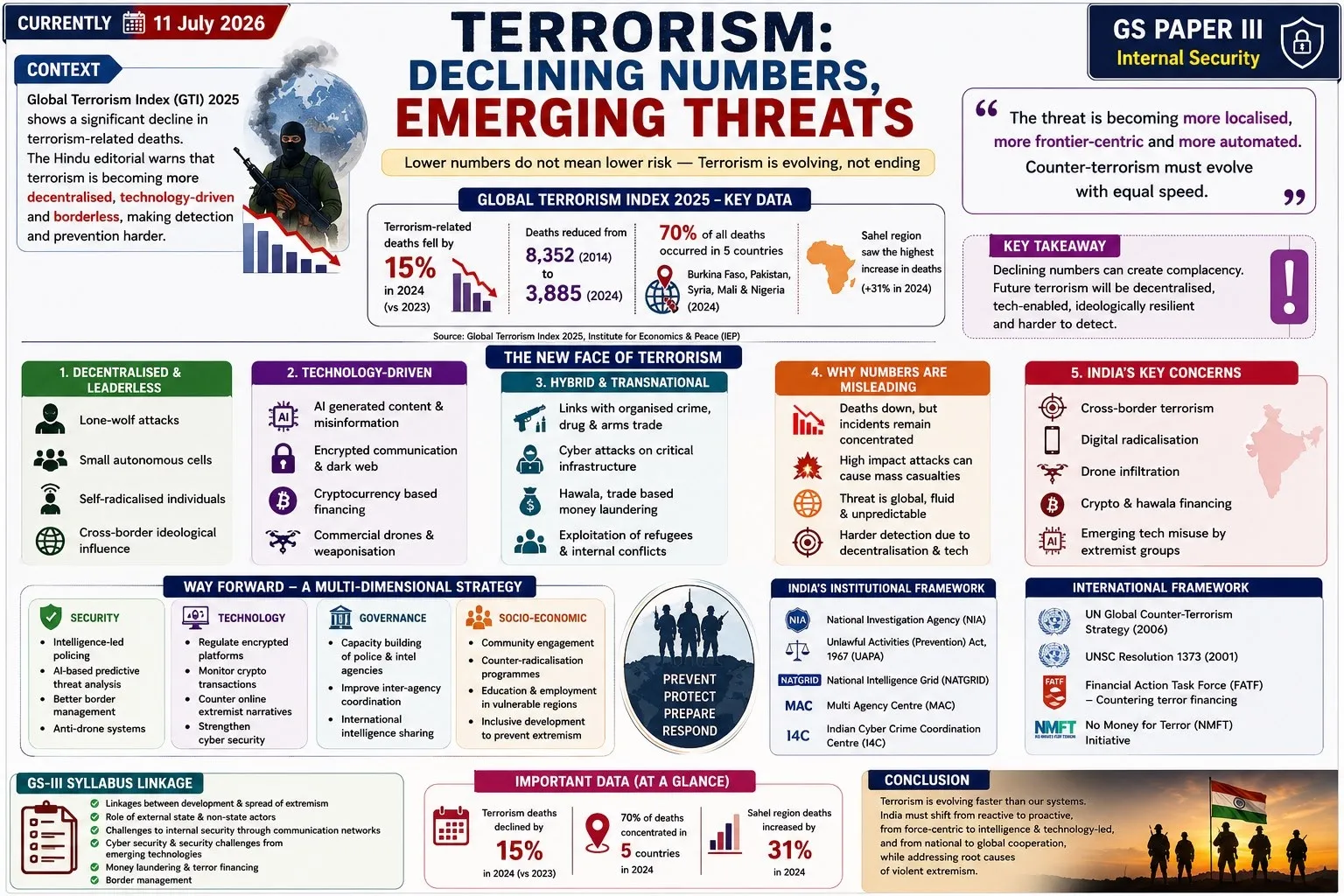
The article argues that although global terrorism-related deaths may be declining in official datasets, emerging threats are becoming harder to detect because terrorism is becoming more decentralised, technology-driven and borderless.

Core Issue

Lower terrorism numbers do not necessarily mean lower risk.

Terrorism is evolving into new forms that are:

  • Decentralised
  • Localised
  • Technology-enabled
  • Harder to track
  • More unpredictable

Emerging Trends in Terrorism

1. Decentralised Terror Networks

Terror groups increasingly rely on:

  • Lone-wolf attackers
  • Small autonomous cells
  • Local radicalisation
  • Online ideological networks

2. Technology-Driven Terrorism

Terrorists are using:

  • Encrypted communication
  • Drones
  • AI-generated propaganda
  • Cryptocurrency
  • Dark web platforms
  • Cyber tools

3. Online Radicalisation

Social media and encrypted platforms can accelerate:

  • Recruitment
  • Propaganda
  • Ideological indoctrination
  • Fundraising

4. Grey-Zone Threats

Terrorism is increasingly linked with:

  • Organised crime
  • Drug trafficking
  • Cybercrime
  • Money laundering
  • Cross-border networks

5. Data Blind Spots

Traditional terrorism databases may miss:

  • Small attacks
  • Online radicalisation
  • Failed plots
  • Cyber-linked terrorism
  • Lone-wolf mobilisation

Why Numbers Can Be Misleading

Deaths may fall, but terrorism risk can remain high because:

  • Attack methods are changing.
  • Radicalisation is harder to detect.
  • Digital recruitment is increasing.
  • Financing networks are becoming hidden.
  • Small attacks may not appear in global databases.
  • Threats may be geographically dispersed.

India’s Concerns

India faces risks from:

  • Cross-border terrorism
  • Digital radicalisation
  • Drone infiltration
  • Crypto-based terror financing
  • Emerging tech misuse by extremist groups
  • Hybrid warfare

Way Forward

1. Intelligence Modernisation

Use AI-enabled analysis while ensuring legal safeguards.

2. Cyber Monitoring

Strengthen tracking of dark web, encrypted platforms and online propaganda.

3. Financial Surveillance

Monitor:

  • Cryptocurrency channels
  • Hawala networks
  • Shell organisations
  • Suspicious digital transactions

4. Counter-Radicalisation

Promote:

  • Community engagement
  • Youth outreach
  • Education
  • Online counter-narratives

5. International Cooperation

Strengthen cooperation through:

  • FATF
  • UN counter-terror frameworks
  • Intelligence sharing
  • Regional security platforms

Key Takeaway

Terrorism is not disappearing. It is changing form. Counter-terrorism must evolve from only tracking deaths and attacks to detecting networks, digital footprints, financing and radicalisation pathways.
Subscribe
Notify of
guest
0 Comments
Oldest
Newest Most Voted

Emerging Global Terrorism Threats for UPSC Explained

Got a question? We're here to help!

Our dedicated Student Support team is ready to assist you and guide you every step of the way.
Reach out to us, and let’s tackle your queries together!

About the UPSC Civil Services Examination (UPSC CSE)

The UPSC Civil Services Examination (CSE) is one of the most competitive and esteemed examinations in India, conducted by the Union Public Service Commission to recruit officers for services such as the Indian Administrative Service (IAS), Indian Police Service (IPS), Indian Foreign Service (IFS), and others. The exam comprises three stages — Prelims, Mains, and the Personality Test (Interview) — designed to test a candidate’s knowledge, aptitude, decision-making, and leadership skills.


How to Prepare Effectively for UPSC CSE

Cracking the UPSC CSE requires a deep understanding of the syllabus, consistent revision, structured answer writing, and smart test-taking strategies. The Prelims test analytical and conceptual clarity, the Mains focuses on critical thinking, articulation, and subject mastery, while the Interview assesses presence of mind, ethical judgment, and personality traits relevant to public service.

At UnderStand UPSC, we empower aspirants with a personalized and focused approach to each stage of the exam.


Why Choose UnderStand UPSC?

UnderStand UPSC is a mentorship-driven platform offering a clear, clutter-free strategy to tackle the Civil Services Examination. Our programs like Transform (for beginners and intermediate learners) and Conquer (for advanced mains preparation) provide structured study plans, syllabus-wise video content, interactive live sessions, and answer writing support.

We emphasize:

  • Concept clarity through topic-wise lectures

  • Test series designed around real UPSC standards

  • Personalized mentorship in small groups

  • Regular performance tracking and peer benchmarking

  • Doubt-clearing sessions, current affairs analysis, and monthly magazines


Join the UnderStand UPSC Learning Community

Our mission is to make UPSC preparation less overwhelming and more strategic. We combine mentorship, discipline, and academic rigor to help you clear CSE with confidence. Whether you’re preparing from Delhi, Mumbai, Bangalore, or a remote village — our online-first model ensures quality guidance reaches every corner of India.

Join the thousands of aspirants who trust UnderStand UPSC to guide their journey toward becoming civil servants.

Stay connected with us through our Telegram, YouTube, and Instagram channels for daily tips, strategies, and updates.

Copyright © 2026 USARAMBHA EDUCATION (UnderStand UPSC). All Rights Reserved.

Fill out the form for

Downloading the free Agriculture Short Notes


0
Would love your thoughts, please comment.x
()
x