20 July 2026 | UPSC Daily Current Affairs

20 July 2026 | UPSC Daily Current Affairs

National Song Amendment Bill 2026: RS Protection Bill

Context: National Song Amendment Bill 2026
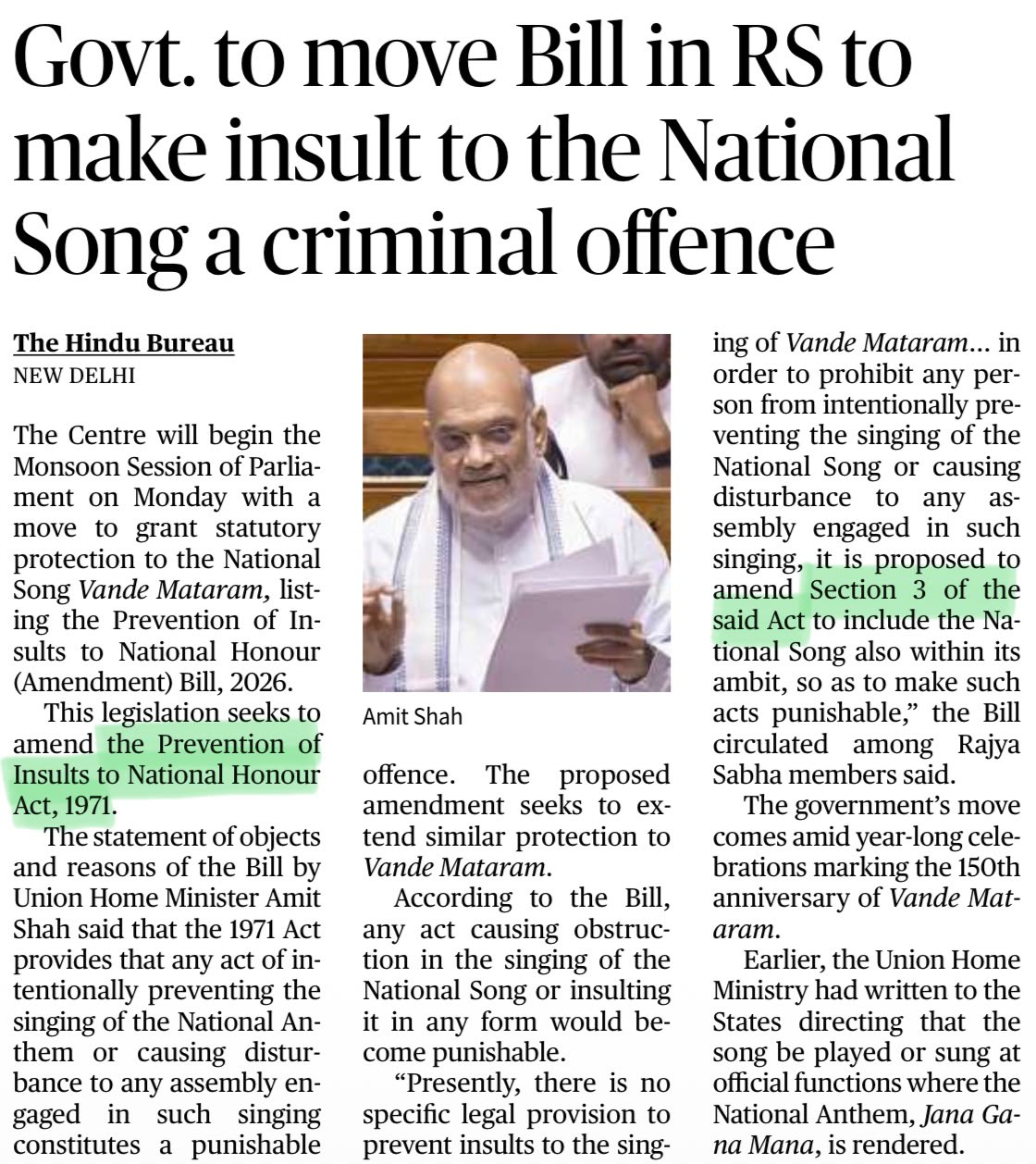
The Union Government has introduced the Prevention of Insults to National Honour (Amendment) Bill, 2026 in the Rajya Sabha.

The Bill seeks to extend statutory protection to Vande Mataram, the National Song, by making its intentional insult, obstruction or disruption during singing a punishable offence.

Prevention of Insults to National Honour Act, 1971

The Act was enacted to protect the dignity of:

  • National Flag
  • Constitution of India
  • National Anthem

Section 3

Section 3 punishes anyone who intentionally prevents the singing of the National Anthem or causes disturbance to an assembly engaged in singing it.

Punishment

Punishment may include:

  • Imprisonment up to 3 years
  • Fine
  • Both

2026 Amendment

The proposed amendment extends the same legal protection to Vande Mataram.

This means intentional insult or obstruction during its singing will also become punishable.

Vande Mataram – Basics

Written By

Bankim Chandra Chattopadhyay.

First Published In

Anandamath, 1882.

National Song

The first two stanzas were adopted as the National Song by the Constituent Assembly on 24 January 1950.

Recent Development

The Union Government has been observing the 150th anniversary of Vande Mataram.

The Ministry of Home Affairs recently advised States to ensure that Vande Mataram is played or sung at official functions where the National Anthem is rendered.

The present Bill gives statutory backing by extending legal protection under the 1971 Act.

Difference Between National Anthem and National Song

Jana Gana Mana is the National Anthem.

Vande Mataram is the National Song.

Both command high national respect, but until now only the National Anthem had explicit statutory protection under the 1971 Act.

Key Takeaway

The Bill seeks to legally protect the National Song in the same manner as the National Anthem, by making intentional insult or obstruction punishable.
National Song Amendment Bill 2026

Embodied AI in Robotics: Next Frontier Explained

Context: Embodied AI in Robotics
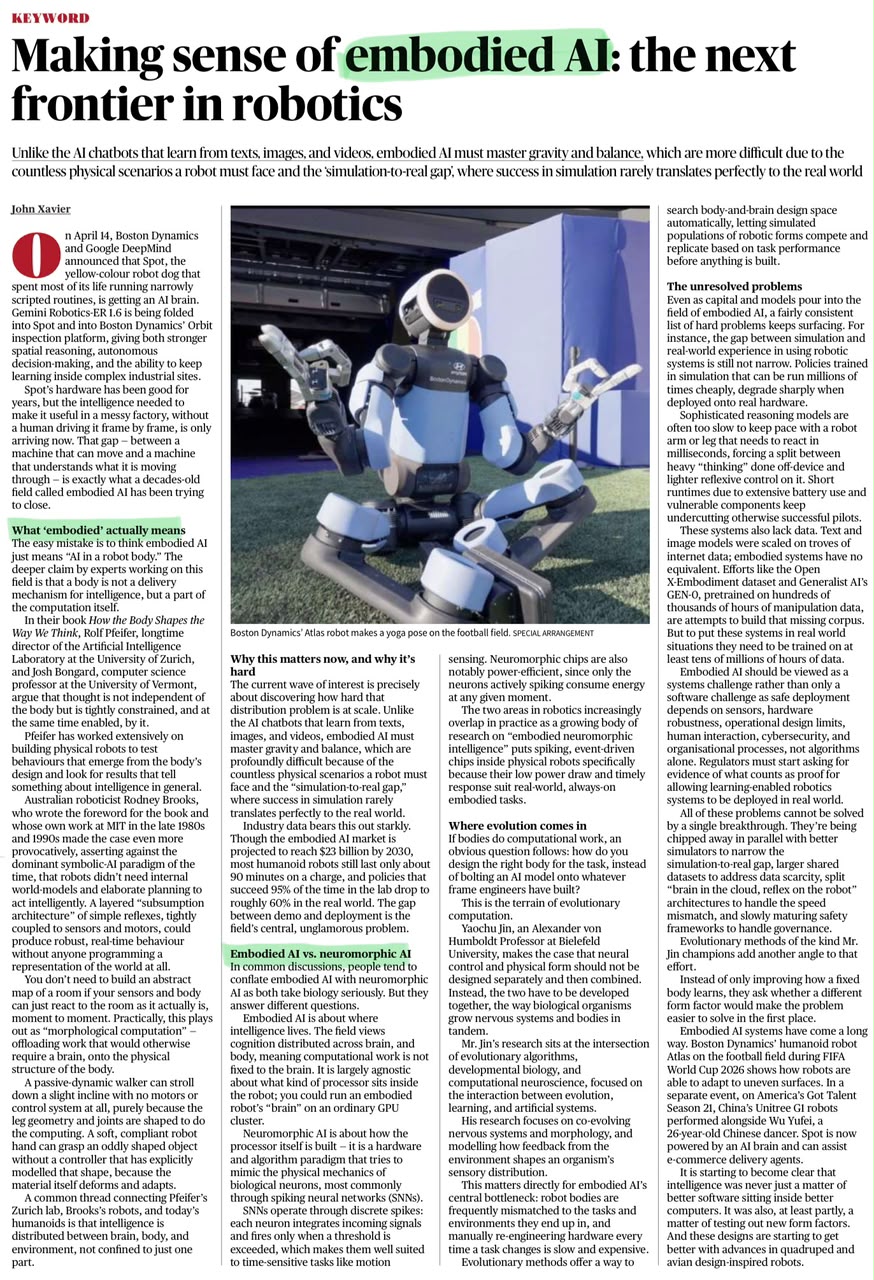
Artificial Intelligence is evolving from software-based systems to Embodied AI, where intelligent robots can perceive, learn and interact with the physical world.

This expands the use of AI across industry, public services, defence, healthcare and disaster response.

Embodied AI vs Neuromorphic AI

Embodied AI

Embodied AI focuses on AI with a physical body, usually a robot.

It learns through:

  • Sensing
  • Movement
  • Interaction with the environment

Neuromorphic AI

Neuromorphic AI focuses on brain-inspired hardware.

It uses AI chips that mimic biological neurons to make AI faster and more energy-efficient.

Easy Recall

Embodied AI = AI with a Body

Neuromorphic AI = AI with a Brain-like Chip

Embodied AI

Embodied AI means AI integrated with a physical robot capable of:

  • Sensing
  • Reasoning
  • Learning
  • Acting

Here, intelligence is distributed across:

  • Brain or AI system
  • Body or robot
  • Environment

Key Challenge: Simulation-to-Real Gap

A major challenge in embodied AI is the simulation-to-real gap.

This means performance in computer simulations often does not match real-world conditions.

For example, a robot may work well in a controlled lab simulation but fail in real life because of:

  • Uneven surfaces
  • Unpredictable human behaviour
  • Weather conditions
  • Obstacles
  • Physical wear and tear
  • Sensor limitations

Applications

Embodied AI can be used in:

  • Manufacturing
  • Logistics
  • Healthcare
  • Defence
  • Disaster response
  • Household assistance
  • Elderly care
  • Industrial automation

Significance

1. Robotics Revolution

Embodied AI can make robots more useful in real-world environments.

2. Public Services

It can support disaster rescue, hospital assistance and public infrastructure maintenance.

3. Defence and Security

Robots with embodied AI can help in surveillance, mine detection, logistics and risky operations.

4. Industry

It can improve automation in factories, warehouses and supply chains.

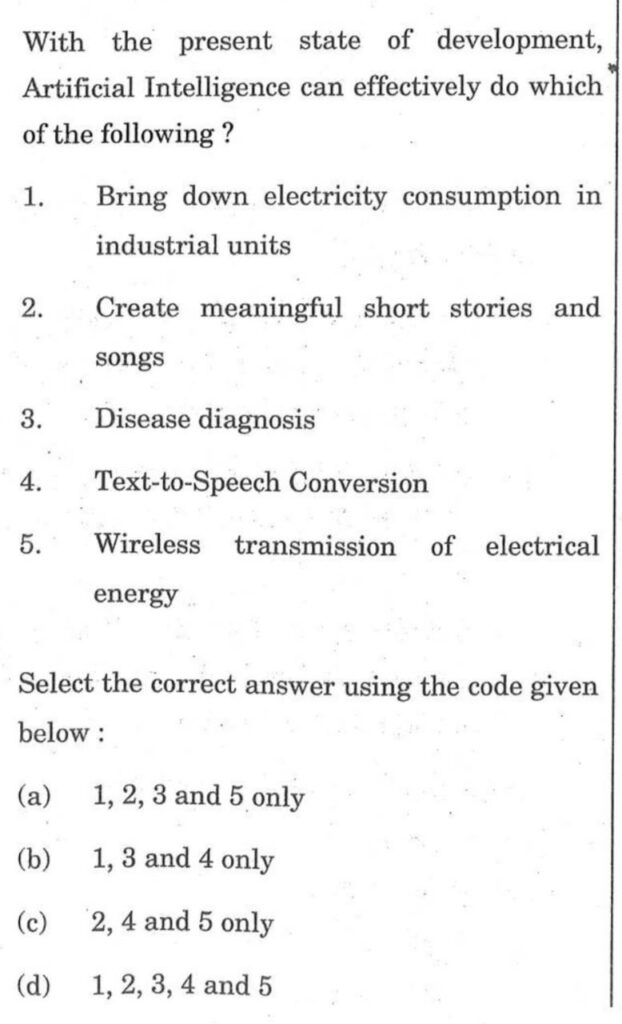
PYQ Link

AI can currently be used for:

  • Reducing electricity consumption in industrial units
  • Creating short stories and songs
  • Disease diagnosis
  • Text-to-speech conversion
  • Wireless transmission of electrical energy

Key Takeaway

Embodied AI is the next step in robotics because it takes AI beyond screens and software into physical machines that can act in the real world.

Embodied AI in Robotics

Shabdalok Language Museum: India’s First Immersive Hub

Context: Shabdalok Language Museum
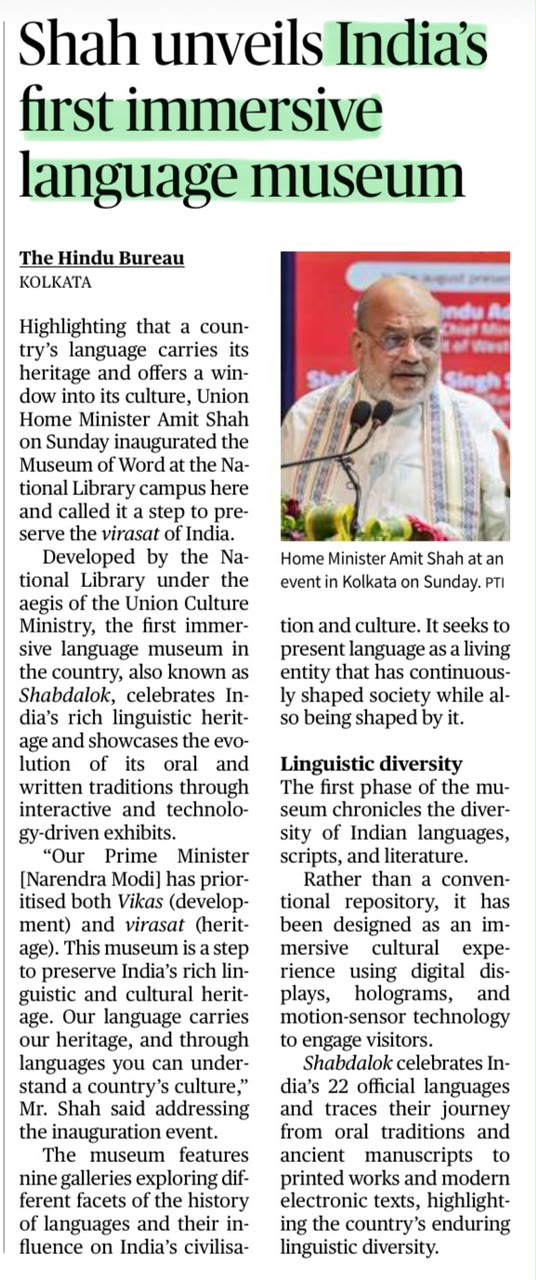
Union Home Minister Amit Shah inaugurated India’s first immersive language museum, Shabdalok, at the National Library, Kolkata.

The museum aims to preserve and showcase India’s linguistic and cultural heritage using modern digital technology.

Shabdalok

Meaning

Shabdalok means Museum of Words.

Status

India’s first immersive language museum.

Developed By

National Library under the Ministry of Culture.

Location

National Library Campus, Kolkata, West Bengal.

Technology Used

The museum uses:

  • Digital displays
  • Holograms
  • Motion-sensor technology

These features create an interactive visitor experience.

Purpose

The museum showcases the evolution of:

  • Indian languages
  • Scripts
  • Literature
  • Oral traditions
  • Ancient manuscripts
  • Printed texts
  • Digital texts

Key Features

1. Nine Galleries

It features nine galleries on the history and evolution of Indian languages.

2. Eighth Schedule Languages

It celebrates all 22 languages listed in the Eighth Schedule of the Constitution.

3. Language Journey

It traces the journey of languages from oral traditions and ancient manuscripts to modern printed and digital texts.

Significance

1. Cultural Preservation

It helps preserve India’s linguistic diversity and cultural heritage.

2. Constitutional Value

It highlights the importance of languages recognised in the Eighth Schedule.

3. Use of Technology in Culture

It shows how modern digital tools can be used for heritage conservation.

4. Public Awareness

It can help citizens understand how language shapes identity, history and civilisation.

Key Takeaway

Shabdalok is important because it combines language, heritage and technology to preserve India’s linguistic diversity.

Shabdalok Language Museum

India Australia Strategic Partnership: Key Developments

Context: India Australia Strategic Partnership
India–Australia relations have evolved into a robust Comprehensive Strategic Partnership.

The relationship is now based on shared democratic values, Indo-Pacific cooperation, defence and maritime engagement, resilient supply chains, critical technologies, economic ties and people-to-people links.

Recent Developments in India–Australia Relations

1. Defence and Security Cooperation

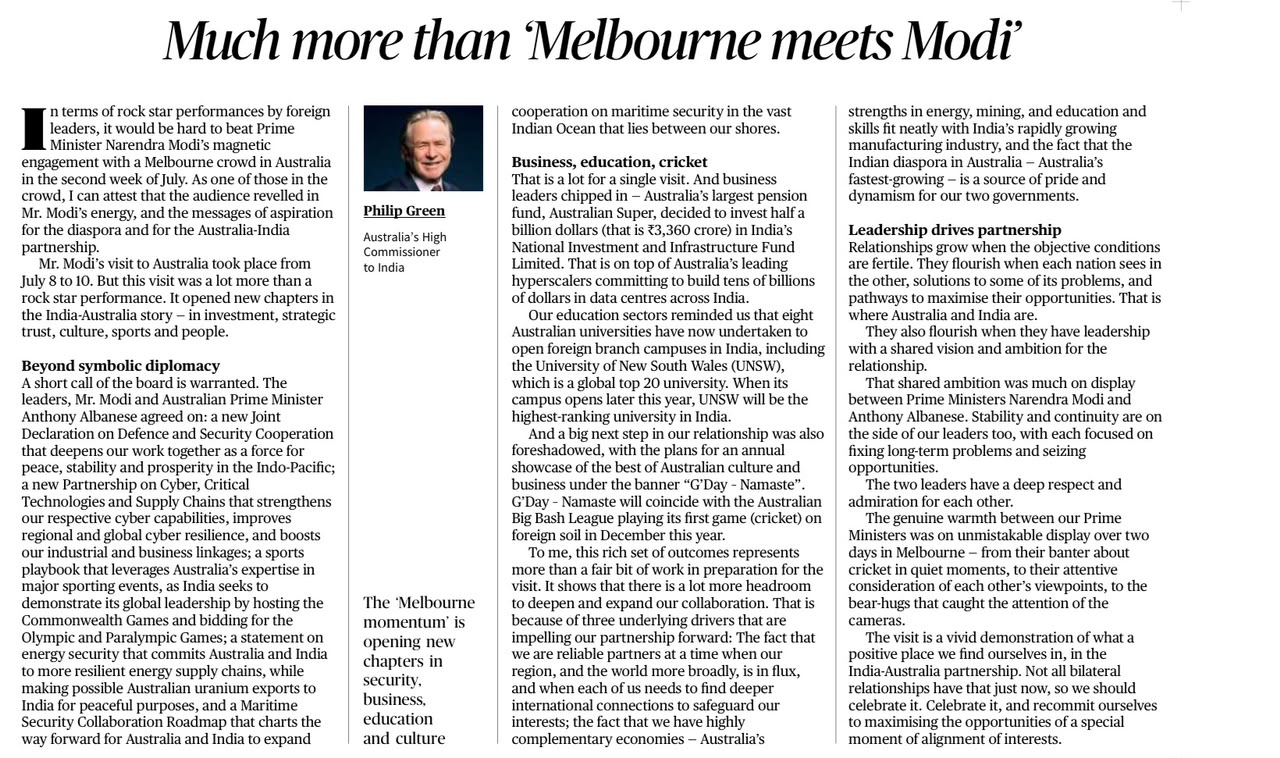
Both countries have strengthened defence and security cooperation through a Joint Declaration and enhanced strategic dialogue.

2. Cyber Security and Critical Technologies

They launched a partnership on:

  • Cyber security
  • Critical technologies
  • Resilient supply chains

3. Maritime Security

A Maritime Security Cooperation Roadmap was adopted to reinforce a free, open and rules-based Indo-Pacific.

4. Civil Nuclear Energy

Cooperation has expanded in civil nuclear energy, including Australia’s uranium supply for India’s civilian nuclear programme.

5. Infrastructure Investment

AustralianSuper announced an investment of about ₹3,360 crore in India’s National Investment and Infrastructure Fund.

6. Digital and Emerging Technologies

Australian firms committed investments in:

  • Data centres
  • Digital infrastructure
  • Emerging technologies

7. Education Cooperation

Eight Australian universities, including the University of New South Wales, will establish branch campuses in India.

8. G’Day–Namaste Initiative

The annual G’Day–Namaste initiative has been institutionalised to deepen:

  • Trade
  • Innovation
  • Tourism
  • Cultural exchanges

9. Wider Areas of Cooperation

India and Australia are expanding collaboration in:

10. Diaspora Link

The Indian diaspora has been reaffirmed as a strategic pillar of bilateral economic, cultural and innovation partnerships.

Significance

1. Indo-Pacific Stability

India and Australia share an interest in a free, open and inclusive Indo-Pacific.

2. Economic Partnership

The relationship is moving beyond old cultural links towards trade, investment and technology.

3. Critical Minerals

Australia is important for India’s clean energy transition because of its critical minerals.

4. Education and Skills

University campuses and skilled mobility strengthen long-term people-to-people ties.

5. Strategic Trust

Regular defence, maritime and technology cooperation reflects growing strategic trust.

Key Takeaway

India–Australia ties are now much deeper than diaspora events or cultural diplomacy. They are becoming a long-term strategic partnership across security, technology, education, energy and the Indo-Pacific.

India Australia Strategic Partnership

Gen Z Employment Challenges India: Key Issues Explained

Context: Gen Z Employment Challenges India
India’s demographic dividend can be realised only through productive, formal and quality employment.

The challenge is not only about creating jobs. It is also about ensuring better labour force participation, employability, social security and a smooth transition from education to work, especially for the youth.

Key Challenges in Gen Z Employment

1. Low Labour Force Participation

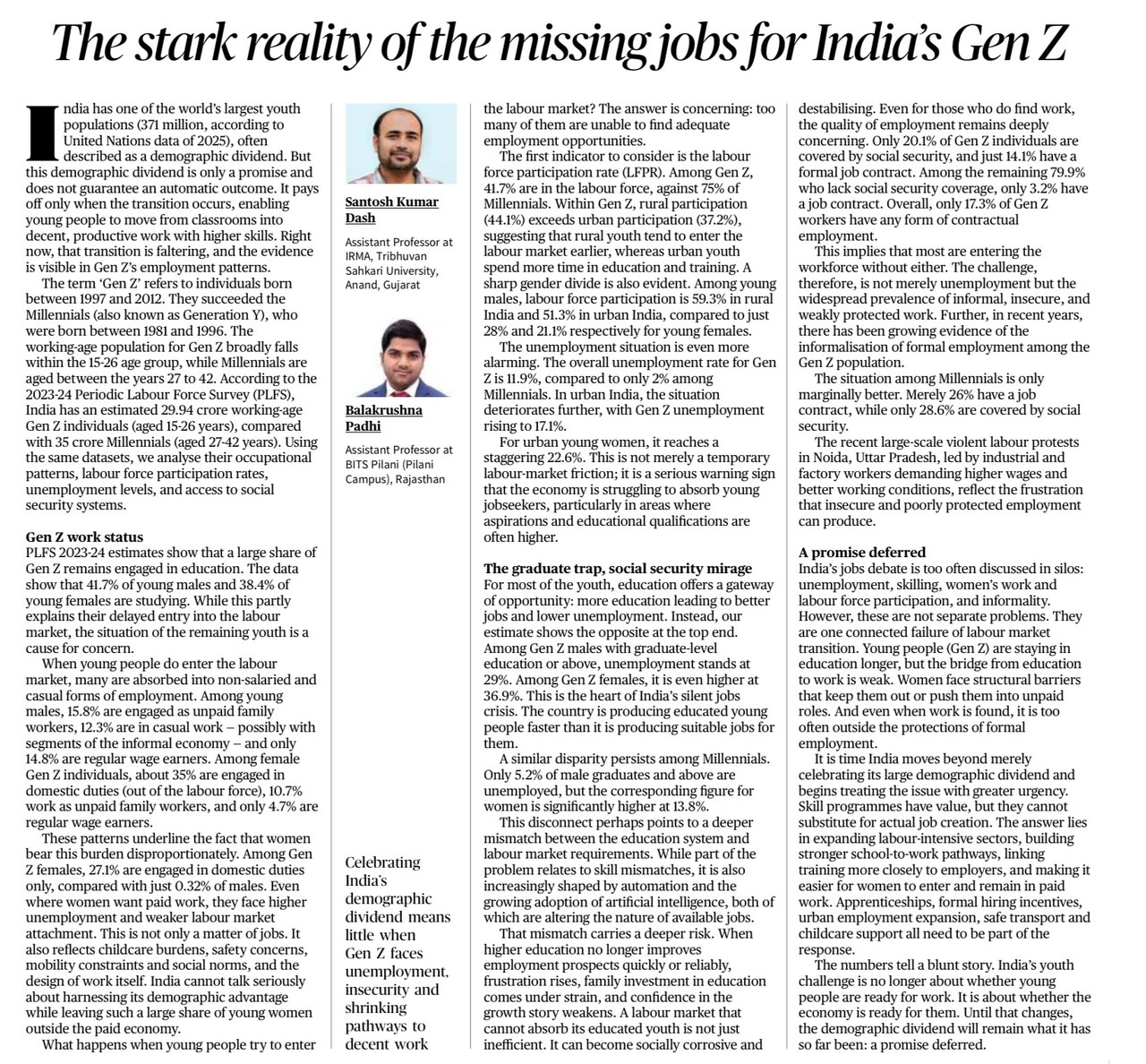
Labour Force Participation Rate is only 41.7% among Gen Z, compared to 75% among Millennials.

This indicates delayed or weak entry into the labour market.

2. High Unemployment

Overall Gen Z unemployment is 11.9%.

It rises to:

  • 17.1% in urban areas
  • 22.6% among urban women

This reflects poor job absorption.

3. Graduate Employment Crisis

Unemployment among graduates stands at 29%.

For female graduates, it rises to 36.9%.

This highlights the education-employment mismatch.

4. Informal and Insecure Employment

A large share of youth is engaged in:

  • Casual work
  • Unpaid family work
  • Informal employment

Only 17.3% have formal employment contracts.

5. Weak Social Security

Only 20.1% of Gen Z workers are covered by social security.

This makes youth employment highly vulnerable.

6. Gender Disparities

Women continue to face lower labour force participation due to:

  • Unpaid care work
  • Safety concerns
  • Social norms
  • Limited access to quality jobs

7. Structural Labour Market Challenges

Employment opportunities for educated youth are affected by:

Why This Matters

India’s demographic dividend can become a demographic burden if young people are educated but unable to find productive and secure employment.

The issue is especially serious because unemployment is high among graduates and urban women.

Way Forward

1. Labour-Intensive Manufacturing and Services

Promote sectors that can generate large-scale quality employment.

2. School-to-Work Pathways

Strengthen:

  • Apprenticeships
  • Vocational education
  • Industry-academia partnerships

3. Skill Alignment

Align higher education and skilling with industry demand and emerging technologies.

4. Formal Employment

Expand written contracts, social security and labour protection.

5. Female Labour Force Participation

Increase women’s participation through:

  • Childcare support
  • Safe transport
  • Flexible work arrangements
  • Gender-sensitive workplaces

6. Private Investment and MSMEs

Encourage private investment, MSMEs and urban employment opportunities to fully harness India’s demographic dividend.

Key Takeaway

India’s youth challenge is not only unemployment. It is also about insecure work, weak social security, gender gaps and poor transition from education to employment.

Gen Z Employment Challenges India

Mali Sahel Security Crisis: Rebel Attack Explained

Context: Mali Sahel Security Crisis
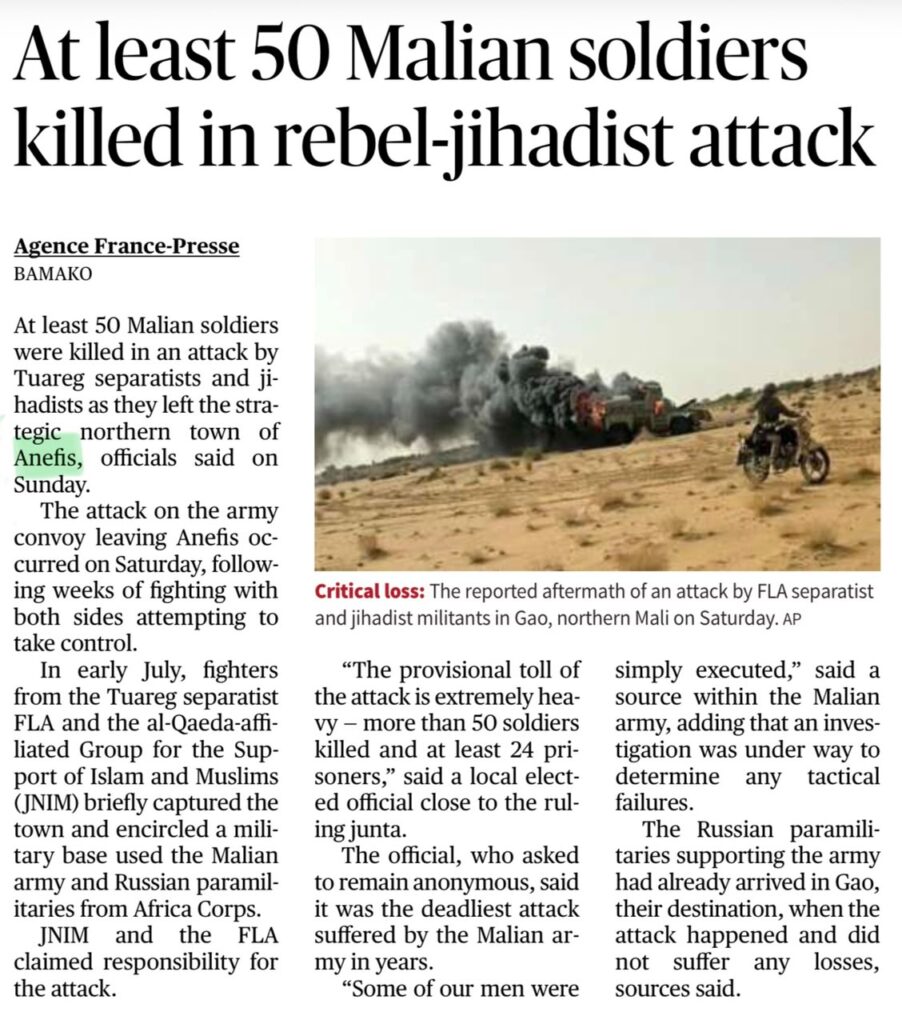
More than 50 Malian soldiers were killed in an attack near Anefis in northern Mali by Tuareg separatists and Jama’at Nusrat al-Islam wal-Muslimin.

The attack highlights the deteriorating security situation in the Sahel region.

Location in News – Mali

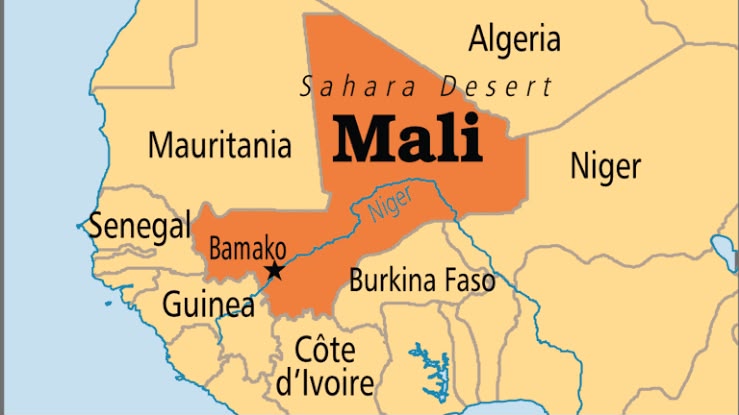
Mali

Mali is a landlocked country in West Africa.

It lies in the Sahel region.

Capital

Bamako.

Anefis

Anefis is a strategic town in the Gao Region, near Kidal, in northern Mali.

Significance

Anefis is a conflict hotspot involving:

  • Malian military
  • Tuareg separatists
  • Islamist militant groups

Sahel Region

The Sahel is a semi-arid belt south of the Sahara Desert.

It has faced serious security challenges due to:

  • Weak State capacity
  • Terror groups
  • Separatist movements
  • Climate stress
  • Poverty
  • Cross-border arms flows
  • Political instability

Why It Matters for UPSC

This topic is important under “Places in News” and broader international relations because instability in the Sahel affects:

  • African security
  • Counter-terrorism
  • Migration
  • Resource politics
  • External power involvement
  • Regional governance

Key Takeaway

Mali’s conflict reflects the larger instability in the Sahel, where separatism, jihadist violence and weak governance continue to threaten regional security.

Mali Sahel Security Crisis
Mali Sahel Security Crisis Map
About the UPSC Civil Services Examination (UPSC CSE)

The UPSC Civil Services Examination (CSE) is one of the most competitive and esteemed examinations in India, conducted by the Union Public Service Commission to recruit officers for services such as the Indian Administrative Service (IAS), Indian Police Service (IPS), Indian Foreign Service (IFS), and others. The exam comprises three stages — Prelims, Mains, and the Personality Test (Interview) — designed to test a candidate’s knowledge, aptitude, decision-making, and leadership skills.


How to Prepare Effectively for UPSC CSE

Cracking the UPSC CSE requires a deep understanding of the syllabus, consistent revision, structured answer writing, and smart test-taking strategies. The Prelims test analytical and conceptual clarity, the Mains focuses on critical thinking, articulation, and subject mastery, while the Interview assesses presence of mind, ethical judgment, and personality traits relevant to public service.

At UnderStand UPSC, we empower aspirants with a personalized and focused approach to each stage of the exam.


Why Choose UnderStand UPSC?

UnderStand UPSC is a mentorship-driven platform offering a clear, clutter-free strategy to tackle the Civil Services Examination. Our programs like Transform (for beginners and intermediate learners) and Conquer (for advanced mains preparation) provide structured study plans, syllabus-wise video content, interactive live sessions, and answer writing support.

We emphasize:

  • Concept clarity through topic-wise lectures

  • Test series designed around real UPSC standards

  • Personalized mentorship in small groups

  • Regular performance tracking and peer benchmarking

  • Doubt-clearing sessions, current affairs analysis, and monthly magazines


Join the UnderStand UPSC Learning Community

Our mission is to make UPSC preparation less overwhelming and more strategic. We combine mentorship, discipline, and academic rigor to help you clear CSE with confidence. Whether you’re preparing from Delhi, Mumbai, Bangalore, or a remote village — our online-first model ensures quality guidance reaches every corner of India.

Join the thousands of aspirants who trust UnderStand UPSC to guide their journey toward becoming civil servants.

Stay connected with us through our Telegram, YouTube, and Instagram channels for daily tips, strategies, and updates.

Copyright © 2026 USARAMBHA EDUCATION (UnderStand UPSC). All Rights Reserved.

Fill out the form

Fill out the form for

Downloading the free Agriculture Short Notes