Context: Machine readable legal publishing
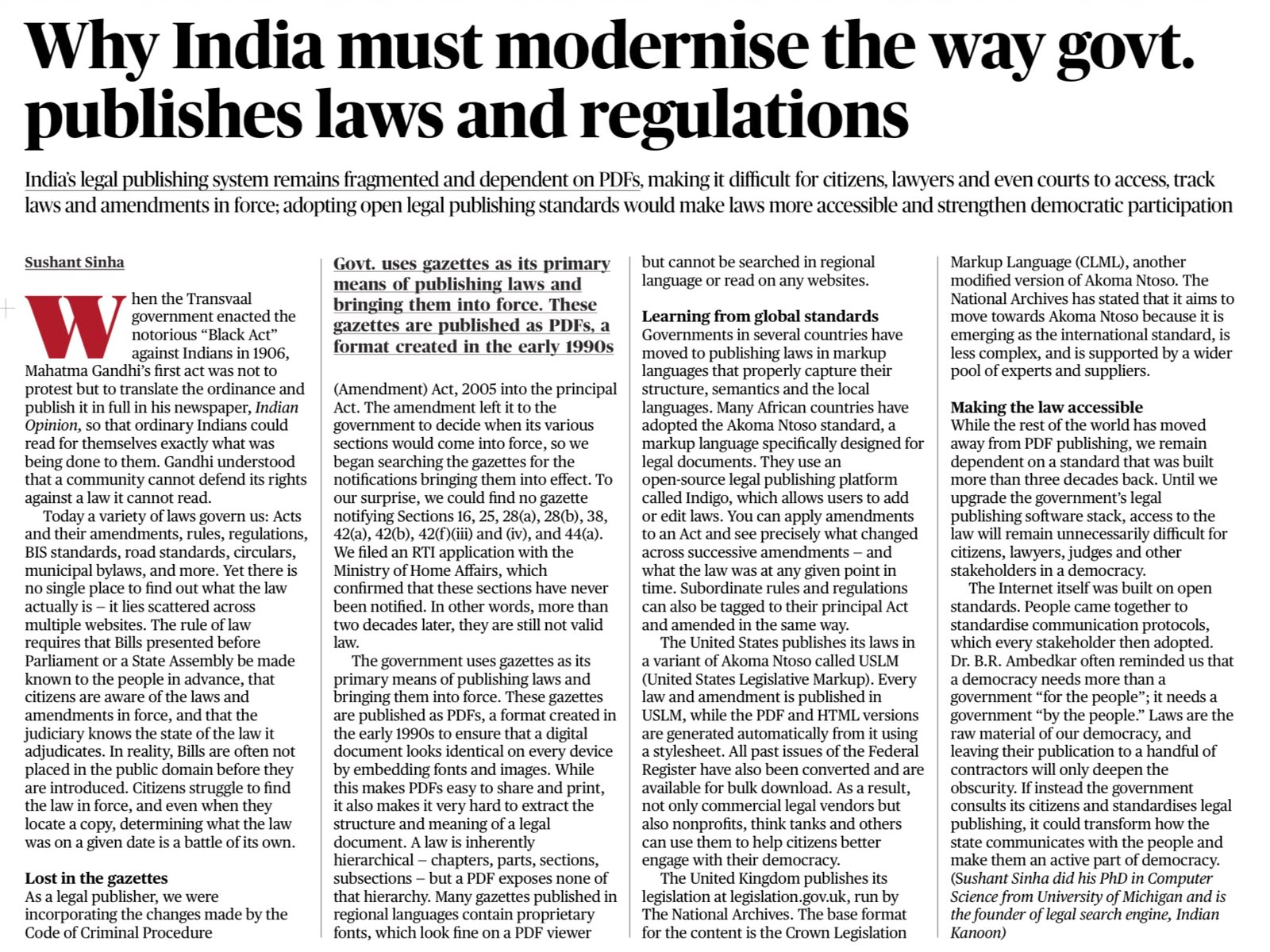
India’s legal publishing system still depends heavily on PDF-based Gazette notifications for publishing laws, rules and regulations.
This makes it difficult to search laws, track amendments and identify the law currently in force. The article argues that India should adopt open and machine-readable legal publishing standards.
Core Problem
Laws, rules, notifications and amendments are scattered across multiple platforms.
Many are published as PDFs, which are not always easy to search, update or cross-reference.
This creates confusion for:
- Citizens
- Lawyers
- Judges
- Researchers
- Businesses
- Government officials
Key Issues
1. Fragmented Legal Information
Legal documents are spread across different websites and departments.
This makes it difficult to find the latest legal position.
2. PDF-Based Publication
Gazette notifications are mostly in PDF format.
PDFs limit searchability, machine readability and automated tracking.
3. Difficulty in Tracking Amendments
It is often difficult to know what the law said earlier, what changed later and what is currently in force.
4. Regional Language Barriers
Regional-language gazettes are often not digitally searchable.
This affects accessibility and inclusive governance.
Proposed Reforms
India should move towards machine-readable legal publishing standards.
This would allow:
- Searchable laws
- Updated legal versions
- Amendment history
- Cross-linking between Acts and rules
- Easier access for citizens and institutions
- Better compliance by businesses
Global Best Practices
Akoma Ntoso
An international open standard for legislative documents.
It helps structure legal text in a machine-readable format.
USLM
United States Legislative Markup is used by the United States for digital legal publication.
legislation.gov.uk
The United Kingdom provides updated and consolidated legislation through a searchable platform.
CLML
India’s National Archives is exploring Common Legislative Markup Language.
Significance
Modernising legal publication can improve:
- Transparency
- Legal certainty
- Judicial efficiency
- Ease of compliance
- Rule of law
- Citizen participation
Key Takeaway
A modern democracy needs laws that are not only passed but also easily accessible, searchable and understandable. Legal publishing reform is essential for transparency and rule of law.