Context: India Employment-Centric Growth Strategy
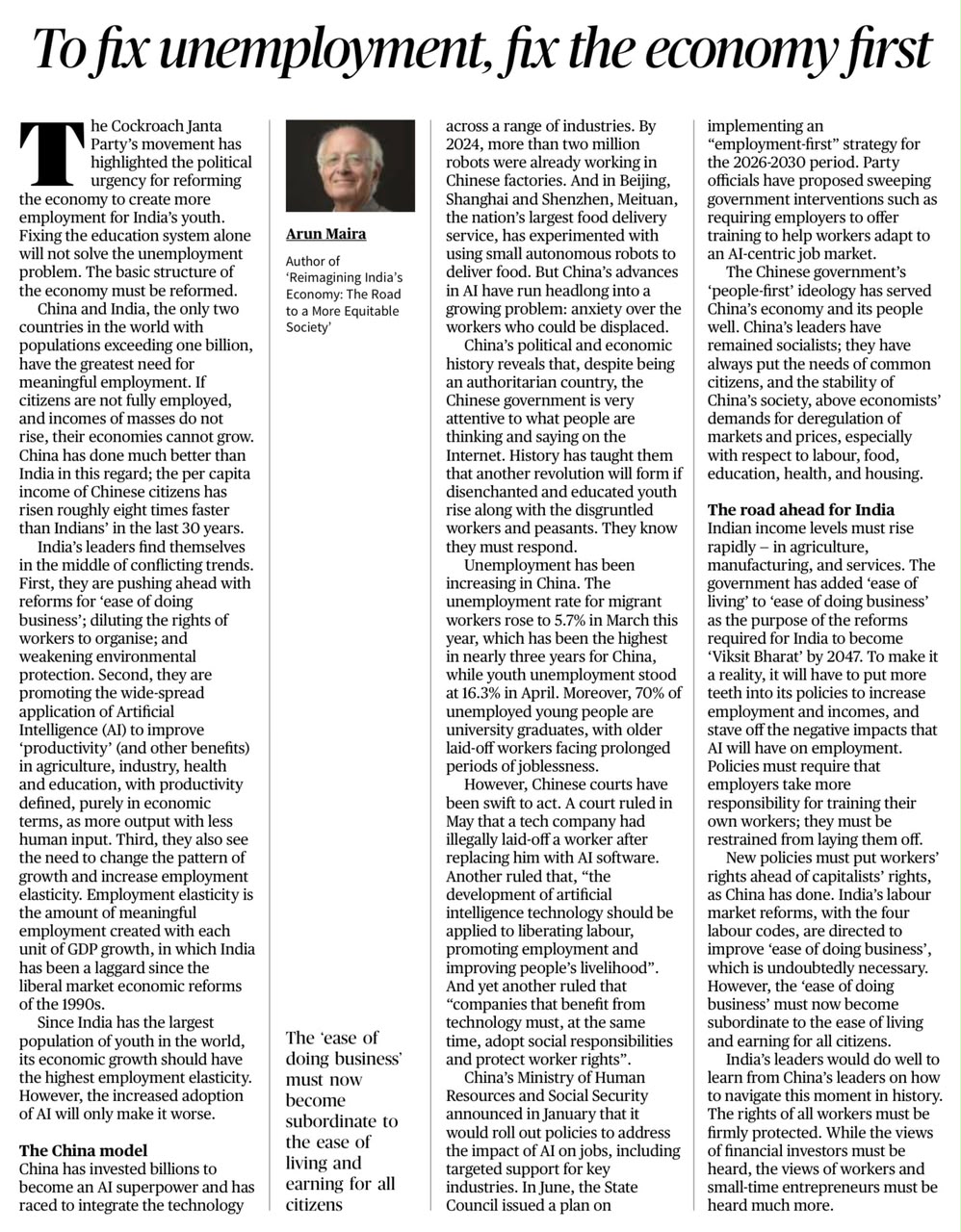
The editorial argues that India’s unemployment challenge cannot be solved only by reforming education or training systems.
The deeper issue is that the economy itself must generate enough meaningful jobs. India’s demographic dividend can be realised only through employment-led growth.
Employment-Centric Growth
Employment-centric growth means economic expansion that creates sufficient and quality jobs.
For India, growth must not only increase GDP but also raise incomes, expand work opportunities and improve livelihoods.
Key Challenges
1. Jobless Growth
India has witnessed economic growth, but employment generation has not kept pace.
This is because employment elasticity remains low.
Employment elasticity means the amount of employment created for every unit of GDP growth.
2. Weak Labour-Intensive Sectors
Labour-intensive sectors have not expanded enough.
These sectors include:
- Manufacturing
- MSMEs
- Agriculture-linked processing
- Tourism
- Construction
- Small enterprises
Without their expansion, large-scale job creation becomes difficult.
3. AI and Automation
Artificial Intelligence can increase productivity, but it can also reduce demand for routine jobs.
This makes reskilling and upskilling important.
Workers must be prepared for an AI-driven labour market.
4. Ease of Doing Business vs Ease of Living
Ease of Doing Business focuses on simpler regulations, lower compliance costs and a better investment climate.
Ease of Living focuses on employment, income security, affordable healthcare, education, housing and social protection.
The editorial argues that India must balance both.
Business reforms are important, but they should not weaken workers’ rights or social protections.
5. Labour Market Constraints
India’s labour market faces several structural problems:
- Skill mismatch
- Informality
- Low female labour force participation
- Weak social security
- Inadequate quality jobs
- Regional employment gaps
Way Forward
India needs an employment-first strategy.
This means industrial and economic policy must be aligned with job creation.
India should promote labour-intensive sectors such as manufacturing, MSMEs, agriculture and tourism.
The country must improve employment elasticity so that growth creates more jobs.
Skill development, reskilling and AI-readiness must be expanded.
Economic reforms must also be combined with labour protection and social security.
Key Takeaway
India cannot solve unemployment only by improving education or skills. The economy must be structured to create more secure, productive and meaningful jobs.