Supreme Court Anti-Defection Law Case Explained for UPSC

Context: Supreme Court Anti-Defection Law Case
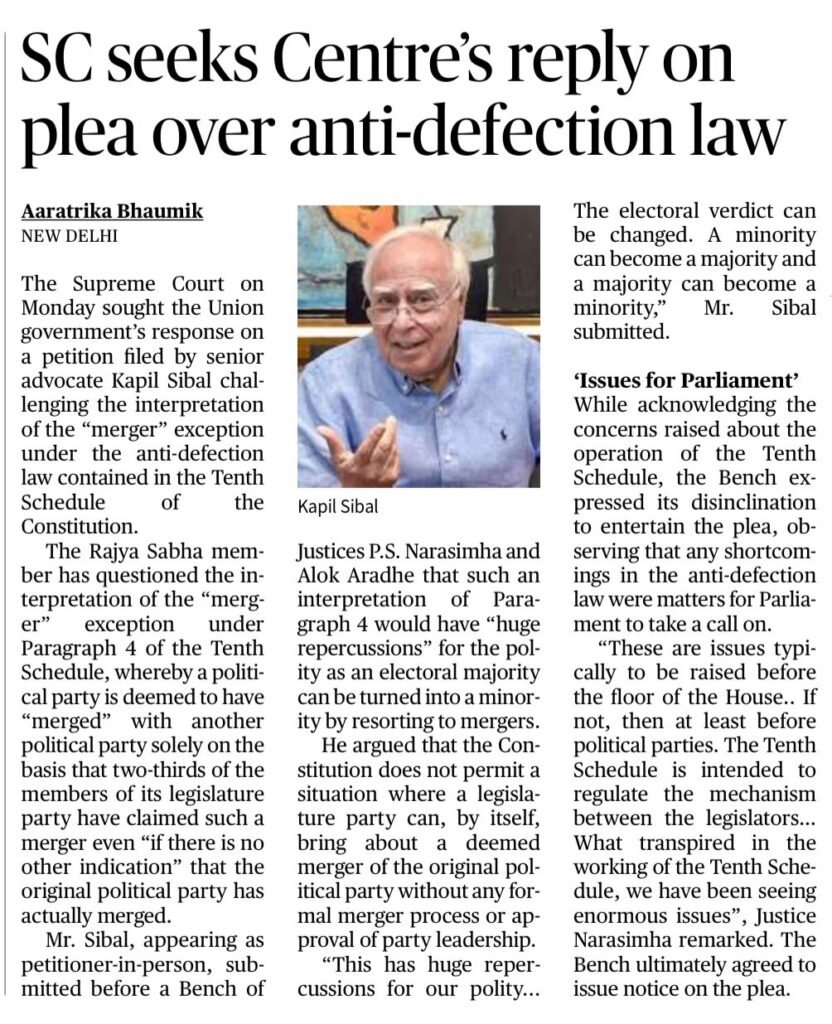
The Supreme Court has sought the Centre’s response on a petition challenging the interpretation of the merger exception under Paragraph 4 of the Tenth Schedule.

The plea argues that a two-thirds majority of legislators alone should not be enough to claim a merger unless the original political party has also formally merged.

Anti-Defection Law

The anti-defection law was added to the Constitution through the 52nd Constitutional Amendment Act, 1985.

It is contained in the Tenth Schedule of the Constitution.

The law was introduced to prevent elected representatives from switching parties for political or personal gain.

91st Constitutional Amendment Act, 2003

The 91st Constitutional Amendment Act, 2003 removed the earlier one-third split exception.

This means that a simple split by one-third members no longer protects defectors from disqualification.

Grounds for Disqualification

A legislator can be disqualified under the anti-defection law if they:

  • Voluntarily give up membership of their political party
  • Vote or abstain from voting against the party whip without permission
  • Are elected as an independent member and later join a political party
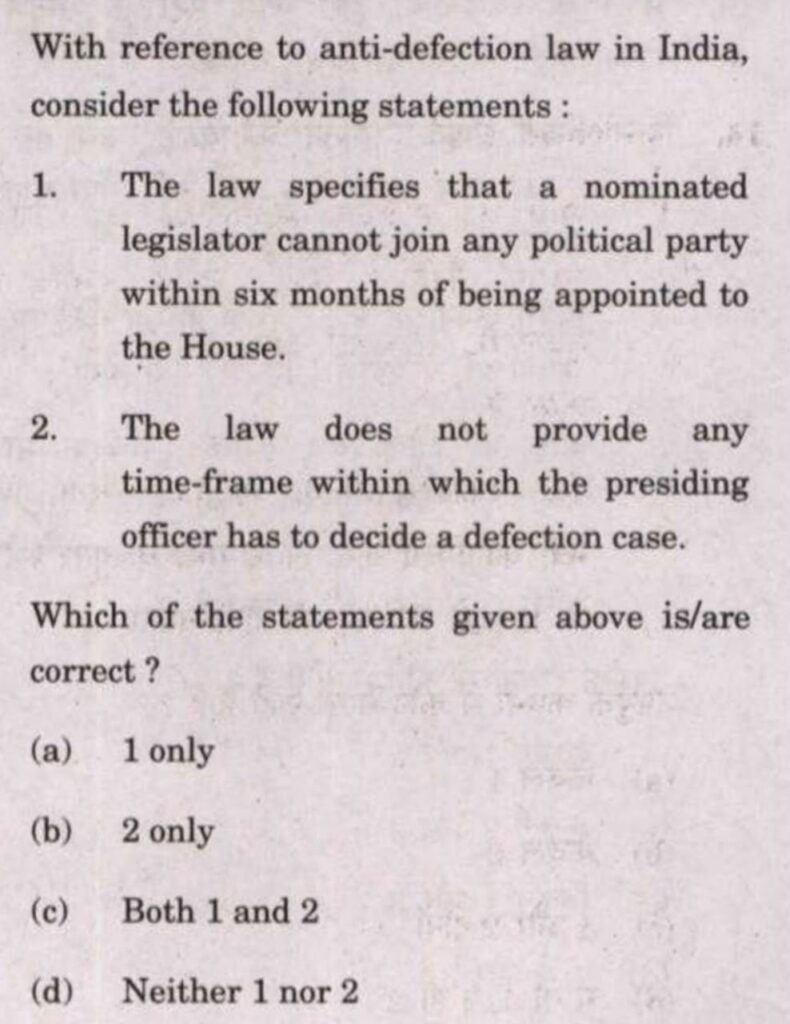
  • Are nominated members and join a political party after six months

Merger Exception

Under Paragraph 4 of the Tenth Schedule, disqualification does not apply if at least two-thirds of the members of a legislature party merge with another party.

However, the present case questions whether a legislature party can claim such a merger even when the original political party has not actually merged.

Why the Case Matters

The petition argues that the current interpretation may allow mass defections to be legitimised.

It raises concerns that elected governments may be changed without fresh elections by using numerical shifts in the legislature.

This affects:

  • Electoral mandate
  • Political stability
  • Party discipline
  • Representative democracy
  • Effectiveness of anti-defection law

Supreme Court’s Observation

The Court issued notice to the Centre.

At the same time, it observed that larger structural reform of the Tenth Schedule is ultimately a matter for Parliament.

Key Takeaway

The case questions whether the anti-defection law is protecting democracy or allowing large-scale political shifts through the merger route. The issue is central to electoral mandate, party stability and constitutional morality.
Subscribe
Notify of
guest
0 Comments
Oldest
Newest Most Voted

Supreme Court Anti-Defection Law Case Explained for UPSC

Got a question? We're here to help!

Our dedicated Student Support team is ready to assist you and guide you every step of the way.
Reach out to us, and let’s tackle your queries together!

About the UPSC Civil Services Examination (UPSC CSE)

The UPSC Civil Services Examination (CSE) is one of the most competitive and esteemed examinations in India, conducted by the Union Public Service Commission to recruit officers for services such as the Indian Administrative Service (IAS), Indian Police Service (IPS), Indian Foreign Service (IFS), and others. The exam comprises three stages — Prelims, Mains, and the Personality Test (Interview) — designed to test a candidate’s knowledge, aptitude, decision-making, and leadership skills.

How to Prepare Effectively for UPSC CSE

Cracking the UPSC CSE requires a deep understanding of the syllabus, consistent revision, structured answer writing, and smart test-taking strategies. The Prelims test analytical and conceptual clarity, the Mains focuses on critical thinking, articulation, and subject mastery, while the Interview assesses presence of mind, ethical judgment, and personality traits relevant to public service.

At UnderStand UPSC, we empower aspirants with a personalized and focused approach to each stage of the exam.

Why Choose UnderStand UPSC?

UnderStand UPSC is a mentorship-driven platform offering a clear, clutter-free strategy to tackle the Civil Services Examination. Our programs like Transform (for beginners and intermediate learners) and Conquer (for advanced mains preparation) provide structured study plans, syllabus-wise video content, interactive live sessions, and answer writing support.

We emphasize:

  • Concept clarity through topic-wise lectures

  • Test series designed around real UPSC standards

  • Personalized mentorship in small groups

  • Regular performance tracking and peer benchmarking

  • Doubt-clearing sessions, current affairs analysis, and monthly magazines

Join the UnderStand UPSC Learning Community

Our mission is to make UPSC preparation less overwhelming and more strategic. We combine mentorship, discipline, and academic rigor to help you clear CSE with confidence. Whether you’re preparing from Delhi, Mumbai, Bangalore, or a remote village — our online-first model ensures quality guidance reaches every corner of India.

Join the thousands of aspirants who trust UnderStand UPSC to guide their journey toward becoming civil servants.

Stay connected with us through our Telegram, YouTube, and Instagram channels for daily tips, strategies, and updates.

Copyright © 2026 USARAMBHA EDUCATION (UnderStand UPSC). All Rights Reserved.

Fill out the form for

Downloading the free Agriculture Short Notes


0
Would love your thoughts, please comment.x
()
x