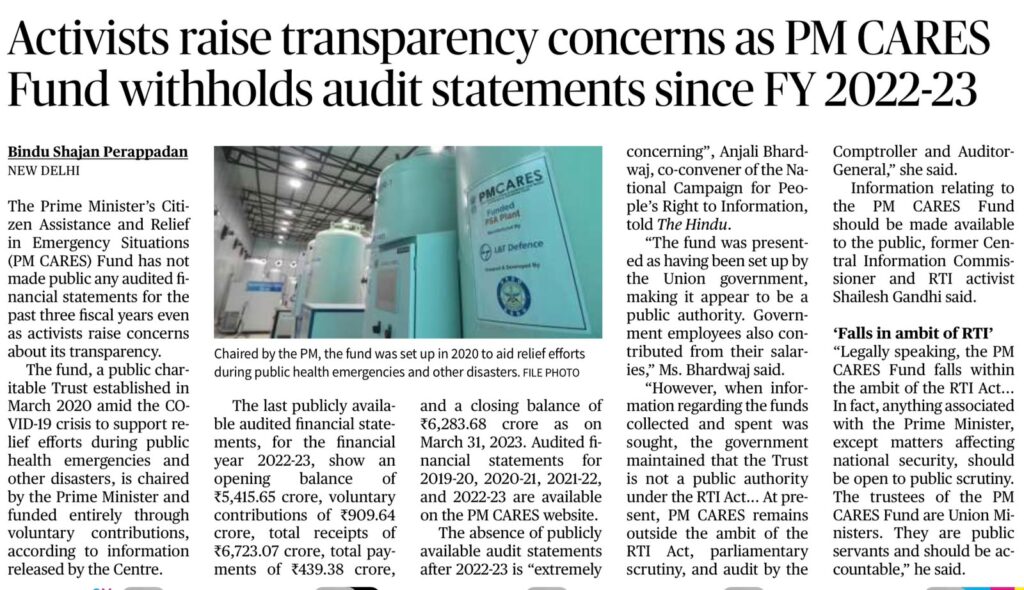
Context: PM CARES Fund Transparency
The non-disclosure of audited financial statements of the PM CARES Fund after FY 2022–23 has revived debate over transparency, accountability and the applicability of the Right to Information Act, 2005.
Activists have raised concerns because recent audit statements have not been made public.
PM CARES Fund
PM CARES stands for Prime Minister’s Citizen Assistance and Relief in Emergency Situations Fund.
It was established in March 2020 as a public charitable trust.
It was created to provide relief during public health emergencies, natural disasters and other emergency situations.
Structure
The Prime Minister is the ex-officio Chairperson of the Fund.
The Defence Minister, Home Minister and Finance Minister are ex-officio Trustees.
The Fund is financed entirely through voluntary contributions from individuals, organisations and institutions.
It does not receive budgetary support from the Consolidated Fund of India.
Legal Status
PM CARES is not a constitutional body.
It is not a statutory body.
It is not a constitutional fund.
It is a public charitable trust registered under the Registration Act, 1908.
RTI and Audit Debate
The Union Government has maintained that PM CARES is not a public authority under Section 2(h) of the RTI Act, 2005.
Therefore, it is not directly subject to RTI provisions.
It is also not audited by the Comptroller and Auditor General.
Instead, its accounts are audited by an independent Chartered Accountant appointed by the Trust.
Issues and Concerns
The non-disclosure of recent audit reports has raised concerns about financial transparency.
The close association of the Fund with constitutional functionaries has led to debate over whether it should face greater public scrutiny.
Critics argue that information about funds collected and spent should be publicly available.
The issue also raises broader questions about emergency funds, institutional accountability and public trust.
Governance Angle
Emergency relief funds require speed and flexibility.
However, transparency is also important when funds are linked with public institutions and national emergency response.
Good governance requires balancing operational flexibility with accountability.
Key Takeaway
The PM CARES debate is not only about one fund. It reflects a larger governance question: how should emergency relief mechanisms balance speed, flexibility, transparency and public accountability?