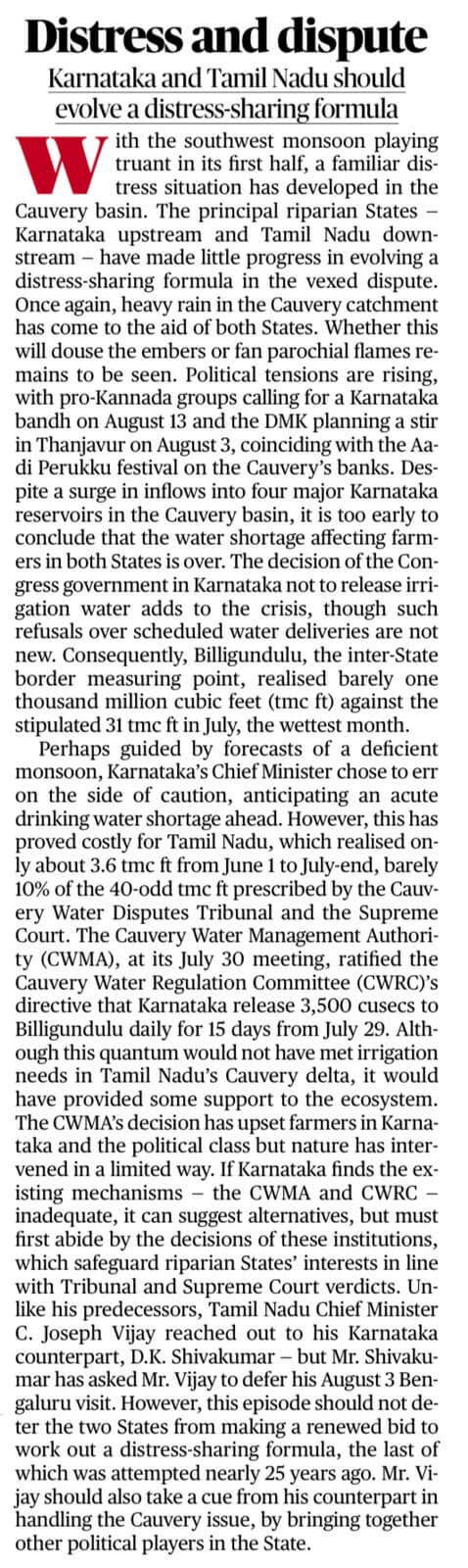
Context: Karnataka Tamil Nadu water dispute
The Cauvery water dispute has again highlighted the need for a scientific distress-sharing formula between Karnataka and Tamil Nadu during low-rainfall years.
The issue reflects the wider challenge of equitable inter-State river water sharing in a federal system.
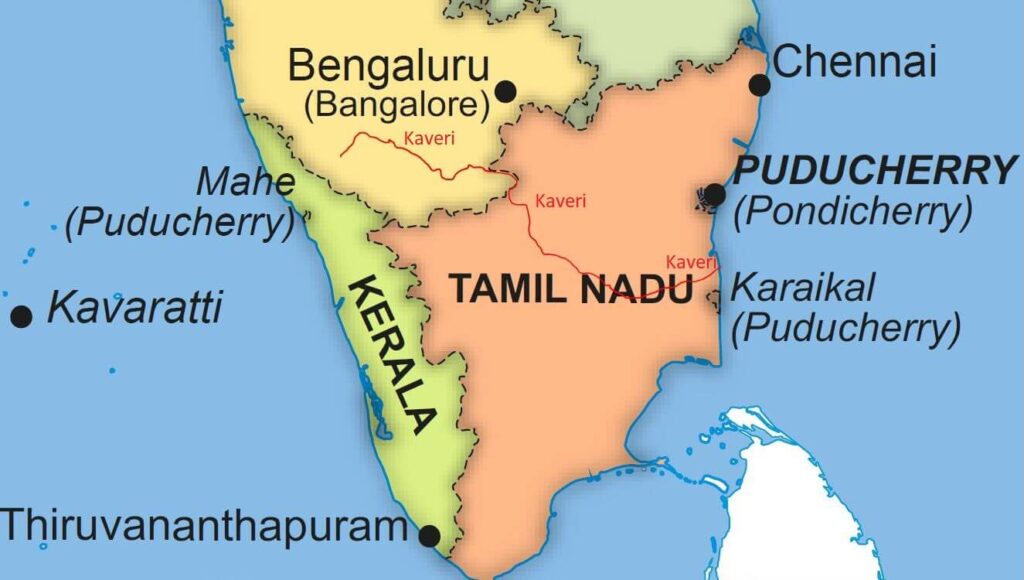
Cauvery River
The Cauvery originates at Talakaveri in the Brahmagiri Hills of the Western Ghats in Karnataka.
It flows through Karnataka and Tamil Nadu.
It forms part of the boundary with Kerala and drains into the Bay of Bengal.
Basin States and Union Territory
The Cauvery basin includes:
- Karnataka
- Tamil Nadu
- Kerala
- Puducherry, especially Karaikal
Tributaries
Right-Bank Tributaries
Important right-bank tributaries include:
- Lakshmana Tirtha
- Kabini
- Shimsha
- Arkavathi
Left-Bank Tributaries
Important left-bank tributaries include:
- Harangi
- Hemavathi
- Bhavani
- Amaravathi
- Noyyal
Importance of Cauvery
The Cauvery supports:
- Irrigation
- Drinking water supply
- Hydropower generation
- Agriculture
- Fertile Cauvery delta
- Livelihoods of farmers
Cauvery Dispute
The dispute arises from competing water demands of upstream and downstream States.
Karnataka is the upstream State.
Tamil Nadu is the major downstream user, especially for the Cauvery delta.
The dispute becomes sharper during deficient monsoon years.
Core Issue
The major unresolved issue is the absence of a mutually accepted distress-sharing formula.
During drought or low-rainfall years, States disagree over how reduced water availability should be shared.
This leads to political mobilisation, legal battles and social tension.
Institutional Framework
Cauvery Water Disputes Tribunal
The Cauvery Water Disputes Tribunal was constituted in 1990 under the Inter-State River Water Disputes Act, 1956.
It gave its final award in 2007.
Supreme Court Judgment, 2018
The Supreme Court modified water allocation and upheld the Tribunal’s award with changes.
Cauvery Water Management Authority
The CWMA implements the Tribunal award and Supreme Court directions.
Cauvery Water Regulation Committee
The CWRC monitors reservoir levels and recommends periodic water releases.
Way Forward
Karnataka and Tamil Nadu need a scientific distress-sharing formula.
Basin-level planning should be strengthened.
Cooperative federalism is essential.
Irrigation efficiency must improve.
Demand-side water management should be promoted.
Timely compliance with CWDT, CWMA and Supreme Court directions is necessary.
Key Takeaway
The Cauvery dispute cannot be solved only through periodic court orders. A scientific distress-sharing formula and cooperative federalism are essential for fair and predictable water sharing during drought years.