Context:
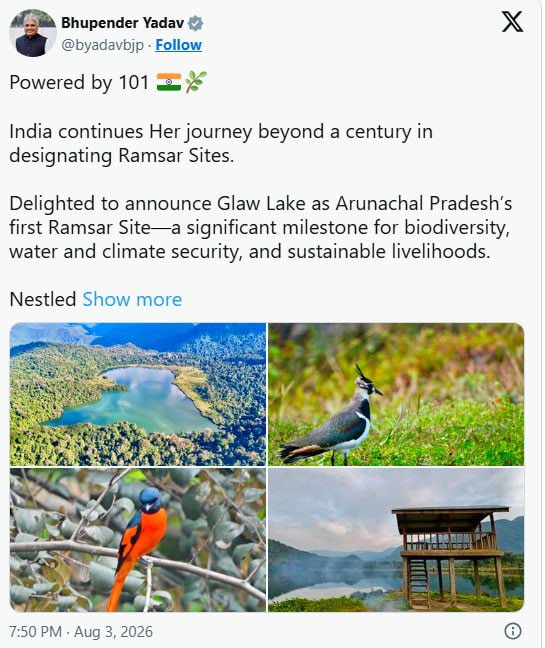
India has designated Glaw Lake as its 101st Ramsar Site.
It is also the first Ramsar Site in Arunachal Pradesh, marking an important milestone for wetland conservation in the State.
Glaw Lake
Glaw Lake is located in Arunachal Pradesh.
Its designation as a Ramsar Site recognises its ecological value and importance for biodiversity, water security and climate resilience.
Ramsar Convention
The Ramsar Convention is an international treaty for the conservation and wise use of wetlands.
It was adopted in 1971 in Ramsar, Iran.
Wetlands recognised under the Convention are called Ramsar Sites.
India’s Ramsar Sites
With Glaw Lake’s inclusion, India now has 101 Ramsar Sites.
This shows India’s expanding commitment to wetland conservation.
Glaw Lake is the first Ramsar Site from Arunachal Pradesh.
Importance of Wetlands
Wetlands provide several ecological services.
They help in:
- Water storage
- Flood control
- Groundwater recharge
- Biodiversity conservation
- Carbon storage
- Livelihood support
- Climate resilience
- Migratory bird habitats
Significance of Glaw Lake
The site supports rich wetland biodiversity.
It provides habitat for migratory birds.
Its recognition can improve conservation planning, sustainable wetland management and local livelihood support.
It also strengthens India’s commitment under the Ramsar Convention.
Key Takeaway
Glaw Lake’s Ramsar recognition is important because it strengthens wetland conservation in Arunachal Pradesh and adds to India’s growing network of internationally recognised wetlands.