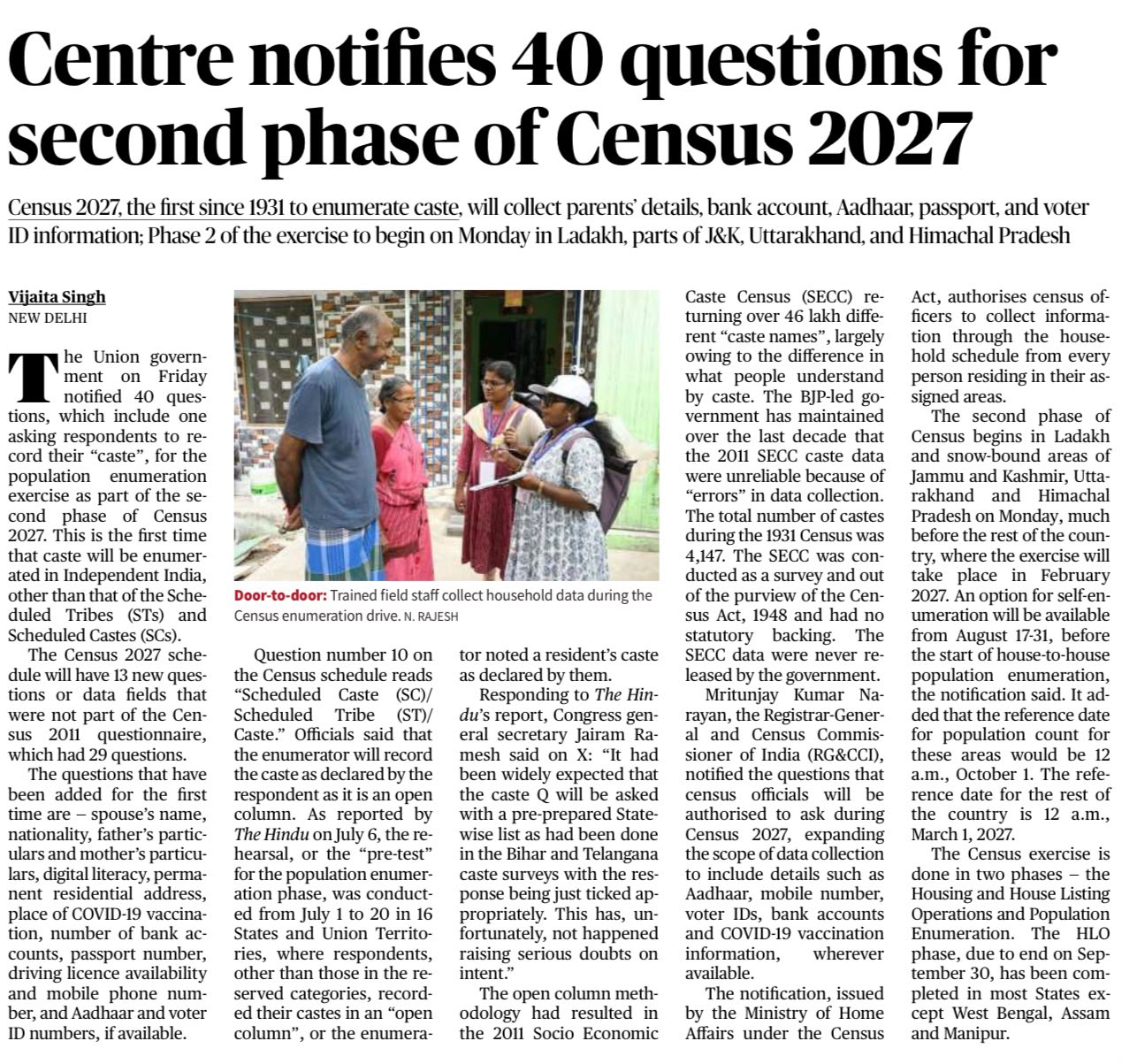
Context: Census 2027 caste enumeration
The Centre has notified 40 questions for the second phase of Census 2027. This includes caste enumeration for the first time in independent India beyond Scheduled Castes and Scheduled Tribes. The exercise will also collect selected socio-economic and identity-related information.
Census 2027: Key Changes
First Census since 1931 to enumerate caste
Respondents will be asked to record their caste as declared by them in an open column.
This is different from the enumeration of SCs and STs, which has been undertaken in earlier Censuses.
40 Questions
The second-phase questionnaire will now have 40 questions.
This includes 13 new questions added to the earlier 2011 Census questionnaire.
New Information to be Collected
The new questions include information such as:
- Spouse’s name
- Nationality
- Parents’ particulars
- Digital literacy
- Permanent residential address
- Bank-account details
- Passport details
- Driving licence details
- Mobile number
- Aadhaar details
- Voter-ID details
These will be collected where applicable.
Why Caste Enumeration Matters
Caste enumeration can provide updated empirical data on India’s caste composition.
This may help inform policies related to:
- Social justice
- Affirmative action
- Targeted welfare
- Representation
- Socio-economic planning
SECC 2011 Experience
The 2011 Socio-Economic and Caste Census collected caste information.
However, its caste data was not officially released due to concerns over data quality and the very large number of caste names reported.
Standardisation Challenge
The 1931 Census recorded 4,147 castes.
The 2011 SECC reportedly produced around 46 lakh different caste names.
This highlights the challenge of standardisation and classification.
Self-Declared Caste
The Census approach now relies on the respondent’s self-declared caste.
This makes accurate enumeration and later classification especially important.
Governance Significance
The Census is the foundation for demographic and socio-economic planning.
Updated caste data can influence welfare design, resource allocation and social-justice policy.
However, data quality, classification, privacy and political sensitivity will be major governance challenges.
Key Takeaway
Census 2027 is significant because it will include caste enumeration beyond SCs and STs for the first time in independent India. The exercise can support evidence-based social-justice policy, but its success will depend on accurate data collection, classification and safeguards.