COP31 Ends Without Agreement on Fossil Fuel Phase-out
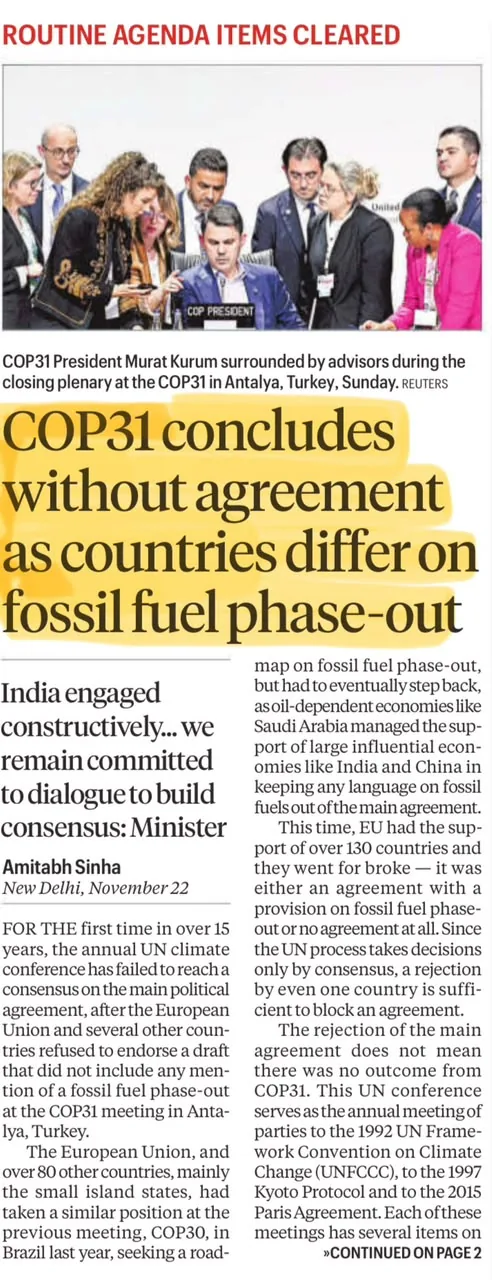
Context: COP31, held in Antalya, Türkiye, ended without consensus on its main political agreement due to disagreements over phasing out fossil fuels, climate finance and other mitigation measures. However, routine agenda decisions were cleared.
Why Did COP31 Fail?
Gradually reducing and ending the use of coal, oil and natural gas, replacing them with renewable and low-carbon sources.
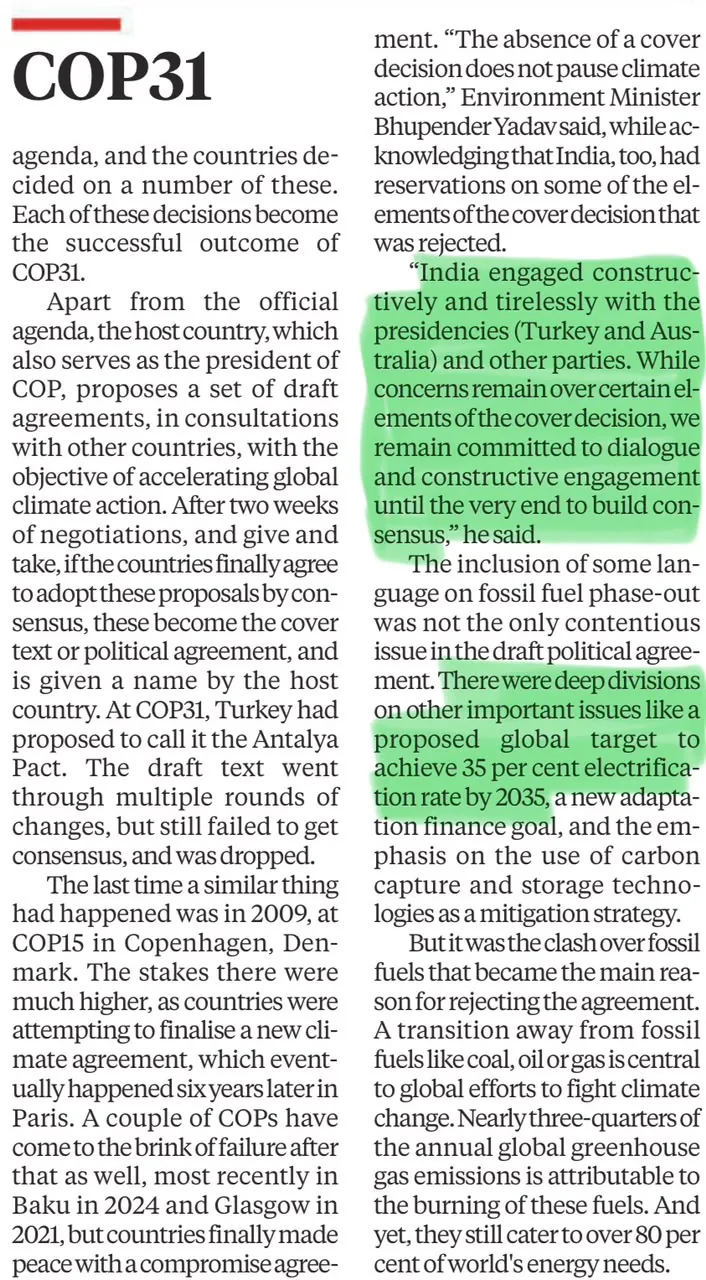
Fossil fuels meet over 80% of global energy needs and cause nearly three-fourths of annual greenhouse gas emissions.
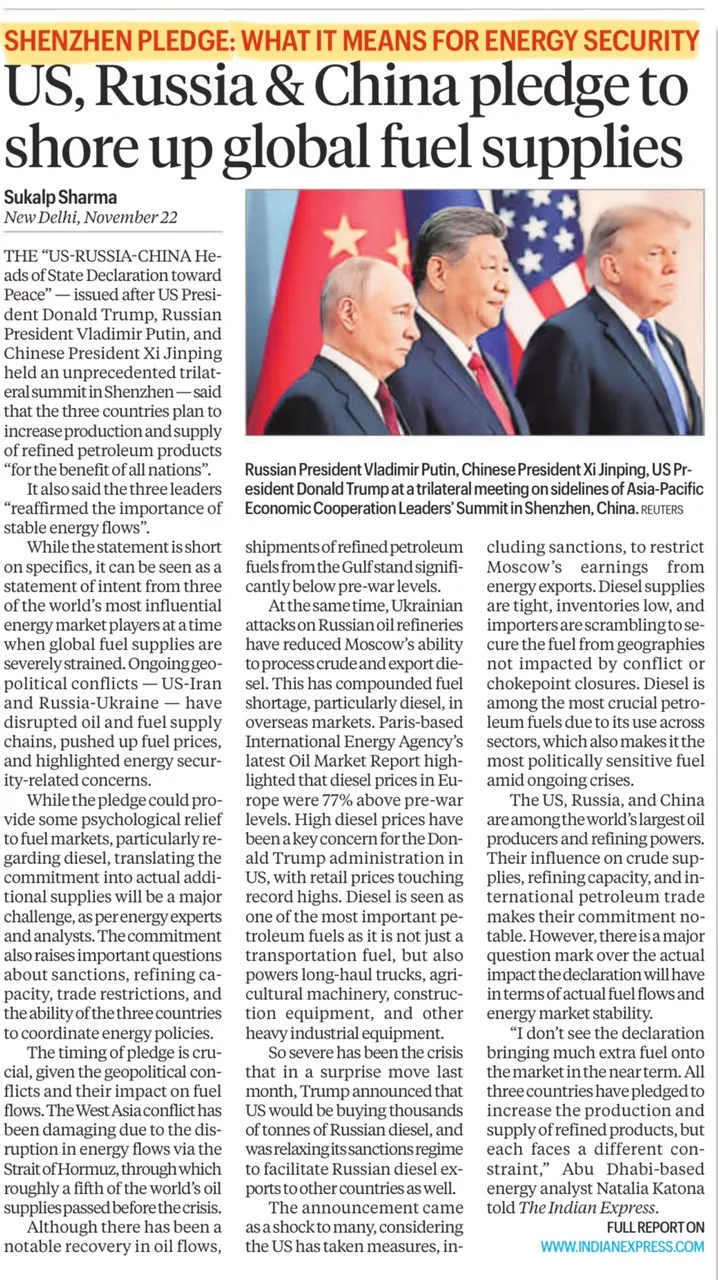
The European Union and over 80 countries, including many SIDS, demanded a clear phase-out roadmap.
Saudi Arabia opposed it; India and China had reservations on explicit phase-out language.
The proposed Antalya Pact failed. UN climate decisions need consensus – even one country can block an agreement.
Other Major Disagreements
A new financial target to help developing countries cope with floods, droughts and heat.
A proposed global target of 35% electrification by 2035.
Capture CO₂ from emissions → transport it → store it in deep underground geological formations.
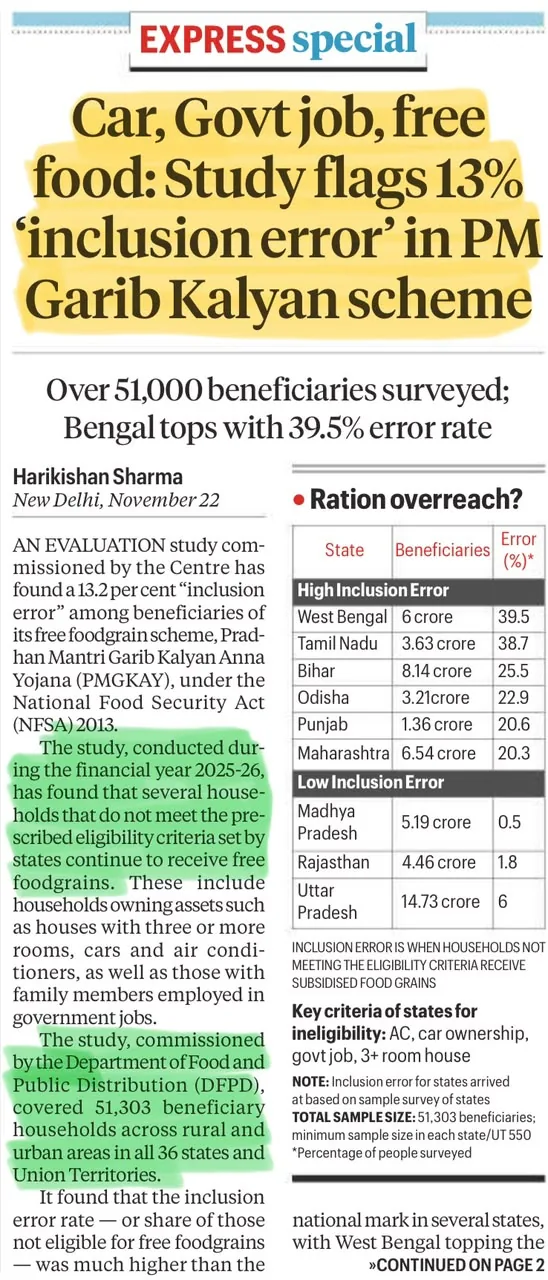
Useful for hard-to-decarbonise sectors like cement and steel; critics warn it must not justify continued fossil-fuel dependence.
India's Position
Affordable and reliable energy for a growing population and economy.
No identical obligations despite different historical emissions and development levels.
Developed countries must provide finance and technology.
Engaged with the Turkish and Australian presidencies but kept reservations.
Major Implications
Differences over historical responsibility, finance and obligations.
Balance decarbonisation with growth and energy access.
Weak funding hurts adaptation and resilience.
Consensus rule makes ambitious commitments difficult.
Important International Frameworks
Framework for international climate cooperation.
Legally binding emission targets for developed countries.
Limit warming to well below 2°C, pursue 1.5°C.
Copenhagen also failed to reach consensus on a comprehensive agreement.
Prelims Practice MCQ
+2 correct • −0.66 wrongUPSC Prelims PYQ 2023: Consider the following activities:
1. Spreading finely ground basalt rock on farmlands extensively
2. Increasing the alkalinity of oceans by adding lime
3. Capturing carbon dioxide released by industries and pumping it into abandoned subterranean mines in the form of carbonated waters
How many of the above activities are often considered and discussed for carbon capture and sequestration?
UPSC Mains Question
GS3 • 15 Marks • 250 WordsThe failure of COP31 reflects the deepening North–South divide in climate negotiations. Discuss with reference to fossil fuel phase-out and India's position.
- Principles — CBDR-RC, climate equity, just transition, carbon budget.
- Frameworks — UNFCCC 1992, Kyoto 1997, Paris 2015, NCQG (COP29 Baku).
- Data — fossil fuels meet 80%+ of energy needs and cause ~3/4 of GHG emissions.
- PYQ link — Prelims 2023 (carbon capture), Prelims 2017 (carbon sequestration sites).