Context
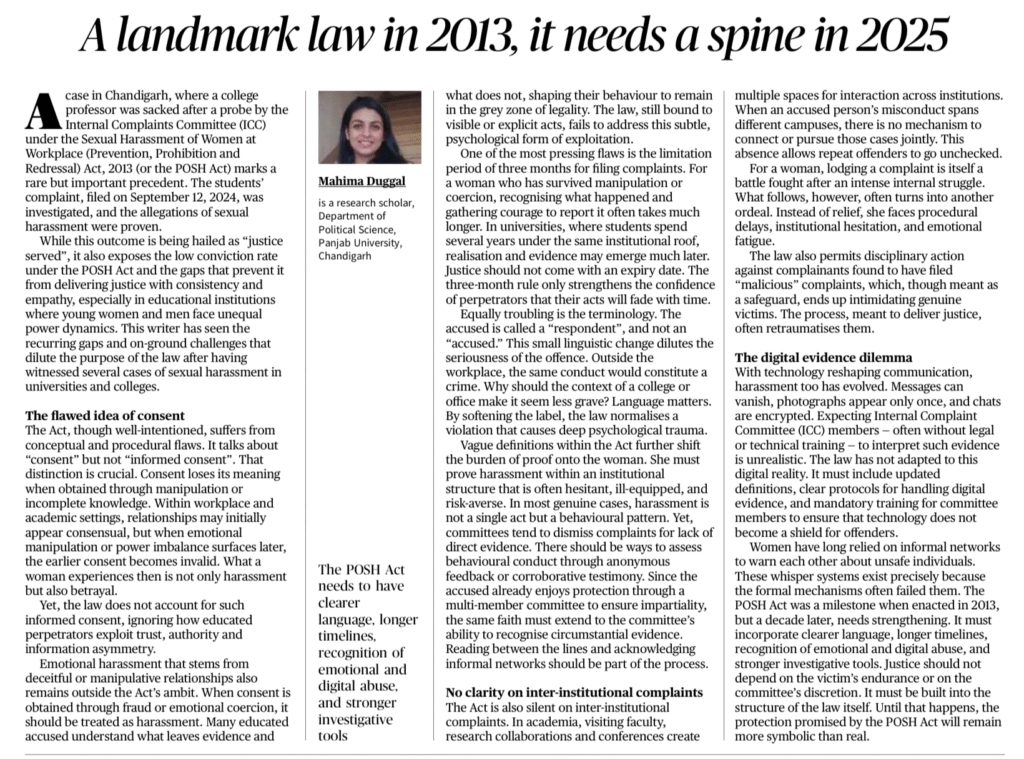
Chandigarh case shows POSH Act works rarely; highlights low conviction, procedural gaps, and power imbalance in campuses.
Key Issues in POSH Act
• Consent ≠ informed consent → law ignores manipulation, emotional coercion, power imbalance.
• 3-month filing limit unrealistic; trauma delays reporting.
• Terminology (“respondent”) softens seriousness.
• Burden of proof on woman; law ignores behavioural patterns & circumstantial evidence.
• No mechanism for inter-institutional complaints (common in academia).
• Fear of “malicious complaint” clause retraumatises victims.
Digital Age Gaps
• Harassment now via disappearing messages, encrypted chats.
• ICCs lack training; no standard protocol for digital evidence.
• Risk: tech loopholes allow offenders to escape.
What Needs Reform (2025)
• Clearer definitions: informed consent, emotional & digital abuse.
• Extend complaint timelines.
• Accept behavioural & circumstantial evidence.
• Joint ICCs across institutions.
• Digital forensics training + national guidelines.
• Victim-centric processes to prevent re-trauma.
Mains Question (as in doc)
“Despite being a landmark legislation, the POSH Act, 2013 struggles to deliver justice in educational institutions.”
Examine the conceptual and procedural gaps in the law and suggest reforms needed in the context of the digital age.
(10 marks)