Context: BHAVYA Scheme for Chemical Parks
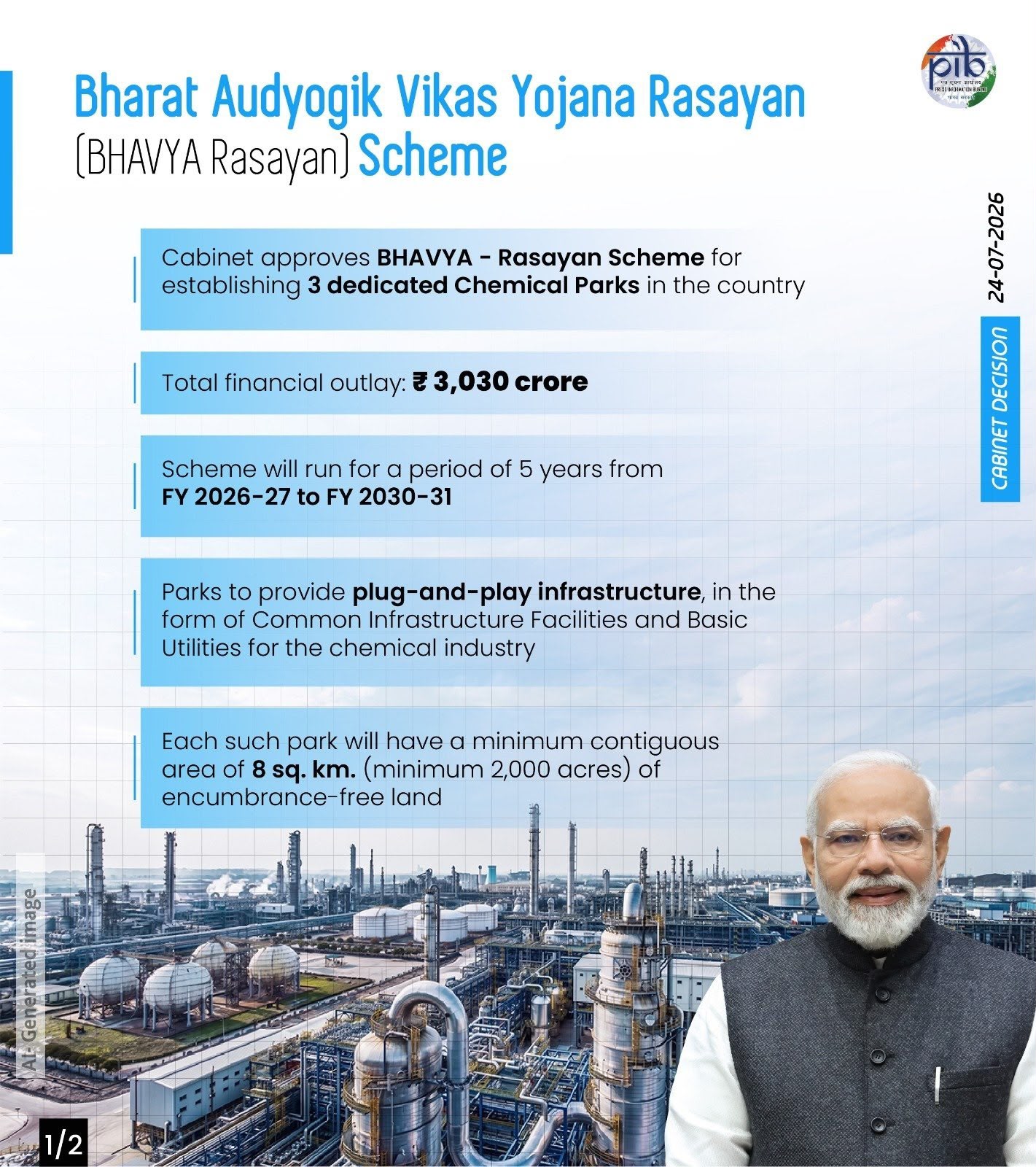
The Union Cabinet has approved the BHAVYA Scheme, or Bharat Audyogik Vikas Yojana Rasayan, to establish 3 dedicated Chemical Parks in India.
The scheme aims to create world-class common infrastructure for the chemical industry and promote manufacturing, exports, Global Value Chain integration, import substitution and employment.
BHAVYA Scheme
BHAVYA stands for Bharat Audyogik Vikas Yojana Rasayan.
It is a scheme for developing integrated chemical parks with common infrastructure and plug-and-play facilities.
Ministry
The scheme comes under the Ministry of Chemicals and Fertilizers.
Duration
The scheme will run for 5 years, from FY 2026–27 to FY 2030–31.
Financial Outlay
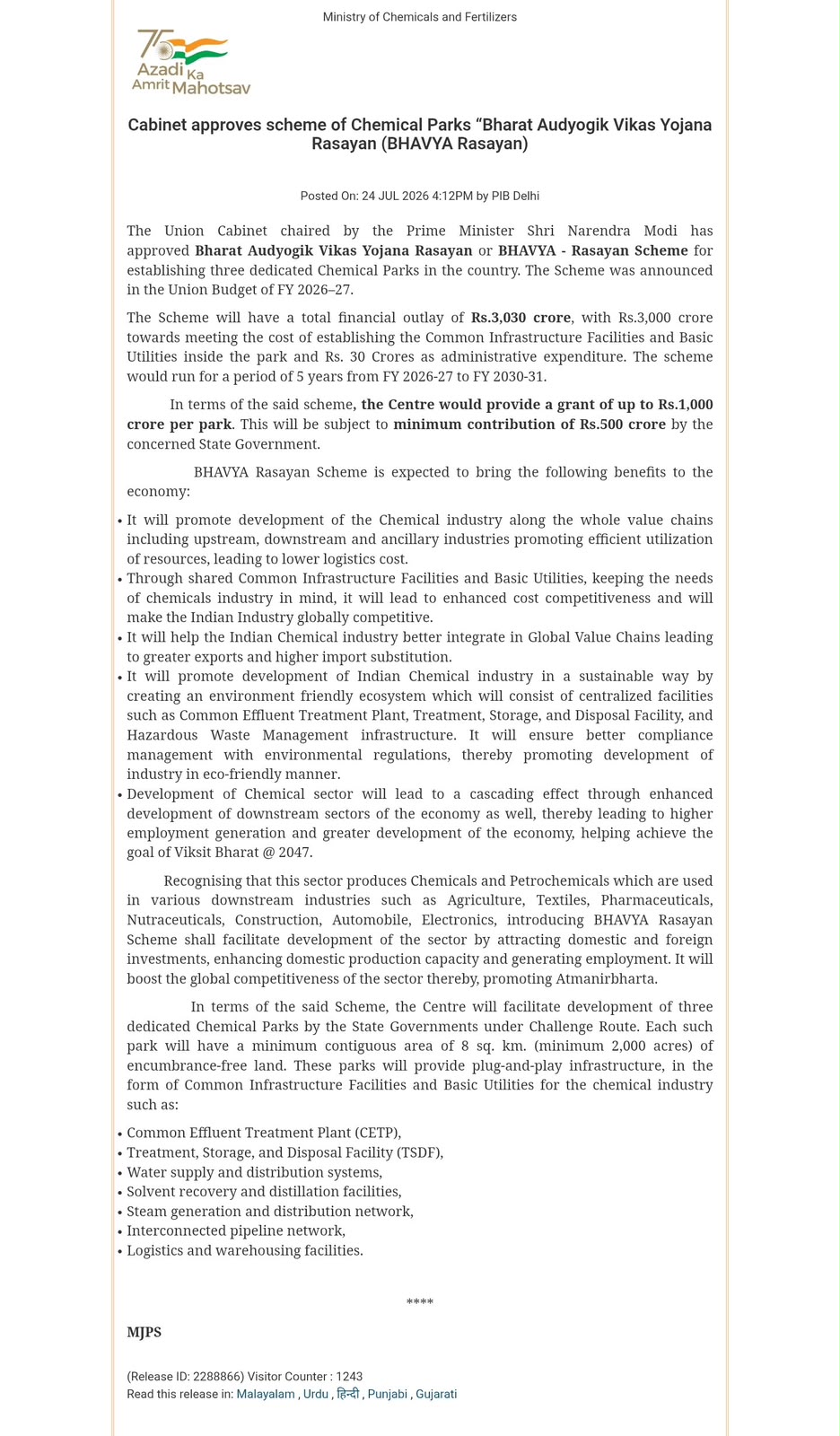
The total financial outlay is ₹3,030 crore.
This includes:
- ₹3,000 crore for infrastructure
- ₹30 crore for administrative expenditure
Funding Pattern
The Centre will provide a grant of up to ₹1,000 crore per park.
The concerned State Government will provide a minimum contribution of ₹500 crore.
Selection Method
States will be selected through a competitive Challenge Route, based on project readiness.
Eligibility
Each chemical park must have at least 8 sq. km., or around 2,000 acres, of contiguous and encumbrance-free land.
Infrastructure Facilities
The parks will provide plug-and-play infrastructure such as:
- Common Effluent Treatment Plant
- Treatment, Storage and Disposal Facility
- Water supply and distribution systems
- Steam generation and distribution network
- Solvent recovery and distillation facilities
- Interconnected pipeline network
- Logistics and warehousing facilities
Significance
The scheme will help reduce logistics costs and improve competitiveness of the chemical sector.
It will also promote sustainable manufacturing by providing common environmental infrastructure like CETP and hazardous waste management facilities.
The scheme is expected to support domestic and foreign investment, exports, employment generation, Atmanirbhar Bharat and Viksit Bharat 2047.
Key Takeaway
BHAVYA is important because it aims to build integrated chemical manufacturing ecosystems with common infrastructure, lower costs and stronger global competitiveness.