Context: Cancer Nationally Notifiable Disease
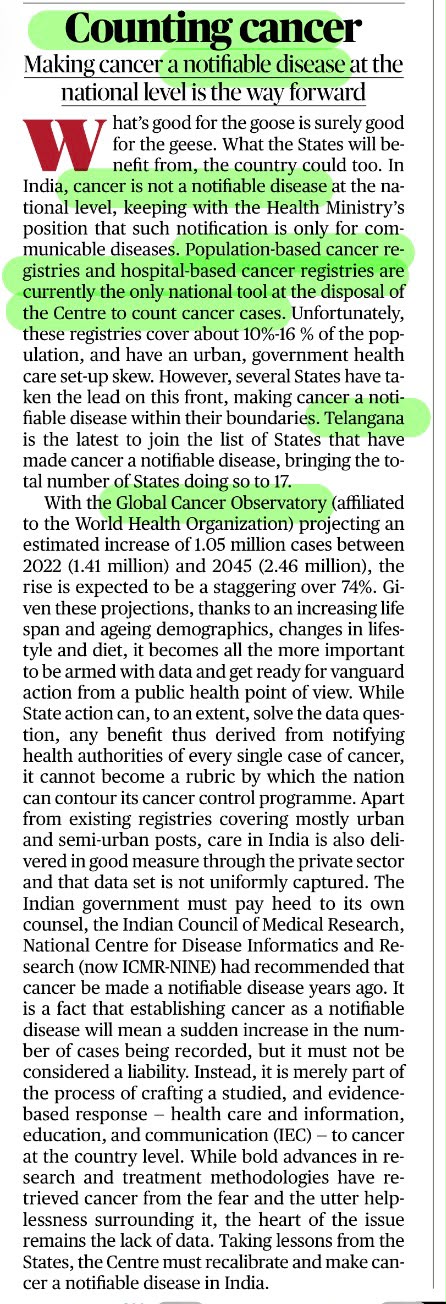
Cancer cases are projected to rise from 1.41 million in 2022 to 2.46 million in 2045, an increase of around 74%, according to the Global Cancer Observatory.
There is growing demand to make cancer a nationally notifiable disease to strengthen surveillance and evidence-based policymaking.
Present Situation
India has not yet declared cancer as a nationally notifiable disease.
However, 17 States, including Telangana, have already notified cancer under their respective public health laws.
Existing Cancer Data System in India
India currently relies on the National Cancer Registry Programme of the Indian Council of Medical Research.
Types of Registries
Population-Based Cancer Registries
- Track cancer cases in defined populations.
Hospital-Based Cancer Registries
- Track cancer cases reported in hospitals.
Limitation
These registries cover only around 10–16% of India’s population, leading to incomplete national data.
What Is a Notifiable Disease?
A notifiable disease is a disease that must be reported by:
- Hospitals
- Laboratories
- Registered medical practitioners
to the designated public health authority.
Purpose
- Surveillance
- Early detection of trends
- Public health action
- Resource planning
- Disease control
Who Can Notify a Disease?
State Governments
States can notify diseases under their respective State Public Health Acts.
This is why States like Telangana have already notified cancer.
Union Government
The Union Government can declare a disease nationally notifiable, making reporting mandatory across all States and Union Territories through a uniform framework.
Advantages of Making Cancer Nationally Notifiable
- Creates a comprehensive nationwide cancer database.
- Ensures uniform reporting from public and private healthcare facilities.
- Helps identify regional cancer hotspots.
- Enables better policy formulation.
- Improves resource allocation.
- Strengthens cancer control programmes.
- Supports research and surveillance.
- Helps plan screening, diagnosis and treatment infrastructure.
Why It Matters
Cancer care requires strong data because different regions may show different cancer patterns due to:
- Lifestyle
- Pollution
- Tobacco use
- Occupational exposure
- Genetics
- Diet
- Healthcare access
Way Forward
- Make cancer nationally notifiable.
- Strengthen cancer registries.
- Ensure mandatory reporting from private hospitals.
- Integrate cancer data with digital health systems.
- Protect patient privacy.
- Improve screening programmes.
- Use data for targeted prevention and treatment strategies.