Batch 2 Starts 16 Nov: Admissions Open! Enroll Now
US
UnderStand UPSC Daily Current Affairs Practice
0.00Score / 14
0 / 7MCQs Attempted
0%Accuracy
15–16 November 2026 • UPSC CSE

Read the news. Test the concept. Write the Mains answer.

This interactive edition converts each current-affairs item into one Prelims-level MCQ, one Mains-level question, and a compact value-addition section for revision.

+2 correct −0.66 incorrect Explanation after attempt Image/PDF answer upload
NEWS 1 GS2 • International Relations | India–Nepal Source: The Hindu

India–Nepal Train to Connect Janakpur Dham and Ayodhya

Context: Indian Railways will run a new weekly train between Janakpur Dham in Nepal and Ayodhya Cantt. in Uttar Pradesh. The link deepens cross-border connectivity, religious tourism and people-to-people ties under India's Neighbourhood First policy.
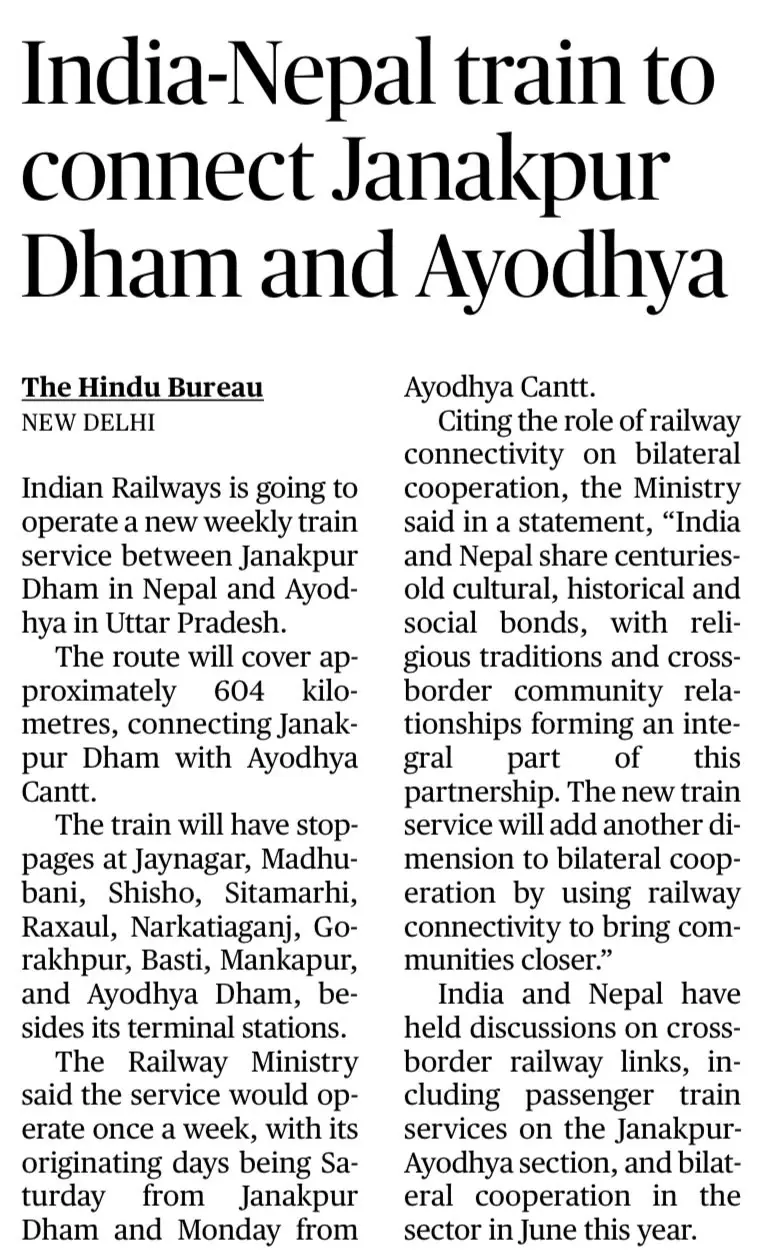
India-Nepal train to connect Janakpur Dham and Ayodhya – new weekly cross-border train (The Hindu)
India–Nepal train to connect Janakpur Dham and Ayodhya. Source: The Hindu

Janakpur–Ayodhya Rail Link

Distance
About 604 km, Janakpur Dham → Ayodhya Cantt.
Frequency
Weekly – Saturday from Janakpur, Monday from Ayodhya.
Key stops
Jaynagar, Madhubani, Sitamarhi, Raxaul, Narkatiaganj, Gorakhpur, Basti, Mankapur.
Cultural link
Janakpur – birthplace of Mata Sita; Ayodhya – birthplace of Lord Ram.
Gains
Religious tourism, local trade and cross-border community ties.

Major India–Nepal Connectivity Projects

Jaynagar–Janakpur–Bijalpura rail
Passenger link; extension to Bardibas underway.
Jogbani–Biratnagar rail
Cross-border freight connectivity.
Raxaul–Kathmandu rail
Proposed link to Nepal's capital.
Hulaki/Terai roads
Road network across southern Nepal.
ICPs
Operational at Birgunj, Biratnagar, Nepalgunj; new ones planned at Bhairahawa and Dodhara Chandani.
Motihari–Amlekhgunj pipeline
South Asia's first cross-border petroleum pipeline; Siliguri–Jhapa pipeline proposed.

Hydropower & Water Cooperation

Arun III (900 MW)
On the Arun river, built by India's SJVN.
Lower Arun (~670 MW)
Additional capacity on the Arun.
Pancheshwar
Multipurpose project on the Mahakali – power, irrigation, flood control.
Kosi Agreement
1954 (revised 1966) – flood control, irrigation.
Gandak Agreement
1959 (revised 1964) – irrigation.
Mahakali Treaty
1996 – equitable use of Mahakali waters, incl. Pancheshwar.

Development Partnership

Health
B.P. Koirala Institute, Dharan; Emergency & Trauma Centre, Kathmandu.
Capacity building
Schools and the Nepal Police Academy, Panauti.
Reconstruction
Support after the 2015 earthquake.
HICDPs
High Impact Community Development Projects – schools, water, sanitation.

Significance & Way Forward

Strategic
Strengthens Neighbourhood First and regional integration.
Energy
Cross-border electricity trade improves energy security.
Delivery
Finish rail, road and pipeline projects on time.
Trust
Fair water and hydropower benefit-sharing; resilient infrastructure.
Key Takeaway: Railways that link Janakpur and Ayodhya connect more than two cities – they turn shared civilisational ties into trade, tourism and trust. Timely delivery of projects is the key to India's credibility in Nepal.

Prelims Practice MCQ

+2 correct • −0.66 wrong

Consider the following statements regarding India–Nepal cooperation:
1. The Mahakali Treaty of 1996 covers the Pancheshwar Multipurpose Project.
2. Janakpur in Nepal is traditionally regarded as the birthplace of Mata Sita.
3. The Raxaul–Kathmandu railway line is already operational.
Which of the statements given above are correct?

Explanation: The Mahakali Treaty (1996) provides for the integrated development of the Mahakali river, including Pancheshwar, and Janakpur is associated with Mata Sita. The Raxaul–Kathmandu railway is still a proposed project, so Statement 3 is wrong.

UPSC Mains Question

GS2 • 15 Marks • 250 Words

Connectivity projects are central to India's Neighbourhood First policy. Examine the role of cross-border infrastructure in strengthening India–Nepal relations and the challenges in their implementation.

Attempt before opening the value-addition tab.
Accepted: JPG, JPEG, PNG, WEBP or PDF. The standalone file previews your answer locally; connect the API hook for real server submission.
Use after attempting the Mains answer
  • PYQ trend — UPSC asks about Indian projects in neighbours with location and partner country (e.g. Mangdechhu–Bhutan, Stor Palace–Afghanistan, Dickoya hospital–Sri Lanka).
  • Treaties — India–Nepal Treaty of Peace and Friendship (1950), Kosi (1954), Gandak (1959), Mahakali (1996).
  • Concepts — Neighbourhood First, BBIN, cross-border electricity trade, soft-power and civilisational diplomacy (Ramayana Circuit).
  • Keywords — connectivity diplomacy, people-to-people ties, project delivery deficit.
NEWS 2 GS3 • Science & Technology | International Cooperation Source: The Hindu

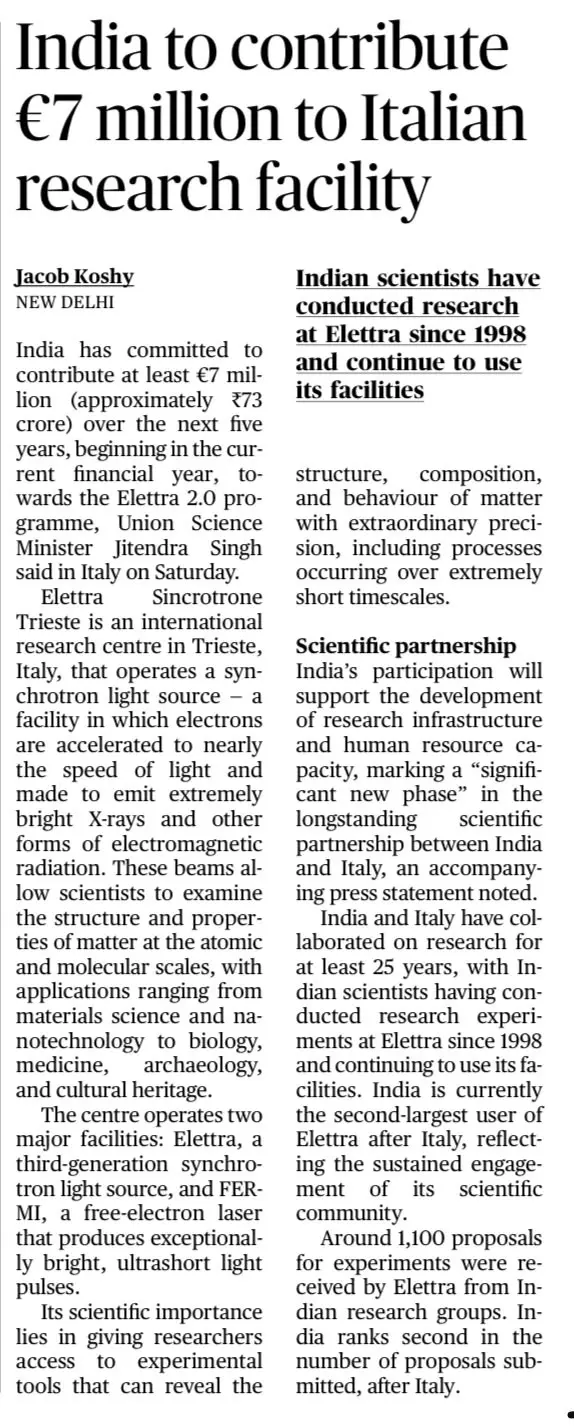
India to Contribute €7 Million to Italy's Elettra Research Facility

Context: India has committed at least €7 million (about ₹73 crore) over five years to the Elettra 2.0 programme at Elettra Sincrotrone Trieste, Italy, marking a new phase in India–Italy scientific cooperation.

India to contribute 7 million euro to Italian research facility Elettra Sincrotrone Trieste (The Hindu)
India to contribute €7 million to Elettra, Italy. Source: The Hindu

What Is Elettra Sincrotrone?

Location
Trieste, Italy – an international research centre.
Synchrotron
Accelerates electrons to near light speed to emit extremely bright X-rays.
Elettra
A third-generation synchrotron light source.
FERMI
A free-electron laser giving ultrashort, very bright light pulses.
Use
Study the structure and behaviour of matter at atomic and molecular scale.

India–Italy Science Partnership

Commitment
€7 million (~₹73 crore) over 5 years, from the current financial year.
Since 1998
Indian scientists have run experiments at Elettra for over 25 years.
Big user
India is the second-largest user after Italy.
Proposals
About 1,100 experiment proposals from Indian groups.

Applications

Materials
New materials, batteries, semiconductors.
Nanotech
Understanding matter at the nanoscale.
Biology & medicine
Protein structures and drug design.
Heritage
Non-destructive study of archaeological artefacts.

Other Global Research Facilities

LHC (CERN)
France–Switzerland border – particle collisions, fundamental physics.
LIGO
USA – gravitational waves; LIGO-India coming up in Maharashtra.
FAIR
Germany – antimatter, nuclear and hadron physics.
SKA
Australia & South Africa – radio astronomy.
Elettra vs LHC
Elettra uses electrons to make light to study matter; LHC collides particles to study fundamental forces.

PYQ Linkage

UPSC Prelims 2009: In 2008, which organisation conducted an experiment in which subatomic particles were accelerated to nearly the speed of light? Answer – European Organization for Nuclear Research (CERN).

Lesson: UPSC repeatedly tests big science facilities – what they do, where they are and India's role in them.

Key Takeaway: Access to world-class facilities like Elettra lets Indian scientists do frontier research without building every machine at home. Such partnerships also build human capacity for India's own future facilities.

Prelims Practice MCQ

+2 correct • −0.66 wrong

With reference to Elettra Sincrotrone Trieste, consider the following statements:
1. It operates a synchrotron light source in which electrons are accelerated to nearly the speed of light.
2. India is the largest user of the facility.
3. It is located in Geneva, Switzerland.
Which of the statements given above is/are correct?

Explanation: Elettra accelerates electrons to produce intense X-rays and other radiation. India is the second-largest user after Italy, and the facility is in Trieste, Italy; CERN is near Geneva.

UPSC Mains Question

GS3 • 10 Marks • 150 Words

How does participation in international mega-science facilities benefit India's scientific research ecosystem? Illustrate with examples.

Attempt before opening the value-addition tab.
Accepted: JPG, JPEG, PNG, WEBP or PDF. The standalone file previews your answer locally; connect the API hook for real server submission.
Use after attempting the Mains answer
  • India's mega-science links — CERN (associate member), ITER, FAIR, Thirty Meter Telescope, SKA, LIGO-India.
  • Indian facility — Indus-1 and Indus-2 synchrotron sources at RRCAT, Indore.
  • Concepts — synchrotron radiation, free-electron laser, science diplomacy.
  • Keywords — research infrastructure, capacity building, global scientific collaboration.
NEWS 3 GS2 • International Relations | West Asia & UN Source: The Hindu (PTI)

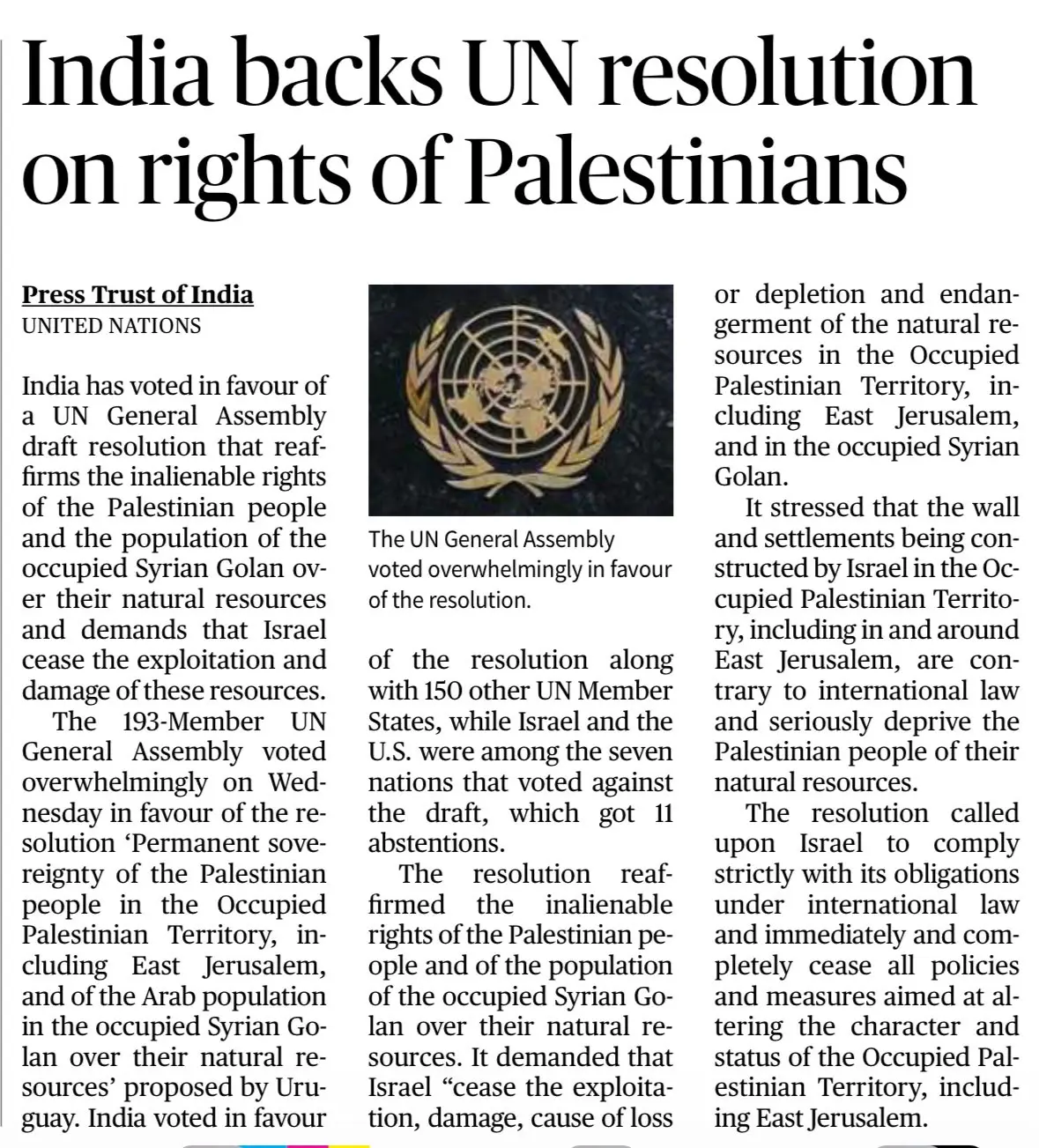
India Backs UN Resolution on Palestinian Rights over Natural Resources

Context: India voted in favour of a UN General Assembly resolution reaffirming the permanent sovereignty of the Palestinian people, and of the population of the occupied Syrian Golan, over their natural resources.

India backs UN resolution on rights of Palestinians over natural resources (The Hindu)
India backs UN resolution on rights of Palestinians. Source: The Hindu / PTI

The Resolution

Title
'Permanent sovereignty of the Palestinian people in the Occupied Palestinian Territory, including East Jerusalem, and of the Arab population in the occupied Syrian Golan over their natural resources'.
Proposed by
Uruguay.
Vote
151 in favour, 7 against (incl. Israel and the US), 11 abstentions.
India
Voted in favour.

Key Demands

Resources
Israel must cease exploitation, damage and depletion of natural resources.
Settlements
Wall and settlements in and around East Jerusalem are contrary to international law.
Status quo
End measures altering the character and status of the occupied territory.
Compliance
Israel to follow its obligations under international law.

India's Position on Palestine

PLO
India recognised the PLO in 1974 – first non-Arab country to do so.
State of Palestine
Recognised in 1988.
Two-State Solution
A sovereign, independent, viable Palestine living side by side with Israel.
Balance
Strong ties with Israel along with support for Palestinian rights.

Significance for India

Rules-based order
Reaffirms faith in the UN framework and international law.
Continuity
Consistent with India's long support for Palestinian self-determination.
Strategic autonomy
Keeps engagement with both sides and the Arab world.
Global South
Aligns India with the majority view of developing countries.
Key Takeaway: India's vote shows continuity: support for Palestinian rights and a two-state solution, while keeping a close strategic partnership with Israel – a balance rooted in strategic autonomy.

Prelims Practice MCQ

+2 correct • −0.66 wrong

Consider the following statements:
1. The UNGA resolution on permanent sovereignty of the Palestinian people over natural resources was proposed by Uruguay.
2. The United States voted in favour of the resolution.
3. India recognised the State of Palestine in 1988.
Which of the statements given above are correct?

Explanation: Uruguay proposed the resolution, and India recognised the State of Palestine in 1988. The US and Israel were among the seven countries that voted against it, so Statement 2 is wrong.

UPSC Mains Question

GS2 • 15 Marks • 250 Words

India's West Asia policy seeks to balance support for Palestinian rights with a strategic partnership with Israel. Critically examine.

Attempt before opening the value-addition tab.
Accepted: JPG, JPEG, PNG, WEBP or PDF. The standalone file previews your answer locally; connect the API hook for real server submission.
Use after attempting the Mains answer
  • Milestones — PLO recognition (1974), State of Palestine (1988), full diplomatic ties with Israel (1992), de-hyphenation policy.
  • Links — I2U2, IMEC (India–Middle East–Europe Economic Corridor), energy security, diaspora in the Gulf.
  • UN facts — UNGA resolutions are recommendatory, not legally binding.
  • Keywords — two-state solution, strategic autonomy, international humanitarian law.
NEWS 4 GS2 • International Relations | GS3 • Indian Economy Source: The Hindu (PTI)

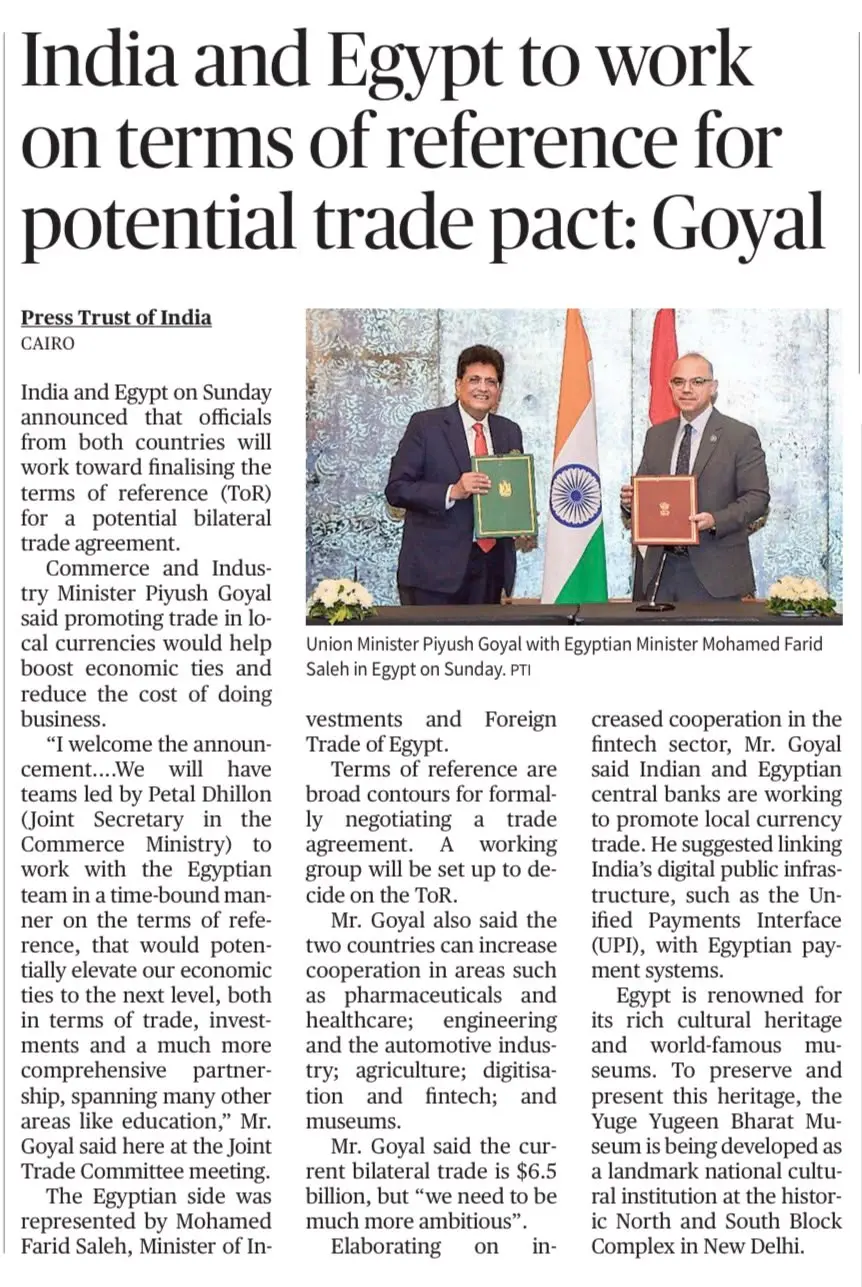
India and Egypt to Work on Terms of Reference for a Trade Pact

Context: At the Joint Trade Committee meeting in Cairo, India and Egypt agreed to finalise the Terms of Reference (ToR) for a potential bilateral trade agreement. Bilateral trade currently stands at about US$6.5 billion.

India and Egypt to work on terms of reference for potential trade pact – Piyush Goyal in Cairo (The Hindu)
India and Egypt to work on terms of reference for a trade pact. Source: The Hindu / PTI

Key Announcements

ToR
A working group will finalise the ToR in a time-bound manner.
Trade
About US$6.5 billion; Goyal: 'we need to be much more ambitious'.
Local currency
Central banks working on local-currency trade to cut costs.
Fintech
Proposal to link UPI with Egyptian payment systems.
Sectors
Pharma, healthcare, engineering, automobiles, agriculture, digitisation, museums.

What Is a Terms of Reference?

The ToR is the preliminary framework that sets the scope, objectives and process for negotiating a trade agreement. Finalising the ToR does not mean an FTA has been concluded – it only opens the door to formal talks.

Scope
Goods, services and investment.
Objectives
Lower trade barriers, better market access.
Mechanism
Working groups and institutional roles.
Timeline
Schedule and milestones.

Stages of an FTA

1. Exploratory talks
Assess feasibility and trade potential.
2. ToR
Define scope and negotiating framework.
3. Negotiations
Tariffs, services, investment, rules of origin.
4. Legal scrubbing
Finalise text and tariff schedules.
5. Signing & approval
Sign and complete domestic procedures.
6. Entry into force
Agreement becomes operational; then monitoring.

Core Components of an FTA

Goods
Cut or remove customs duties.
Services
Access for IT, banking, healthcare.
Rules of origin
Decide which products qualify for concessions.
Trade facilitation
Simpler customs and documentation.
Dispute settlement
Mechanism to resolve disagreements.

Why Egypt Matters

Gateway
Bridge to Africa, Arab world and Europe; controls the Suez Canal.
Partnership
Ties elevated to a Strategic Partnership (2023).
Food & fertiliser
Key partner for wheat and fertiliser supply chains.
Global South
Both are NAM founders and BRICS members.
Key Takeaway: The ToR is a first step, not a deal. A trade pact with Egypt can open a gateway to Africa and the Arab world, especially if paired with local-currency trade and UPI linkage.

Prelims Practice MCQ

+2 correct • −0.66 wrong

Consider the following statements:
1. Finalisation of the Terms of Reference means that the Free Trade Agreement has been concluded.
2. Rules of origin determine whether a product is eligible for concessions under an FTA.
3. Egypt is a member of BRICS.
Which of the statements given above are correct?

Explanation: Rules of origin decide which goods qualify for FTA concessions, and Egypt joined BRICS in 2024. The ToR is only the framework for negotiations, not a concluded agreement, so Statement 1 is wrong.

UPSC Mains Question

GS2 • 15 Marks • 250 Words

Discuss the significance of Egypt for India's engagement with Africa and West Asia. How can trade and fintech cooperation deepen the bilateral partnership?

Attempt before opening the value-addition tab.
Accepted: JPG, JPEG, PNG, WEBP or PDF. The standalone file previews your answer locally; connect the API hook for real server submission.
Use after attempting the Mains answer
  • History — Nehru–Nasser friendship, NAM (1961); Egypt's President was Chief Guest at Republic Day 2023.
  • Economy — Suez Canal Economic Zone, local-currency settlement (SRVA), UPI internationalisation.
  • Concepts — FTA vs CEPA vs PTA, rules of origin, ToR.
  • Keywords — gateway to Africa, South–South cooperation, trade diversification.
NEWS 5 GS2 • Governance | GS3 • Indian Economy Source: The Indian Express

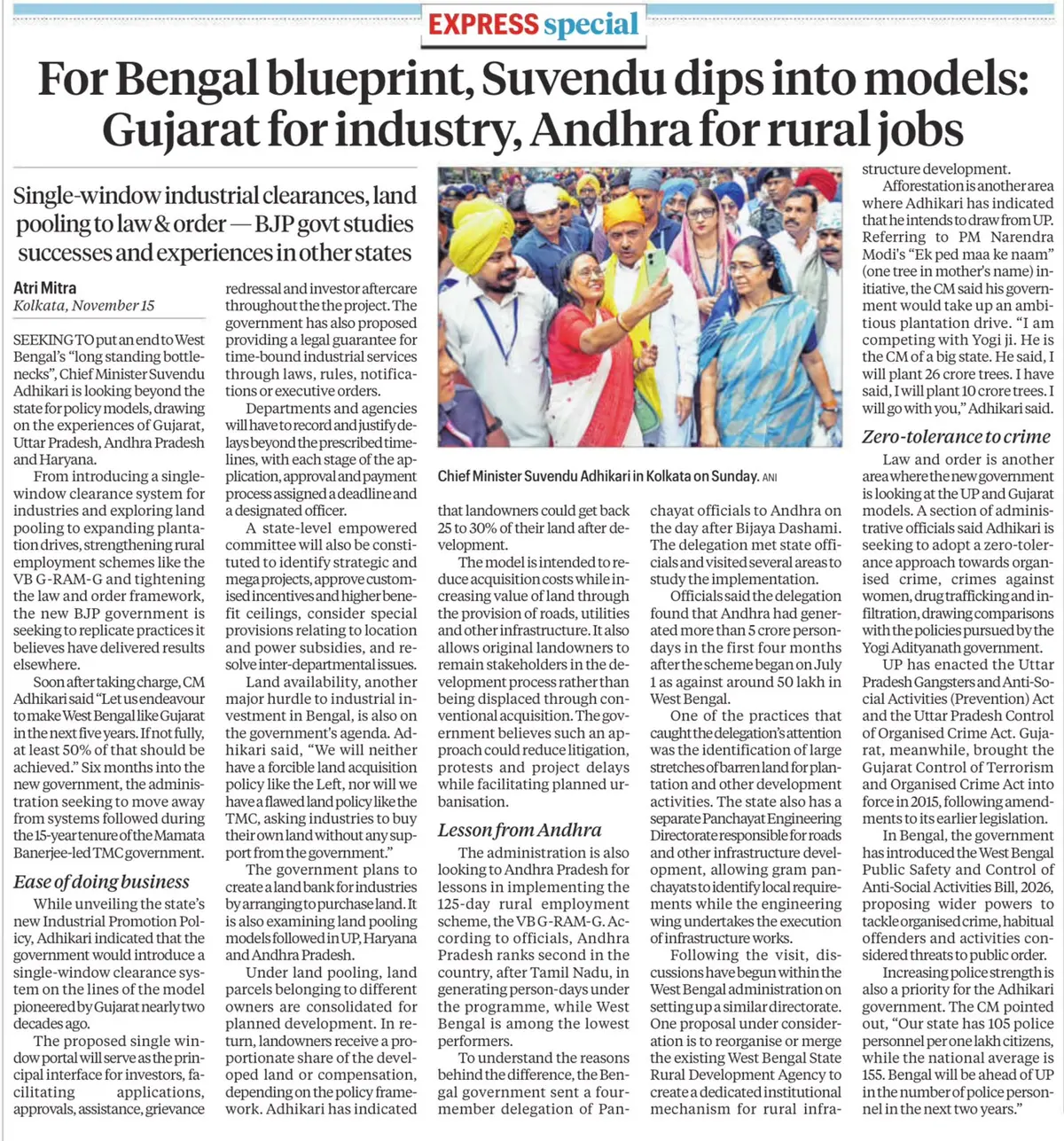
Gujarat for Industry, Andhra for Rural Jobs: Lessons for West Bengal

Context: West Bengal Chief Minister Suvendu Adhikari is borrowing policy models from other states – Gujarat for industrial clearances, Andhra Pradesh for rural employment, and UP and Gujarat for law and order – to end the state's long-standing bottlenecks.

For Bengal blueprint, Suvendu dips into models – Gujarat for industry, Andhra for rural jobs (The Indian Express)
West Bengal studies Gujarat and Andhra models. Source: The Indian Express

Gujarat Model: Industry

Single window
One portal for approvals, assistance and grievance redressal.
Time-bound services
Legal guarantee of deadlines; delays must be recorded and justified.
Empowered committee
State-level panel for mega projects and custom incentives.
Land bank
State to buy land for industries; no forcible acquisition.
Land pooling
Landowners may get back 25–30% of their land after development.

Andhra Model: Rural Jobs

Scheme
VB-G-RAM-G – 125-day rural employment guarantee.
Performance
AP: 5 crore+ person-days in 4 months vs ~50 lakh in West Bengal.
Ranking
AP is second after Tamil Nadu in person-days.
Engineering wing
Separate Panchayat Engineering Directorate executes works.
Planning
Gram Panchayats identify local needs; barren land used for plantations.

Other Borrowed Ideas

Afforestation
Target of 10 crore trees, inspired by UP and 'Ek Ped Maa Ke Naam'.
Law & order
Zero tolerance on organised crime; new West Bengal Public Safety Bill, 2026.
Policing
Bengal has 105 police personnel per lakh vs national average of 155.

Key Concepts

Person-day
One person working for one day; 100 workers × 10 days = 1,000 person-days.
Land pooling
Owners pool land, get a share of developed land – cuts litigation and acquisition cost.
Single window
One-stop clearance – improves ease of doing business.

Lessons & Cautions

Balance
Combine industry and rural jobs instead of a single strategy.
Accountability
Deadlines, designated officers, monitoring.
Decentralisation
Empower Panchayats with funds and engineering support.
Adapt, don't copy
Fit models to local land, geography and politics.
Key Takeaway: States learning from each other is competitive federalism at work. Success, however, depends on adapting models to local conditions and building strong institutions to deliver them.

Prelims Practice MCQ

+2 correct • −0.66 wrong

Consider the following statements:
1. Under land pooling, landowners receive a share of the developed land or compensation in return for their land.
2. One person employed for one day equals one person-day.
3. The VB-G-RAM-G scheme guarantees 100 days of wage employment.
Which of the statements given above are correct?

Explanation: Land pooling gives owners a share of the developed land, and a person-day is one person working for one day. VB-G-RAM-G provides 125 days of rural employment, so Statement 3 is wrong.

UPSC Mains Question

GS2 • 15 Marks • 250 Words

"Competitive and cooperative federalism allows states to learn from each other's successful policy models." Discuss with examples, highlighting the limits of replicating such models.

Attempt before opening the value-addition tab.
Accepted: JPG, JPEG, PNG, WEBP or PDF. The standalone file previews your answer locally; connect the API hook for real server submission.
Use after attempting the Mains answer
  • Examples — Gujarat (iNDEXTb single window), Andhra (Amaravati land pooling), Tamil Nadu (women's factory workforce), Kerala (local planning).
  • Indices — BRAP (Business Reform Action Plan) state rankings, NITI Aayog indices.
  • Concepts — competitive federalism, land pooling vs land acquisition (LARR Act 2013), person-days.
  • Keywords — ease of doing business, decentralised planning, policy diffusion.
NEWS 6 GS2 • Social Justice | GS3 • Indian Economy Source: The Indian Express

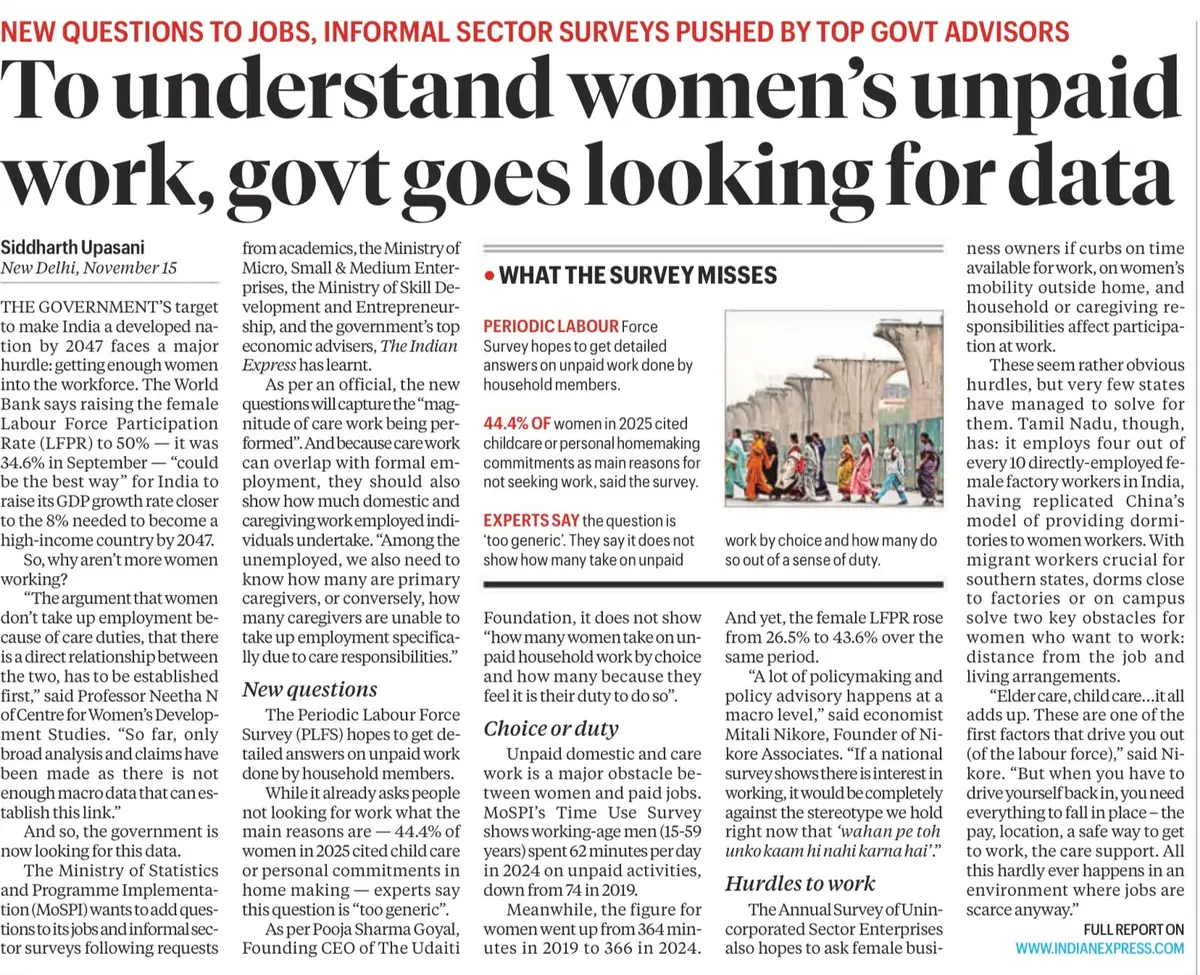
Measuring Women's Unpaid Work: Government Seeks Better Data

Context: MoSPI plans to add new questions to the Periodic Labour Force Survey (PLFS) and informal-sector surveys to measure women's unpaid domestic and care work, and how it keeps them out of paid jobs.

To understand women's unpaid work, govt goes looking for data – PLFS and Time Use Survey (The Indian Express)
To understand women's unpaid work, govt goes looking for data. Source: The Indian Express

Why Better Data Is Needed

Viksit Bharat
World Bank: raising female LFPR to 50% could push growth towards the 8% needed by 2047.
Current LFPR
Female LFPR was 34.6% in September 2026.
Care burden
44.4% of women (2025) cited childcare or homemaking as the reason for not seeking work.
Data gap
Experts call the current question 'too generic' – it can't separate choice from duty.

What Will Change

Magnitude
Capture the scale of care work at home.
Caregivers
Count primary caregivers among the unemployed.
Choice vs duty
How many do unpaid work by choice and how many out of duty.
Business owners
Annual Survey of Unincorporated Enterprises to ask women owners about time, mobility and care limits.

Key Data (Time Use Survey)

Women
366 min/day on unpaid work in 2024 (364 in 2019).
Men (15–59)
62 min/day in 2024, down from 74 in 2019.
Female LFPR
Rose from 26.5% to 43.6% over the same period.
Insight
More women working has not reduced their unpaid load – a double burden.

Barriers to Women's Employment

Care duties
Childcare, eldercare, housework.
Mobility
Distance, unsafe transport.
Infrastructure
Few affordable crèches and hostels.
Social norms
Care seen as 'women's duty'.

Way Forward

Measure it
Make unpaid work visible in regular surveys and satellite accounts.
Care economy
Affordable childcare, Palna crèches, community care.
TN model
Tamil Nadu employs 4 in 10 women factory workers – dorms near factories.
Share the load
Promote equal sharing of domestic work; flexible, safe jobs near home.
Key Takeaway: What is not measured is not valued. Counting unpaid care work is the first step to designing policies – childcare, safe transport, housing – that let more women choose paid work.

Prelims Practice MCQ

+2 correct • −0.66 wrong

Consider the following statements:
1. The Periodic Labour Force Survey is conducted by the Ministry of Statistics and Programme Implementation (MoSPI).
2. As per the Time Use Survey 2024, women spend far more time on unpaid activities than men.
3. The Labour Force Participation Rate includes both people who are working and those seeking or available for work.
Which of the statements given above are correct?

Explanation: The PLFS is conducted by MoSPI (NSO). Women spent about 366 minutes a day on unpaid activities in 2024, against 62 minutes for men. LFPR counts the employed plus those seeking or available for work, so all three statements are correct.

UPSC Mains Question

GS2 • 15 Marks • 250 Words

Unpaid care work remains a major barrier to women's participation in the labour force in India. Discuss the measures needed to recognise, reduce and redistribute this work.

Attempt before opening the value-addition tab.
Accepted: JPG, JPEG, PNG, WEBP or PDF. The standalone file previews your answer locally; connect the API hook for real server submission.
Use after attempting the Mains answer
  • Framework — ILO's 3R/5R: Recognise, Reduce, Redistribute (+ Reward, Representation) unpaid care work.
  • Schemes — Palna (Mission Shakti), Working Women Hostels (Sakhi Niwas), Maternity Benefit Act 2017, Code on Social Security.
  • Data — Time Use Survey (2019, 2024), PLFS, SDG 5.4 (value unpaid care work).
  • Keywords — care economy, double burden, female LFPR, gender budgeting.
NEWS 7 GS2 • Indian Polity | Fundamental Rights Source: The Hindu

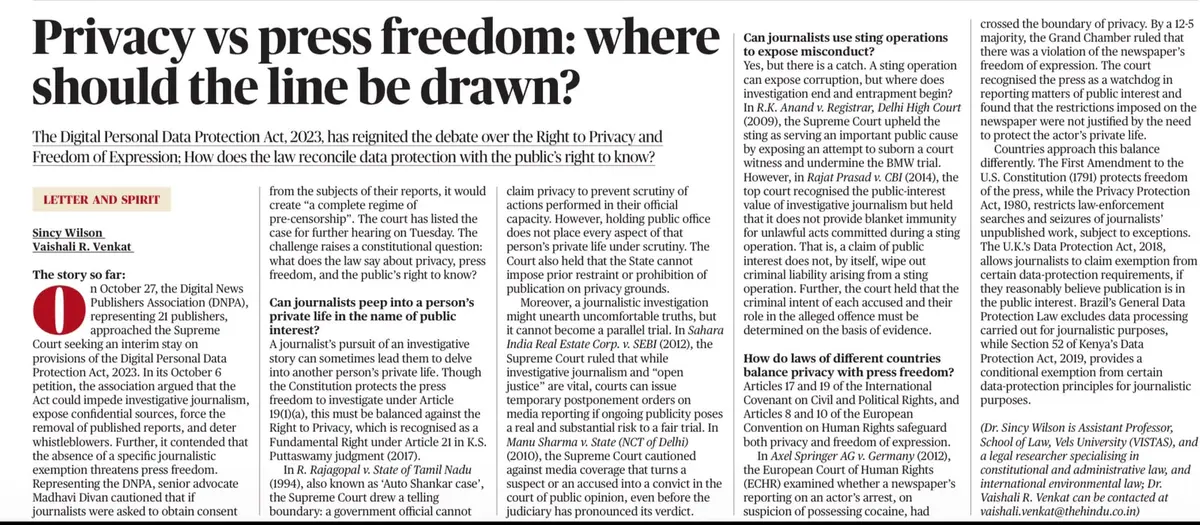
Privacy vs Press Freedom: Where Should the Line Be Drawn?

Context: The Digital News Publishers Association (DNPA), representing 21 publishers, has sought an interim stay on provisions of the Digital Personal Data Protection (DPDP) Act, 2023, arguing that the law could stifle investigative journalism. The case revives the balance between privacy (Article 21) and press freedom (Article 19(1)(a)).

Privacy vs press freedom – where should the line be drawn, DPDP Act 2023 (The Hindu)
Privacy vs press freedom: where should the line be drawn? Source: The Hindu

The Challenge to the DPDP Act

Petitioner
DNPA (21 publishers); petition filed 6 October, stay sought 27 October.
Concerns
Could expose sources, force removal of reports and deter whistleblowers.
Consent problem
Seeking consent from subjects = 'pre-censorship' (Madhavi Divan).
No exemption
The Act has no specific journalistic exemption.

Relevant Provisions of the DPDP Act

Section 3(c)(ii)
Excludes data made public by the person or under a legal duty – a limited exclusion.
Sections 4–6
Grounds, notice and consent for processing personal data.
Section 8
Duties of data fiduciaries – security, accuracy, erasure.
Section 17
Exemptions for legal proceedings, law enforcement, research – not journalism.

The Constitutional Balance

Right to Privacy
Article 21 – dignity, autonomy, personal data (K.S. Puttaswamy, 2017).
Press freedom
Article 19(1)(a) – investigate and report on public interest.
Limits
Both are not absolute; Article 19(2) allows reasonable restrictions.

Key Judgments

R. Rajagopal (1994)
'Auto Shankar case' – officials can't use privacy to block reports on official conduct; no prior restraint.
R.K. Anand (2009)
Upheld a sting operation exposing an attempt to subvert the BMW trial.
Manu Sharma (2010)
Warned against media trials that turn suspects into convicts.
Sahara v. SEBI (2012)
Courts may postpone reporting if there is real risk to a fair trial.
Rajat Prasad v. CBI (2014)
Sting journalism gives no blanket immunity for unlawful acts.
Axel Springer v. Germany (2012)
ECHR Grand Chamber (12–5) upheld a newspaper's report on an actor's arrest as public-interest journalism.

Global Approaches

USA
First Amendment; Privacy Protection Act, 1980 limits searches of journalists' work.
UK
Data Protection Act, 2018 – exemption if publication is in the public interest.
Brazil
General Data Protection Law excludes journalistic processing.
Kenya
Section 52, Data Protection Act, 2019 – conditional exemption.
International law
Articles 17 & 19 ICCPR; Articles 8 & 10 ECHR.

Way Forward

Journalistic exemption
A narrow, public-interest exemption in the DPDP framework.
Public interest test
Separate genuine scrutiny from needless intrusion.
Source protection
Protect sources while ensuring accuracy and fairness.
Proportionality
Restrictions must be necessary and proportionate.
Key Takeaway: Neither privacy nor press freedom is absolute. A narrow, public-interest journalistic exemption in the DPDP framework can protect both – the citizen's dignity and the public's right to know.

Prelims Practice MCQ

+2 correct • −0.66 wrong

Consider the following statements:
1. The Supreme Court recognised the Right to Privacy as a Fundamental Right under Article 21 in the K.S. Puttaswamy case (2017).
2. The DPDP Act, 2023 provides an express blanket exemption for journalistic activities.
3. R. Rajagopal v. State of Tamil Nadu (1994) is also known as the 'Auto Shankar case'.
Which of the statements given above are correct?

Explanation: Puttaswamy (2017) made privacy a Fundamental Right, and R. Rajagopal (1994) is known as the Auto Shankar case. The DPDP Act's Section 17 exemptions do not include a general exemption for journalism, so Statement 2 is wrong.

UPSC Mains Question

GS2 • PYQ 2017 • 15 Marks

Examine the scope of Fundamental Rights in the light of the latest judgement of the Supreme Court on Right to Privacy.

Attempt before opening the value-addition tab.
Accepted: JPG, JPEG, PNG, WEBP or PDF. The standalone file previews your answer locally; connect the API hook for real server submission.
Use after attempting the Mains answer
  • Committee — Justice B.N. Srikrishna Committee (2018) had recommended an exemption for journalistic purposes.
  • Laws — DPDP Act 2023, DPDP Rules 2025, RTI Act (Section 8(1)(j) amended by DPDP Act).
  • Concepts — prior restraint, public interest test, proportionality (Puttaswamy), chilling effect.
  • Keywords — informational privacy, press freedom, investigative journalism, media trial.

Copyright © 2026 USARAMBHA EDUCATION (UnderStand UPSC). All Rights Reserved.