
Batch 2 Starts 16 Nov: Admissions Open! Enroll Now
US
UnderStand UPSC Daily Current Affairs Practice
0.00Score / 12
0 / 6MCQs Attempted
0%Accuracy
17 November 2026 • UPSC CSE

Read the news. Test the concept. Write the Mains answer.

This interactive edition converts each current-affairs item into one Prelims-level MCQ, one Mains-level question, and a compact value-addition section for revision.

+2 correct −0.66 incorrect Explanation after attempt Image/PDF answer upload
NEWS 1 GS2 • Health | GS3 • Environment Source: The Hindu

The Road to a Disease-Free World Goes Through Water

Context: Ending diseases like polio needs more than vaccines. Safe drinking water, sanitation and hygiene (WASH), along with wastewater surveillance, are now seen as core public-health infrastructure.
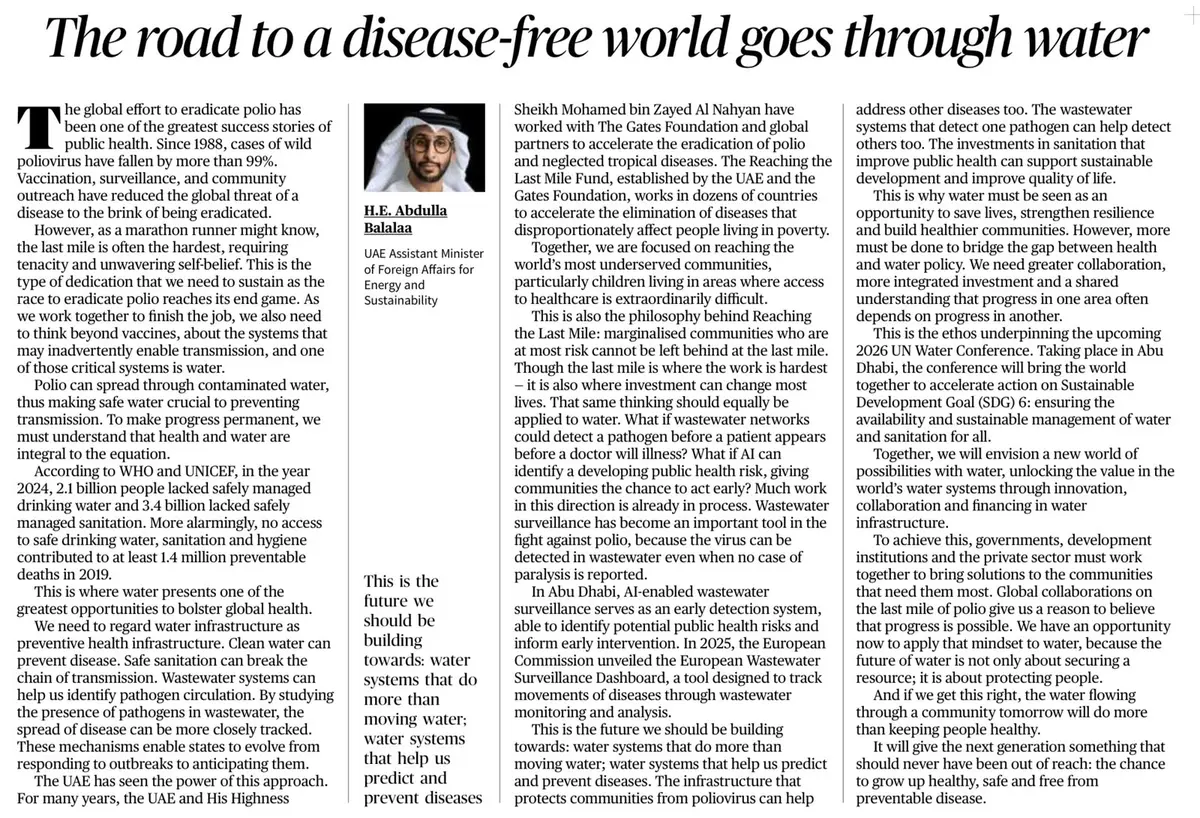
The road to a disease-free world goes through water – WASH, polio and wastewater surveillance (The Hindu)
The road to a disease-free world goes through water. Source: The Hindu

Why Water Matters for Health

Polio spread
Poliovirus spreads mainly by the faecal–oral route, including contaminated water and food.
Progress
Wild poliovirus cases have fallen by over 99% since 1988.
Water gap (2024)
2.1 billion people lacked safely managed drinking water (WHO–UNICEF).
Sanitation gap (2024)
3.4 billion lacked safely managed sanitation.
Deaths
Unsafe WASH caused at least 1.4 million preventable deaths in 2019.

Water Infrastructure = Health Infrastructure

Safe drinking water
Stops waterborne pathogens.
Sanitation
Breaks the chain of transmission.
Wastewater surveillance
Detects pathogens in sewage before outbreaks spread.
Early warning
Helps move from reacting to outbreaks to anticipating them.

Technology & Global Initiatives

AI surveillance
Abu Dhabi uses AI-enabled wastewater surveillance for early detection.
Polio detection
Virus found in wastewater even when no paralysis case is reported.
EU Dashboard (2025)
European Wastewater Surveillance Dashboard tracks disease trends.
Reaching the Last Mile Fund
By the UAE and Gates Foundation – polio and neglected tropical diseases.
UN Water Conference 2026
In Abu Dhabi to speed up SDG 6 – clean water and sanitation for all.

Way Forward

Integrated WASH
Treat water and sanitation as part of health policy.
Surveillance
Expand wastewater monitoring to more pathogens.
Last mile
Prioritise underserved communities.
Partnerships
Joint financing by governments, development banks and private sector.
Key Takeaway: Clean water and sanitation are preventive health infrastructure. Combining WASH with wastewater surveillance can help finish polio and catch the next outbreak early.

Prelims Practice MCQ

+2 correct • −0.66 wrong

With reference to wastewater surveillance, consider the following statements:
1. It can detect poliovirus in sewage even before any case of paralysis is reported.
2. It can be used only for poliovirus and not for other pathogens.
3. Sustainable Development Goal 6 relates to clean water and sanitation for all.
Which of the statements given above are correct?

Explanation: Wastewater surveillance can pick up poliovirus before paralytic cases appear, and SDG 6 covers water and sanitation. The same systems can track many other pathogens, such as SARS-CoV-2, so Statement 2 is wrong.

UPSC Mains Question

GS2 • 10 Marks • 150 Words

Water, sanitation and hygiene (WASH) must be treated as preventive public-health infrastructure. Discuss in the context of India's experience with disease control.

Attempt before opening the value-addition tab.
Accepted: JPG, JPEG, PNG, WEBP or PDF. The standalone file previews your answer locally; connect the API hook for real server submission.
Use after attempting the Mains answer
  • India links — Jal Jeevan Mission, Swachh Bharat Mission, Namami Gange; India declared polio-free in 2014 (last case 2011).
  • Data — 2.1 bn without safe water, 3.4 bn without safe sanitation (2024), 1.4 mn WASH-linked deaths (2019).
  • Concepts — faecal–oral transmission, wastewater-based epidemiology, One Health approach.
  • Keywords — WASH, preventive healthcare, last-mile delivery, SDG 6.
NEWS 2 GS2 • International Relations | GS3 • Internal Security Source: The Indian Express

Karakoram-2026: What Deepening China–Pakistan Ties Mean for India

Context: China and Pakistan held their first joint army-level exercise, Karakoram-2026, in Xinjiang – the region bordering Ladakh and Jammu & Kashmir. It marks a deeper phase of their military integration.

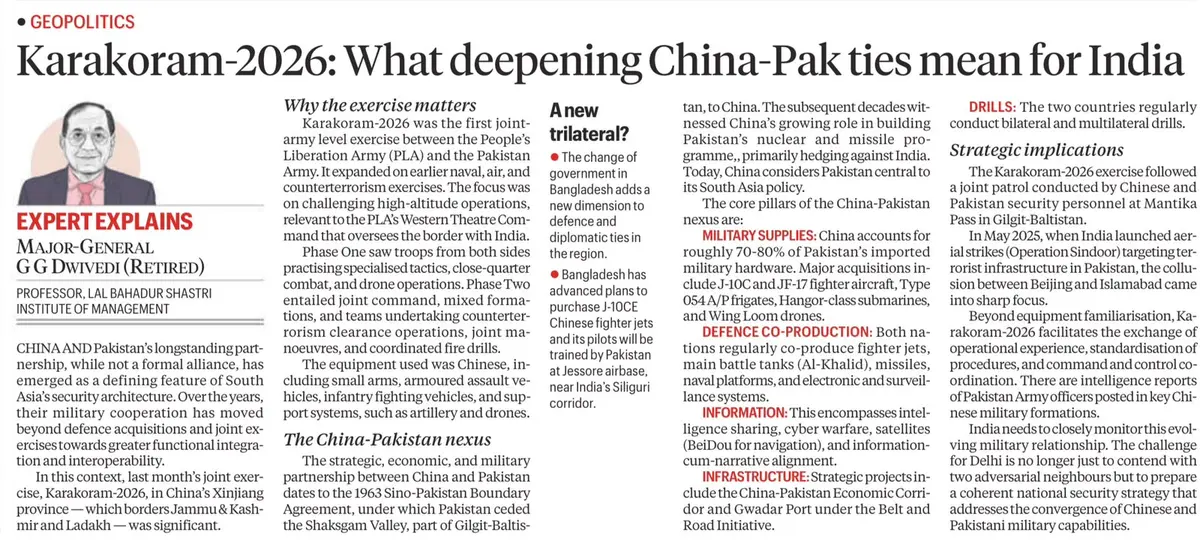
Karakoram-2026: what deepening China–Pakistan ties mean for India (The Indian Express)
Karakoram-2026: China–Pakistan joint army exercise. Source: The Indian Express

Karakoram-2026: Key Features

Participants
China's PLA and the Pakistan Army.
Location
Xinjiang, bordering Ladakh and J&K; overseen by PLA's Western Theatre Command.
First
First joint army-level exercise – earlier ones were naval, air and counter-terror.
Phase I
Specialised tactics, close-quarter combat, drone operations.
Phase II
Joint command, mixed formations, counter-terror clearance, fire drills.
Equipment
All Chinese – small arms, armoured vehicles, artillery, drones.

China–Pakistan Nexus: Four Pillars

Military supplies
China = 70–80% of Pakistan's arms imports – J-10C, JF-17, Type 054A/P frigates, Hangor submarines, Wing Loong drones.
Co-production
Fighter jets, Al-Khalid tanks, missiles, naval and surveillance systems.
Information
Intelligence sharing, cyber, BeiDou navigation, narrative alignment.
Infrastructure
CPEC and Gwadar Port under the Belt and Road Initiative.
History
1963 Boundary Agreement – Pakistan ceded the Shaksgam Valley (claimed by India) to China.

Implications for India

Two-front threat
Risk of simultaneous pressure on northern and western borders.
Interoperability
Joint drills build shared procedures and command-and-control.
Operation Sindoor (May 2025)
China–Pakistan collusion came into sharp focus.
Joint patrol
Chinese and Pakistani personnel patrolled at Mintaka Pass, Gilgit-Baltistan.
Bangladesh angle
Plans to buy J-10CE jets, pilots trained in Pakistan – concern for the Siliguri Corridor.

Way Forward

Preparedness
Strengthen two-front readiness and theatre commands.
Indigenisation
Faster domestic jets, drones, surveillance systems.
ISR
Better satellite, cyber and border intelligence.
Diplomacy
Deeper ties with neighbours and strategic partners.
Key Takeaway: Karakoram-2026 shows China and Pakistan moving from arms sales to joint operations. India needs one coherent strategy for the combined China–Pakistan challenge, not two separate ones.

Prelims Practice MCQ

+2 correct • −0.66 wrong

Consider the following statements:
1. Under the 1963 Sino-Pakistan Boundary Agreement, Pakistan ceded the Shaksgam Valley to China.
2. Gwadar Port is part of the China–Pakistan Economic Corridor (CPEC).
3. Karakoram-2026 was held in Pakistan's Gilgit-Baltistan region.
Which of the statements given above are correct?

Explanation: Pakistan ceded the Shaksgam Valley to China in 1963, and Gwadar Port is a key CPEC project. Karakoram-2026 was held in China's Xinjiang province, so Statement 3 is wrong.

UPSC Mains Question

GS2 • PYQ 2017 • 15 Marks

"China is using its economic relations and positive trade surplus as tools to develop potential military power status in Asia." In the light of this statement, discuss its impact on India as her neighbour.

Attempt before opening the value-addition tab.
Accepted: JPG, JPEG, PNG, WEBP or PDF. The standalone file previews your answer locally; connect the API hook for real server submission.
Use after attempting the Mains answer
  • Map — Xinjiang, Shaksgam Valley, Mintaka Pass, Gilgit-Baltistan, Gwadar, Siliguri Corridor.
  • India's exercises — Yudh Abhyas (USA), Garuda Shakti (Indonesia), Mitra Shakti (Sri Lanka).
  • Concepts — two-front war, collusive threat, String of Pearls, strategic encirclement.
  • Keywords — interoperability, defence indigenisation, integrated theatre commands.
NEWS 3 GS3 • Science & Technology | Space Source: The Hindu (AFP)

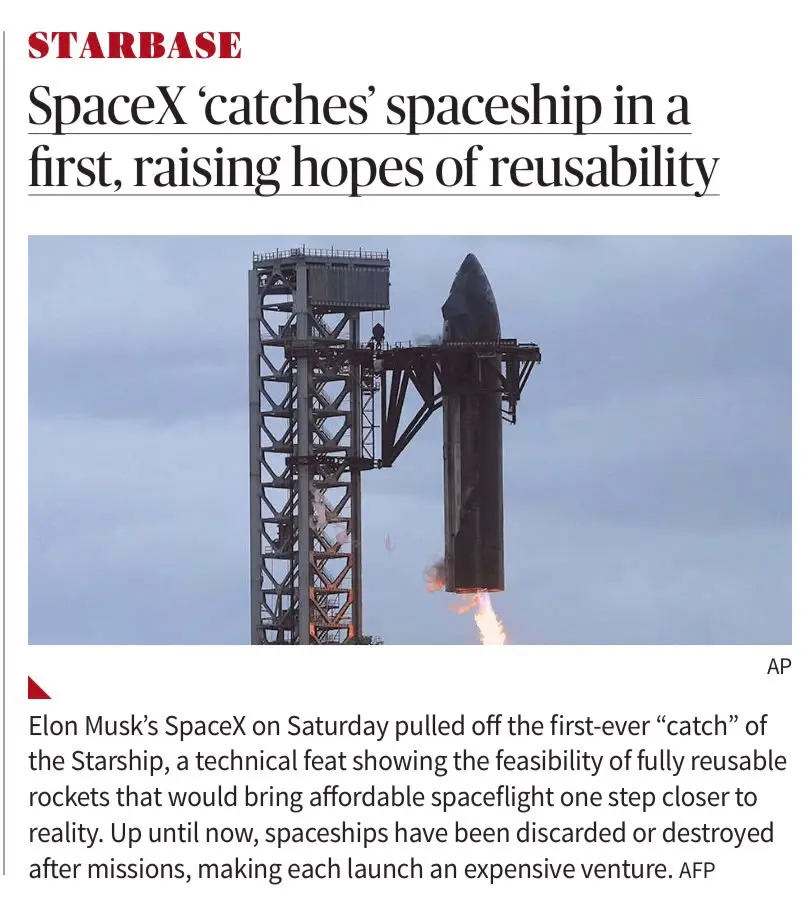
SpaceX 'Catches' Starship in a First, Raising Hopes of Reusability

Context: SpaceX caught its Starship upper stage with the launch tower's mechanical arms ('Chopsticks') for the first time – a big step towards fully reusable rockets.

SpaceX catches Starship in a first, raising hopes of reusability (The Hindu)
SpaceX 'catches' Starship in a first. Source: The Hindu / AP

Key Developments

2024
SpaceX first caught the Super Heavy booster (first stage).
Now
First-ever catch of the Starship upper stage after flight.
Method
Tower arms called 'Chopsticks' catch the vehicle mid-air.
Before
Upper stages were discarded or destroyed after missions.

Why It Matters

Full reusability
Both stages can be recovered and reused.
Cost
Sharp fall in cost per launch.
Frequency
Faster turnaround – more launches.
Deep space
Supports Moon and Mars missions (NASA Artemis uses Starship as lander).

India Link

RLV-TD
ISRO's Reusable Launch Vehicle demonstrator; 'Pushpak' landing tests (2023–24).
NGLV
Next Generation Launch Vehicle planned with a reusable first stage.
Private sector
Space reforms via IN-SPACe; firms like Skyroot and Agnikul.
Key Takeaway: Reusability is the key to cheap access to space. Catching both stages brings fully reusable rockets closer and raises the bar for ISRO and other agencies.

Prelims Practice MCQ

+2 correct • −0.66 wrong

With reference to reusable launch vehicles, consider the following statements:
1. SpaceX's 'Chopsticks' are mechanical arms on the launch tower used to catch rocket stages.
2. ISRO's 'Pushpak' is a reusable launch vehicle technology demonstrator.
3. Before this catch, Starship upper stages were routinely recovered and reused.
Which of the statements given above are correct?

Explanation: Chopsticks are tower arms that catch rocket stages, and Pushpak is ISRO's RLV demonstrator. Until this catch, upper stages were discarded or destroyed after missions, so Statement 3 is wrong.

UPSC Mains Question

GS3 • 10 Marks • 150 Words

What is the significance of reusable launch vehicle technology? Discuss India's progress and the role of private players in this field.

Attempt before opening the value-addition tab.
Accepted: JPG, JPEG, PNG, WEBP or PDF. The standalone file previews your answer locally; connect the API hook for real server submission.
Use after attempting the Mains answer
  • ISRO — RLV-TD, Pushpak landing experiments, NGLV, Indian Space Policy 2023.
  • Global — Falcon 9 booster reuse, Starship, Blue Origin New Glenn.
  • Concepts — orbital vs suborbital flight, stages of a rocket, cost per kg to orbit.
  • Keywords — reusability, launch economics, space commercialisation.
NEWS 4 GS3 • Indian Economy | Infrastructure & Blue Economy Source: The Hindu

India Eyes a Place Among the Top 10 Shipbuilding Nations by 2030

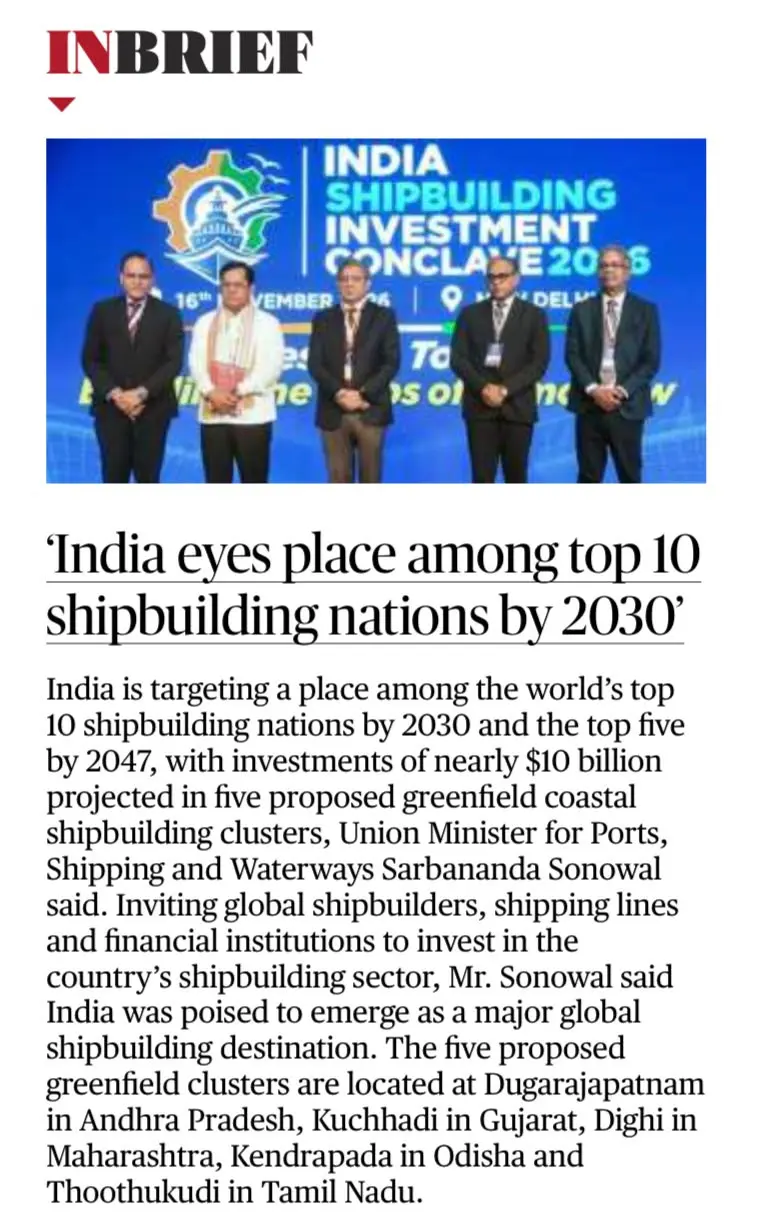
Context: At the India Shipbuilding Investment Conclave 2026, Union Minister Sarbananda Sonowal said India aims to be among the top 10 shipbuilders by 2030 and top 5 by 2047, with nearly $10 billion planned for five greenfield clusters.

India eyes place among top 10 shipbuilding nations by 2030 – five greenfield shipbuilding clusters (The Hindu)
India eyes place among top 10 shipbuilding nations by 2030. Source: The Hindu

Targets & Investment

Targets
Top 10 by 2030, top 5 by 2047.
Investment
Nearly $10 billion across five greenfield coastal clusters.
Invitation
Global shipbuilders, shipping lines and financial institutions invited to invest.

Five Proposed Shipbuilding Clusters

Andhra Pradesh
Dugarajapatnam
Gujarat
Kuchhadi
Maharashtra
Dighi
Odisha
Kendrapada
Tamil Nadu
Thoothukudi

Why It Matters

Jobs
Labour-intensive; boosts steel, engineering, electronics.
Strategic autonomy
Less dependence on foreign shipyards.
Maritime security
Domestic capacity to build and repair vessels.
Blue economy
Coastal industrialisation under Maritime Amrit Kaal Vision 2047.

Challenges

Finance
High capital need, long gestation.
Imports
Engines, propulsion and marine equipment mostly imported.
Competition
China, South Korea, Japan dominate global shipbuilding.
Skills & approvals
Shortage of marine engineers; land and environmental clearances.

Way Forward

Finance
Long-term maritime finance; use Shipbuilding Financial Assistance Policy and Maritime Development Fund.
Supply chain
Make marine components in India.
Technology
Automation, digital design, green ships.
Clusters
Link shipyards with ports, logistics and repair hubs.
Key Takeaway: Shipbuilding can power jobs, strategic autonomy and the blue economy. Cheap finance, domestic components and skilled workers will decide whether India reaches the top 10.

Prelims Practice MCQ

+2 correct • −0.66 wrong

Which of the following pairs regarding the proposed greenfield shipbuilding clusters is/are correctly matched?
1. Dugarajapatnam – Andhra Pradesh
2. Dighi – Gujarat
3. Kendrapada – Odisha
Select the correct answer:

Explanation: Dugarajapatnam is in Andhra Pradesh and Kendrapada is in Odisha. Dighi is in Maharashtra; Gujarat's proposed cluster is at Kuchhadi.

UPSC Mains Question

GS3 • 15 Marks • 250 Words

India aims to be among the top 10 shipbuilding nations by 2030. Discuss the significance of shipbuilding for India's economy and security, and the challenges in achieving this goal.

Attempt before opening the value-addition tab.
Accepted: JPG, JPEG, PNG, WEBP or PDF. The standalone file previews your answer locally; connect the API hook for real server submission.
Use after attempting the Mains answer
  • Policies — Maritime India Vision 2030, Maritime Amrit Kaal Vision 2047, Sagarmala, Shipbuilding Financial Assistance Policy.
  • Map — mark all five clusters on India's coastline (east: Dugarajapatnam, Kendrapada, Thoothukudi; west: Kuchhadi, Dighi).
  • Data — India's share of global shipbuilding is under 1%; China, South Korea and Japan dominate.
  • Keywords — blue economy, strategic autonomy, cluster development, green shipbuilding.
NEWS 5 GS3 • Poverty & Inclusive Growth Source: The Hindu

A Poverty Line That Falls Short

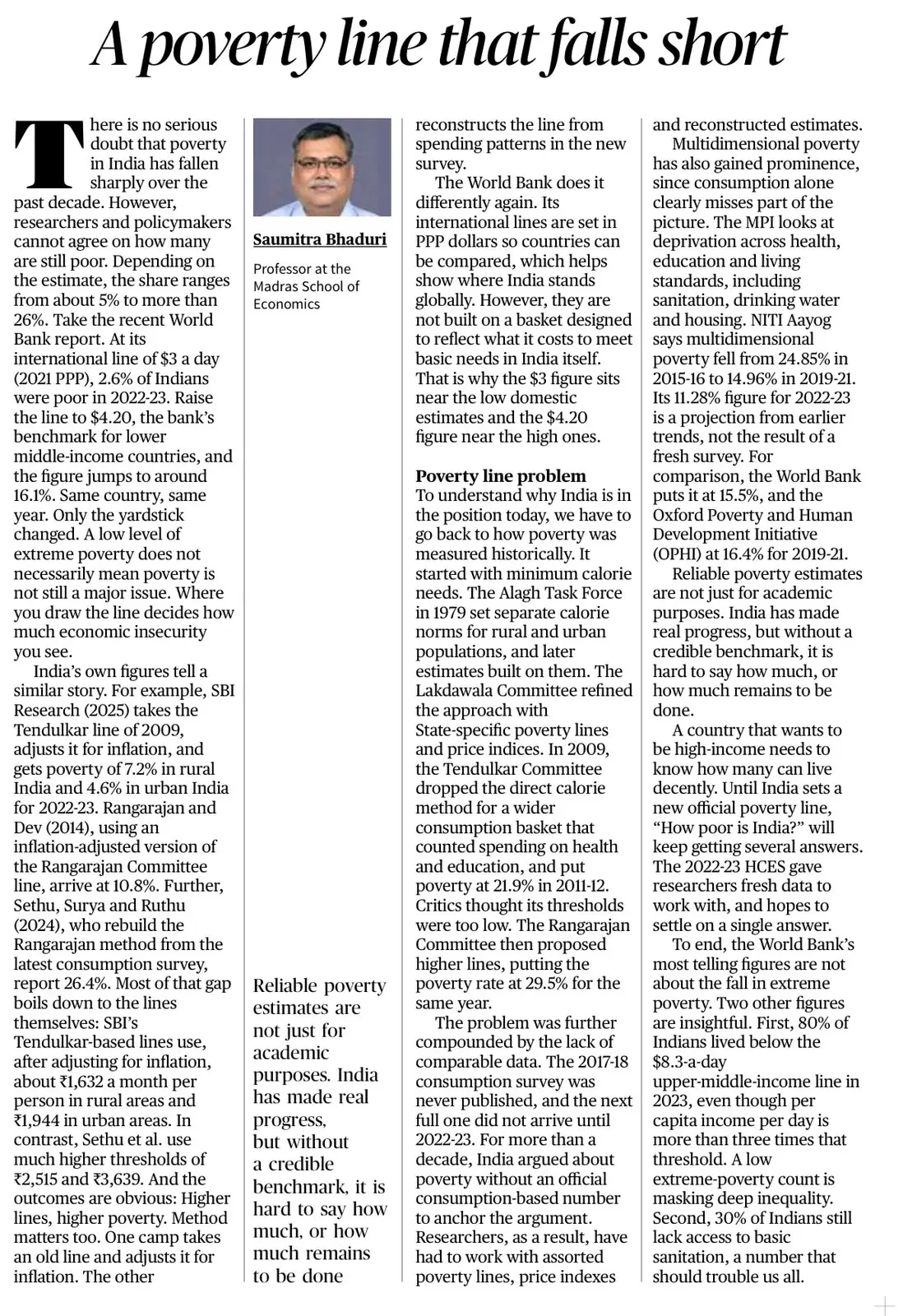
Context: Poverty in India has fallen sharply, but estimates range from about 5% to over 26% depending on the line used. Without an updated official poverty line, 'How poor is India?' still has many answers.

A poverty line that falls short – India poverty estimates, Tendulkar, Rangarajan and MPI (The Hindu)
A poverty line that falls short. Source: The Hindu

Why Estimates Differ (2022–23)

World Bank $3/day
2.6% (2021 PPP).
World Bank $4.20/day
16.1% – lower-middle-income benchmark.
SBI Research (Tendulkar-based)
7.2% rural, 4.6% urban.
Rangarajan-based
10.8%.
Sethu, Surya & Ruthu (2024)
26.4% – higher thresholds (₹2,515 rural / ₹3,639 urban per month).
Lesson
Same country, same year – only the yardstick changed.

Evolution of Poverty Lines in India

Alagh Task Force (1979)
Calorie-based norms, separate for rural and urban.
Lakdawala Committee
State-specific poverty lines and price indices.
Tendulkar (2009)
Wider basket incl. health and education; 21.9% poverty in 2011–12.
Rangarajan (2014)
Higher lines; 29.5% poverty in 2011–12.
Data gap
2017–18 consumption survey never published; next full survey only in 2022–23 (HCES).

Multidimensional Poverty

MPI dimensions
Health, education, living standards.
NITI Aayog
24.85% (2015–16) → 14.96% (2019–21); 11.28% for 2022–23 is a projection.
Others (2019–21)
World Bank 15.5%; OPHI 16.4%.
Hidden insecurity
80% below $8.3/day upper-middle-income line (2023); 30% lack basic sanitation.

Way Forward

New line
An updated official poverty line based on current needs.
Data
Regular, timely consumption surveys.
Regional
Account for state and rural–urban price differences.
Beyond income
Use MPI alongside consumption poverty.
Key Takeaway: Escaping extreme poverty is not the same as a decent life. India needs a credible, updated poverty line to measure how many can actually afford basic needs.

Prelims Practice MCQ

+2 correct • −0.66 wrong

Consider the following statements regarding poverty estimation in India:
1. The Tendulkar Committee estimated poverty at 21.9% in 2011–12.
2. The Rangarajan Committee estimated a lower poverty rate than the Tendulkar Committee for 2011–12.
3. The Multidimensional Poverty Index covers health, education and living standards.
Which of the statements given above are correct?

Explanation: Tendulkar put poverty at 21.9% in 2011–12, and MPI covers health, education and living standards. Rangarajan used higher lines and estimated a higher figure (29.5%), so Statement 2 is wrong.

UPSC Mains Question

GS3 • 15 Marks • 250 Words

Different poverty lines give very different estimates of poverty in India. Discuss the need for a new official poverty line and the role of multidimensional poverty measures.

Attempt before opening the value-addition tab.
Accepted: JPG, JPEG, PNG, WEBP or PDF. The standalone file previews your answer locally; connect the API hook for real server submission.
Use after attempting the Mains answer
  • Committees — Alagh (1979), Lakdawala (1993), Tendulkar (2009), Rangarajan (2014).
  • Indices — NITI Aayog National MPI, UNDP–OPHI Global MPI; HCES 2022–23 and 2023–24.
  • Concepts — PPP, absolute vs relative poverty, extreme vs multidimensional poverty.
  • Keywords — vulnerability, economic insecurity, dignified standard of living.
NEWS 6 GS3 • Indian Economy | Employment Source: The Hindu

Marginal Decline in Unemployment Rate in October 2026: PLFS

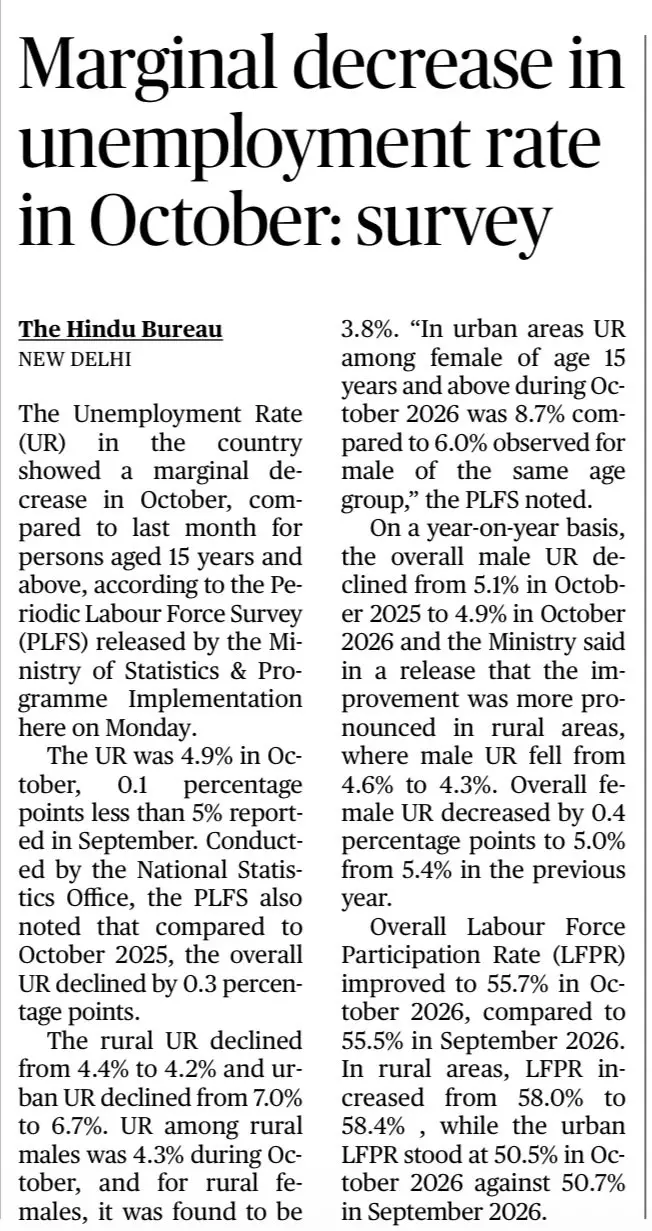
Context: MoSPI's monthly Periodic Labour Force Survey (PLFS) shows India's unemployment rate for persons aged 15+ dipped to 4.9% in October 2026, with participation rising slightly.

Marginal decrease in unemployment rate in October 2026 – PLFS survey (The Hindu)
Marginal decrease in unemployment rate in October: PLFS. Source: The Hindu

Key Findings (Age 15+)

Overall UR
4.9% – down from 5.0% (Sept) and 5.2% (Oct 2025).
Rural UR
4.4% → 4.2%.
Urban UR
7.0% → 6.7%.
Male UR (YoY)
5.1% → 4.9%; rural male 4.6% → 4.3%.
Female UR (YoY)
5.4% → 5.0%.

Gender & Area Gap

Rural males
4.3%
Rural females
3.8%
Urban males
6.0%
Urban females
8.7% – highest of all groups.

Labour Force Participation

Overall LFPR
55.5% → 55.7%.
Rural LFPR
58.0% → 58.4%.
Urban LFPR
50.7% → 50.5% (slight fall).

Key Indicators Explained

UR
Unemployed as % of the labour force.
LFPR
% of population working or seeking/available for work.
WPR
% of population that is employed.
CWS
Monthly PLFS uses Current Weekly Status (last 7 days).
Caution
Lower UR ≠ more jobs; people may leave the labour force.

Way Forward

Jobs
Promote labour-intensive manufacturing.
Women
Safe workplaces, childcare, flexible jobs.
Skills
Industry-linked vocational training.
Quality
Track wages, formality and underemployment, not just UR.
Key Takeaway: Unemployment is easing, mainly in rural areas, but urban women still face the highest jobless rate. Job quality and women's participation need as much attention as the headline number.

Prelims Practice MCQ

+2 correct • −0.66 wrong

With reference to the Periodic Labour Force Survey (PLFS), consider the following statements:
1. It is conducted by the National Statistics Office under MoSPI.
2. The Labour Force Participation Rate includes only persons who are employed.
3. In October 2026, urban female unemployment was higher than urban male unemployment.
Which of the statements given above are correct?

Explanation: PLFS is conducted by the NSO under MoSPI, and urban female UR (8.7%) was higher than urban male UR (6.0%). LFPR includes both the employed and those seeking or available for work; only-employed is the Worker Population Ratio, so Statement 2 is wrong.

UPSC Mains Question

GS3 • 10 Marks • 150 Words

A falling unemployment rate does not always mean better employment outcomes. Discuss with reference to recent PLFS data and the quality of employment in India.

Attempt before opening the value-addition tab.
Accepted: JPG, JPEG, PNG, WEBP or PDF. The standalone file previews your answer locally; connect the API hook for real server submission.
Use after attempting the Mains answer
  • Concepts — Usual Status vs Current Weekly Status, disguised unemployment, underemployment.
  • Schemes — ELI scheme, PM Vishwakarma, Skill India Mission, VB-G-RAM-G (rural jobs).
  • Data — monthly PLFS started in 2025; female urban UR 8.7% (Oct 2026).
  • Keywords — LFPR, WPR, job quality, informal employment.

Copyright © 2026 USARAMBHA EDUCATION (UnderStand UPSC). All Rights Reserved.