Batch 1 Starts 23 Nov: UPSC GS Foundation 2028/29 Enroll Now
US
UnderStand UPSC Daily Current Affairs Practice
0.00Score / 14
0 / 7MCQs Attempted
0%Accuracy
22 & 23 November 2026 • UPSC CSE

Read the news. Test the concept. Write the Mains answer.

This interactive edition converts each current-affairs item into one Prelims-level MCQ, one Mains-level question, and a compact value-addition section for revision.

+2 correct −0.66 incorrect Explanation after attempt Image/PDF answer upload
NEWS 1 GS3 • Environment | Climate Change & International Agreements Source: The Indian Express

COP31 Ends Without Agreement on Fossil Fuel Phase-out

Context: COP31, held in Antalya, Türkiye, ended without consensus on its main political agreement due to disagreements over phasing out fossil fuels, climate finance and other mitigation measures. However, routine agenda decisions were cleared.
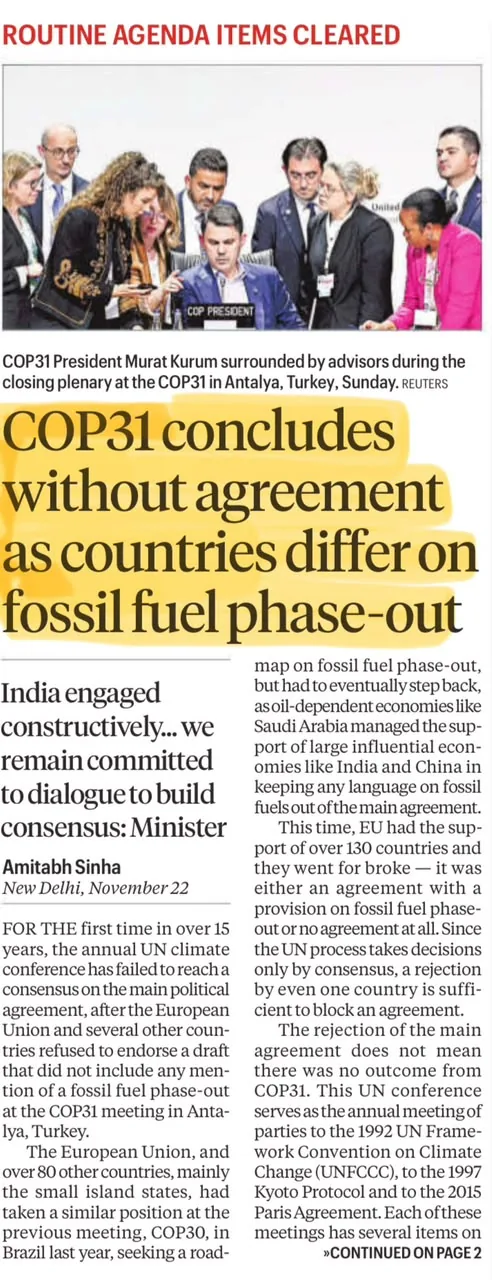
COP31 concludes without agreement as countries differ on fossil fuel phase-out (The Indian Express)
COP31 concludes without agreement on fossil fuel phase-out. Source: The Indian Express
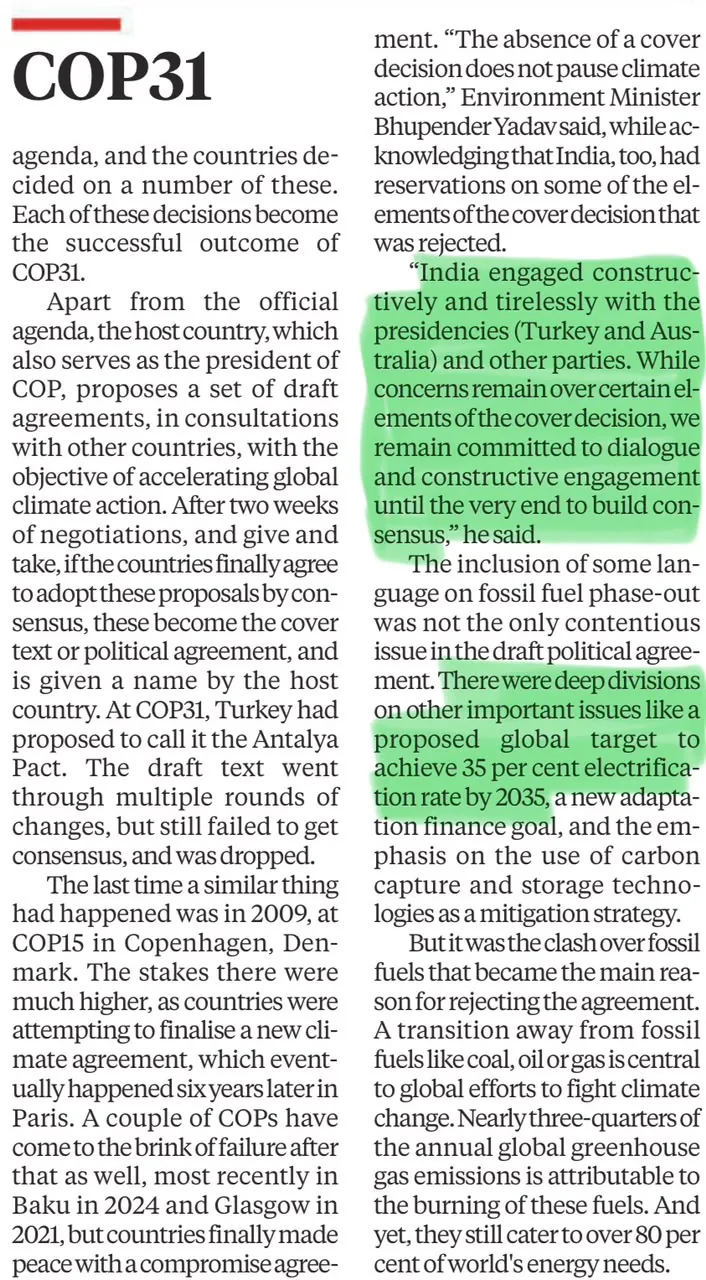
COP31: India's position, electrification target and fossil fuel clash (The Indian Express)
India's position and other contentious issues at COP31. Source: The Indian Express

Why Did COP31 Fail?

Fossil fuel phase-out
Gradually reducing and ending the use of coal, oil and natural gas, replacing them with renewable and low-carbon sources.
Why important
Fossil fuels meet over 80% of global energy needs and cause nearly three-fourths of annual greenhouse gas emissions.
Supporters
The European Union and over 80 countries, including many SIDS, demanded a clear phase-out roadmap.
Opposition
Saudi Arabia opposed it; India and China had reservations on explicit phase-out language.
Outcome
The proposed Antalya Pact failed. UN climate decisions need consensus – even one country can block an agreement.

Other Major Disagreements

Adaptation finance
A new financial target to help developing countries cope with floods, droughts and heat.
Electrification target
A proposed global target of 35% electrification by 2035.
Carbon Capture & Storage
Capture CO₂ from emissions → transport it → store it in deep underground geological formations.
CCS debate
Useful for hard-to-decarbonise sectors like cement and steel; critics warn it must not justify continued fossil-fuel dependence.

India's Position

Energy security
Affordable and reliable energy for a growing population and economy.
Climate equity
No identical obligations despite different historical emissions and development levels.
Climate finance
Developed countries must provide finance and technology.
Engagement
Engaged with the Turkish and Australian presidencies but kept reservations.

Major Implications

North–South divide
Differences over historical responsibility, finance and obligations.
Energy transition
Balance decarbonisation with growth and energy access.
Finance gap
Weak funding hurts adaptation and resilience.
Cooperation
Consensus rule makes ambitious commitments difficult.

Important International Frameworks

UNFCCC, 1992
Framework for international climate cooperation.
Kyoto Protocol, 1997
Legally binding emission targets for developed countries.
Paris Agreement, 2015
Limit warming to well below 2°C, pursue 1.5°C.
COP15, 2009
Copenhagen also failed to reach consensus on a comprehensive agreement.
Key Takeaway: For the first time in over 15 years, a COP failed to adopt its main political agreement. The fossil-fuel divide shows how hard it is to balance climate ambition with energy security and equity.

Prelims Practice MCQ

+2 correct • −0.66 wrong

UPSC Prelims PYQ 2023: Consider the following activities:
1. Spreading finely ground basalt rock on farmlands extensively
2. Increasing the alkalinity of oceans by adding lime
3. Capturing carbon dioxide released by industries and pumping it into abandoned subterranean mines in the form of carbonated waters
How many of the above activities are often considered and discussed for carbon capture and sequestration?

Explanation: All three are discussed for carbon capture and sequestration: enhanced rock weathering with basalt, ocean alkalinity enhancement with lime, and storing captured CO₂ underground in abandoned mines.

UPSC Mains Question

GS3 • 15 Marks • 250 Words

The failure of COP31 reflects the deepening North–South divide in climate negotiations. Discuss with reference to fossil fuel phase-out and India's position.

Attempt before opening the value-addition tab.
Accepted: JPG, JPEG, PNG, WEBP or PDF. The standalone file previews your answer locally; connect the API hook for real server submission.
Use after attempting the Mains answer
  • Principles — CBDR-RC, climate equity, just transition, carbon budget.
  • Frameworks — UNFCCC 1992, Kyoto 1997, Paris 2015, NCQG (COP29 Baku).
  • Data — fossil fuels meet 80%+ of energy needs and cause ~3/4 of GHG emissions.
  • PYQ link — Prelims 2023 (carbon capture), Prelims 2017 (carbon sequestration sites).
NEWS 2 GS2 • Governance | Food Security & Welfare Schemes Source: The Indian Express

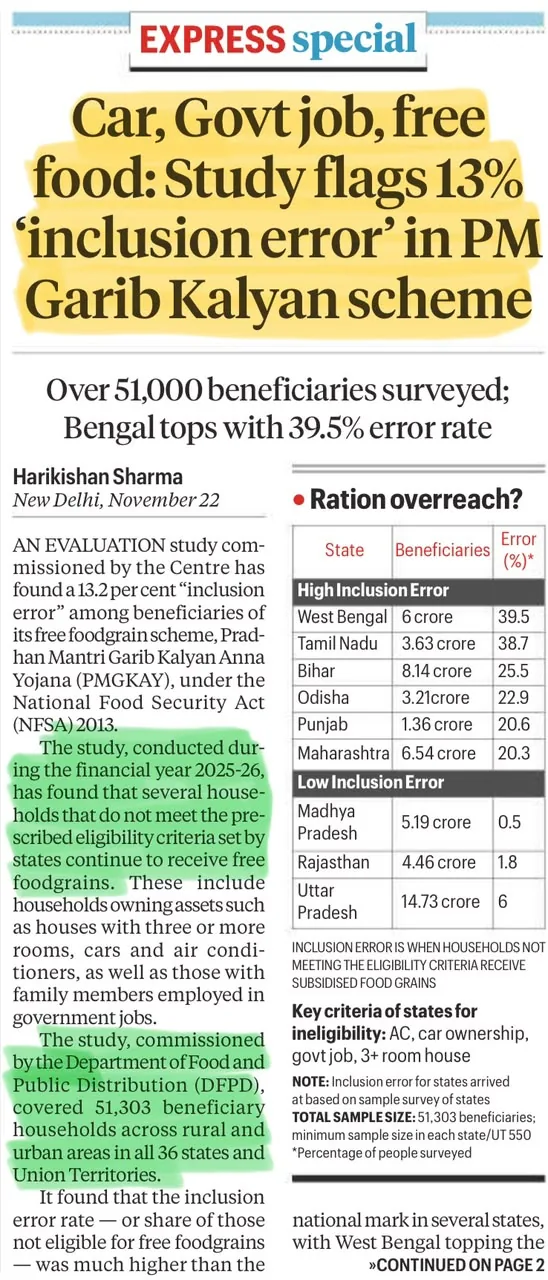
PM Garib Kalyan Anna Yojana: 13.2% Inclusion Error in Foodgrain Distribution

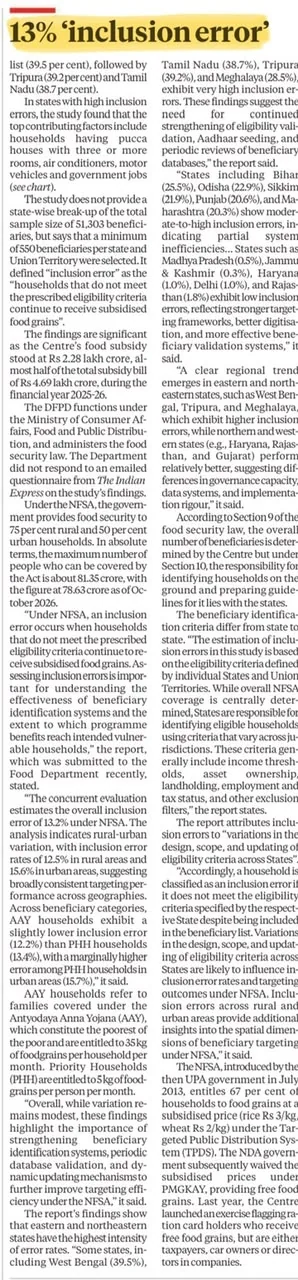
Context: A Centre-commissioned evaluation found that 13.2% of households receiving free foodgrains under the National Food Security Act (NFSA), 2013, do not satisfy State-prescribed eligibility criteria.

Car, Govt job, free food: Study flags 13% inclusion error in PM Garib Kalyan scheme (The Indian Express)
Study flags 13% inclusion error in PMGKAY. Source: The Indian Express
13% inclusion error: state-wise findings and NFSA provisions (The Indian Express)
State-wise inclusion error findings. Source: The Indian Express

Major Findings

Sample
51,303 beneficiary households across 36 States/UTs during 2025–26.
Overall error
13.2%; rural 12.5%, urban 15.6%.
Highest
West Bengal (39.5%), Tripura (39.2%), Tamil Nadu (38.7%), Meghalaya (28.5%), Bihar (25.5%).
Lowest
Jammu and Kashmir (0.3%), Madhya Pradesh (0.5%), Haryana and Delhi (1% each), Rajasthan (1.8%).
Categories
AAY households 12.2% vs Priority Households (PHH) 13.4%.

Reasons for Inclusion Errors

Asset criteria
Households with cars, ACs or 3+ room houses still get benefits.
Employment
Households with government-employed members remain on lists.
Outdated databases
Weak periodic verification of income, assets and jobs.
State variation
Different design, scope and updating of criteria.
Weak validation
Gaps let ineligible households continue.

Governance Implications

Leakage
Benefits meant for the vulnerable go to ineligible households.
Fiscal efficiency
Food subsidy ₹2.28 lakh crore in 2025–26, out of a total food subsidy bill of ₹4.69 lakh crore.
Regional gap
High errors in eastern and northeastern States.
Last-mile delivery
Inaccurate lists weaken targeted delivery.
Centre–State
Centre fixes coverage; States identify households.

Way Forward

Periodic review
Verify income, assets, employment regularly.
Databases
Better updating, Aadhaar seeding, inter-departmental data.
Dynamic criteria
Update State criteria to changing conditions.
Social audits
Involve local institutions and communities.
No exclusion
Aadhaar or data errors must not deny genuine beneficiaries.

NFSA, 2013: Relevant Provisions

Coverage
Up to 75% rural and 50% urban population.
AAY
35 kg of foodgrains per household per month.
PHH
5 kg per person per month.
Section 9
Centre determines the overall number of beneficiaries.
Section 10
States identify eligible households and prepare guidelines.
Key Takeaway: Free foodgrains reach many who are not eligible. Better, regularly updated beneficiary lists – without excluding the genuinely poor – are key to efficient food security.

Prelims Practice MCQ

+2 correct • −0.66 wrong

With reference to the National Food Security Act (NFSA), 2013, consider the following statements:
1. It covers up to 75% of the rural and 50% of the urban population.
2. Antyodaya Anna Yojana households are entitled to 35 kg of foodgrains per household per month.
3. Under the Act, the Centre identifies eligible households in each State.
Which of the statements given above are correct?

Explanation: NFSA covers up to 75% rural and 50% urban population, and AAY households get 35 kg per month. Under Section 9 the Centre fixes the total number of beneficiaries, but under Section 10 the States identify eligible households. So statement 3 is incorrect.

UPSC Mains Question

GS2 • 15 Marks • 250 Words

Inclusion and exclusion errors weaken the targeting of welfare schemes. Examine with reference to PMGKAY and suggest measures to improve beneficiary identification.

Attempt before opening the value-addition tab.
Accepted: JPG, JPEG, PNG, WEBP or PDF. The standalone file previews your answer locally; connect the API hook for real server submission.
Use after attempting the Mains answer
  • Law & schemes — NFSA 2013, PMGKAY, One Nation One Ration Card, TPDS.
  • Concepts — inclusion vs exclusion error, targeted vs universal PDS, leakages.
  • Data — 13.2% inclusion error; food subsidy ₹2.28 lakh crore (2025–26).
  • Keywords — Aadhaar seeding, social audit, dynamic eligibility, cooperative federalism.
NEWS 3 GS3 • Science & Technology | GS2 • Governance Source: The Indian Express

Why India's Indigenous AI Models Need Better Data for Regional Languages

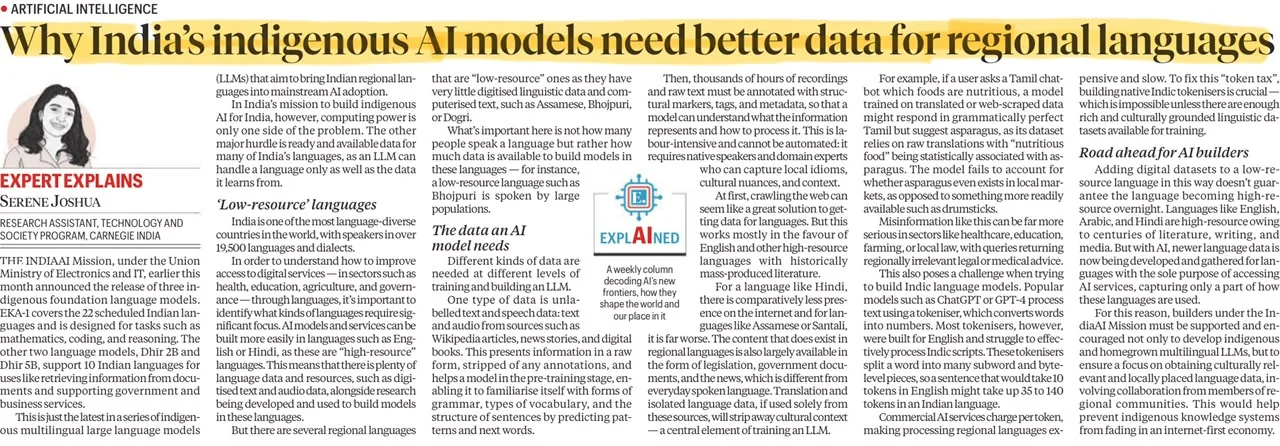
Context: India's indigenous Large Language Models (LLMs) face a major challenge due to inadequate digital linguistic data, limited cultural representation and inefficient processing of regional languages.

Why India's indigenous AI models need better data for regional languages (The Indian Express)
Indigenous AI models need better regional-language data. Source: The Indian Express

India's Indigenous AI Initiatives

IndiaAI Mission
Supports indigenous foundation models for Indian languages.
EKA-1
Covers 22 scheduled languages; for mathematics, coding and reasoning.
Dhir 2B and Dhir 5B
Support 10 Indian languages, incl. document-based information retrieval and government/business services.

Major Challenges

Low-resource languages
Over 19,500 languages and dialects, but Assamese, Bhojpuri, Dogri have little digitised data.
Poor-quality data
Raw text and audio need annotations, tags and metadata.
Cultural gaps
Translated and web-scraped content misses local idioms and usage.
High costs
Annotation needs native speakers and domain experts.
Token tax
10 tokens in English may need 35–140 tokens in an Indian language.
Bias & misinformation
Wrong outputs in health, farming, education, law.

Governance Implications

Digital divide
Limits services for non-English speakers.
Unequal access
Higher token costs make regional AI more expensive.
Knowledge
Risk to indigenous languages and local knowledge.
Service delivery
Errors can undermine AI-enabled government services.
Data sovereignty
External datasets weaken representation of India's diversity.

Way Forward

Quality datasets
Large, annotated, culturally grounded text and audio.
Community
Native speakers, linguists and domain experts.
Indic tokenisers
Cut token costs and improve efficiency.
Research
Multilingual LLMs through the IndiaAI Mission.
Validation
Test against local realities before use in critical sectors.
Key Takeaway: Computing power alone cannot build AI for Bharat. Rich, culturally grounded regional-language data is the real foundation for inclusive AI.

Prelims Practice MCQ

+2 correct • −0.66 wrong

UPSC Prelims PYQ 2026: Which of the following statements with regard to Large Language Models (LLMs) used in machine learning is/are correct?
1. LLMs assign probabilities to the next possible words and then pick the one with the highest probability.
2. LLMs process data through mathematical optimisation to minimise prediction errors.
3. LLMs produce unbiased outputs.

Explanation: LLMs predict the next tokens using probability distributions, and training uses mathematical optimisation to minimise prediction errors. They are not unbiased – they can inherit biases present in their training data.

UPSC Mains Question

GS3 • 10 Marks • 150 Words

Building inclusive AI for India requires more than computing power. Discuss the challenges of developing AI for regional languages and suggest measures.

Attempt before opening the value-addition tab.
Accepted: JPG, JPEG, PNG, WEBP or PDF. The standalone file previews your answer locally; connect the API hook for real server submission.
Use after attempting the Mains answer
  • Initiatives — IndiaAI Mission, Bhashini, AI Kosh, BharatGen.
  • Concepts — low-resource languages, tokenisation, algorithmic bias, data sovereignty.
  • Data — 22 scheduled languages; 19,500+ languages and dialects.
  • PYQ link — Prelims 2026 (Large Language Models).
NEWS 4 GS2 • International Relations | Cultural Diplomacy Source: The Indian Express

First SCO Civilisational Dialogue Forum: Indraprastha Communiqué

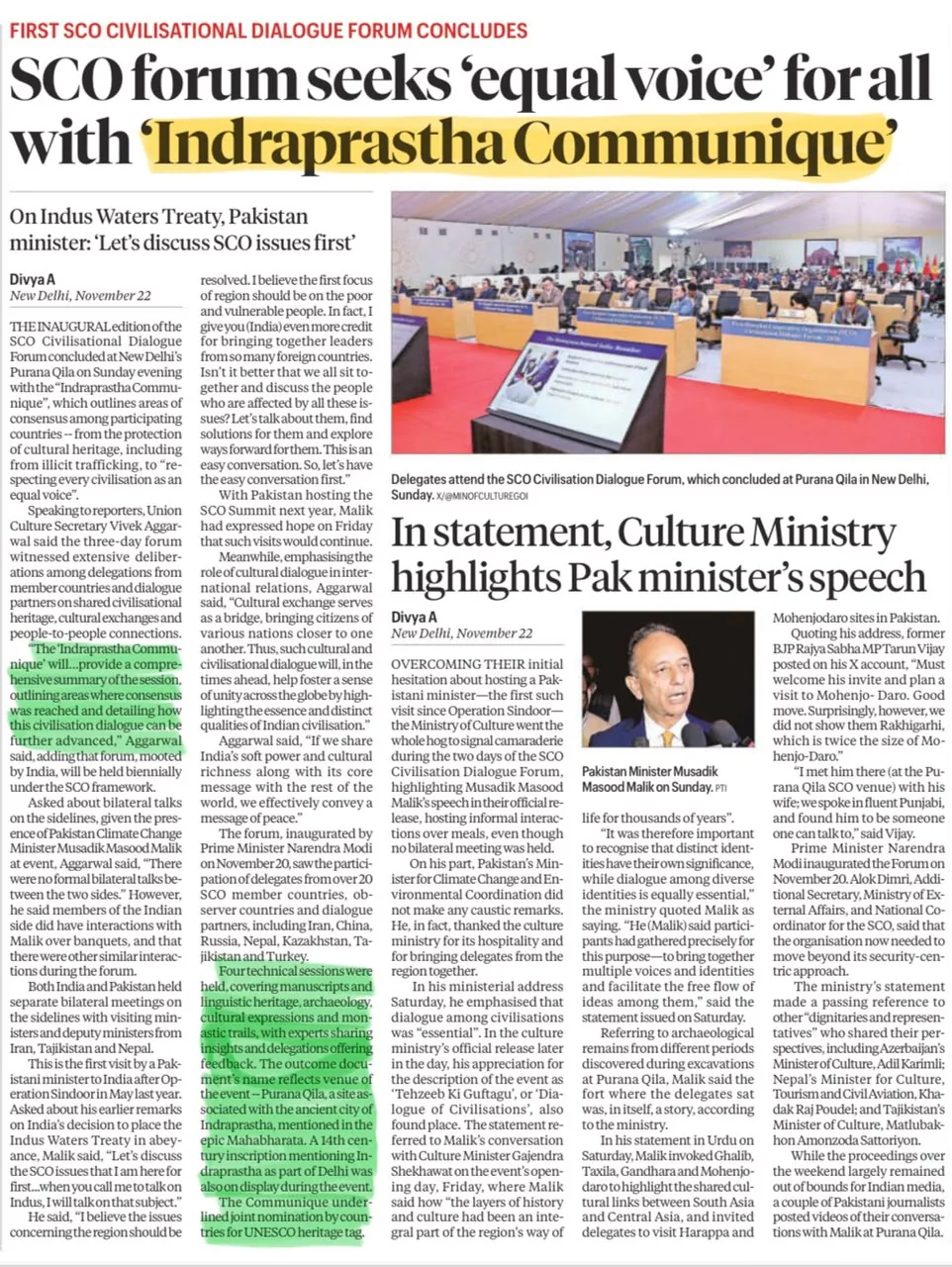
Context: The first Shanghai Cooperation Organisation (SCO) Civilisational Dialogue Forum concluded at Purana Qila, New Delhi (20–22 November 2026), with the adoption of the Indraprastha Communiqué to promote cultural cooperation and equal recognition of civilisations.

SCO forum seeks equal voice for all with Indraprastha Communique (The Indian Express)
SCO forum adopts the Indraprastha Communiqué. Source: The Indian Express

Indraprastha Communiqué

A 12-point outcome document recording areas of convergence and proposing future cooperation among SCO countries. It is a framework for cultural cooperation, not a legally binding treaty.

Major Commitments

Civilisational equality
Respect every civilisation as an equal voice.
Shared heritage
Joint projects on architecture, music, cuisine, textiles and traditional knowledge.
UNESCO
Explore joint nominations of tangible, intangible and documentary heritage.
Digital preservation
Digitise manuscripts, scripts and oral traditions; a shared digital repository.
Technology & AI
Use AI for access while keeping historical accuracy.
Institutions
Museums, libraries, archives, universities.
People-to-people
Festivals, exhibitions, exchanges of artists, scholars, students.
Heritage protection
Against illicit trafficking, environmental pressure and disasters.
Spiritual traditions & youth
Respect pilgrimage sites and centres of learning; youth in heritage.
Institutional proposal
Forum to be held every two years; venue decided at SCO Summits.

Historical and Archaeological Sites Highlighted

Purana Qila – Delhi, India
Forum venue; linked to ancient Indraprastha of the Mahabharata tradition.
Taxila – Punjab, Pakistan
Ancient centre of learning and Gandhara hub; Buddhist scholarship.
Gandhara – Pakistan & Afghanistan
Renowned for Greco-Buddhist art.
Mohenjo-daro – Sindh, Pakistan
Indus Valley site known for planned towns and drainage.
Harappa – Punjab, Pakistan
Gives the Harappan Civilisation its name.

Pakistan's Participation

Visit
Climate Change Minister Musadik Masood Malik – a ministerial visit after Operation Sindoor.
Message
Shared heritage of South and Central Asia; invited delegates to Harappa and Mohenjo-daro.
Bilateral
No formal India–Pakistan meeting; only informal interactions.
Indus Waters Treaty
Malik suggested discussing SCO issues first.
Key Takeaway: The Indraprastha Communiqué uses shared heritage as soft power – positioning India as a convenor of civilisational dialogue within the SCO.

Prelims Practice MCQ

+2 correct • −0.66 wrong

Consider the following pairs:
Site — Present location
1. Taxila — Punjab, Pakistan
2. Mohenjo-daro — Sindh, Pakistan
3. Harappa — Sindh, Pakistan
How many of the above pairs are correctly matched?

Explanation: Taxila (Punjab, Pakistan) and Mohenjo-daro (Sindh, Pakistan) are correctly matched. Harappa is in the Punjab province of Pakistan, not Sindh.

UPSC Mains Question

GS2 • 10 Marks • 150 Words

Cultural diplomacy can complement India's strategic engagement in multilateral groupings. Discuss with reference to the SCO Civilisational Dialogue Forum.

Attempt before opening the value-addition tab.
Accepted: JPG, JPEG, PNG, WEBP or PDF. The standalone file previews your answer locally; connect the API hook for real server submission.
Use after attempting the Mains answer
  • SCO — founded 2001; India a full member since 2017; Pakistan to host the next SCO Summit.
  • Concepts — soft power, civilisational diplomacy, Vasudhaiva Kutumbakam.
  • Heritage — UNESCO joint nominations, illicit trafficking of antiquities.
  • Keywords — Indraprastha Communiqué, Purana Qila, Gandhara, people-to-people ties.
NEWS 5 GS2 • Polity | Parliament & Procedures Source: The Hindu

Parliamentary Prorogation: Constitutional Provisions and the Unusual 100-Day Gap

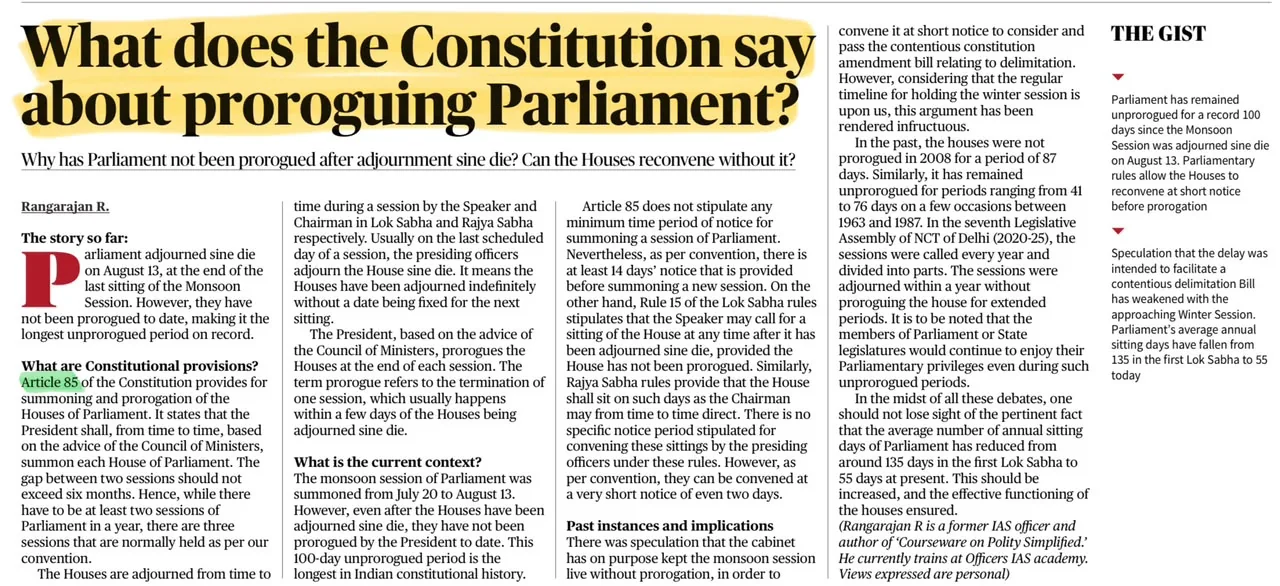
Context: Parliament remained unprorogued for 100 days after the Monsoon Session was adjourned sine die on 13 August 2026, creating an unusual situation in which the existing session could be reconvened.

What does the Constitution say about proroguing Parliament? (The Hindu)
What the Constitution says about proroguing Parliament. Source: The Hindu

Constitutional Provisions

Article 85(1) – Summoning
President summons Parliament; gap between sessions cannot exceed six months.
Article 85(2)(a) – Prorogation
President can formally terminate the session of either or both Houses.
Article 85(2)(b) – Dissolution
President can dissolve Lok Sabha; Rajya Sabha is a permanent House.
Article 74
President acts on the aid and advice of the Council of Ministers.
Article 118
Each House regulates its own procedure.

Difference Between Parliamentary Procedures

Adjournment
Suspends a sitting – Speaker/Chairman.
Adjournment sine die
Ends a sitting without fixing the next date; session continues – Speaker/Chairman.
Prorogation
Formally terminates the session – President.
Dissolution
Ends the life of Lok Sabha – President.

What Is Different Now?

Session
Monsoon Session ran 20 July – 13 August 2026, then adjourned sine die.
No prorogation
Not prorogued for 100 days – session technically alive.
Lok Sabha Rule 15
Speaker can reconvene after sine die if the House is not prorogued; Rajya Sabha rules empower the Chairman.
Short notice
Parliament can meet without summoning a new session.
Notice period
Article 85 sets no minimum; ~14 days' notice is only a convention.

Historical Context

Precedents
Unprorogued for 87 days in 2008 and 41–76 days between 1963 and 1987.
Sitting days
Fell from ~135 (First Lok Sabha) to ~55 days a year now.
Privileges
MPs keep parliamentary privileges during an unprorogued period.
Pending Bills
Prorogation does not lapse Bills (Art. 107(3)); dissolution can lapse certain Bills (Art. 107(5)).
Key Takeaway: Adjournment sine die pauses Parliament; only prorogation ends the session. A 100-day gap keeps the session alive and allows quick reconvening – but declining sitting days are the bigger concern.

Prelims Practice MCQ

+2 correct • −0.66 wrong

UPSC Prelims PYQ 2024: With reference to the Parliament of India, consider the following statements:
1. Prorogation of a House by the President of India does not require the advice of the Council of Ministers.
2. Prorogation is generally done after the adjournment of a House sine die but there is no bar to the President of India proroguing the House which is in session.
3. Dissolution of the Lok Sabha is done by the President of India who, save in exceptional circumstances, does so on the advice of the Council of Ministers.
Which of the statements given above is/are correct?

Explanation: Under Article 74, the President acts on ministerial advice, so statement 1 is wrong. Prorogation normally follows adjournment sine die but can happen while a House is in session, and dissolution is ordinarily done on the advice of the Council of Ministers.

UPSC Mains Question

GS2 • 10 Marks • 150 Words

Declining sitting days and procedural delays weaken parliamentary accountability. Examine in light of the recent 100-day unprorogued period.

Attempt before opening the value-addition tab.
Accepted: JPG, JPEG, PNG, WEBP or PDF. The standalone file previews your answer locally; connect the API hook for real server submission.
Use after attempting the Mains answer
  • Articles — 74, 85, 107, 118; Lok Sabha Rule 15.
  • Data — sitting days ~135 (First Lok Sabha) vs ~55 now; 87-day precedent (2008).
  • Reforms — fixed parliamentary calendar, NCRWC suggestion of minimum sitting days.
  • PYQ link — Prelims 2024 (prorogation and dissolution).
NEWS 6 GS2 • International Relations | GS3 • Energy Security Source: The Indian Express

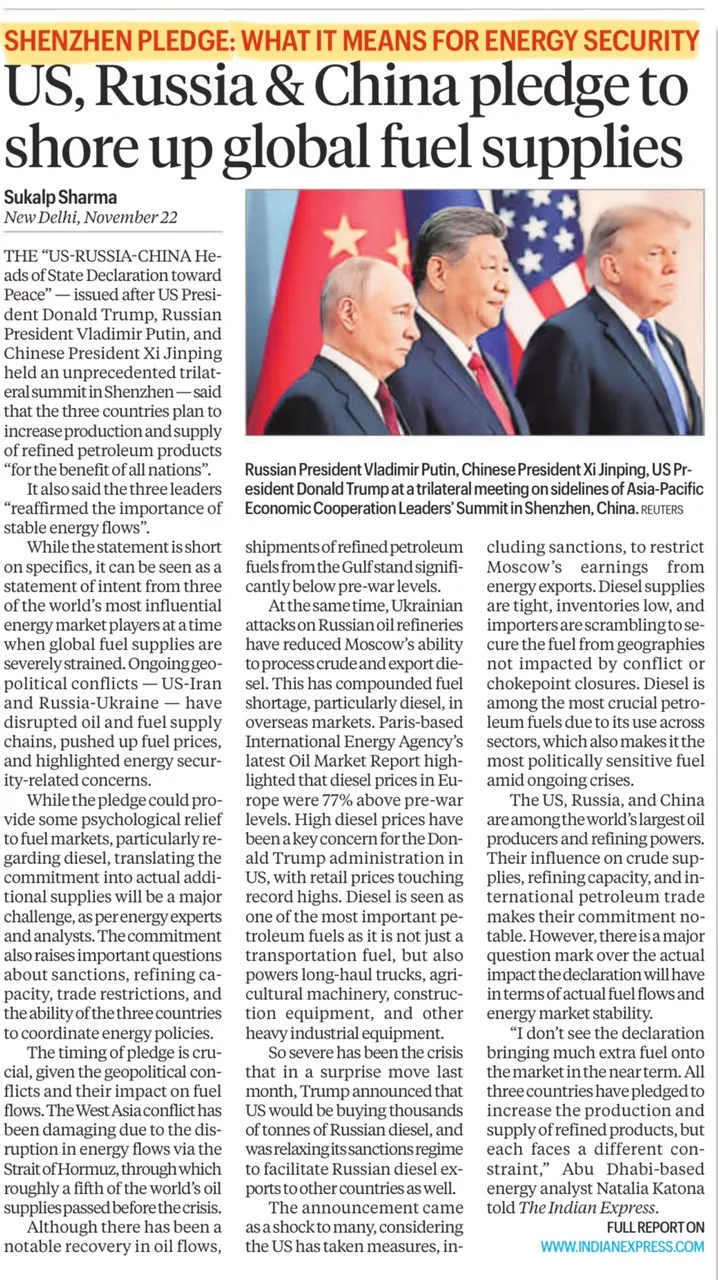
Shenzhen Pledge: US, Russia and China Commit to Strengthening Global Fuel Supplies

Context: The US, Russia and China issued the US–Russia–China Heads of State Declaration toward Peace following their trilateral summit in Shenzhen, pledging to increase production and supply of refined petroleum products to strengthen global energy security.

US, Russia and China pledge to shore up global fuel supplies (The Indian Express)
Shenzhen Pledge on global fuel supplies. Source: The Indian Express

Key Highlights of the Pledge

Increased production
Expand refined petroleum products for the benefit of all nations.
Stable energy flows
Reaffirmed uninterrupted global energy supplies.
Strategic weight
Among the world's major oil producers and refiners.

Position of the Three Countries

United States
World's largest crude oil producer; major exporter of refined products incl. diesel.
Russia
Major crude and product exporter; sanctions and Ukrainian attacks on refineries limit diesel exports.
China
World's largest oil-refining power, but heavily dependent on imported crude.
Key distinction
Pledge involves both crude availability and refining capacity.

Background: Supply Disruptions

West Asia
Disrupted flows via the Strait of Hormuz – about one-fifth of world oil supplies passed through it before the crisis.
Russia–Ukraine
Attacks on Russian refineries cut diesel exports.
Sanctions
Restrictions on Russian energy exports.
Diesel shortage
European diesel prices ~77% above pre-war levels.

Challenges to Implementation

Geopolitics
Conflicts and sanctions.
Refining
Damaged Russian refineries.
Trade
Sanctions and export controls.
Domestic needs
Balance exports with home demand.
Supply chains
Chokepoints and transport constraints.

Implications for Energy Security

Supply stability
More fuel could moderate prices.
Dependence
Import-dependent economies stay vulnerable.
Economy
Diesel shortages hit transport, farming, construction.
Energy diplomacy
Major producers can shape market stability.
Key Takeaway: The Shenzhen Pledge is a statement of intent, not a guarantee. For import-dependent India, diversified sources and strategic reserves remain the real shield.

Prelims Practice MCQ

+2 correct • −0.66 wrong

With reference to the Strait of Hormuz, consider the following statements:
1. It connects the Persian Gulf with the Gulf of Oman.
2. Iran and Oman lie on either side of the strait.
3. It connects the Red Sea with the Gulf of Aden.
Which of the statements given above are correct?

Explanation: The Strait of Hormuz links the Persian Gulf to the Gulf of Oman and the Arabian Sea, with Iran to the north and Oman (Musandam) to the south. The Red Sea–Gulf of Aden link is the Bab-el-Mandeb strait.

UPSC Mains Question

GS3 • 15 Marks • 250 Words

Geopolitical conflicts have exposed vulnerabilities in global energy supply chains. Discuss the implications for India's energy security and suggest measures.

Attempt before opening the value-addition tab.
Accepted: JPG, JPEG, PNG, WEBP or PDF. The standalone file previews your answer locally; connect the API hook for real server submission.
Use after attempting the Mains answer
  • India — imports over 85% of its crude; Strategic Petroleum Reserves (Visakhapatnam, Mangaluru, Padur).
  • Concepts — energy security, chokepoints, diversification, refining capacity.
  • Geography — Strait of Hormuz, Bab-el-Mandeb, Strait of Malacca.
  • Keywords — supply-chain resilience, energy diplomacy, sanctions.
NEWS 7 GS3 • Economy | Mineral Resources & Trade Source: The Hindu

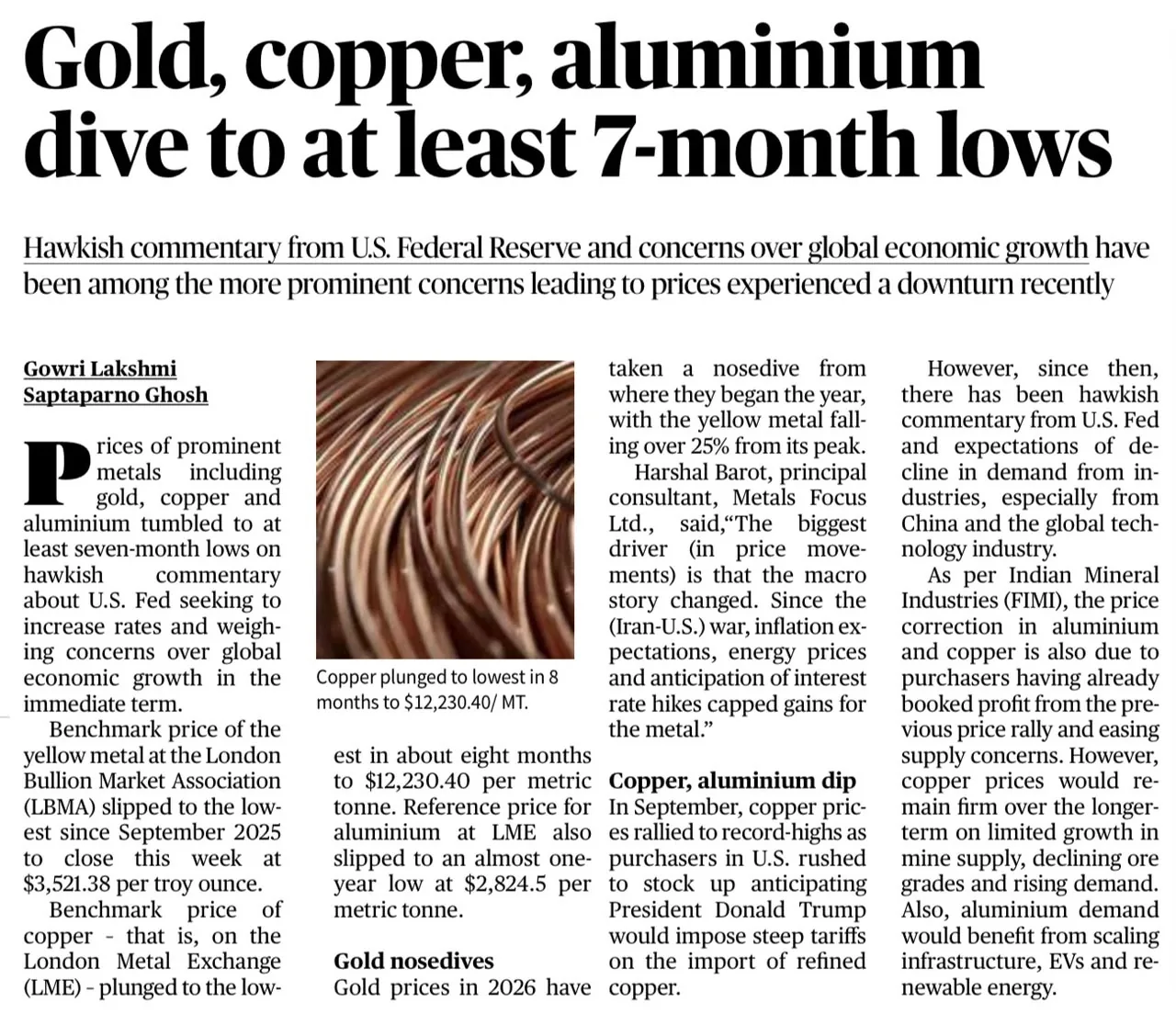
Gold, Copper and Aluminium Prices Fall to Multi-Month Lows

Context: Prices of gold, copper and aluminium declined amid hawkish US Federal Reserve signals, global growth concerns and weakening industrial demand.

Gold, copper, aluminium dive to at least 7-month lows (The Hindu)
Gold, copper, aluminium dive to at least 7-month lows. Source: The Hindu

Major Reasons for Price Decline

Hawkish US Fed
Higher rate expectations strengthen the dollar and cut gold's appeal.
Slowdown fears
Weak growth, especially in China, reduces demand.
Industrial demand
Concerns over manufacturing and tech demand hit copper and aluminium.
Profit booking
Investors sell after the previous rally.
Supply concerns
Easing supply worries lead to price corrections.

Price Trends

Gold
$3,521.38 per troy ounce; lowest since September 2025.
Copper
$12,230.40 per metric tonne; eight-month low.
Aluminium
$2,824.50 per metric tonne; nearly one-year low.

Global Production and Reserves (USGS, 2026)

Gold
Largest producer China; major reserves Australia, Russia. Mine output ~3,300 tonnes.
Copper
Largest producer Chile; major reserves Chile, Peru. Mine output ~23 million tonnes.
Bauxite
Largest producer Guinea; major reserves Guinea, Australia. Output ~440 million tonnes.
Primary aluminium
China by far the largest; India among the leading producers.

India: Economic Relevance

Gold
Jewellery, household savings, import bill.
Copper
Power transmission, EVs, electronics, renewables.
Aluminium
Infrastructure, railways, automobiles, power.
Price impact
Lower prices cut input costs; volatility hits mining investment.

Prelims Facts

Aluminium chain
Bauxite → Alumina → Aluminium.
Chile
Leading copper producer and reserve holder.
China
Largest gold and primary aluminium producer.
Guinea
Largest bauxite producer.
Australia
Largest gold reserve holder.
Key Takeaway: Metal prices track interest rates and global growth. For India, cheaper copper and aluminium ease input costs, while lower gold prices ease the import bill.

Prelims Practice MCQ

+2 correct • −0.66 wrong

Consider the following pairs:
Mineral — Largest producer (2025)
1. Copper — Chile
2. Bauxite — Australia
3. Gold — China
How many of the above pairs are correctly matched?

Explanation: Chile is the largest copper producer and China the largest gold producer. The largest bauxite producer is Guinea, not Australia.

UPSC Mains Question

GS3 • 10 Marks • 150 Words

Global commodity price cycles are shaped by monetary policy and geopolitics. Discuss their impact on India's economy with reference to gold, copper and aluminium.

Attempt before opening the value-addition tab.
Accepted: JPG, JPEG, PNG, WEBP or PDF. The standalone file previews your answer locally; connect the API hook for real server submission.
Use after attempting the Mains answer
  • Concepts — hawkish vs dovish policy, safe-haven asset, commodity super-cycle, profit booking.
  • India — Sovereign Gold Bonds, Gold Monetisation Scheme, National Critical Mineral Mission.
  • Data — gold $3,521.38/oz; copper $12,230.40/t; aluminium $2,824.50/t.
  • Keywords — import bill, current account deficit, energy transition metals.

Copyright © 2026 USARAMBHA EDUCATION (UnderStand UPSC). All Rights Reserved.

Call Now · 83770 72252