
Admissions Open: MAD-X for UPSC Prelims 2027 · Batch starts 1st Nov 2026 Explore MAD-X
US
UnderStand UPSC Daily Current Affairs Practice
0.00Score / 14
0 / 7MCQs Attempted
0%Accuracy
5 November 2026 • UPSC CSE

Read the news. Test the concept. Write the Mains answer.

This interactive edition converts each current-affairs item into one Prelims-level MCQ, one Mains-level question, and a compact value-addition section for revision.

+2 correct −0.66 incorrect Explanation after attempt Image/PDF answer upload
NEWS 1 GS2 • International Relations | Comparative Polity Source: The Hindu

U.S. Midterm Elections 2026: What a Divided Government Means for India

Context: In the 3 November 2026 U.S. midterm elections, Democrats won control of both the House and the Senate while Republican President Donald Trump stays in office — producing a divided government with consequences for U.S. policy and India's interests.
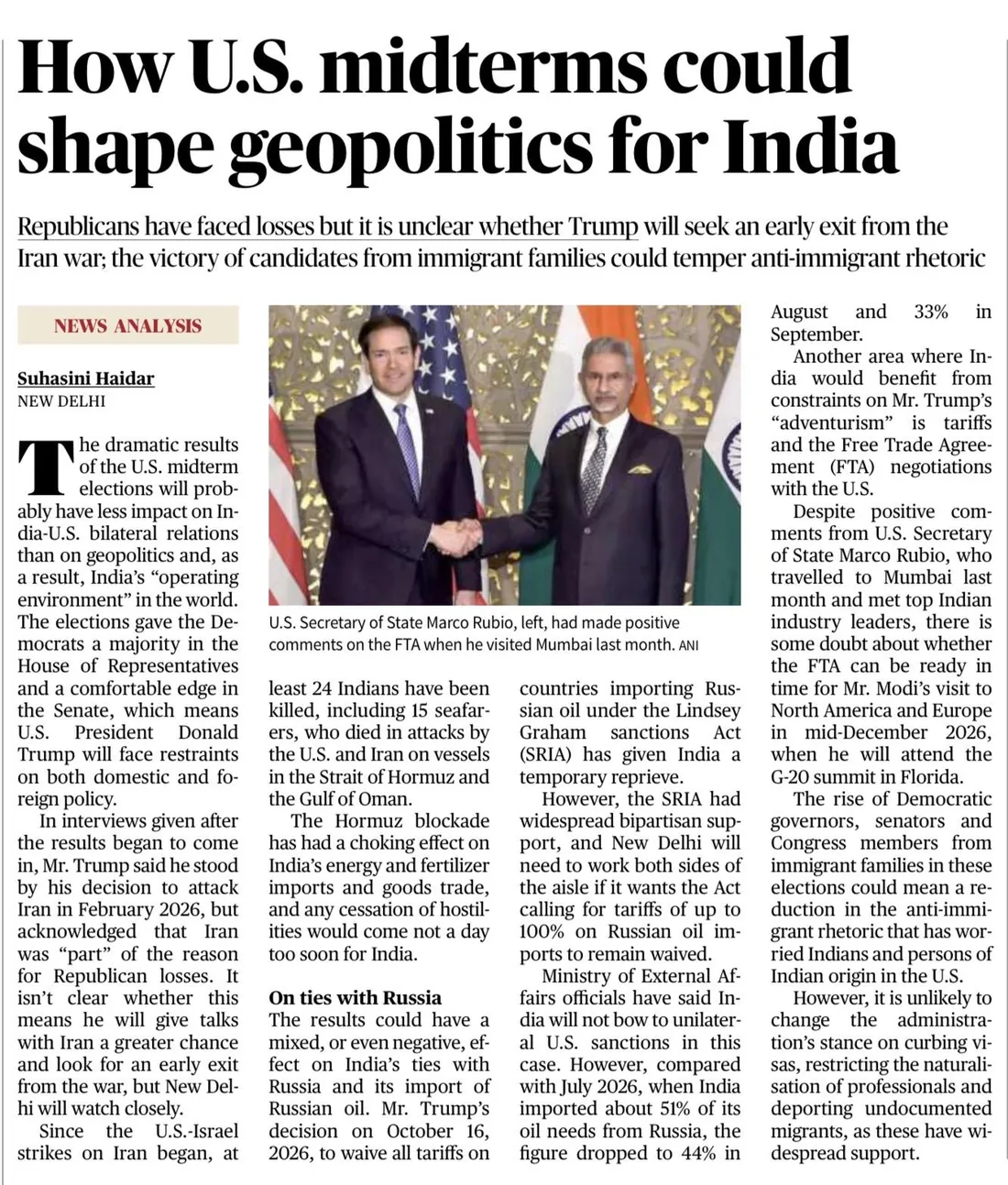
U.S. midterm elections 2026 – Democrats win House and Senate, divided government and implications for India (The Hindu)
Democrats take both chambers of Congress in the 2026 midterms. Source: The Hindu

The Outcome

House
All 435 seats contested every two years; Democrats won a majority.
Senate
33 regular + 2 special seats of 100 contested; Senators serve staggered six-year terms; Democrats in control.
President
Fixed four-year term — midterms do not remove the President.

How Congress Checks the President

Law & money
Can block or amend Bills; the power of the purse (appropriations).
Oversight
Committees can investigate the administration.
Senate
Confirms key appointments and gives consent to treaties.
Impeachment
House impeaches, Senate tries; losing a majority alone cannot remove the President.

Presidential (USA) vs Parliamentary (India)

Executive
USA: separately elected President · India: PM leads the government.
Tenure
USA: fixed term · India: depends on Lok Sabha confidence (Art. 75(3), collective responsibility).
Relationship
USA: separation of powers · India: fusion of executive and legislature.

Implications for India

West Asia
U.S. Iran policy affects India's energy security, fertiliser supply and shipping via the Strait of Hormuz.
Russian oil
Bipartisan support for sanctions → uncertain tariff relief; India must engage both parties.
Trade & diaspora
Tariffs, BTA talks; visa and immigration curbs for students and professionals.
Continuity
Defence, technology and Indo-Pacific cooperation remain stable pillars.

Previous-Year Questions

UPSC Mains 2018 — GS II
India and USA are two large democracies. Examine the basic tenets on which the two political systems are based.
UPSC Mains 2021 — GS II
To what extent is Parliament able to ensure accountability of the executive in India?
Key Takeaway: In the U.S., losing Congress weakens a President but does not end his term; in India, losing the Lok Sabha's confidence ends a government. For India, a divided Washington means engaging both parties, not just the White House.

Prelims Practice MCQ

+2 correct • −0.66 wrong

With reference to the political system of the United States, consider the following statements:
1. All seats of the House of Representatives are contested every two years.
2. The President must resign if his party loses control of both Houses of Congress.
3. The Senate gives its consent to the ratification of treaties.
Which of the statements given above are correct?

Explanation: Statements 1 and 3 are correct. The U.S. President has a fixed four-year term and can be removed only by impeachment, not by losing a congressional majority.

UPSC Mains Question

15 Marks • 250 Words

Compare the accountability of the executive in the presidential system of the USA and the parliamentary system of India. What does a 'divided government' in the USA mean for India–US relations?

Attempt before opening the value-addition tab.
Accepted: JPG, JPEG, PNG, WEBP or PDF. The standalone file previews your answer locally; connect the API hook for real server submission.
Use after attempting the Mains answer
  • U.S. — Art. I (Congress), Art. II (President); checks and balances; power of the purse; impeachment.
  • India — Art. 75(3) collective responsibility; no-confidence motion; fused executive.
  • Issues — Hormuz & energy, Russian oil sanctions, tariffs/BTA, H-1B and students.
  • Pillars — iCET/TRUST, defence (GSOMIA-type pacts, BECA), Quad.
  • Approach — bipartisan outreach, diaspora diplomacy, strategic autonomy.
NEWS 2 GS3 • Defence Reforms & Security Source: The Hindu

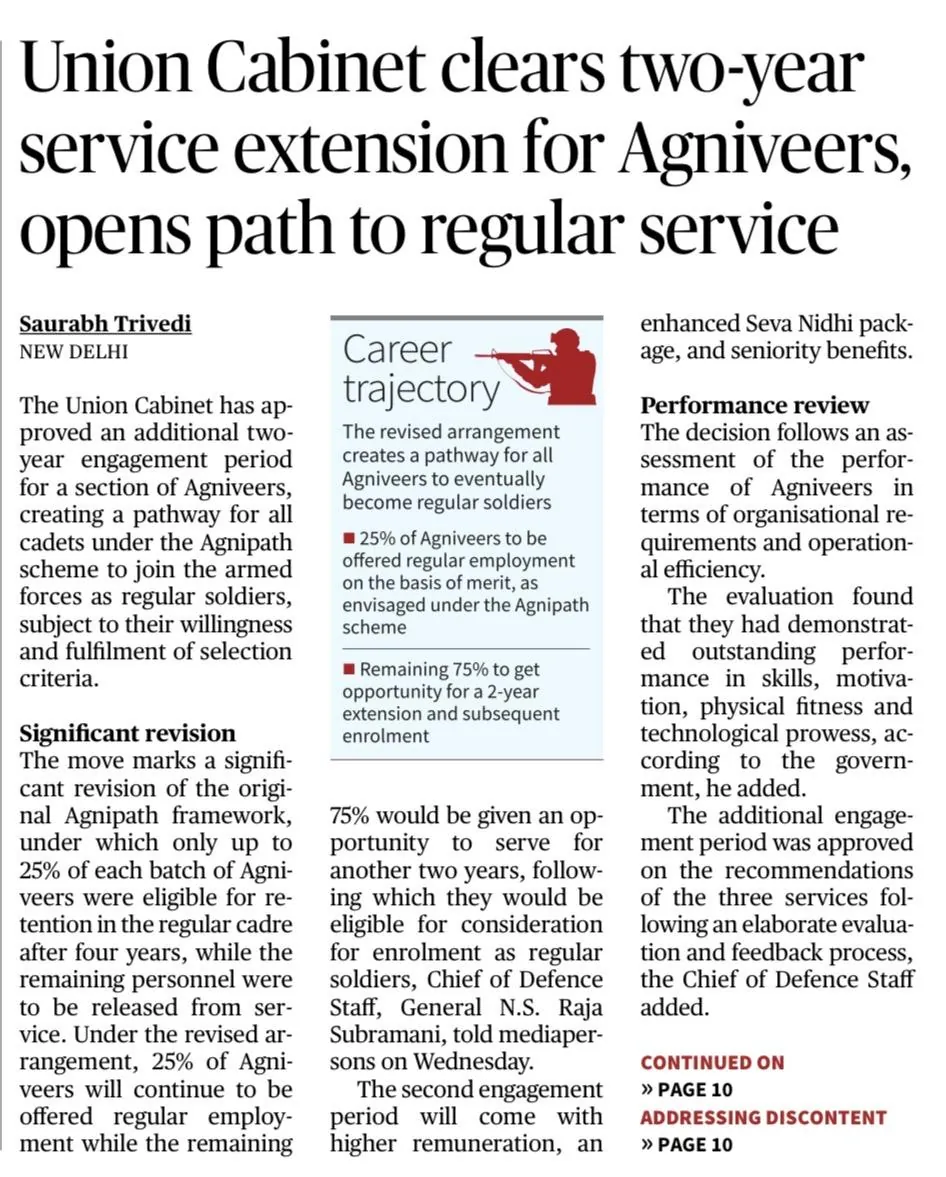
Agnipath Scheme: Cabinet Approves Two-Year Extension for Agniveers

Context: After a four-year review and recommendations from the three services, the Union Cabinet has approved an additional two-year engagement for the 75% of Agniveers not retained in the first round, with a pathway to regular service.

Agnipath scheme – Cabinet approves two-year extension for Agniveers and pathway to regular service (The Hindu)
Agniveers not retained after four years get two more years of service. Source: The Hindu

Agnipath: Original Design (June 2022)

Who
Short-term recruitment of personnel below officer rank in Army, Navy and Air Force — called Agniveers.
Tenure & age
Four years including training; age 17.5–21 years.
Retention
Up to 25% of each batch absorbed into the regular cadre on merit.
Benefits
Seva Nidhi exit package (matching government contribution), ₹48 lakh life cover; no pension or gratuity.

Why It Was Criticised

Experience
Four years too short for skills and unit cohesion.
Careers
75% faced uncertain civilian employment after exit.
Equity
Different pay and security from regular soldiers doing the same duties.

The November 2026 Revision

First 25%
Continue to get regular enrolment on merit.
Remaining 75%
Offered two more years (total six), if willing.
After six years
Offered regular enrolment — subject to willingness and selection criteria, not automatic.
Extra benefits
Higher pay, enhanced Seva Nidhi and seniority benefits.

Significance

Preparedness
Keeps trained manpower, improves specialisation and cohesion.
Balance
Retains a youthful profile while reducing loss of experience.
Key Takeaway: The revision answers the scheme's biggest criticism — wasting trained soldiers after four years. Its success will depend on transparent selection so that a six-year path builds both a younger and a more experienced force.

Prelims Practice MCQ

+2 correct • −0.66 wrong

With reference to the Agnipath Scheme, consider the following statements:
1. Agniveers recruited under the original scheme were entitled to pension after four years of service.
2. Up to 25% of each batch could be enrolled in the regular cadre after four years.
3. Under the 2026 revision, the remaining Agniveers will automatically become regular soldiers after six years.
Which of the statements given above is/are correct?

Explanation: Only statement 2 is correct. There was no pension under the original scheme, and regular enrolment after the extension depends on willingness and selection criteria, not automatic.

UPSC Mains Question

10 Marks • 150 Words

The Agnipath Scheme aimed to make the armed forces younger, but raised concerns about experience and career security. Evaluate the scheme in the light of its recent revision.

Attempt before opening the value-addition tab.
Accepted: JPG, JPEG, PNG, WEBP or PDF. The standalone file previews your answer locally; connect the API hook for real server submission.
Use after attempting the Mains answer
  • Original — June 2022; 4 years; 17.5–21 years; 25% retention; Seva Nidhi; ₹48 lakh cover; no pension.
  • Revision — +2 years for remaining 75%; regular enrolment subject to selection; higher pay/Seva Nidhi.
  • Arguments — younger force, lower pension bill vs skills, cohesion, social security.
  • Global — short-service models in Israel, U.S., Russia.
  • Way forward — transparent selection, skilling, lateral entry to CAPFs/State police.
NEWS 3 GS1 • Population | GS2 • Judiciary & Governance Source: The Hindu

Two-Child Norms: Supreme Court Questions Their Continued Relevance

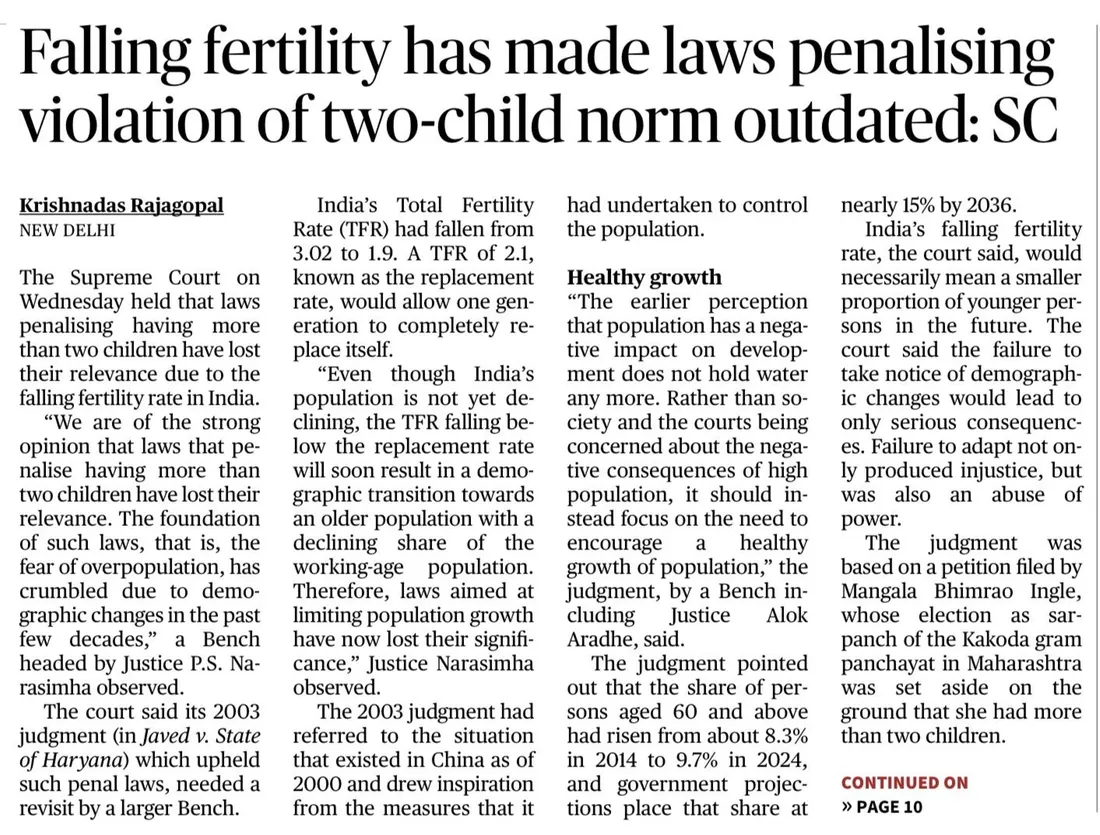
Context: Noting that India's fertility has fallen below replacement level, the Supreme Court has sought reconsideration of Javed v. State of Haryana (2003), which upheld a two-child norm for contesting panchayat elections.

Supreme Court questions two-child norms as India's total fertility rate falls to 1.9 – Javed v. State of Haryana (The Hindu)
India's TFR is now below the replacement level of 2.1. Source: The Hindu

The Court's View

Fertility
India's TFR is 1.9, below the replacement level of 2.1.
Precedent
Larger Bench to reconsider Javed v. State of Haryana (2003).
Shift
Policy must address ageing and regional differences, not only population control.

Demographic Change

Ageing
60+ population: 8.3% (2014) → 9.7% (2024), likely ~15% by 2036.
Pressure
Rising needs for elder care, pensions and health.

Two-Child Norms in States

Assam (2019 Rules)
No direct government job for those with more than two children born after 1 January 2021.
Maharashtra (2005 Rules)
Small-family norm for all groups of State government jobs.
Panchayats
Several States bar people with more than two children from local elections.

Concerns

Rights
Interferes with reproductive autonomy (Art. 21).
Gender
Women face disqualification, desertion and pressure; risk of sex selection.
Exclusion
Keeps poor and marginalised out of local democracy.
Effectiveness
Fertility falls with education, health and income, not penalties.

Previous-Year Questions

UPSC Prelims 2024 — TFR
Average number of live births a woman would have by the end of her child-bearing age. Answer: (d).
UPSC Mains 2024 — GS I
What is the concept of a 'demographic winter'? Is the world moving towards such a situation?
UPSC Mains 2019 — GS I
'Empowering women is the key to control population growth.' Discuss.
Key Takeaway: Two-child rules were designed for a high-fertility India. With TFR now below replacement, coercive norms add little to population control but still cost women and the poor their rights and political voice.

Prelims Practice MCQ

+2 correct • −0.66 wrong

With reference to population policy in India, consider the following statements:
1. India's Total Fertility Rate is currently below the replacement level of about 2.1.
2. In Javed v. State of Haryana (2003), the Supreme Court struck down the two-child norm for panchayat elections.
3. Some States apply a two-child norm for recruitment to government jobs.
Which of the statements given above are correct?

Explanation: Statements 1 and 3 are correct. In Javed (2003) the Court upheld Haryana's two-child norm; it is now being sent to a larger Bench for reconsideration.

UPSC Mains Question

10 Marks • 150 Words

With India's fertility now below replacement level, coercive population-control measures have lost their relevance. Critically examine.

Attempt before opening the value-addition tab.
Accepted: JPG, JPEG, PNG, WEBP or PDF. The standalone file previews your answer locally; connect the API hook for real server submission.
Use after attempting the Mains answer
  • Data — TFR 1.9 (replacement 2.1); 60+ share 9.7% → ~15% by 2036.
  • Cases — Javed v. Haryana (2003) upheld; now for larger Bench; Puttaswamy (privacy, autonomy).
  • Examples — Assam 2019 Rules, Maharashtra 2005 Rules, panchayat bars.
  • Concerns — reproductive rights, gender, sex selection, exclusion.
  • Way forward — rights-based family planning, women's empowerment, ageing policy, regional approach.
NEWS 4 GS2 • Health & Nutrition Source: The Hindu

Anaemia Burden in India: Why Iron Fortification Alone Is Not Enough

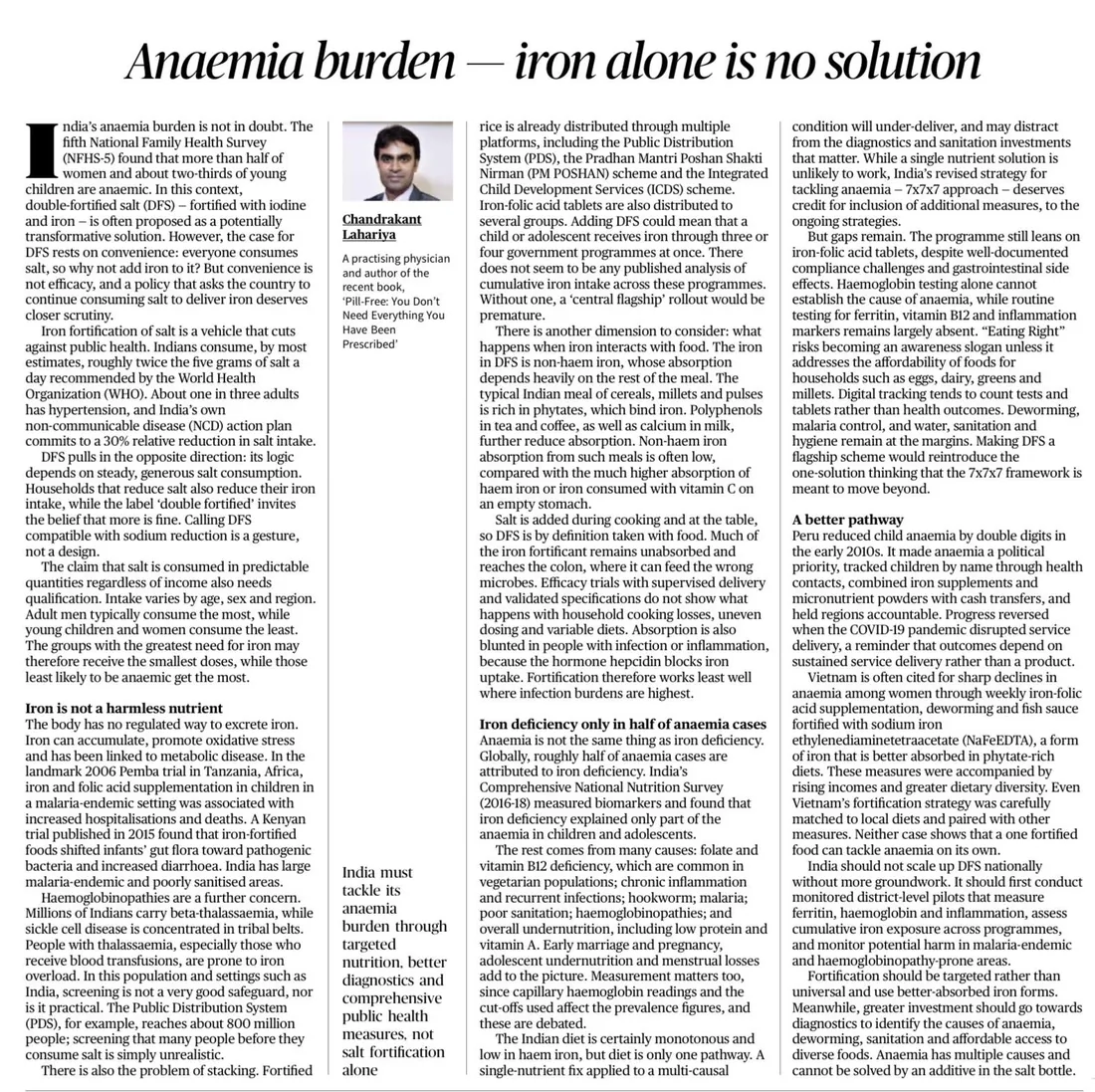
Context: With more than half of women and about two-thirds of children anaemic (NFHS-5), experts argue that India's heavy reliance on iron fortification must give way to cause-specific diagnosis, diverse diets and broader public-health measures.

Anaemia burden in India – why iron fortification alone is not enough, NFHS-5 and Anaemia Mukt Bharat (The Hindu)
Anaemia has many causes beyond iron deficiency. Source: The Hindu

The Problem

Scale
NFHS-5: over half of women and ~two-thirds of children are anaemic.
Causes
Iron, folate and B12 deficiency, infections, worms, malaria, thalassaemia and sickle-cell.

Why Iron Alone Fails

Excess iron
Can build up and damage organs, especially with haemoglobin disorders.
Absorption
Phytates (cereals, pulses) and polyphenols (tea, coffee) block iron; Vitamin C helps.
Overlap
Iron comes through PDS, PM POSHAN, ICDS and salt — cumulative intake is not tracked.
Salt
Double-Fortified Salt conflicts with the goal of cutting sodium.

Government Initiatives

Anaemia Mukt Bharat (2018)
6×6×6 strategy — 6 beneficiary groups, 6 interventions, 6 institutional mechanisms.
Others
National Iron Plus Initiative, PM POSHAN, POSHAN Abhiyaan, DFS.
Global lessons
Peru — supplements plus follow-up; Vietnam — fortified fish sauce plus diet diversity.

Way Forward

Diagnosis
Test ferritin, B12 and inflammation, not just haemoglobin.
Diet & health
Diverse diets, deworming, malaria control, WASH.
Evidence
District studies on cumulative iron exposure before universal fortification.

Previous-Year Question

UPSC Prelims 2023 — Anaemia Mukt Bharat
Delayed cord clamping, deworming and non-nutritional causes are covered; supplementation is IFA, not calcium. Answer: (c) Only three.
Key Takeaway: Anaemia is not one disease with one cure. Treating every case as iron deficiency wastes resources and can even harm; the right fix starts with finding the cause.

Prelims Practice MCQ

+2 correct • −0.66 wrong

With reference to anaemia in India, consider the following statements:
1. Anaemia Mukt Bharat follows a 6×6×6 strategy.
2. Tea and coffee consumed with meals improve the absorption of non-haem iron.
3. Vitamin B12 deficiency can also cause anaemia.
Which of the statements given above are correct?

Explanation: Statements 1 and 3 are correct. Polyphenols in tea and coffee reduce non-haem iron absorption; Vitamin C improves it.

UPSC Mains Question

15 Marks • 250 Words

Despite several programmes, anaemia remains widespread in India. Why is iron fortification alone insufficient, and what should a comprehensive strategy include?

Attempt before opening the value-addition tab.
Accepted: JPG, JPEG, PNG, WEBP or PDF. The standalone file previews your answer locally; connect the API hook for real server submission.
Use after attempting the Mains answer
  • Data — NFHS-5: 57% women, 67% children (6–59 months) anaemic.
  • Causes — nutritional (iron, folate, B12) and non-nutritional (malaria, worms, haemoglobinopathies).
  • Schemes — AMB 6×6×6, NIPI, PM POSHAN, POSHAN Abhiyaan, fortified rice, DFS.
  • Issues — iron overload, absorption, overlapping schemes, adherence.
  • Way forward — test-and-treat, diet diversity, WASH, evidence-based fortification.
NEWS 5 GS2 • Education Source: The Indian Express

QS Asia University Rankings 2027: More Indian Universities, Lower Ranks

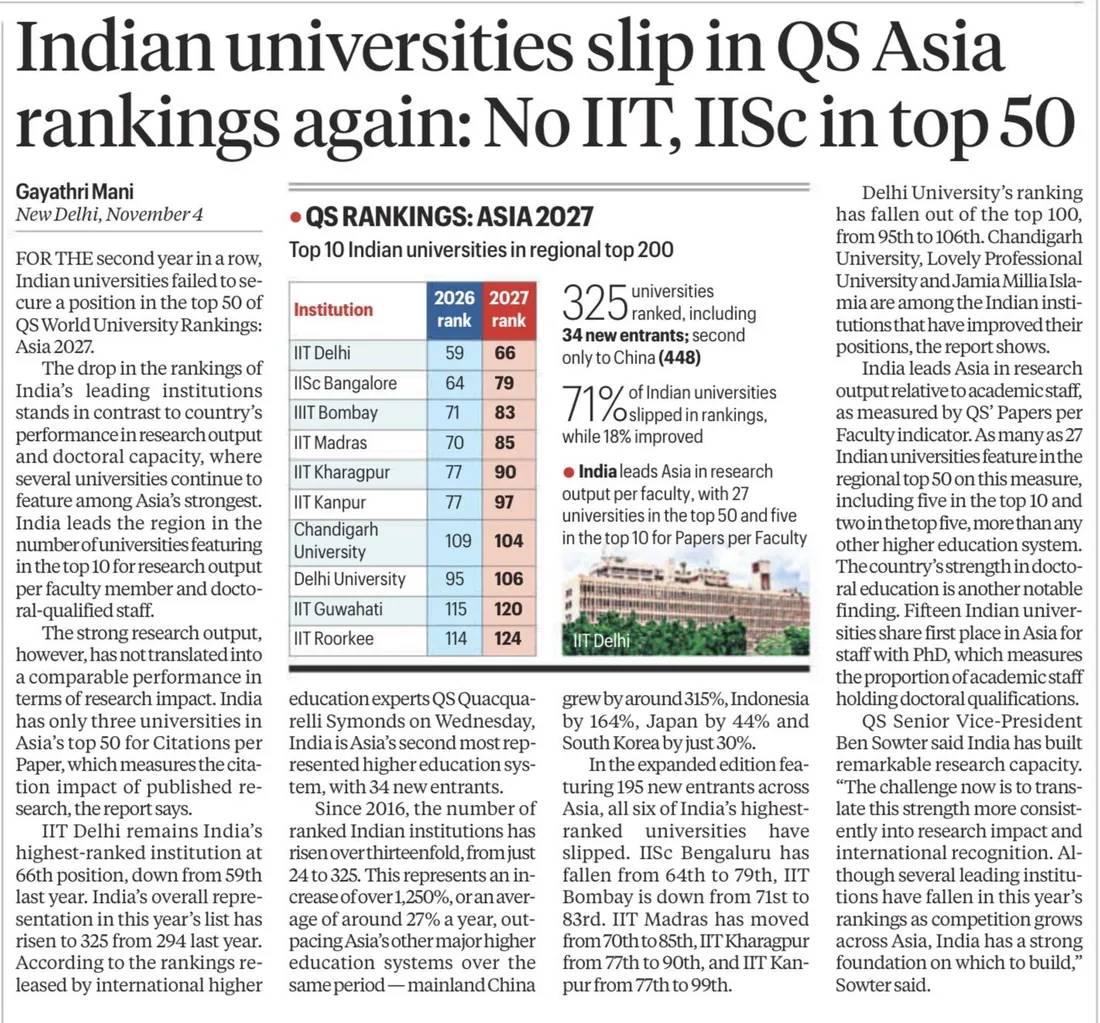
Context: India has more institutions than ever in the QS Asia University Rankings 2027, but none in Asia's top 50 for the second year running, and 71% of Indian institutions slipped.

QS Asia University Rankings 2027 – India 325 institutions, IIT Delhi 66th, no Indian university in top 50 (The Indian Express)
India is the second most represented country after China. Source: The Indian Express

India's Performance

Presence
325 institutions (294 last year); second only to China (448).
Top ranks
IIT Delhi 66th, IISc Bengaluru 79th, IIT Bombay 83rd; none in top 50.
Decline
71% of Indian institutions fell in rank.

Strengths & Gaps

Volume
India leads Asia in papers per faculty.
Impact
Only three Indian universities in the top 50 for citations per paper.
Faculty
15 Indian universities share first place for share of PhD-holding staff.

Reforms Needed

Research
Shift from quantity to high-impact research; stable funding (ANRF).
People
Fill faculty vacancies; international faculty and student mobility.
Ecosystem
Industry links, patents, institutional autonomy (NEP 2020).

Previous-Year Questions

UPSC Mains 2015 — GS II
Would the entry of foreign educational institutions help improve the quality of higher and technical education? Discuss.
UPSC Mains 2014 — GS II
Should IITs/IIMs get more academic independence in courses and student selection? Discuss.
Key Takeaway: India is publishing more but being cited less. Moving up the rankings needs research that others build on, not just more papers and more institutions.

Prelims Practice MCQ

+2 correct • −0.66 wrong

With reference to the QS Asia University Rankings 2027, consider the following statements:
1. India is the most represented country in the rankings.
2. No Indian university features in the Asian top 50.
3. IIT Delhi is the highest-ranked Indian institution.
Which of the statements given above are correct?

Explanation: Statements 2 and 3 are correct. China (448) is the most represented country; India (325) is second.

UPSC Mains Question

10 Marks • 150 Words

India's growing presence in global university rankings has not translated into academic excellence. Analyse the reasons and suggest reforms.

Attempt before opening the value-addition tab.
Accepted: JPG, JPEG, PNG, WEBP or PDF. The standalone file previews your answer locally; connect the API hook for real server submission.
Use after attempting the Mains answer
  • Data — 325 institutions; China 448; IIT Delhi 66; 71% declined; none in top 50.
  • Diagnosis — quantity vs citations, faculty shortage, low R&D (~0.65% of GDP).
  • Policy — NEP 2020, ANRF, IoE, foreign campuses (UGC 2023 rules), NIRF.
  • Reforms — autonomy, funding, industry links, internationalisation.
  • Caveat — rankings measure reputation; use them as a tool, not a goal.
NEWS 6 GS3 • Economy & Energy Security Source: The Indian Express

Cabinet Approves ₹2,814 Crore Scheme for Critical Mineral Processing

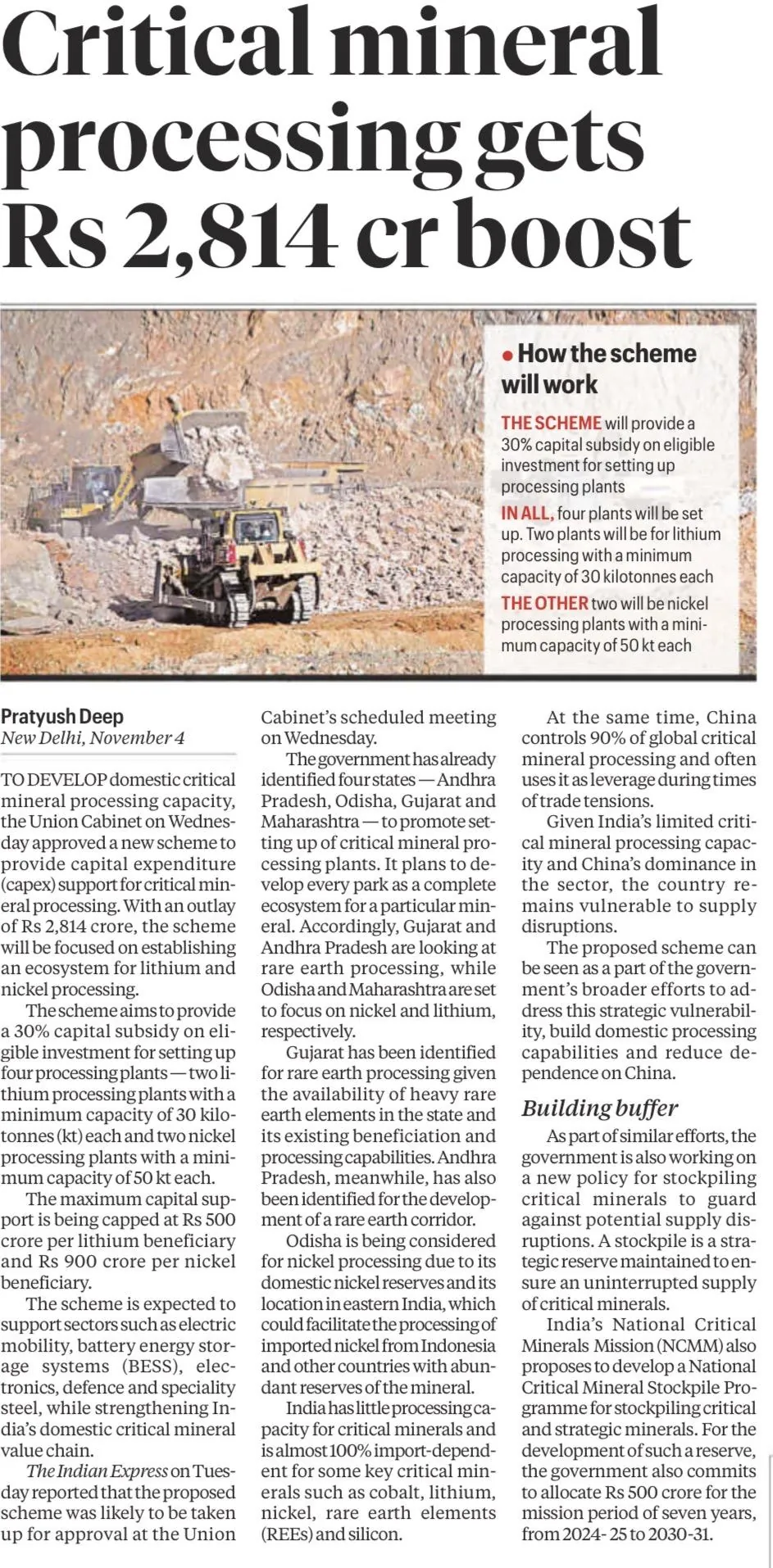
Context: The Union Cabinet has approved a ₹2,814 crore scheme offering capital subsidy to set up domestic lithium and nickel processing plants, to cut dependence on imports dominated by China.

Cabinet approves ₹2,814 crore scheme for critical mineral processing – lithium and nickel plants (The Indian Express)
Capital subsidy for two lithium and two nickel processing plants. Source: The Indian Express

Key Features

Subsidy
30% capital subsidy on eligible investment for four plants.
Plants
Two lithium (30 kt each) and two nickel (50 kt each).
Caps
Up to ₹500 crore per lithium and ₹900 crore per nickel beneficiary.
Locations
Opportunities in Gujarat, Andhra Pradesh, Odisha and Maharashtra.

Why It Matters

China
Controls about 90% of global processing — a strategic chokepoint.
Energy transition
Lithium, nickel, cobalt are vital for EV batteries and storage.
Industry
Electronics, semiconductors, defence; more domestic value addition.

Related Initiatives

NCMM (2025)
National Critical Mineral Mission — exploration, processing, recycling, overseas assets.
Stockpile
₹500 crore for a strategic reserve.
Recycling
Recovering minerals from batteries and e-waste (urban mining).

Prelims Pointers

REEs
17 elements — 15 lanthanides + scandium + yttrium.
Uses
Lithium & cobalt — batteries; nickel — stainless steel & batteries; graphite — battery anodes.
UPSC Prelims 2012
Concern over rare earth supply: China's export curbs and rising electronics demand. Answer: 1 and 3 only.
Key Takeaway: Mining minerals is not enough if they must be sent abroad to be refined. Processing at home is the step that turns India's mineral plans into real supply-chain security.

Prelims Practice MCQ

+2 correct • −0.66 wrong

With reference to Rare Earth Elements (REEs), consider the following statements:
1. There are 17 REEs, including scandium and yttrium.
2. All REEs belong to the lanthanide series.
3. China dominates the global processing of REEs.
Which of the statements given above are correct?

Explanation: Statements 1 and 3 are correct. Scandium and yttrium are REEs but are not lanthanides; the 17 REEs = 15 lanthanides + scandium + yttrium.

UPSC Mains Question

10 Marks • 150 Words

Securing critical mineral supply chains is essential for India's energy transition and strategic autonomy. Discuss the significance of developing domestic processing capacity.

Attempt before opening the value-addition tab.
Accepted: JPG, JPEG, PNG, WEBP or PDF. The standalone file previews your answer locally; connect the API hook for real server submission.
Use after attempting the Mains answer
  • Scheme — ₹2,814 crore; 30% capex subsidy; 2 lithium + 2 nickel plants.
  • Context — China ~90% processing; export curbs on graphite, REEs.
  • Policy — NCMM 2025, KABIL, MMDR Amendment 2023 (auction of critical minerals), stockpile.
  • Partnerships — MSP, Quad, Australia, Argentina, Chile.
  • Challenges — technology, water, environment, financing.
NEWS 7 GS3 • Infrastructure & Energy Source: The Indian Express

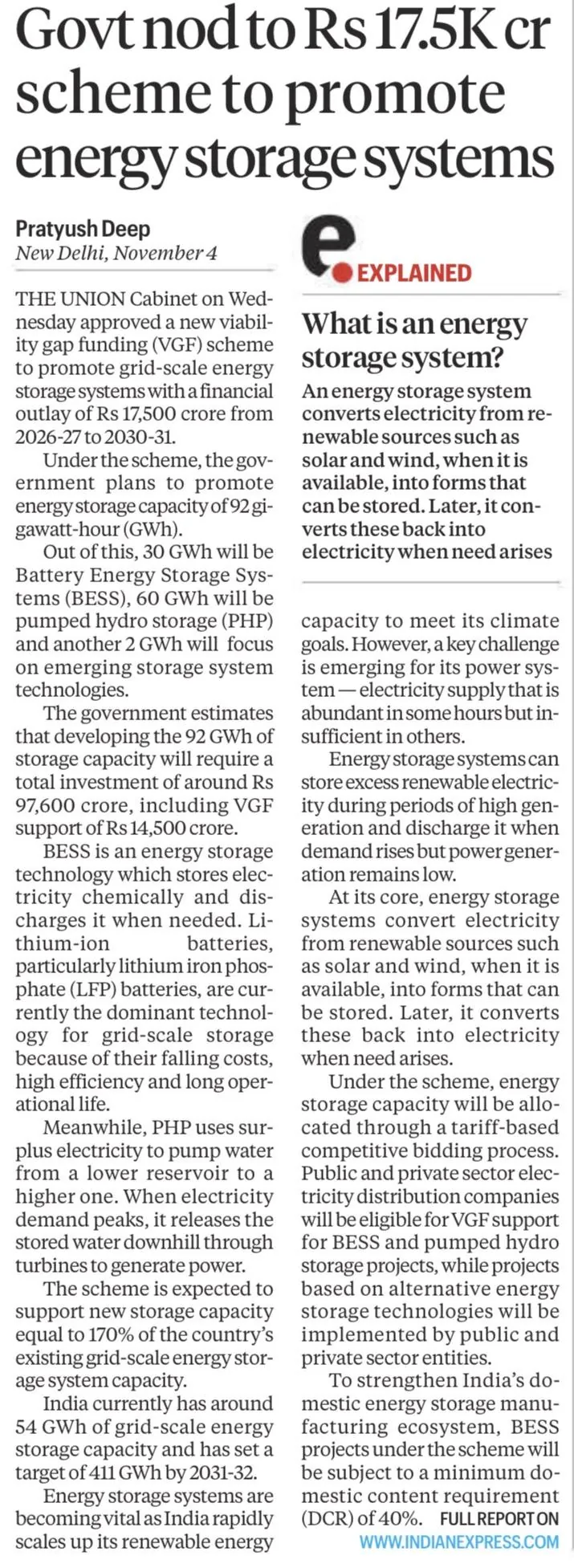
Cabinet Approves ₹17,500 Crore Scheme for Grid-Scale Energy Storage

Context: The Union Cabinet approved a Viability Gap Funding scheme to support 92 GWh of grid-scale energy storage between 2026-27 and 2030-31, combining battery and pumped hydro storage.

Cabinet approves ₹17,500 crore VGF scheme for 92 GWh energy storage – BESS and pumped hydro (The Indian Express)
92 GWh of battery and pumped hydro storage by 2030-31. Source: The Indian Express

Key Features

Capacity
92 GWh — BESS 30 GWh, Pumped Hydro 60 GWh, new technologies 2 GWh.
Money
Outlay ₹17,500 crore (VGF ~₹14,500 crore); investment ~₹97,600 crore.
Make in India
Minimum 40% domestic content for BESS.
Process
Tariff-based competitive bidding; public and private players.

Technologies

BESS
Stores electricity chemically; LFP (lithium iron phosphate) batteries suit the grid.
Pumped hydro
Pumps water uphill with surplus power; releases it through turbines at peak demand.

Why It Matters

Renewables
Stores daytime solar for evening peaks; tackles intermittency.
Gap
Existing storage ~54 GWh; need 411 GWh by 2031-32.
Benefits
Grid stability, energy security, domestic battery manufacturing.

Previous-Year Questions

UPSC Prelims 2024 — Pumped storage
Discussed in the context of long-duration energy storage. Answer: (c).
UPSC Prelims 2024 — DERs
Battery storage, biomass generators, fuel cells and rooftop solar are all distributed energy resources. Answer: (d) All four.
Key Takeaway: India has added solar faster than it can use it at night. Storage is the missing link that turns cheap daytime power into reliable round-the-clock supply.

Prelims Practice MCQ

+2 correct • −0.66 wrong

With reference to the recently approved energy storage scheme, consider the following statements:
1. It uses Viability Gap Funding to support grid-scale storage projects.
2. Battery Energy Storage Systems account for the largest share of the targeted capacity.
3. Pumped hydro storage generates electricity by releasing stored water through turbines.
Which of the statements given above are correct?

Explanation: Statements 1 and 3 are correct. Pumped hydro storage (60 GWh) has the largest share; BESS is 30 GWh.

UPSC Mains Question

15 Marks • 250 Words

Energy storage is the critical link between renewable energy generation and reliable electricity supply. Discuss the significance of India's new energy storage scheme and the challenges ahead.

Attempt before opening the value-addition tab.
Accepted: JPG, JPEG, PNG, WEBP or PDF. The standalone file previews your answer locally; connect the API hook for real server submission.
Use after attempting the Mains answer
  • Scheme — 92 GWh (BESS 30, PHS 60, others 2); ₹17,500 crore; 40% DCR; 2026-27 to 2030-31.
  • Need — 54 GWh existing vs 411 GWh by 2031-32 (CEA); evening peak; 500 GW target.
  • Links — PLI ACC batteries, NCMM, Green Energy Corridors.
  • Challenges — cost, lithium import, recycling, PHS site/ecology issues.
  • Way forward — long-duration storage, market design (ancillary services), recycling rules.

Copyright © 2026 USARAMBHA EDUCATION (UnderStand UPSC). All Rights Reserved.

MAD-X Orientation

Talk to Our Counsellor

Share your details and our counselling team will call you back in 10 minutes.

Please enter your name.
+91
Please enter a valid 10-digit mobile number.
When do you plan to enroll in MAD-X?
Please select an option.

Thank you, !

Our counselling team will call you within 10 minutes.
Please keep your phone handy.