Source: The Hindu | Page 10 | Tags: 20 June 2026, Climate Change, Disaster Management, Environment, GLOF, GS3, Himalayan ecology
Context: High-Risk Glacial Lakes in Arunachal Pradesh
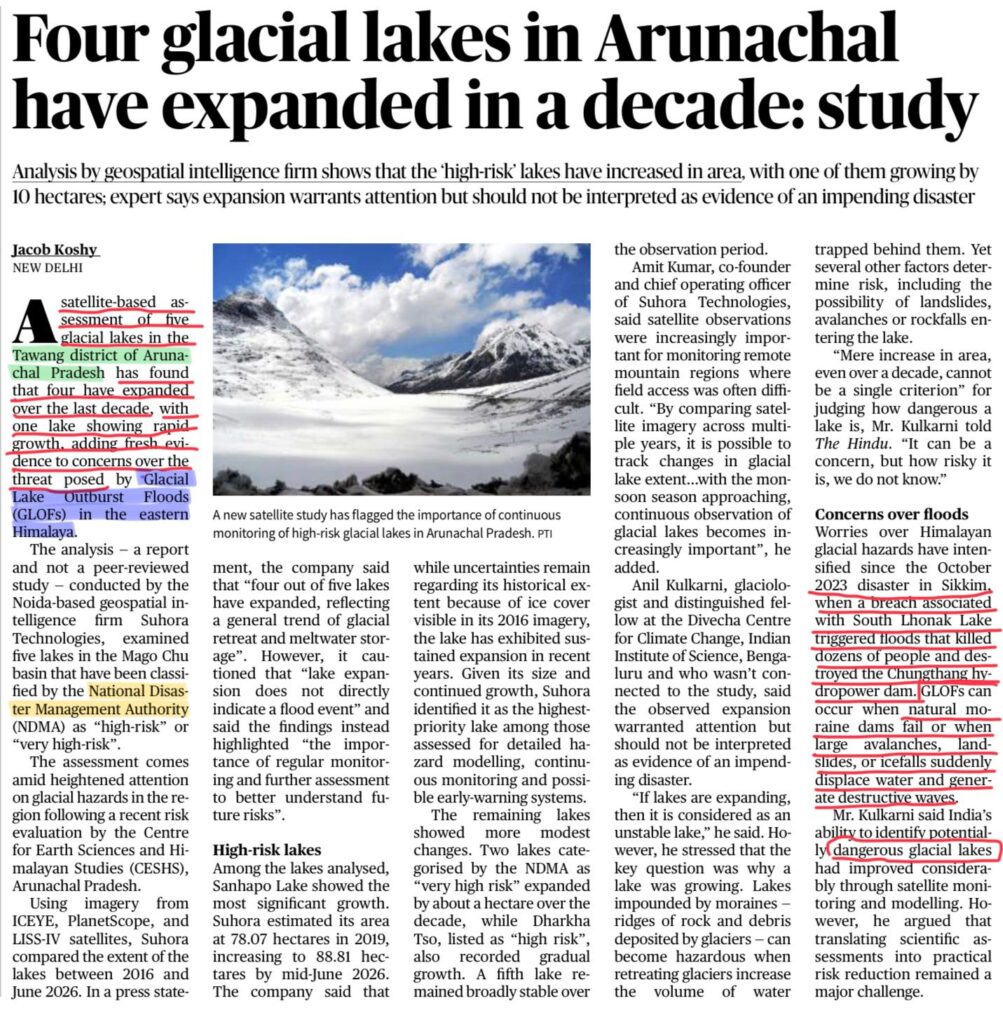
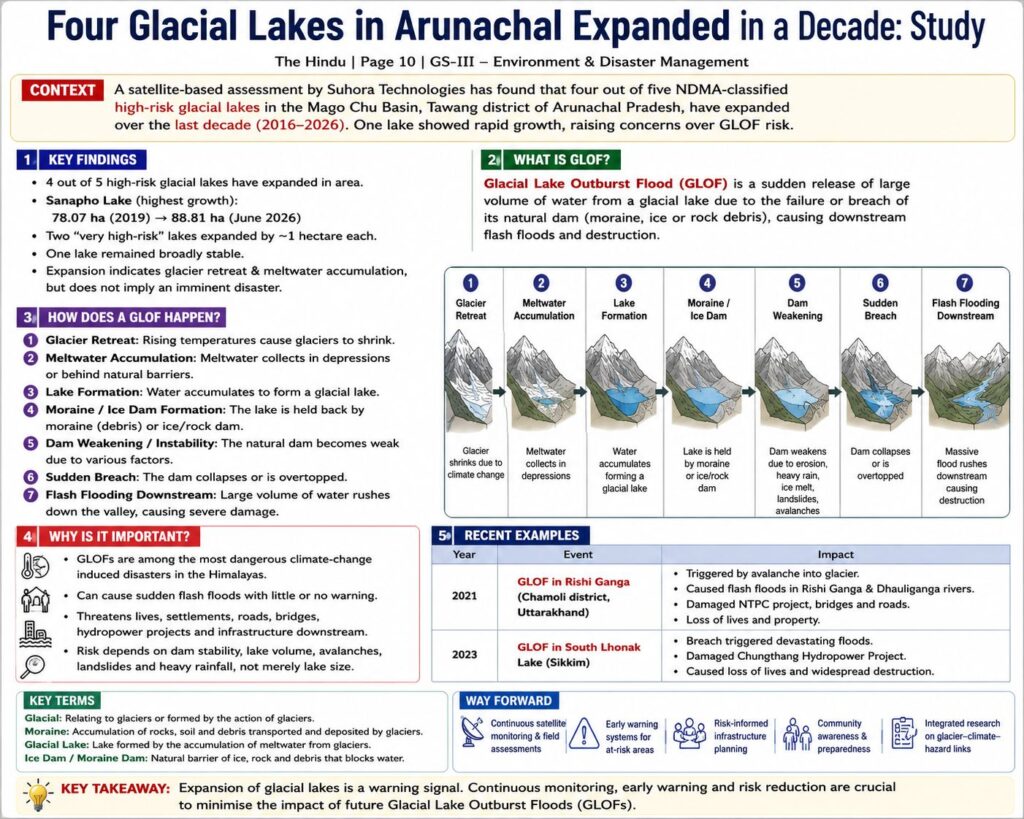
A satellite-based assessment found that four out of five NDMA-classified high-risk glacial lakes in the Mago Chu Basin, Tawang district of Arunachal Pradesh, have expanded in area over the last decade.
This has renewed concerns over Glacial Lake Outburst Floods.
Key Findings
- 4 out of 5 high-risk glacial lakes have expanded in area.
- Sangacho Lake showed major growth.
- One lake expanded by more than one hectare.
- Expansion indicates glacier retreat and meltwater accumulation.
- It does not automatically mean immediate disaster, but it signals rising risk.
Glacial Lake Outburst Flood
A Glacial Lake Outburst Flood is a sudden release of large volumes of water from a glacial lake due to failure or breach of its natural dam.
Natural Dams May Be Made Of
- Moraine
- Ice
- Rock debris
How GLOF Happens
- Glacier retreats due to warming.
- Meltwater accumulates in depressions.
- A lake forms behind moraine, ice or rock debris.
- Dam becomes unstable.
- Sudden breach releases massive water downstream.
- Flash floods, landslides and destruction follow.
Why It Is Important
GLOFs are among the most dangerous climate-induced disasters in the Himalayas.
They can trigger:
- Sudden flash floods
- Damage to hydropower projects
- Damage to roads and bridges
- Landslides
- Loss of lives and livelihoods
- Downstream disaster risks
Recent Examples
Chamoli, Uttarakhand — 2021
- Triggered by avalanche-like glacier event.
- Caused flash floods in Rishi Ganga and Dhauliganga rivers.
- Damaged NTPC project, bridges and roads.
South Lhonak Lake, Sikkim — 2023
- Breach triggered devastating floods.
- Damaged the Chungthang hydropower project.
- Caused loss of lives and widespread destruction.
Way Forward
- Continuous satellite monitoring
- Early warning systems
- Risk-informed infrastructure planning
- Community preparedness
- Integrated research on glacial lakes
- Hazard mapping and evacuation planning