Context: India Education Expenditure Decline
India’s education spending has declined at both the Union and State levels over the past decade.
This raises concerns about the implementation of National Education Policy 2020, quality of education, learning outcomes and human capital development.
Declining Public Investment
The Union Government’s expenditure on education declined from 4.6% of the Union Budget in 2013–14 to 2.5% in the 2025–26 Budget Estimates.
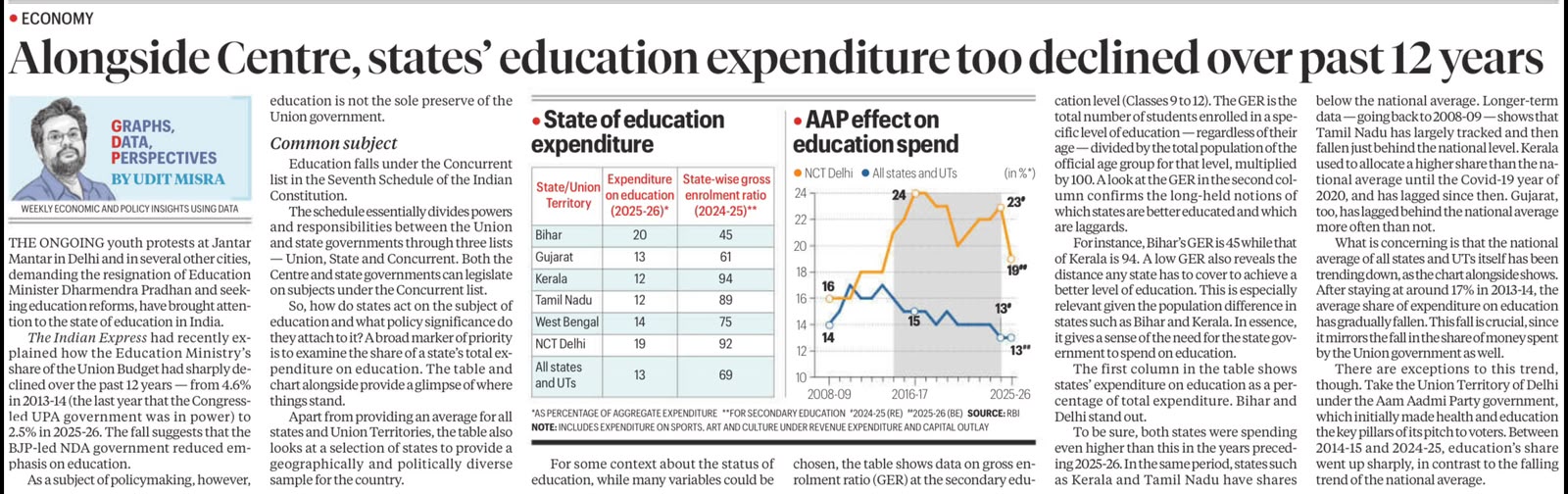
The average share of education expenditure by States and Union Territories also declined from nearly 17% in 2013–14 to 13% in 2025–26.
This shows that the decline is not limited to the Centre.
Education and Federalism
Education is a Concurrent List subject under the Seventh Schedule.
This means both the Union and State governments have responsibility for the sector.
If both levels reduce budgetary priority, overall investment in education weakens.
Key Findings
There are major interstate differences.
Bihar allocates the highest share of its expenditure to education, around 20%, but records a Secondary Gross Enrolment Ratio of only 45.
Kerala and Tamil Nadu allocate around 12% of their expenditure to education, but achieve much better outcomes.
Kerala has a Secondary GER of 94, while Tamil Nadu has a GER of 89.
This shows that higher spending alone does not automatically guarantee better outcomes.
Delhi Exception
Delhi remains a notable exception.
Its education expenditure increased substantially between 2014–15 and 2024–25, showing the impact of sustained policy prioritisation.
Implications
Declining public investment can slow the implementation of NEP 2020.
It may affect:
- School education
- Skill development
- Learning outcomes
- Teacher capacity
- Digital infrastructure
- Human capital formation
Persistent regional disparities can widen inequality in labour productivity and economic growth.
Way Forward
India should progressively increase public investment towards the 6% of GDP target envisaged under NEP 2020.
It should also improve efficiency and outcome-orientation of education spending.
Better governance, teacher training, digital infrastructure and accountability are essential.
Centre-State fiscal coordination must be strengthened to reduce interstate disparities and ensure equitable access to quality education.
Key Takeaway
India’s education challenge is not only about spending more. It is also about spending better, sustaining policy priority and reducing regional inequalities in learning outcomes.