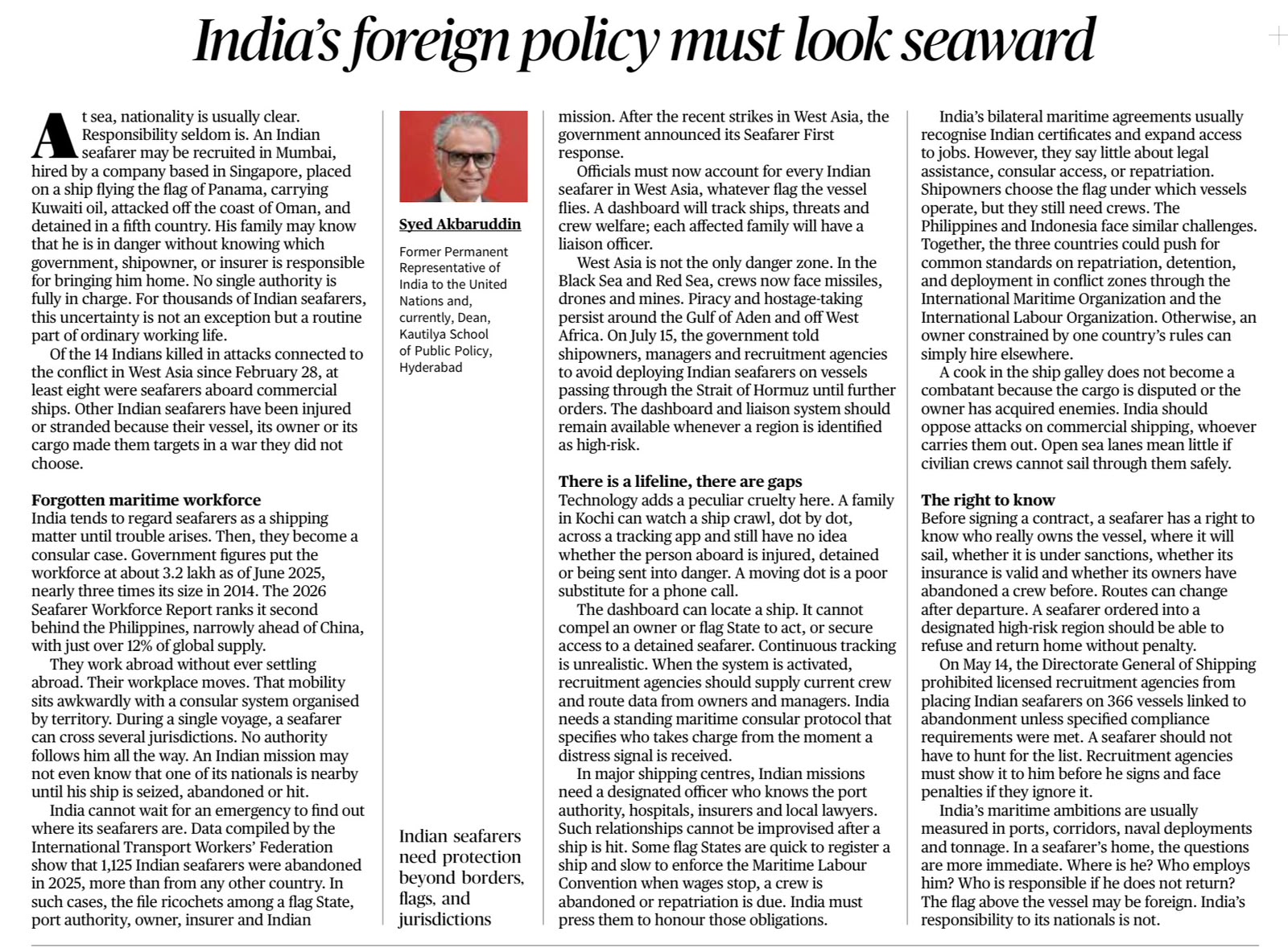
Context: India Seaward Foreign Policy
The editorial argues that India’s maritime diplomacy should go beyond securing sea lanes.
It must also protect Indian seafarers, many of whom work on foreign-flagged vessels and remain vulnerable during conflicts, piracy incidents and jurisdictional disputes.
Core Issue
Indian seafarers often work on ships registered under foreign flags.
This creates uncertainty over:
- Legal jurisdiction
- Consular protection
- Emergency assistance
- Repatriation
- Responsibility during conflict or piracy incidents
Why This Matters
Recent conflicts in West Asia, the Red Sea, the Black Sea and piracy around the Gulf of Aden have exposed gaps in India’s institutional response.
When a ship is foreign-flagged, Indian authorities may face practical difficulties in ensuring quick protection, legal help or evacuation for Indian crew members.
Gaps in Current Maritime Agreements
India’s maritime agreements generally focus on:
- Recognition of certificates
- Employment facilitation
- Shipping cooperation
But they provide limited safeguards for:
- Legal assistance
- Detention-related support
- Evacuation
- Repatriation
- Conflict-zone protection
Maritime Labour Convention, 2006
Ships are governed mainly by Flag State jurisdiction.
The Maritime Labour Convention, 2006 protects seafarers’ rights, but enforcement remains uneven.
As a result, seafarers can remain vulnerable in crisis situations.
Right to Know
A major concern is that seafarers may not have enough information about:
- Vessel ownership
- Insurance status
- Sanctions risk
- Voyage routes
- Conflict-zone risks
Without this information, they cannot make fully informed decisions before joining a vessel.
Way Forward
India should institutionalise a Seafarer First approach.
This requires a permanent maritime consular mechanism with dedicated liaison officers.
There should be clear protocols among:
- Indian Missions
- Shipowners
- Insurers
- Recruitment agencies
- Port authorities
India should also strengthen cooperation through the International Maritime Organization and the International Labour Organization to develop common standards on detention, conflict-zone deployment and crew repatriation.
Key Takeaway
India’s maritime policy must protect not only trade routes but also Indian seafarers. Maritime security is incomplete without legal, consular and emergency protection for Indian citizens at sea.