Context: Indian private space funding 2025
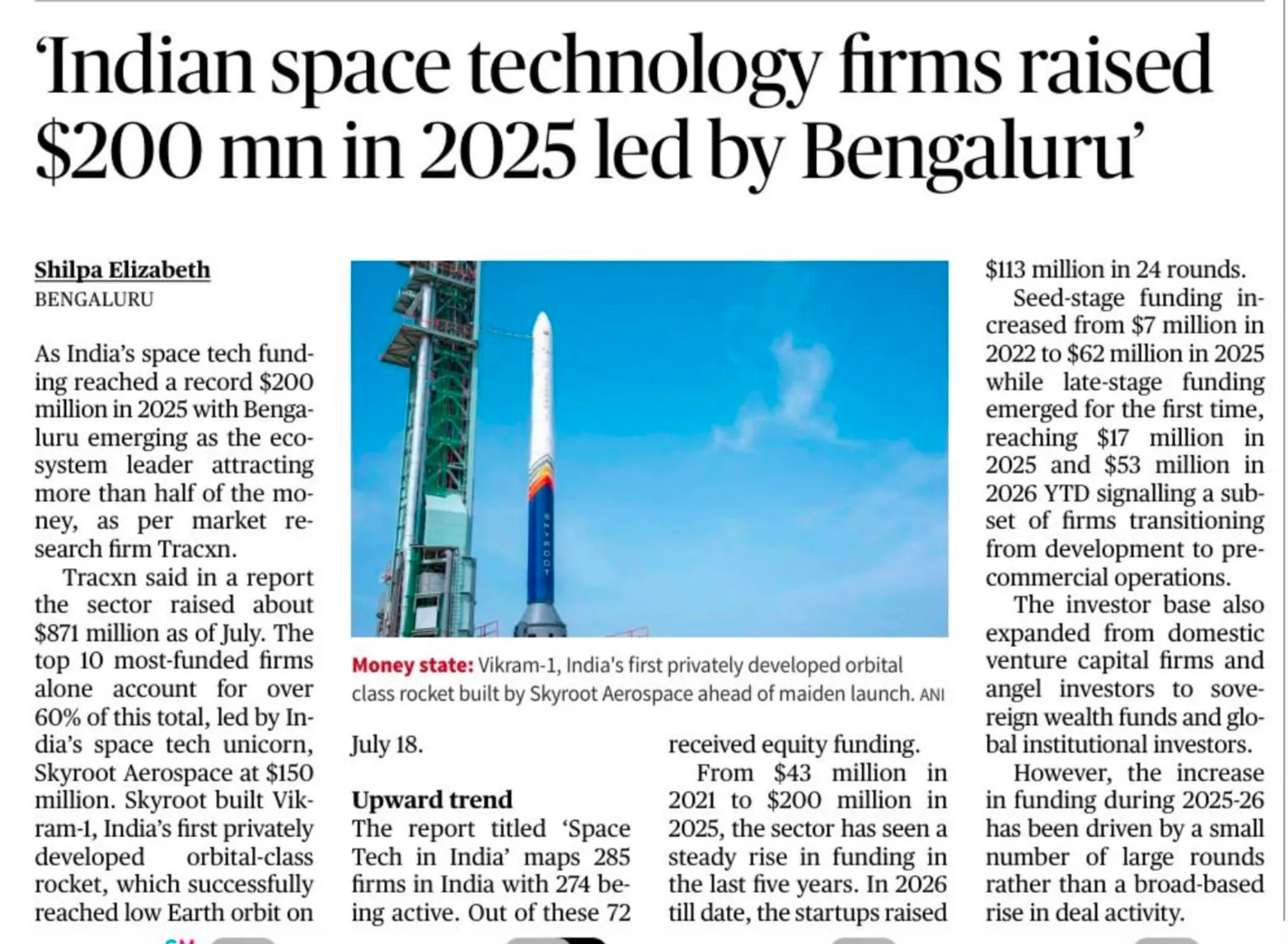
India’s private space technology sector raised a record US$200 million in funding in 2025.
Bengaluru emerged as the leading space-tech hub, attracting more than half of the total investment. This reflects the growing role of private companies in India’s space ecosystem.
Growth of India’s Private Space Sector
India’s space sector has moved beyond a government-only model.
Private companies are now contributing to:
- Satellite manufacturing
- Launch vehicles
- Propulsion systems
- Earth observation
- Space-based services
- Space situational awareness
Key Highlights
Indian space-tech startups raised US$200 million in 2025, compared to US$43 million in 2021.
India has around 285 space-tech startups, of which 274 are active.
Bengaluru attracted more than 50% of total investments, making it the country’s leading space-tech hub.
Global investors are increasingly investing in Indian space startups, showing rising confidence in India’s commercial space market.
Major Companies and Contributions
Skyroot Aerospace
Skyroot developed the Vikram series launch vehicles.
It also developed Vikram-1, India’s first privately developed orbital-class rocket.
This strengthens India’s private launch capability.
Agnikul Cosmos
Agnikul built the Agnibaan launch vehicle.
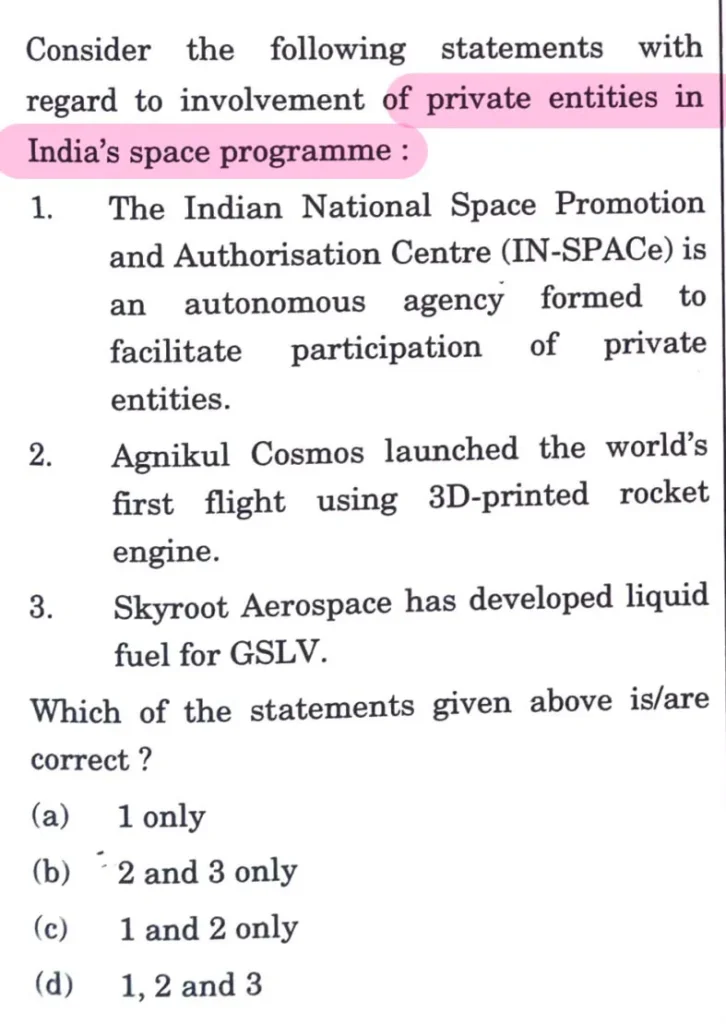
It also developed the world’s first single-piece 3D-printed rocket engine, helping reduce manufacturing time and cost.
Pixxel
Pixxel is developing hyperspectral imaging satellites.
These can support:
- Agriculture
- Climate monitoring
- Mining
- Defence
- Disaster management
Digantara
Digantara works in Space Situational Awareness.
It tracks satellites and space debris, improving safety in orbit.
Bellatrix Aerospace
Bellatrix develops green propulsion systems and orbital transfer vehicles for satellites.
Dhruva Space
Dhruva Space provides end-to-end satellite solutions, including design, manufacturing, integration and mission operations.
SatSure
SatSure uses satellite imagery and AI for agriculture, insurance, infrastructure and climate-risk assessment.
GalaxEye
GalaxEye is developing multi-sensor Earth Observation satellites that can image in all-weather and day-night conditions.
Government Support
The 2020 space sector reforms opened the sector to private participation.
IN-SPACe acts as the nodal agency for authorisation and promotion of private players.
ISRO provides technical support, testing facilities and launch infrastructure to startups.
Significance
The rise of private space firms strengthens Atmanirbhar Bharat in the space sector.
It expands India’s commercial presence in the global space economy.
It promotes innovation, high-skilled employment and technology exports.
It also complements ISRO by enabling private participation in launch services, satellite manufacturing and downstream applications.
Challenges
Funding remains concentrated among a few large startups.
Space technology requires high capital and long development cycles.
India also needs stronger manufacturing capacity, launch infrastructure and global competitiveness.
Key Takeaway
India’s private space sector is entering a serious growth phase. The challenge now is to convert funding momentum into manufacturing depth, commercial launches and global competitiveness.