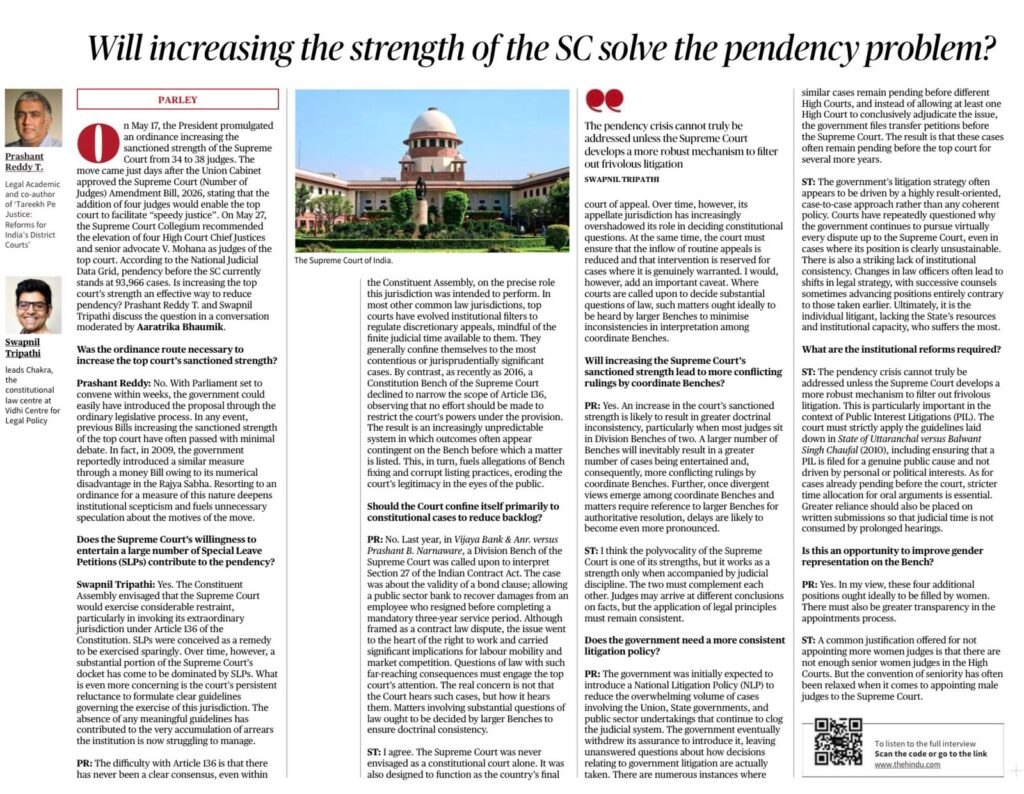
Context: Supreme Court Pendency
The sanctioned strength of the Supreme Court of India has been increased from 34 to 38 judges to address mounting pendency. However, concerns remain that backlog is driven more by excessive appeals, government litigation and weak case-management systems than by judicial vacancies alone.
Constitutional Basis
- Article 124(1): Parliament may increase the number of Supreme Court judges.
- Article 136: Special Leave Petition jurisdiction.
- Article 32: Right to Constitutional Remedies.
- Article 141: Supreme Court decisions are binding on all courts.
- Article 142: Power to do complete justice.
Potential Benefits
- Higher disposal capacity
- More Division Benches and Constitution Benches
- Faster hearing of pending cases
- Better access to justice
- Opportunity to improve women’s representation on the Bench
Key Concerns
- Pendency is not merely a judge-strength issue.
- Excessive use of Special Leave Petitions overloads the Court.
- Growing government litigation contributes significantly to backlog.
- Supreme Court increasingly functions as a regular appellate court rather than focusing on constitutional questions.
- Larger number of coordinate benches may increase inconsistent rulings.
Way Forward
- Filter frivolous litigation and unnecessary Special Leave Petitions.
- Focus on substantial constitutional questions.
- Implement a robust National Litigation Policy.
- Strengthen case-management and written-submission mechanisms.
- Increase use of Constitution Benches for issues of national importance.