1. Context
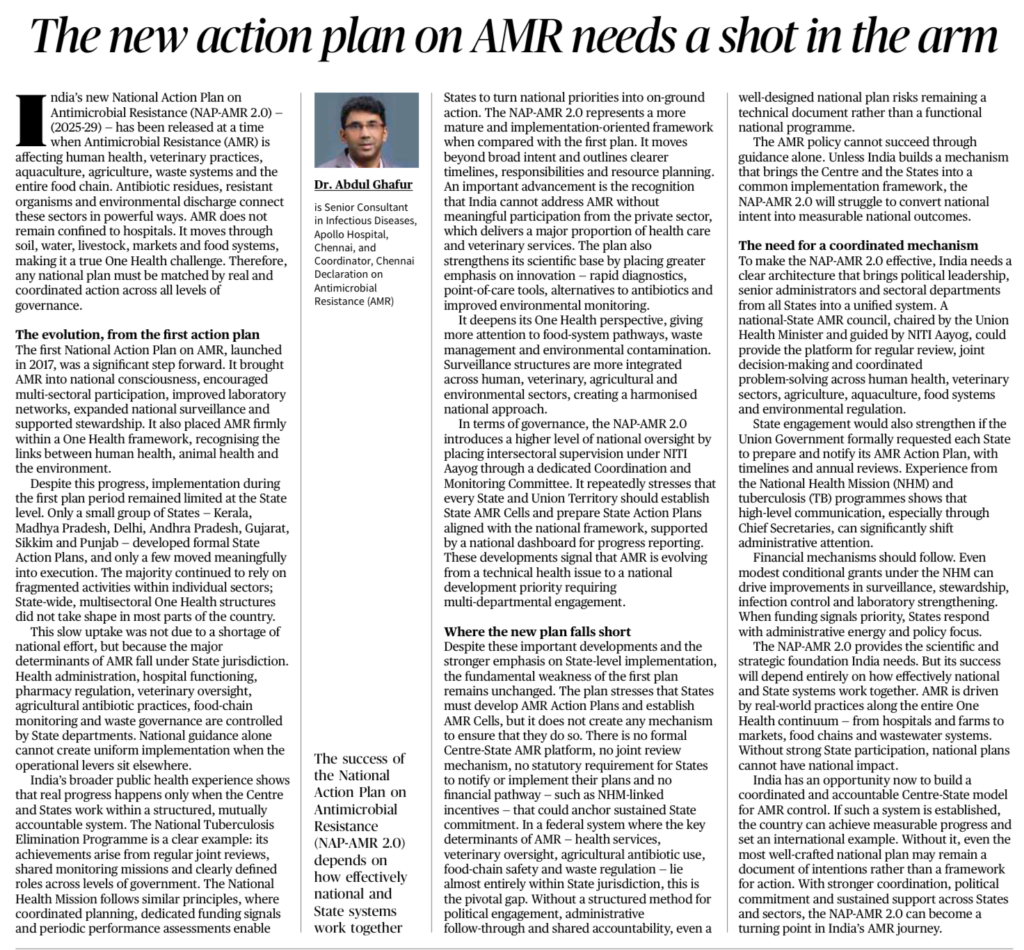
India released the National Action Plan on Antimicrobial Resistance (NAP-AMR 2.0, 2025–29) at a time when AMR is rapidly rising across humans, animals, agriculture, food systems, and the environment.
The editorial argues that while NAP-AMR 2.0 is stronger and more comprehensive than the 2017 plan, it lacks mechanisms for coordinated implementation, remains overly technical, and requires political leadership + Centre–State alignment to succeed.
2. Crisp Mains Notes
A. Why AMR is a Major Challenge
• Affects human health, animal health, food systems, environment.
• Crosses sectors—hospitals, farms, veterinary practice, water, markets.
• India has high antibiotic usage and easy access → accelerates resistance.
• Creates a One Health governance challenge.
B. Evolution from NAP-AMR 1.0 (2017) → NAP-AMR 2.0
NAP-AMR 1.0:
• Increased national awareness.
• Encouraged multi-sector coordination.
• Improved surveillance & stewardship.
• But implementation limited to a few States; lacked coherent national action.
C. Key Strengths of NAP-AMR 2.0
• National One Health framework with stronger state-level engagement.
• Introduces a higher-level national oversight group + intersectoral coordination.
• Pushes every State/UT to prepare State AMR Cells and State Action Plans.
• Technical strengthening: diagnostics, surveillance, laboratories, reporting systems.
• Aims for a national AMR dashboard for real-time monitoring.
D. Key Weaknesses Highlighted (Why it “needs a shot in the arm”)
- No clear Centre–State implementation mechanism
• Coordination gaps persist; AMR lies across State jurisdictions (health, labs, regulation).
• Without structured cooperation, plan risks staying on paper. - Overly technical; lacks political leadership
• Needs Union Health Ministry–led governance with NITI Aayog support.
• Requires stronger involvement from veterinary, agriculture, environment ministries. - Weak private sector participation
• Hospitals, labs, veterinary services are largely private → current plan under-engages them. - Funding challenges
• Needs dedicated financing & convergence across departments (human, animal, food safety). - State implementation uneven
• Few states show progress; others lack AMR surveillance, stewardship, or regulatory control.
E. What the Editorial Recommends
• Create a formal Centre–State mechanism specifically for AMR implementation.
• Turn the plan from a technical document into a governance and action framework.
• Use Union Health Ministry + NITI Aayog for oversight, monitoring, and accountability.
• Build shared political commitment and multi-sector leadership.
• Prioritise financing, lab capacity building, surveillance, innovation, and One Health integration.