Context: Wetlands Rules 2017
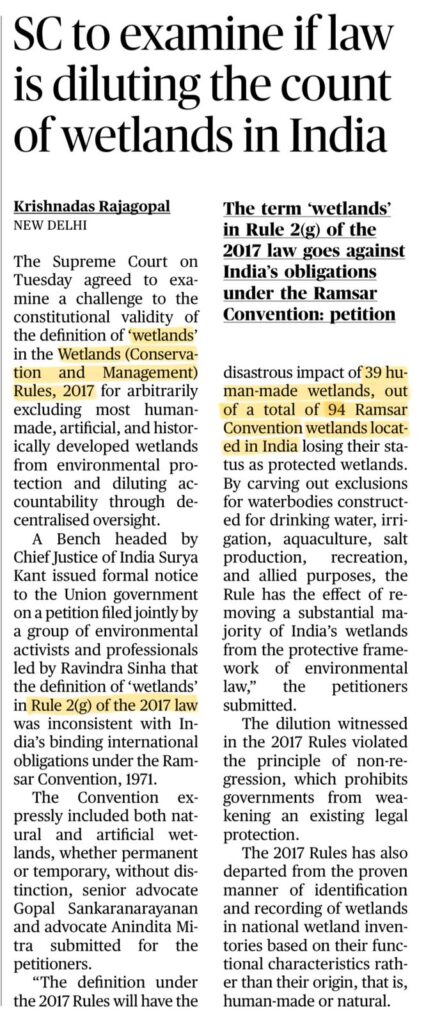
Supreme Court agreed to examine the constitutional validity of the Wetlands (Conservation and Management) Rules, 2017 over claims that Rule 2(g) narrows the definition of wetlands and weakens protection contrary to the Ramsar Convention, 1971.
Core Issue
- Rule 2(g) allegedly excludes artificial, human-made and historically developed wetlands from protection.
- Petition argues this dilutes environmental safeguards and accountability.
Ramsar Convention vs 2017 Rules
Ramsar Convention includes:
- Natural and artificial wetlands
- Permanent and temporary wetlands
Petition claims the 2017 Rules violate India’s international obligations.
Major Concerns
Exempted categories:
- Irrigation tanks
- Drinking water bodies
- Aquaculture ponds
- Salt pans
- Recreational water bodies
Impact:
- Many wetlands may fall outside legal protection framework.
Important Data
- India has 94 Ramsar Sites.
- Petition says nearly 39 human-made wetlands may lose protected status.
Principle Mentioned
Non-regression principle
- Existing environmental protections should not be weakened.
Importance of Wetlands
- Flood control
- Groundwater recharge
- Biodiversity conservation
- Carbon sink
- Climate regulation