7 July 2026 | Daily Current Affairs

Urban Flooding in India: Causes, Impacts & Solutions
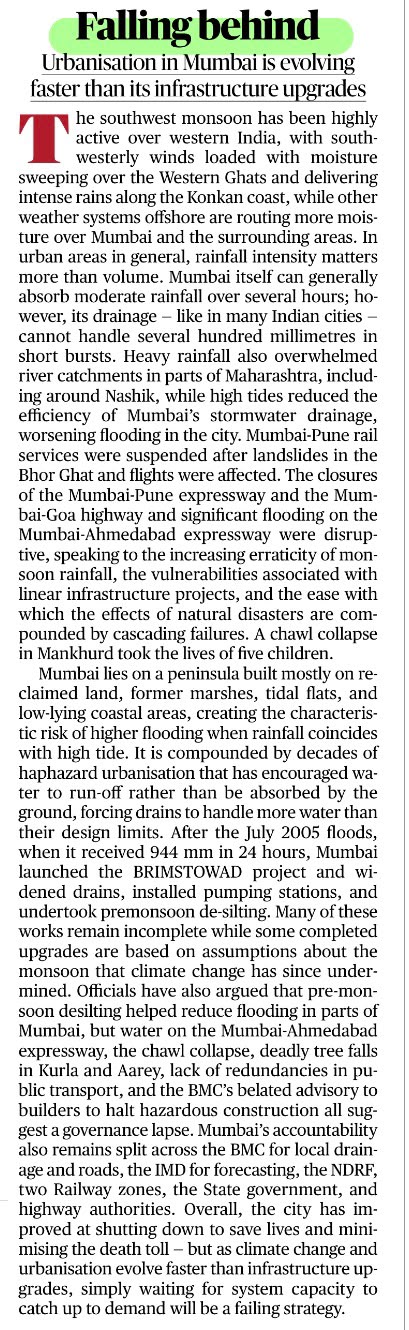
Context: Urban Flooding in India
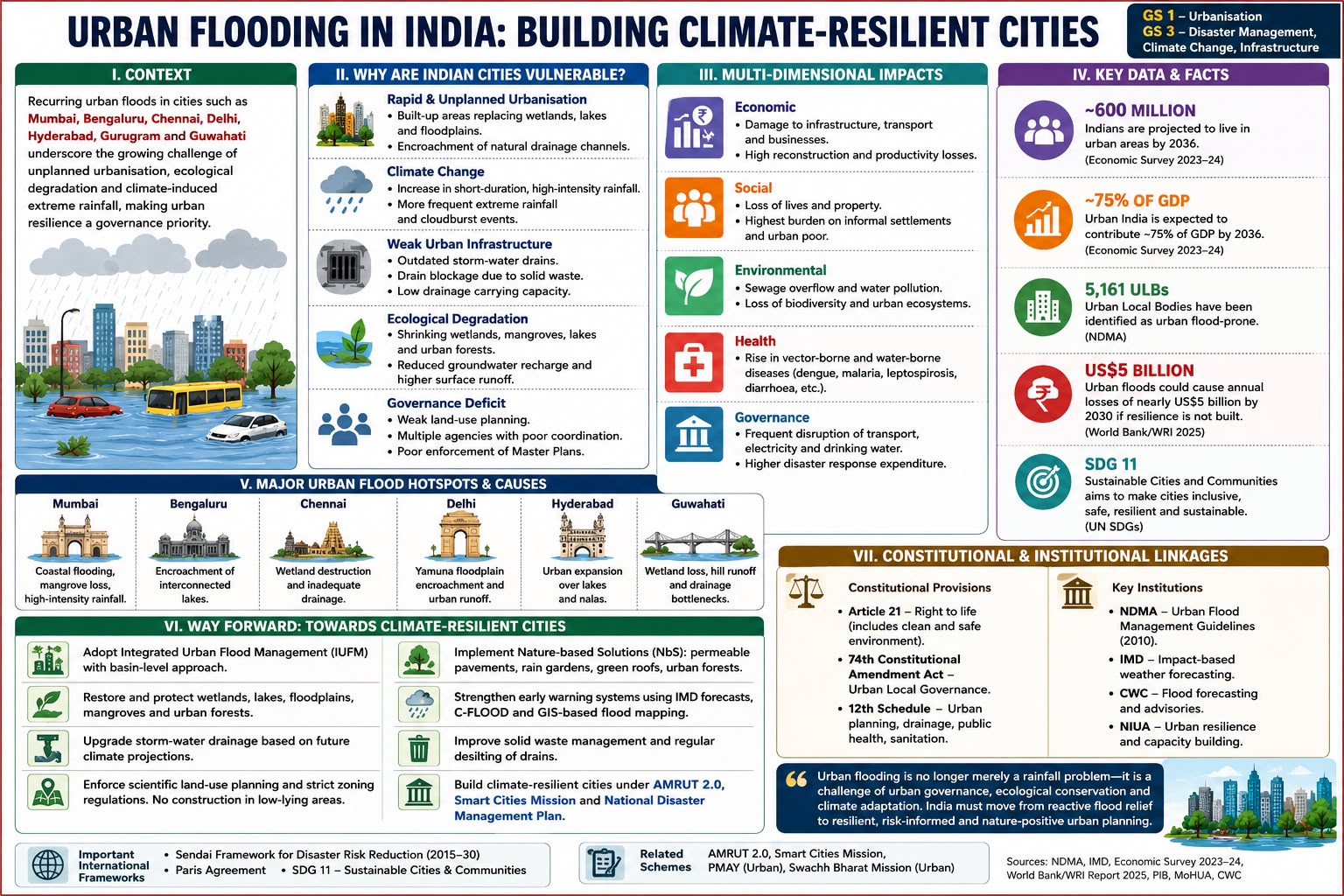
The article discusses recurring urban flooding in Indian cities such as Mumbai, Bengaluru, Chennai, Delhi, Hyderabad, Gurugram and Guwahati.

It argues that urban flooding is not merely a rainfall problem. It is a governance, planning, drainage and climate-resilience failure.

Why Indian Cities Are Vulnerable

1. Rapid and Unplanned Urbanisation

Cities have expanded over:

  • Floodplains
  • Lakes
  • Wetlands
  • Drains
  • Low-lying areas

This reduces natural drainage and increases flood risk.

2. Climate Change

High-intensity rainfall events are becoming more frequent.

Short-duration extreme rainfall overwhelms urban drainage systems.

3. Weak Urban Infrastructure

Cities suffer from:

  • Outdated storm-water drains
  • Poor drainage capacity
  • Encroached drains
  • Clogged drains
  • Weak solid waste management

4. Ecological Degradation

Loss of wetlands, lakes and urban forests reduces natural water absorption.

5. Governance Deficit

Urban flooding worsens due to:

  • Fragmented municipal governance
  • Poor coordination among agencies
  • Weak enforcement of master plans
  • Poor maintenance of drainage infrastructure

Impacts of Urban Flooding

Economic Impact

  • Damage to infrastructure
  • Transport disruption
  • Business losses
  • Higher reconstruction costs

Social Impact

  • Loss of lives
  • Displacement
  • Damage to homes
  • Greater impact on slum dwellers and urban poor

Environmental Impact

  • Sewage overflow
  • Water pollution
  • Solid waste spread
  • Loss of biodiversity

Health Impact

Urban flooding increases risk of:

  • Vector-borne diseases
  • Water-borne diseases
  • Mental stress
  • Poor sanitation

Governance Impact

It exposes weak urban planning and poor disaster preparedness.

Key Data

  • Around 600 million Indians are projected to live in urban areas by 2036.
  • Urban India contributes nearly 75% of India’s GDP.
  • Urban local bodies have often identified large urban flood-prone areas across cities.
  • Urban floods can cause huge economic losses and disrupt productivity.

Constitutional and Institutional Linkages

Article 21

Right to life includes clean and safe environment.

74th Constitutional Amendment

Provides for urban local governance.

12th Schedule

Includes urban planning, public health and sanitation.

Important Institutions

Way Forward

1. Adopt Integrated Urban Flood Management

Cities must combine drainage, land-use planning, climate adaptation and disaster management.

2. Restore Natural Drainage

Protect:

  • Lakes
  • Wetlands
  • Floodplains
  • Storm-water drains
  • Urban green spaces

3. Upgrade Storm-Water Drainage

Drainage systems must be redesigned for future climate projections, not past rainfall averages.

4. Improve Early Warning Systems

Use:

  • IMD forecasts
  • Doppler radar
  • GIS mapping
  • AI-based flood modelling

5. Strengthen Solid Waste Management

Blocked drains due to waste are a major cause of flooding.

6. Build Climate-Resilient Cities

Cities must integrate:

  • AMRUT 2.0
  • Smart Cities Mission
  • National Disaster Management Plan
  • Climate-resilient urban planning

Key Takeaway

Urban flooding is no longer merely a natural disaster. It is a failure of urban governance, ecological conservation and climate adaptation.
AI Governance for Global South: India’s Role for UPSC

Context: AI Governance for Global South
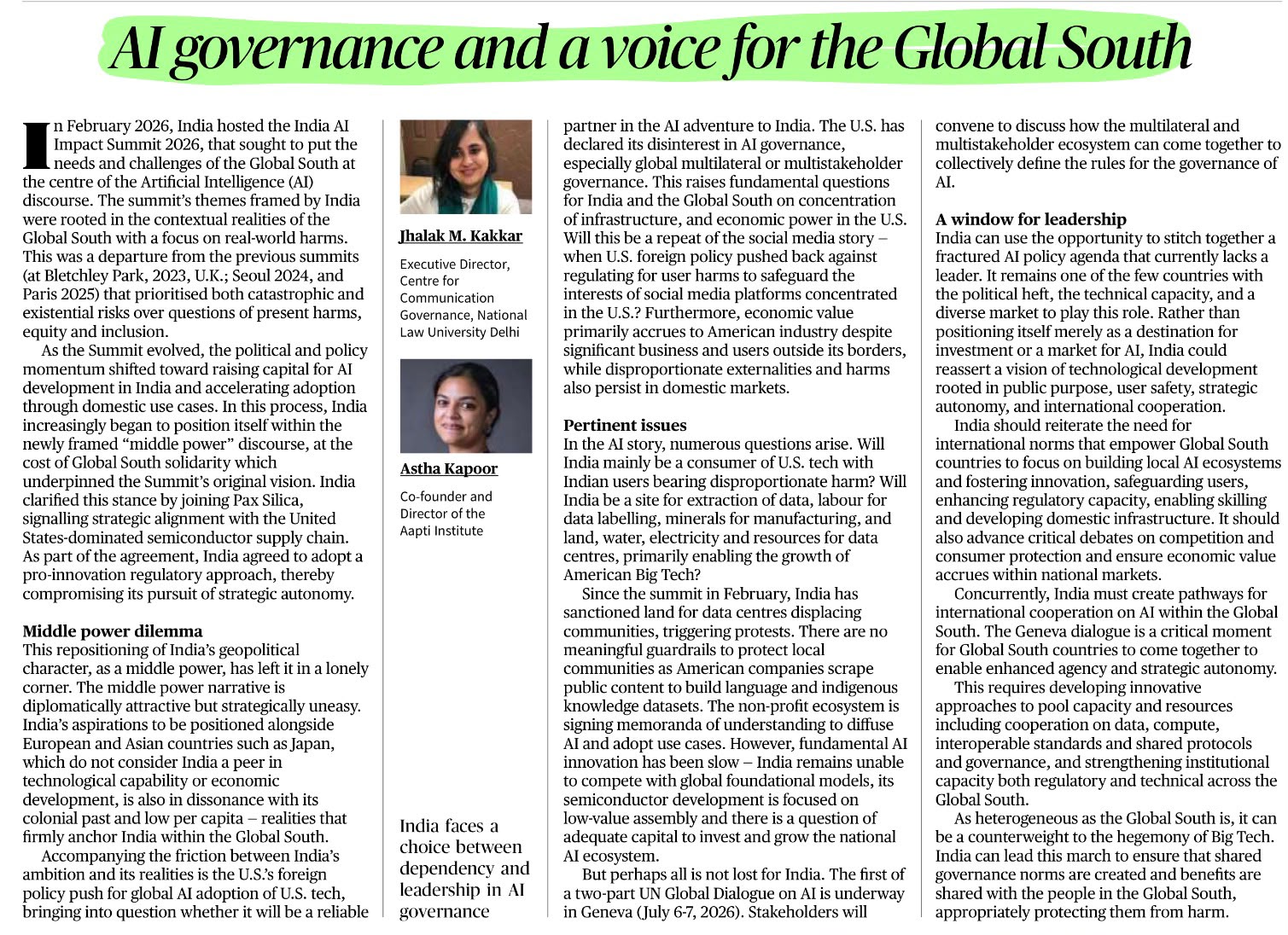
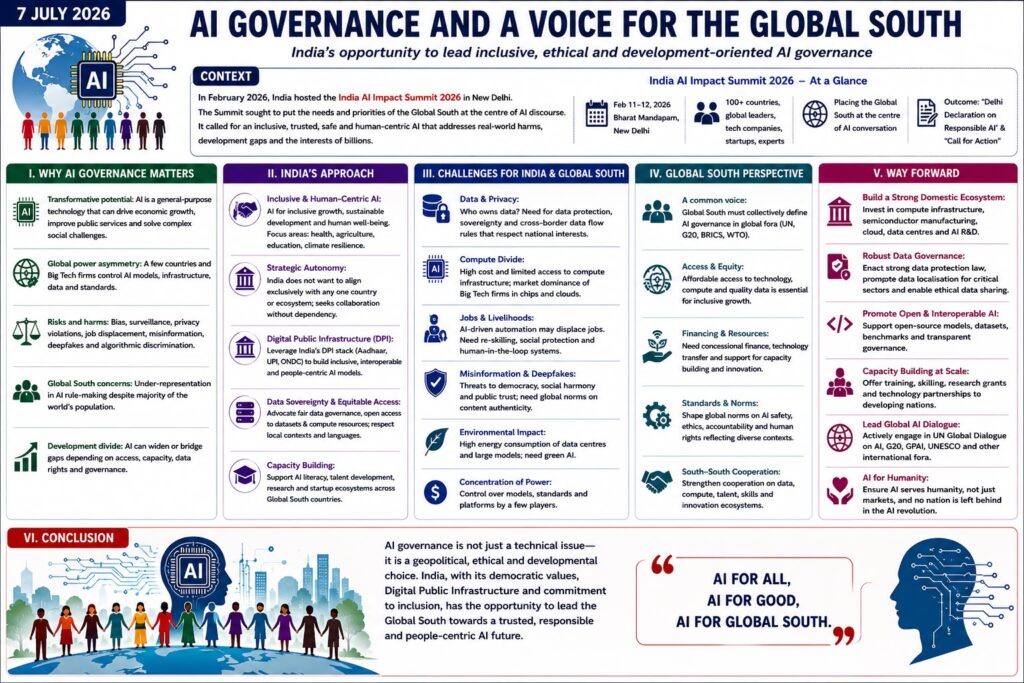
The article argues that India has an opportunity to lead inclusive, ethical and development-oriented AI governance, especially for the Global South.

The concern is that AI governance should not be shaped only by developed countries and large technology companies.

Why AI Governance Matters

AI can transform:

  • Public service delivery
  • Healthcare
  • Education
  • Agriculture
  • Climate modelling
  • Disaster management
  • Economic growth

But it also creates risks such as:

  • Bias
  • Deepfakes
  • Surveillance
  • Misinformation
  • Job disruption
  • Algorithmic discrimination
  • Concentration of power

Global Power Imbalance in AI

AI capabilities are concentrated in a few countries and corporations because they control:

  • Computing power
  • Data
  • Advanced chips
  • Finance
  • Research institutions
  • Skilled talent

This creates a Global North–South AI divide.

India’s Approach

India’s AI approach focuses on:

1. Inclusive AI

AI should serve development and public welfare.

2. Strategic Autonomy

India must avoid dependence on a single technology bloc.

3. Digital Public Infrastructure

India can use its DPI experience, such as Aadhaar, UPI and CoWIN, to build inclusive AI systems.

4. Data Sovereignty

India needs frameworks for safe and responsible use of data.

5. Capacity Building

The Global South needs access to skills, infrastructure, datasets and computing capacity.

Challenges for India and Global South

1. Data Privacy

AI requires large datasets, but privacy and consent must be protected.

2. Compute Divide

Developing countries lack access to high-end chips and cloud computing resources.

3. Jobs and Livelihoods

AI may disrupt jobs in:

  • Services
  • BPO
  • Customer support
  • Creative industries
  • Routine clerical work

4. Misinformation and Deepfakes

AI can accelerate political misinformation and social conflict.

5. Cybersecurity

AI can be used for automated cyberattacks and digital fraud.

6. Concentration of Power

A few companies may control AI infrastructure and standards.

Global South Perspective

The Global South needs AI governance based on:

  • Access to technology
  • Affordable compute
  • Open datasets
  • Capacity building
  • Local-language AI
  • Public-interest AI
  • Inclusive standard-setting

Way Forward

1. Build Strong Domestic Ecosystem

India should invest in:

  • Compute infrastructure
  • Semiconductor manufacturing
  • Cloud capacity
  • AI start-ups
  • Open-source models

2. Ensure Responsible AI

Frameworks must focus on:

  • Transparency
  • Accountability
  • Safety
  • Fairness
  • Privacy
  • Explainability

3. Promote Global South Leadership

India can create platforms where developing countries participate in AI rule-making.

4. Build Public-Interest AI

AI should support:

  • Agriculture advisory
  • Healthcare diagnosis
  • Education access
  • Disaster prediction
  • Welfare delivery

5. Protect Human Rights

AI systems must not violate dignity, privacy, equality and freedom.

Key Takeaway

AI governance is not just a technology issue. It is a geopolitical, ethical and developmental issue. India can lead a Global South approach that makes AI safe, inclusive and development-oriented.

Future of the Quad: Challenges and India’s Role Explained

Context: Future of the Quad
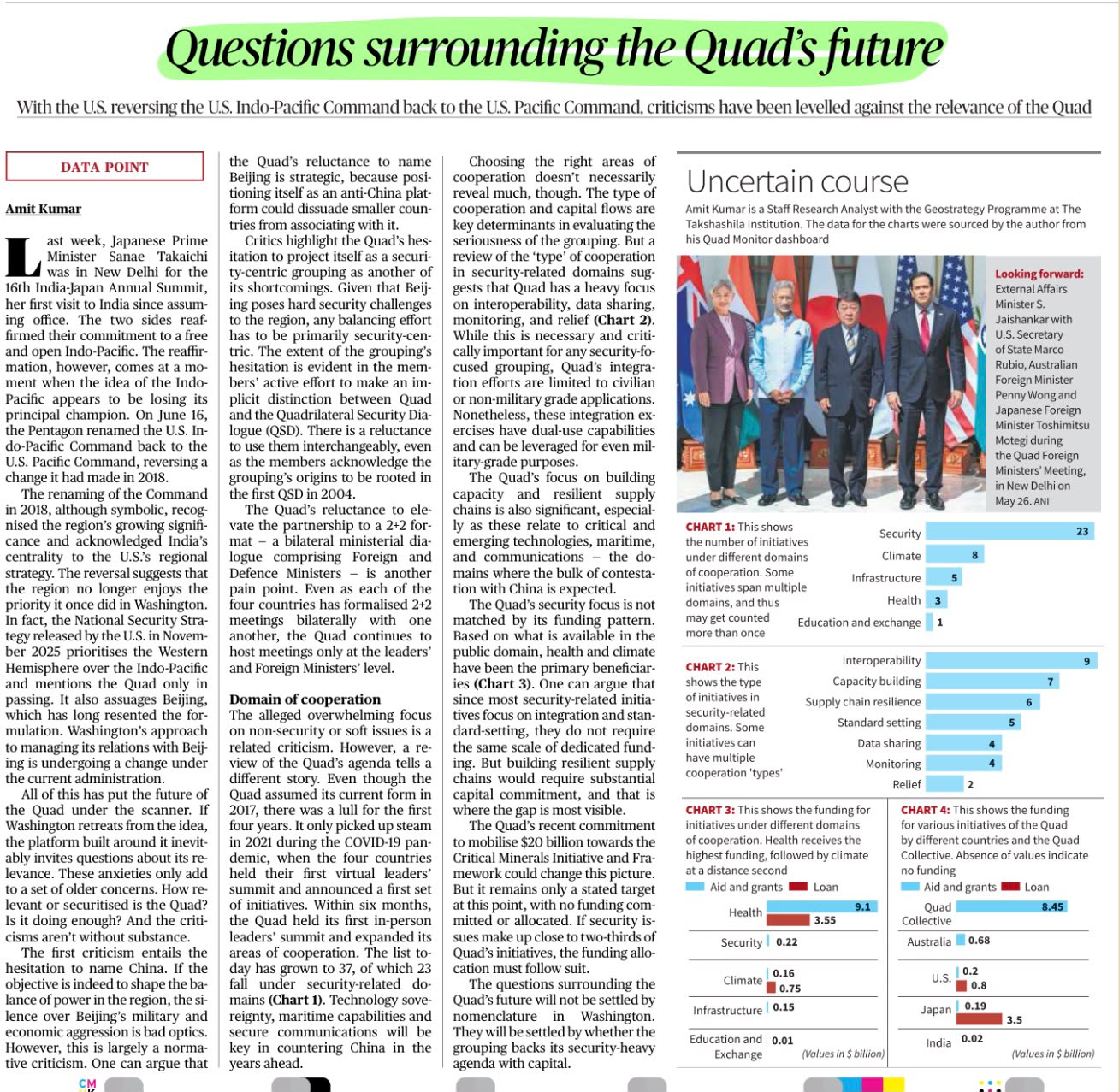
The article discusses uncertainty around the future of the Quad due to shifting U.S. priorities, questions over institutional depth and concerns about whether the grouping can deliver concrete outcomes in the Indo-Pacific.

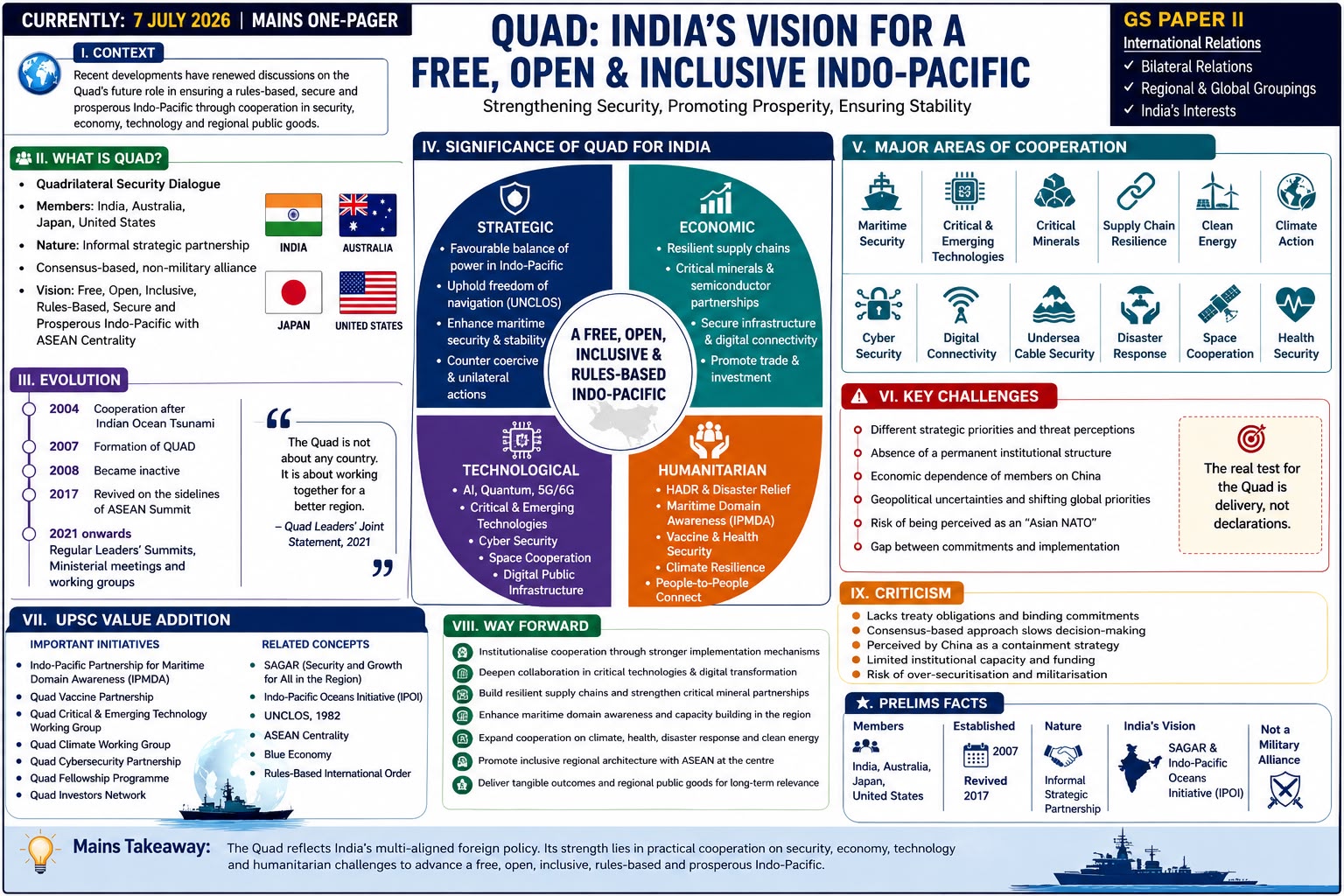
Quad

Full Form

  • Quadrilateral Security Dialogue

Members

  • India
  • United States
  • Japan
  • Australia

Core Vision

A free, open, inclusive and rules-based Indo-Pacific.

Evolution

  • 2004: Cooperation after Indian Ocean Tsunami.
  • 2007: Formation of Quad.
  • 2017: Revival on the sidelines of ASEAN Summit.
  • 2021 onwards: Regular leaders’ summits, ministerial meetings and working groups.

Why Quad Matters for India

1. Strategic Balancing

Quad helps India balance China’s assertiveness in the Indo-Pacific.

2. Maritime Security

Supports freedom of navigation and maritime domain awareness.

3. Economic Security

Can strengthen supply chains and reduce dependence on China.

4. Technology Cooperation

Important for:

  • Critical technologies
  • Semiconductors
  • Cybersecurity
  • Digital public infrastructure
  • Space cooperation

5. Humanitarian Assistance

Quad supports cooperation on:

  • Disaster relief
  • Health security
  • Climate resilience
  • Infrastructure

Major Areas of Cooperation

  • Maritime security
  • Critical and emerging technologies
  • Critical minerals
  • Supply-chain resilience
  • Clean energy
  • Climate action
  • Cybersecurity
  • Digital connectivity
  • Undersea cable security
  • Disaster response
  • Space cooperation
  • Health security

Key Challenges

1. Different Strategic Priorities

All members have different threat perceptions and regional priorities.

2. Lack of Formal Structure

Quad is not a treaty alliance and has no permanent secretariat.

3. China Factor

China sees Quad as an anti-China grouping.

4. Delivery Deficit

There are concerns that Quad announces many initiatives but implementation remains slow.

5. U.S. Policy Uncertainty

Changes in U.S. priorities can affect the grouping’s momentum.

6. India’s Strategic Autonomy

India supports Quad but avoids turning it into a military alliance.

Criticism

  • It lacks binding obligations.
  • It may duplicate other Indo-Pacific mechanisms.
  • It risks becoming overly security-focused.
  • It may not deliver enough public goods.

Way Forward

  • Build institutional continuity.
  • Focus on deliverables.
  • Strengthen maritime domain awareness.
  • Expand cooperation on resilient supply chains.
  • Deliver climate, health and digital public goods.
  • Avoid excessive militarisation.
  • Maintain ASEAN centrality.
  • Respect India’s strategic autonomy.

Key Takeaway

The Quad’s future depends on whether it can move from symbolism to delivery while maintaining flexibility, inclusiveness and strategic balance in the Indo-Pacific.

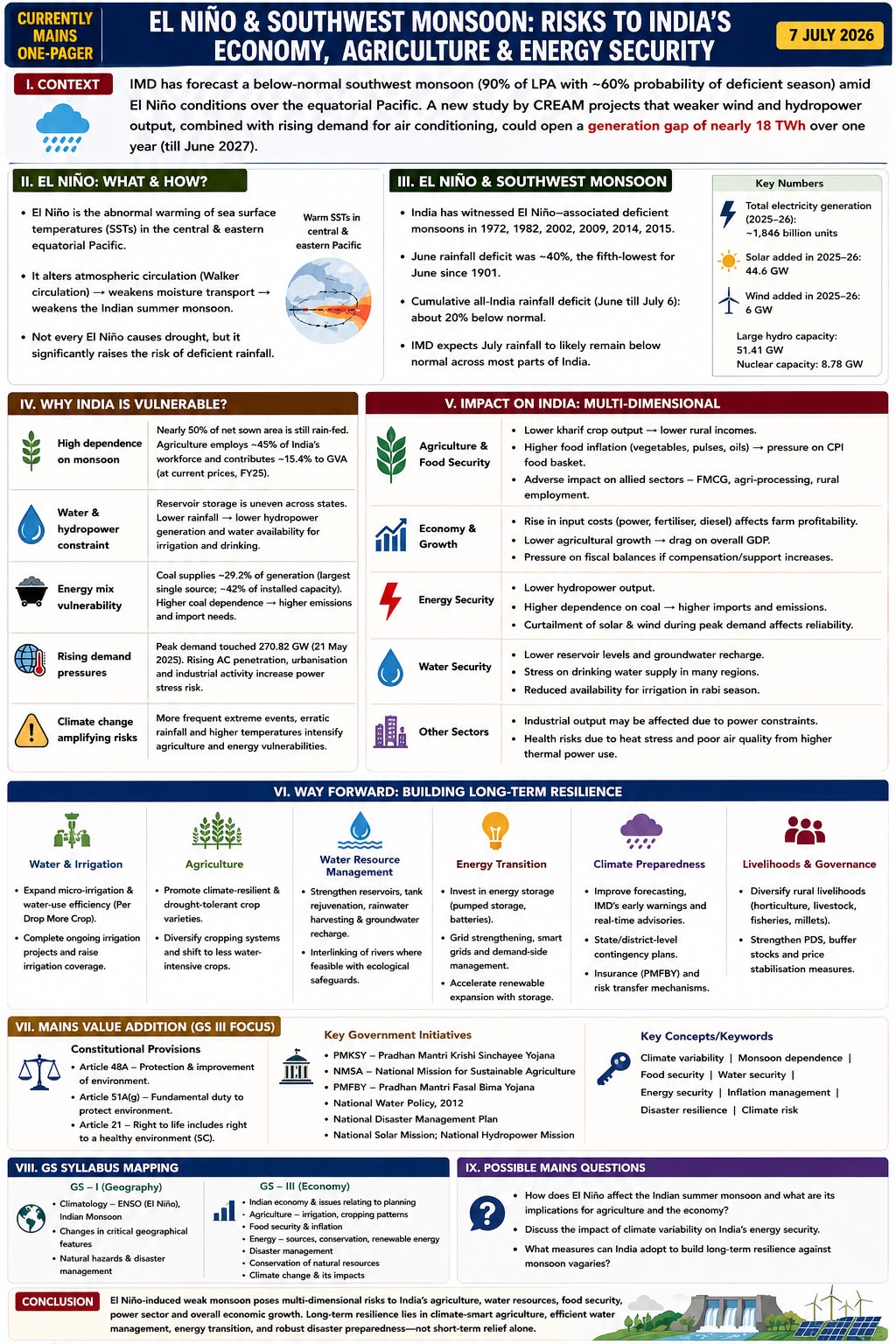
El Niño Impact on India Economy: UPSC Explained

Context: El Niño Impact on India Economy
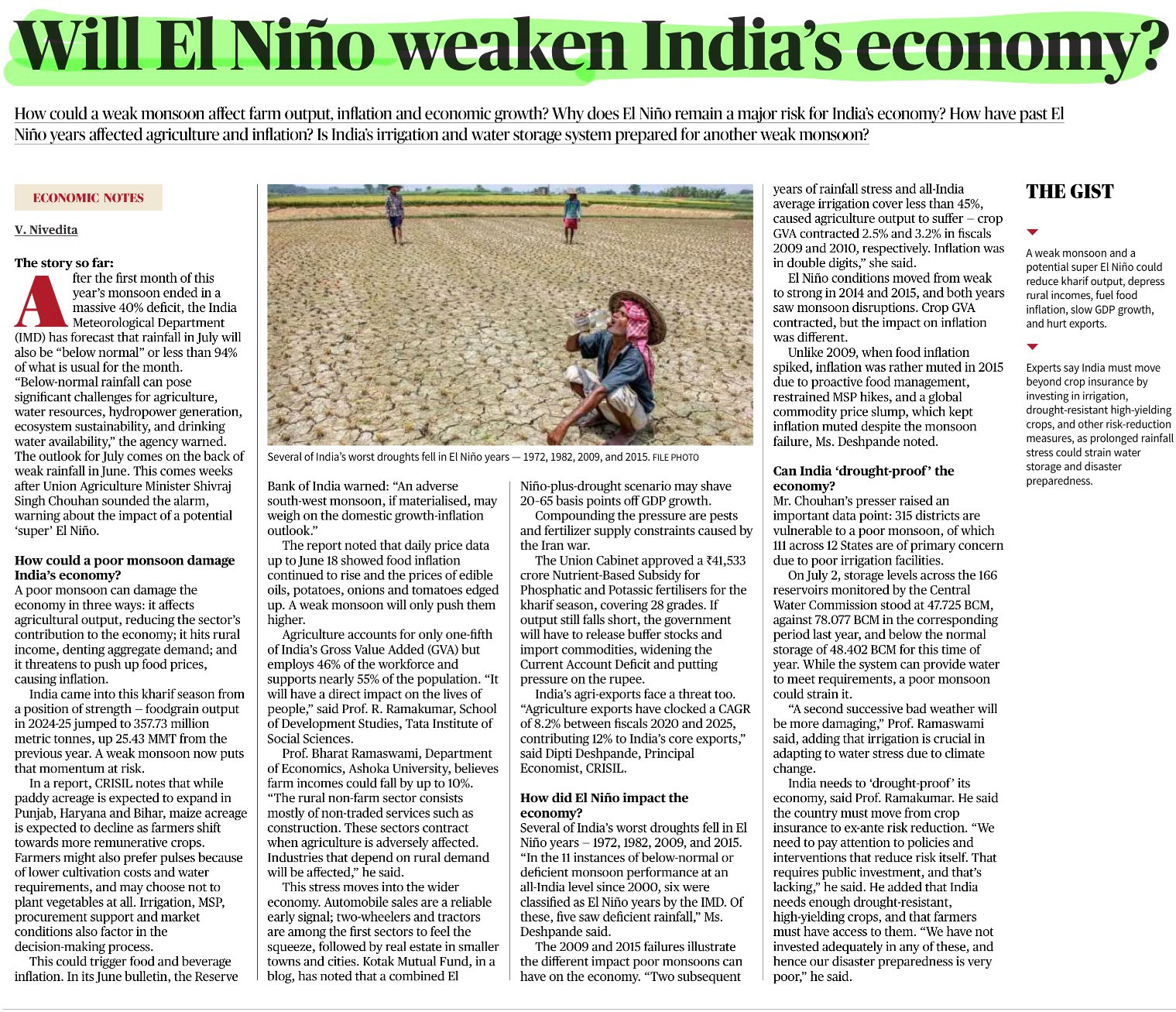
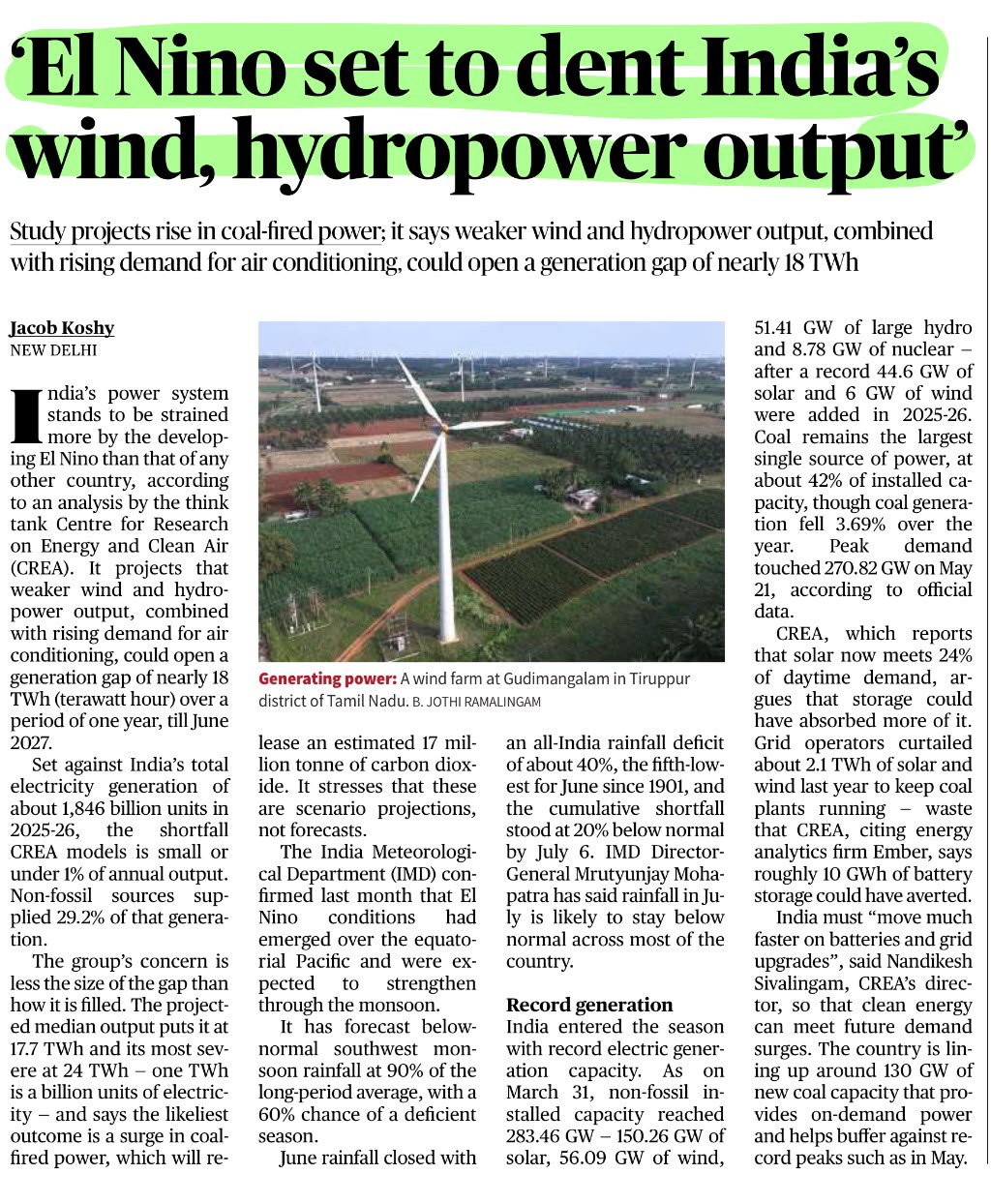
The article discusses how El Niño can affect India’s economy through weaker monsoon rainfall, lower agricultural output, inflationary pressure and reduced renewable energy generation.

El Niño

El Niño refers to abnormal warming of the central and eastern equatorial Pacific Ocean.

It weakens the Walker circulation and can reduce monsoon rainfall over India.

Impact on India’s Economy

1. Agriculture and Food Security

A weak monsoon can reduce:

  • Kharif sowing
  • Crop yields
  • Rural incomes
  • Farm profitability

Affected crops may include:

  • Rice
  • Pulses
  • Oilseeds
  • Cotton
  • Sugarcane

2. Inflation

Lower agricultural output can increase food prices.

This affects:

3. Rural Demand

Weak farm income reduces demand for:

  • Consumer goods
  • Two-wheelers
  • Tractors
  • FMCG products
  • Rural services

4. Energy Sector

El Niño can affect renewable energy output.

Weaker wind and hydropower generation may increase dependence on coal-fired power.

5. Hydropower

Reduced rainfall weakens reservoir storage and hydropower output.

6. Wind Power

El Niño years may reduce wind generation in some regions.

7. Fiscal Pressure

The government may need higher spending on:

  • Food subsidy
  • Fertiliser subsidy
  • Rural employment
  • Irrigation support
  • Crop insurance

Key Findings from the Article

A study by CREAM projected that weak wind and hydropower output during El Niño conditions could create a generation gap of nearly 18 TWh over one year.

The gap may be met largely through coal-based power, increasing emissions.

Why India Is Vulnerable

  • High dependence on monsoon rainfall.
  • Large rainfed agricultural area.
  • Food inflation sensitivity.
  • High dependence on hydropower and wind variability.
  • Water storage constraints.
  • Rural income dependence on agriculture.

Way Forward

1. Water and Irrigation Resilience

  • Expand micro-irrigation.
  • Improve canal efficiency.
  • Complete irrigation projects.
  • Promote water budgeting.

2. Agriculture Resilience

  • Promote drought-resistant crops.
  • Improve weather advisories.
  • Diversify cropping patterns.
  • Expand crop insurance.

3. Water Resource Management

  • Improve reservoir management.
  • Strengthen groundwater recharge.
  • Use real-time water data.

4. Energy Transition Resilience

  • Expand battery storage.
  • Improve grid flexibility.
  • Diversify renewable energy mix.
  • Strengthen coal backup planning without long-term fossil lock-in.

5. Climate Preparedness

  • Improve monsoon forecasting.
  • Strengthen early warning systems.
  • Prepare State-level climate action plans.

Key Takeaway

El Niño is not only a weather event. It can affect agriculture, inflation, energy security, rural demand and fiscal stability.

Sahkar Se Samriddhi Scheme: Cooperatives for Growth

Context: Sahkar Se Samriddhi Scheme
Sahkar Se Samriddhi reflects the government’s focus on strengthening India’s cooperative movement for inclusive growth, rural prosperity and agricultural development.

Meaning

Sahkar Se Samriddhi means prosperity through cooperation.

Ministry

  • Ministry of Cooperation

Vision

To make cooperatives stronger, more transparent, more technology-driven and more inclusive.

Why Cooperatives Matter

Cooperatives support:

  • Farmers
  • Rural credit
  • Dairy sector
  • Fisheries
  • Storage
  • Procurement
  • Processing
  • Marketing
  • Women’s livelihoods
  • Rural entrepreneurship

Key Features

  • Computerisation of Primary Agricultural Credit Societies.
  • Strengthening cooperative banks.
  • Promoting multi-purpose PACS.
  • Expanding cooperatives in dairy, fisheries and agriculture.
  • Improving transparency and governance.
  • Supporting rural entrepreneurship and value addition.

PACS

Primary Agricultural Credit Societies are grassroots-level cooperative credit institutions.

They provide credit and services to farmers at the village level.

Significance

  • Strengthens rural credit access.
  • Reduces dependence on informal moneylenders.
  • Supports farmer producer systems.
  • Promotes local storage and processing.
  • Encourages collective bargaining.
  • Supports inclusive rural growth.

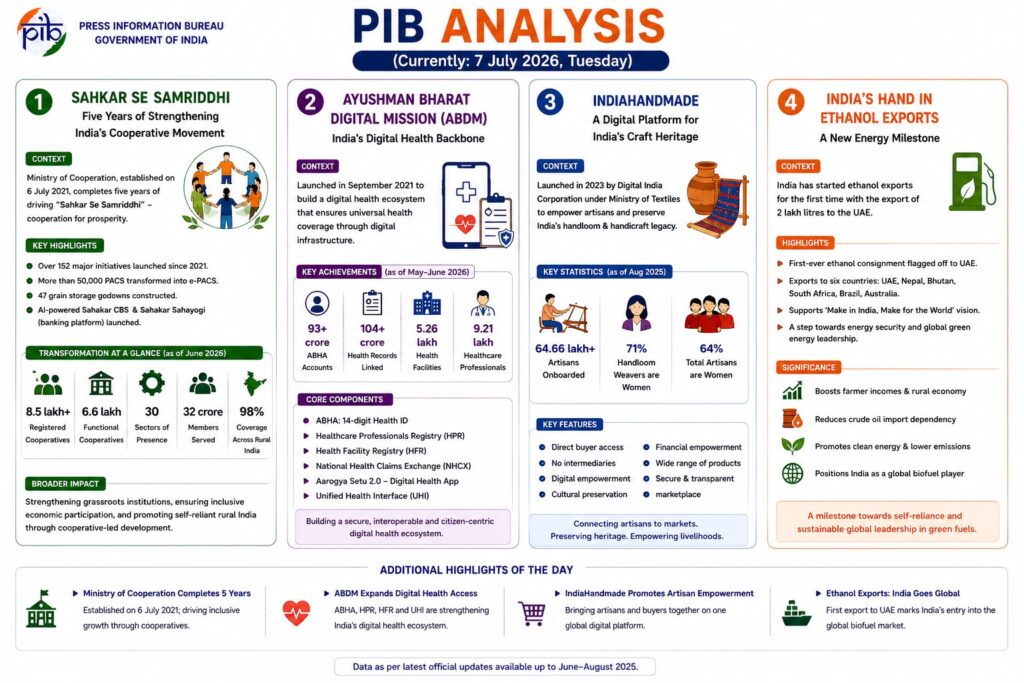
Key Data from PIB

The cooperative network includes:

  • 8.5 lakh cooperatives
  • 6.6 lakh PACS
  • 30 crore members
  • 3 crore new members
  • 98% coverage of rural India

Key Takeaway

Sahkar Se Samriddhi aims to transform cooperatives into engines of rural prosperity, agricultural value addition and inclusive development.

IndiaHandmade Digital Platform: Benefits for Artisans

Context: IndiaHandmade Digital Platform
IndiaHandmade is a digital platform created to promote India’s handloom and handicraft products by connecting artisans directly with markets.

IndiaHandmade

IndiaHandmade is a digital platform for India’s craft heritage.

Purpose

To provide market access to:

  • Artisans
  • Weavers
  • Handloom producers
  • Handicraft workers
  • MSMEs

Key Features

  • Direct buyer access
  • No intermediaries
  • Digital empowerment
  • Cultural preservation
  • Transparent and secure transactions
  • Wider market visibility

Why It Matters

India’s handicrafts and handlooms are important for:

  • Rural livelihoods
  • Women’s employment
  • Cultural heritage
  • Exports
  • Tourism
  • MSME growth

Benefits

  • Better income for artisans.
  • Reduced role of middlemen.
  • Improved brand visibility.
  • Direct access to national and global buyers.
  • Promotion of traditional crafts.
  • Support for Vocal for Local.

Link with Inclusive Growth

IndiaHandmade supports:

  • MSME development
  • Women empowerment
  • Rural entrepreneurship
  • Digital economy
  • Cultural economy
  • Employment generation

Key Data from PIB

  • 64.66 lakh artisans
  • 71% handloom weavers are women
  • 64% handicraft artisans are women

Key Takeaway

IndiaHandmade connects artisans to markets, preserves heritage and strengthens India’s rural creative economy.

Ayushman Bharat Digital Mission: Key Features for UPSC

Context: Ayushman Bharat Digital Mission
Ayushman Bharat Digital Mission is India’s digital health backbone, aimed at building an integrated digital health ecosystem.

Ayushman Bharat Digital Mission

Launched

  • September 2021

Objective

To create a digital health ecosystem through secure, interoperable and consent-based health records.

Key Components

1. ABHA ID

Ayushman Bharat Health Account

A unique digital health ID for citizens.

2. Health Professionals Registry

Digital registry of doctors and healthcare professionals.

3. Health Facility Registry

Digital registry of hospitals, clinics and healthcare institutions.

4. Unified Health Interface

A digital platform to enable health-service discovery and interoperability.

Key Achievements

As per PIB:

  • 93 crore ABHA IDs
  • 10 lakh health professionals registered
  • 5.26 lakh health facilities registered
  • 9.21 lakh health records linked

Benefits

  • Digital health records.
  • Easier access to medical history.
  • Better continuity of care.
  • Reduced duplication of tests.
  • Improved portability of health records.
  • Better telemedicine and remote consultation.
  • Supports data-driven health policy.

Concerns

  • Data privacy
  • Consent management
  • Cybersecurity
  • Digital divide
  • Health data misuse
  • Exclusion of people without digital access

Way Forward

  • Strengthen data protection.
  • Improve consent architecture.
  • Expand digital literacy.
  • Ensure offline alternatives.
  • Improve interoperability among hospitals.
  • Strengthen cybersecurity systems.

Key Takeaway

ABDM can transform healthcare delivery, but trust, privacy and inclusion must remain central.

AI in Healthcare under ABDM: Benefits and Challenges

Context: AI in Healthcare under ABDM
Artificial Intelligence is increasingly being integrated with the Ayushman Bharat Digital Mission to improve healthcare access, diagnosis, efficiency and public health planning.

Role of AI in Healthcare

AI can support:

  • Early diagnosis
  • Predictive analytics
  • Clinical decision support
  • Disease surveillance
  • Public health planning
  • Hospital management
  • Telemedicine
  • Personalised treatment

How AI Can Support ABDM

1. Better Diagnosis

AI can help detect diseases through:

  • Medical imaging
  • Lab reports
  • Symptom analysis
  • Pattern recognition

2. Personalised Healthcare

Linked digital records can help doctors provide more tailored treatment.

3. Public Health Surveillance

AI can identify disease trends, outbreaks and regional health risks.

4. Efficient Service Delivery

AI can improve:

  • Appointment systems
  • Referral pathways
  • Hospital workflows
  • Resource allocation

5. Rural Healthcare

AI-enabled tools can help bridge gaps where specialists are unavailable.

Risks and Concerns

  • Algorithmic bias
  • Data privacy risks
  • Inaccurate diagnosis
  • Lack of explainability
  • Overdependence on technology
  • Cybersecurity threats
  • Unequal access

Way Forward

  • Use ethical AI frameworks.
  • Ensure human oversight.
  • Protect health data privacy.
  • Validate AI tools before deployment.
  • Make AI systems explainable.
  • Train healthcare workers.
  • Use AI to assist doctors, not replace them.

Key Takeaway

AI under ABDM can improve healthcare access and efficiency, but it must be governed by privacy, safety, equity and accountability.

About the UPSC Civil Services Examination (UPSC CSE)

The UPSC Civil Services Examination (CSE) is one of the most competitive and esteemed examinations in India, conducted by the Union Public Service Commission to recruit officers for services such as the Indian Administrative Service (IAS), Indian Police Service (IPS), Indian Foreign Service (IFS), and others. The exam comprises three stages — Prelims, Mains, and the Personality Test (Interview) — designed to test a candidate’s knowledge, aptitude, decision-making, and leadership skills.


How to Prepare Effectively for UPSC CSE

Cracking the UPSC CSE requires a deep understanding of the syllabus, consistent revision, structured answer writing, and smart test-taking strategies. The Prelims test analytical and conceptual clarity, the Mains focuses on critical thinking, articulation, and subject mastery, while the Interview assesses presence of mind, ethical judgment, and personality traits relevant to public service.

At UnderStand UPSC, we empower aspirants with a personalized and focused approach to each stage of the exam.


Why Choose UnderStand UPSC?

UnderStand UPSC is a mentorship-driven platform offering a clear, clutter-free strategy to tackle the Civil Services Examination. Our programs like Transform (for beginners and intermediate learners) and Conquer (for advanced mains preparation) provide structured study plans, syllabus-wise video content, interactive live sessions, and answer writing support.

We emphasize:

  • Concept clarity through topic-wise lectures

  • Test series designed around real UPSC standards

  • Personalized mentorship in small groups

  • Regular performance tracking and peer benchmarking

  • Doubt-clearing sessions, current affairs analysis, and monthly magazines


Join the UnderStand UPSC Learning Community

Our mission is to make UPSC preparation less overwhelming and more strategic. We combine mentorship, discipline, and academic rigor to help you clear CSE with confidence. Whether you’re preparing from Delhi, Mumbai, Bangalore, or a remote village — our online-first model ensures quality guidance reaches every corner of India.

Join the thousands of aspirants who trust UnderStand UPSC to guide their journey toward becoming civil servants.

Stay connected with us through our Telegram, YouTube, and Instagram channels for daily tips, strategies, and updates.

Copyright © 2026 USARAMBHA EDUCATION (UnderStand UPSC). All Rights Reserved.

UpSurge Mains Test Series 2027

Fill out the form

Fill out the form for

Downloading the free Agriculture Short Notes