6 March 2026 | Daily Current Affairs

Governor Appointment in India: Constitutional Provisions, Articles 155 & 156 Explained for UPSC

Context:
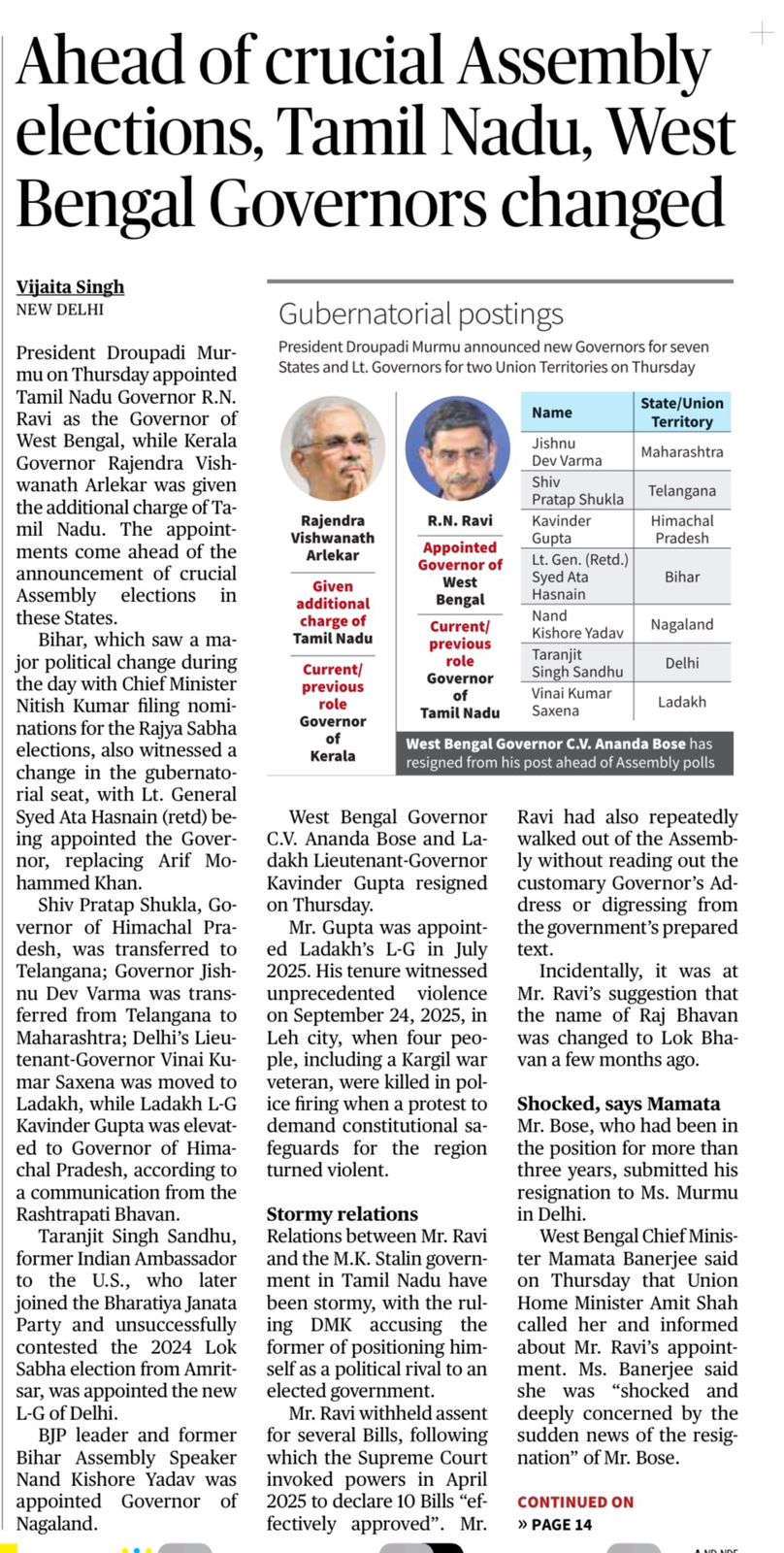
Ahead of crucial Assembly elections, Governors in 7 States and Lt. Governors in 2 UTs were changed, with President Droupadi Murmu making fresh appointments/transfers.

Governor (State)

Article 155 — Appointment

• Governor appointed by President (warrant under hand & seal).
• Done on aid & advice of Union Council of Ministers (Art. 74).

Article 156 — Tenure, Removal, Transfer

• Art. 156(1): Holds office during pleasure of President → removal/change anytime.
• Art. 156(3): Nominal tenure 5 years (not guaranteed).
• Transfer: Not expressly written; flows from Art. 156(1) → treated as removal + fresh appointment under Art. 155.

Lt. Governor / Administrator (UTs)

Article 239 — Basic Rule

• UTs administered by President through Administrator/LG.

Article 239AA — Delhi (Special Case)

• Provides LG + elected Assembly framework.

Article 239A — Puducherry Framework

• Allows Legislature/Council of Ministers for certain UTs.

• Appointment/Change: By President on Union Cabinet advice.
• Tenure: No fixed tenure; serves during President’s pleasure.
Governor Appointment in India
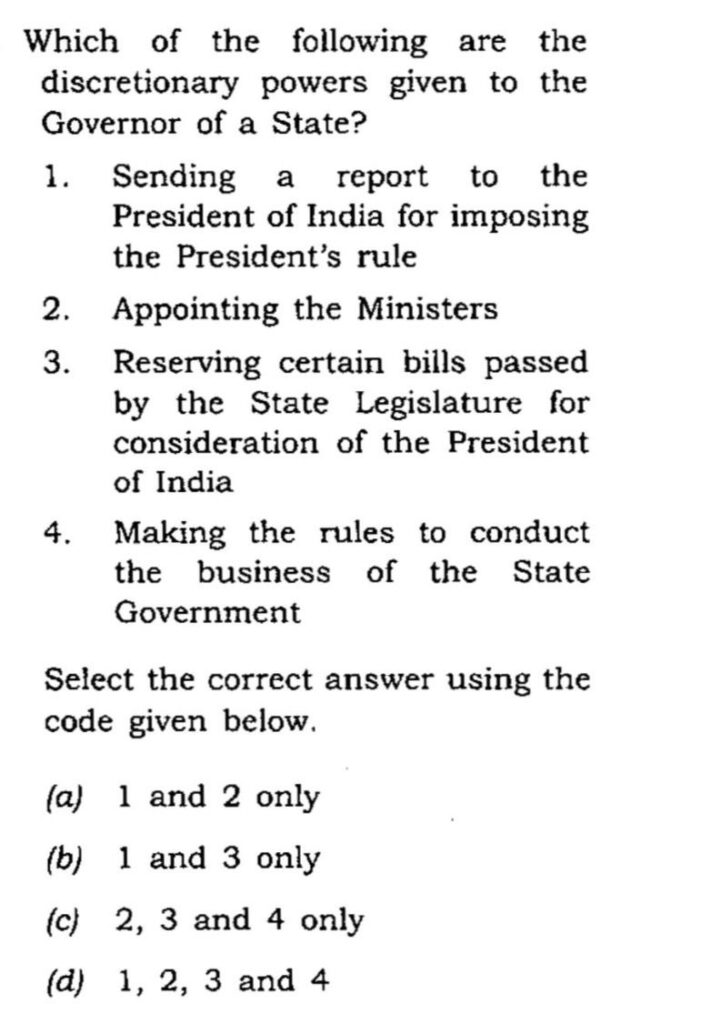
PYQ – 2014, Ans – B

Deputy Chairman of Rajya Sabha: Article 89, Election, Powers and Vacancy Explained for UPSC

Context:
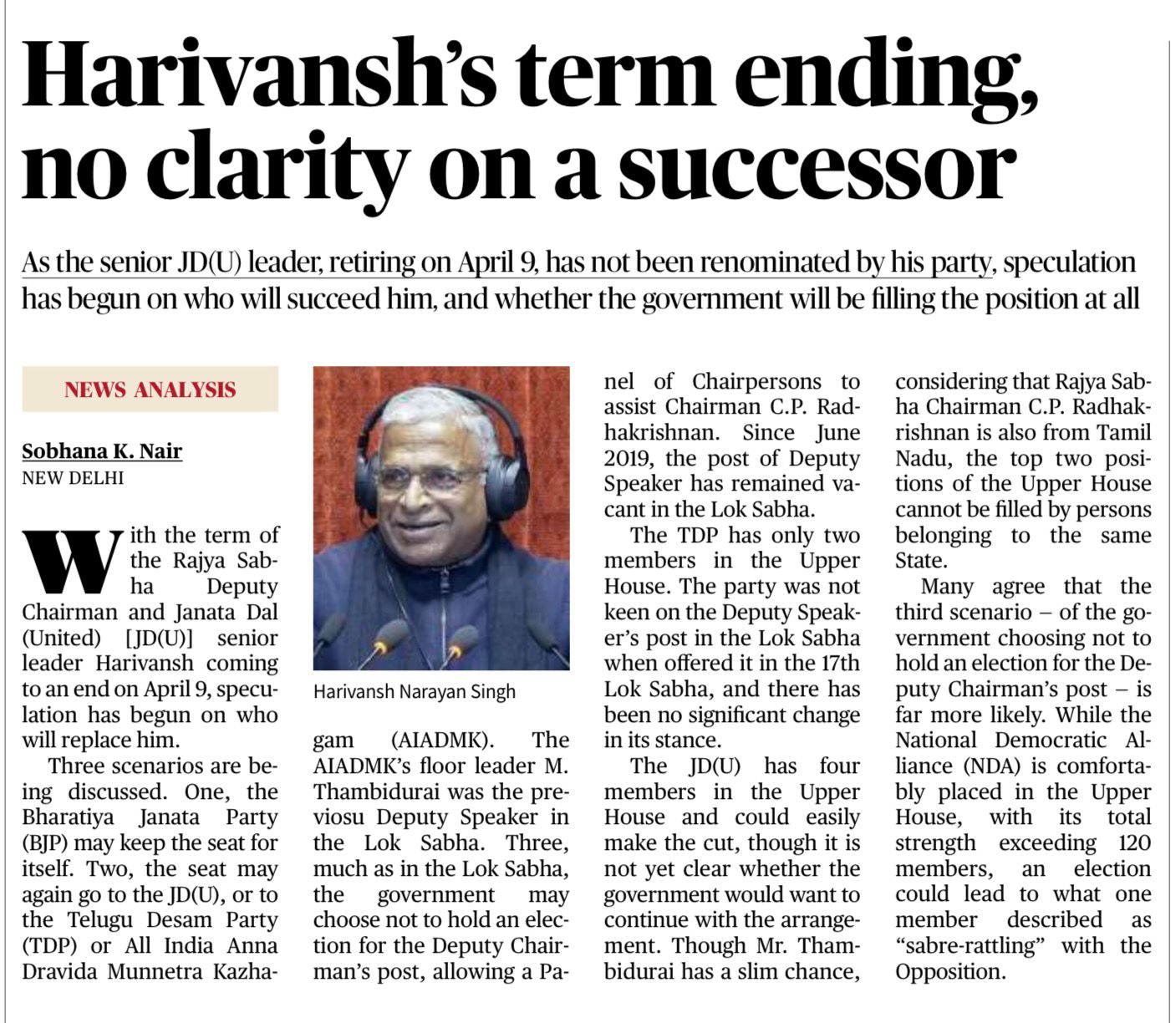
With the term of Rajya Sabha Deputy Chairman Harivansh Narayan Singh ending, uncertainty remains over the successor and whether the post will be filled.

1. Constitutional Basis — Article 89

• Rajya Sabha shall have Chairman (Vice-President) + Deputy Chairman (from among members).

2. Appointment — Article 89

• Elected by Rajya Sabha from among its members (Rules of Procedure; majority of members present & voting).

3. Tenure / Resignation / Removal — Article 90

• Tenure: till ceases to be RS member.
• Resignation: to Chairman.
• Removal: RS resolution (majority of all then members; 14-day notice).

4. Functions — Article 91

• Acts as Chairman when VP’s office vacant or Chairman absent.

5. Is Office Mandatory?

• RS “shall choose” Deputy Chairman (Art. 89) → constitutionally envisaged.
• No time-limit for election → vacancy can exist temporarily (unlike President/VP).

Deputy Chairman of Rajya Sabha
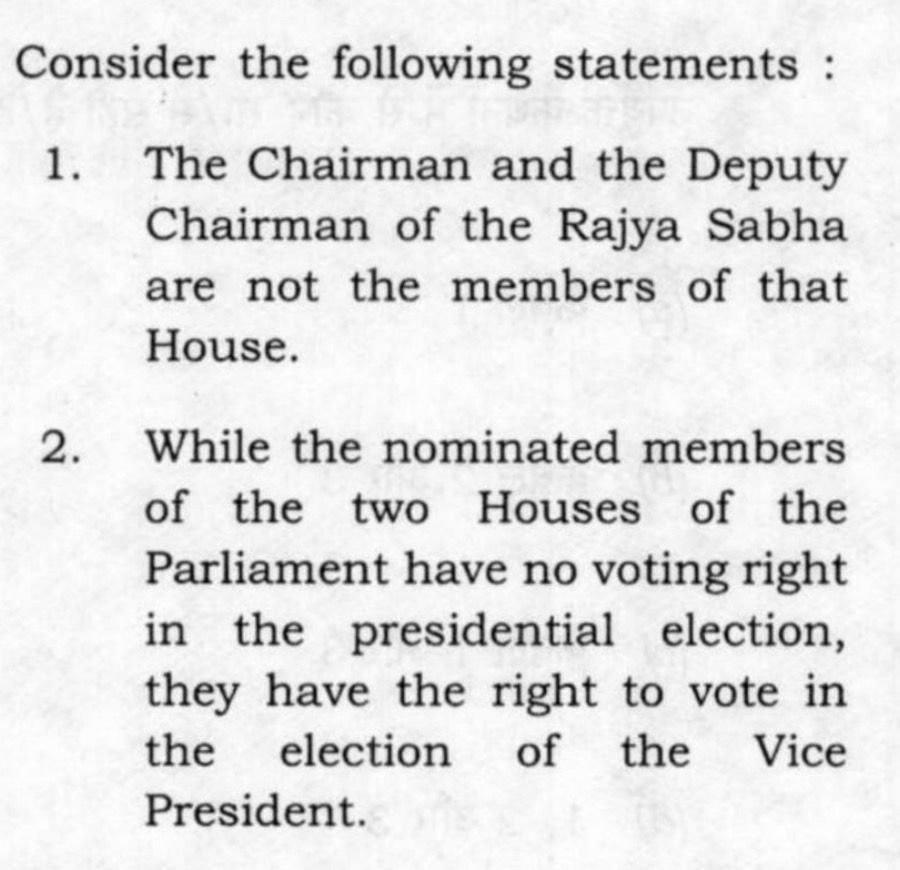
PYQ – 2013, Ans – B

Basmati Rice Exports from India Disrupted by West Asia Conflict: Trade Impact Explained for UPSC

Context:
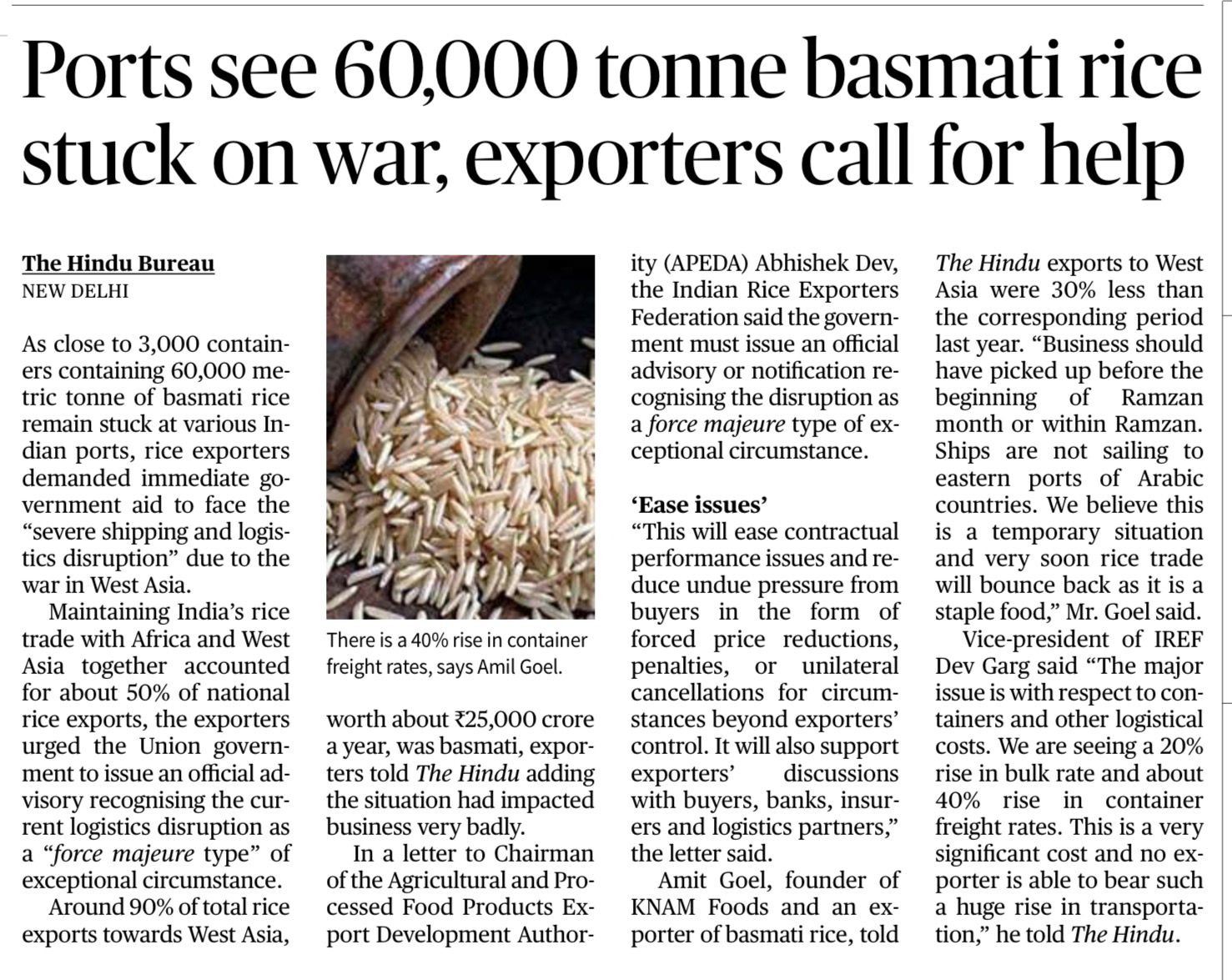
Due to the West Asia conflict, about 60,000 tonnes of basmati rice are stuck at Indian ports amid shipping disruptions; exporters seek government support.

1. World’s Top Rice Producers

India | China | Bangladesh 

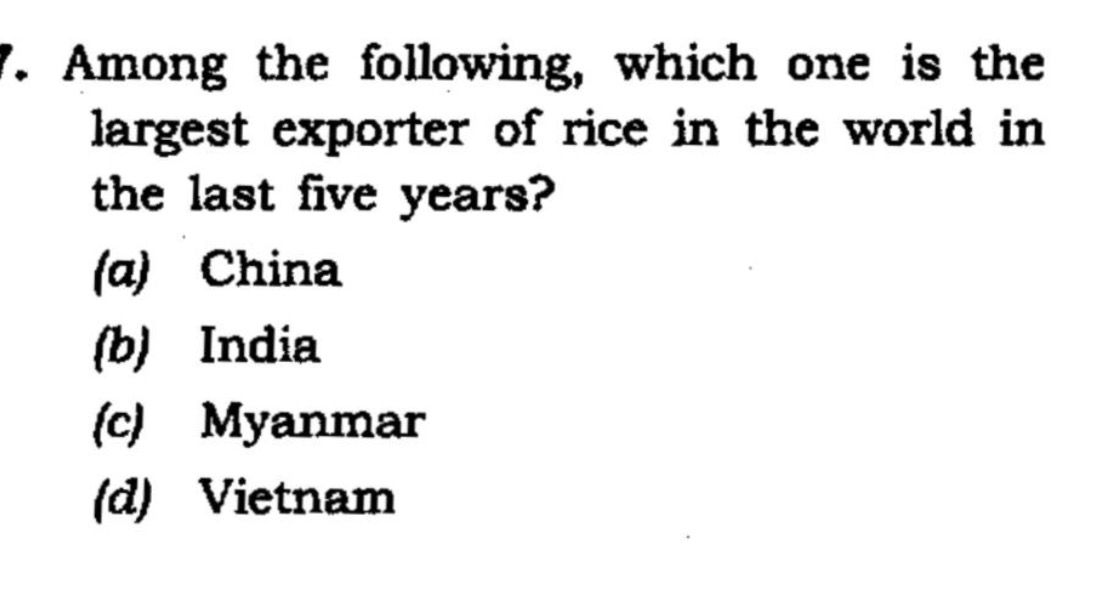
2. World’s Top Rice Exporters

India | Thailand | Vietnam

Top Rice-Producing States (India):
Uttar Pradesh | Telangana | West Bengal

3. India’s Rice Exports — Destinations

Basmati (Premium):

• West Asia/Gulf: Iran, Saudi Arabia, UAE, Iraq
• Others: U.S., U.K., EU (smaller share)

Non-Basmati (Bulk):

• Africa: Benin, Senegal, Côte d’Ivoire, Togo
• Asia: Bangladesh, Nepal
• Others: Malaysia, Philippines

4. Basmati — GI Status (India)

• GI name: Basmati (under Geographical Indications of Goods (Registration and Protection) Act, 1999)
• Registered by: APEDA
• GI belt: Punjab, Haryana, Himachal Pradesh, Delhi, Uttarakhand, W. UP, Jammu region

5. Rice

• Season: Mainly Kharif (sown Jun–Jul; harvested Oct–Nov); also Rabi/Summer rice in some regions with irrigation.
• Temperature: ~20–35°C (high during growth; cooler during ripening).
• Rainfall/Water: ~100–200 cm or assured irrigation; thrives in standing water fields.
• Soil: Fertile alluvial/clayey loams with good water retention; lowland plains ideal.

Basmati Rice Exports from India
PYQ – 2019, Ans – B

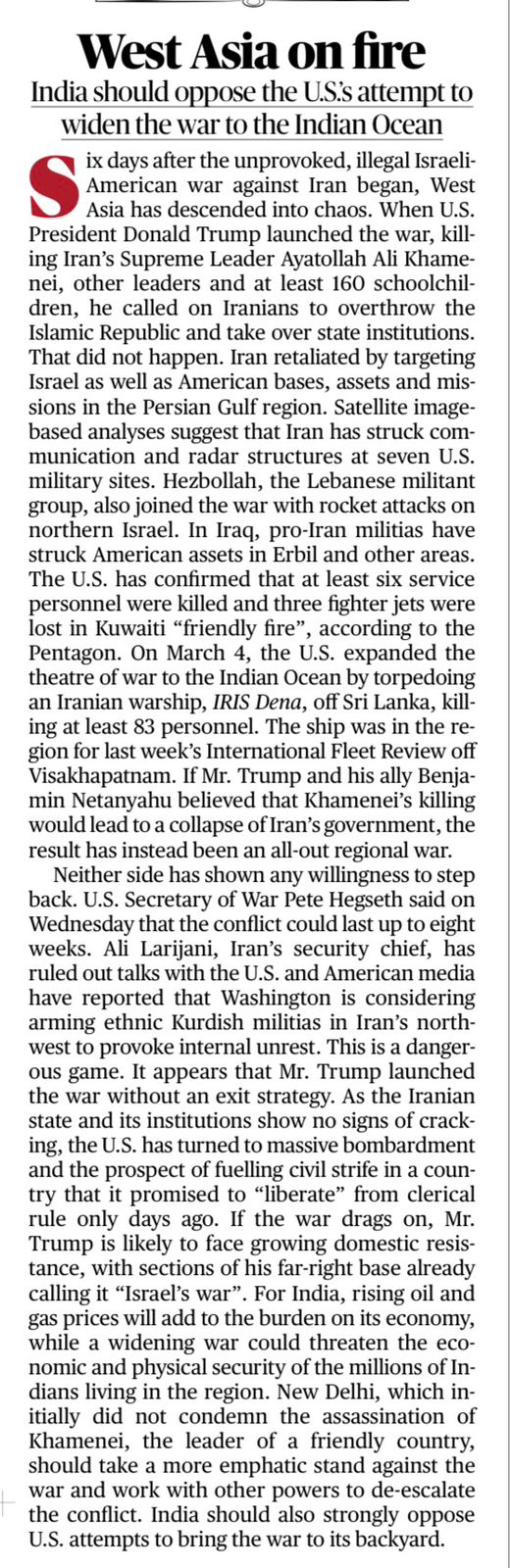
West Asia Conflict: Economic, Security and Energy Risks for India Explained for UPSC

Context:
The widening U.S.–Israel–Iran conflict across West Asia and into the Indian Ocean raises economic and security risks for India, stressing the need for restraint and de-escalation.

Core Idea

• Economic risk: Possible surge in oil & gas prices, higher freight/insurance costs, pressure on inflation and current account.
• Trade risk: Disruptions in sea lanes (Persian Gulf–Arabian Sea routes) affecting energy imports and exports.
• Diaspora risk: Safety concerns for millions of Indians working in Gulf countries.
• Security risk: Wider war near Indian Ocean can threaten maritime security and regional stability.

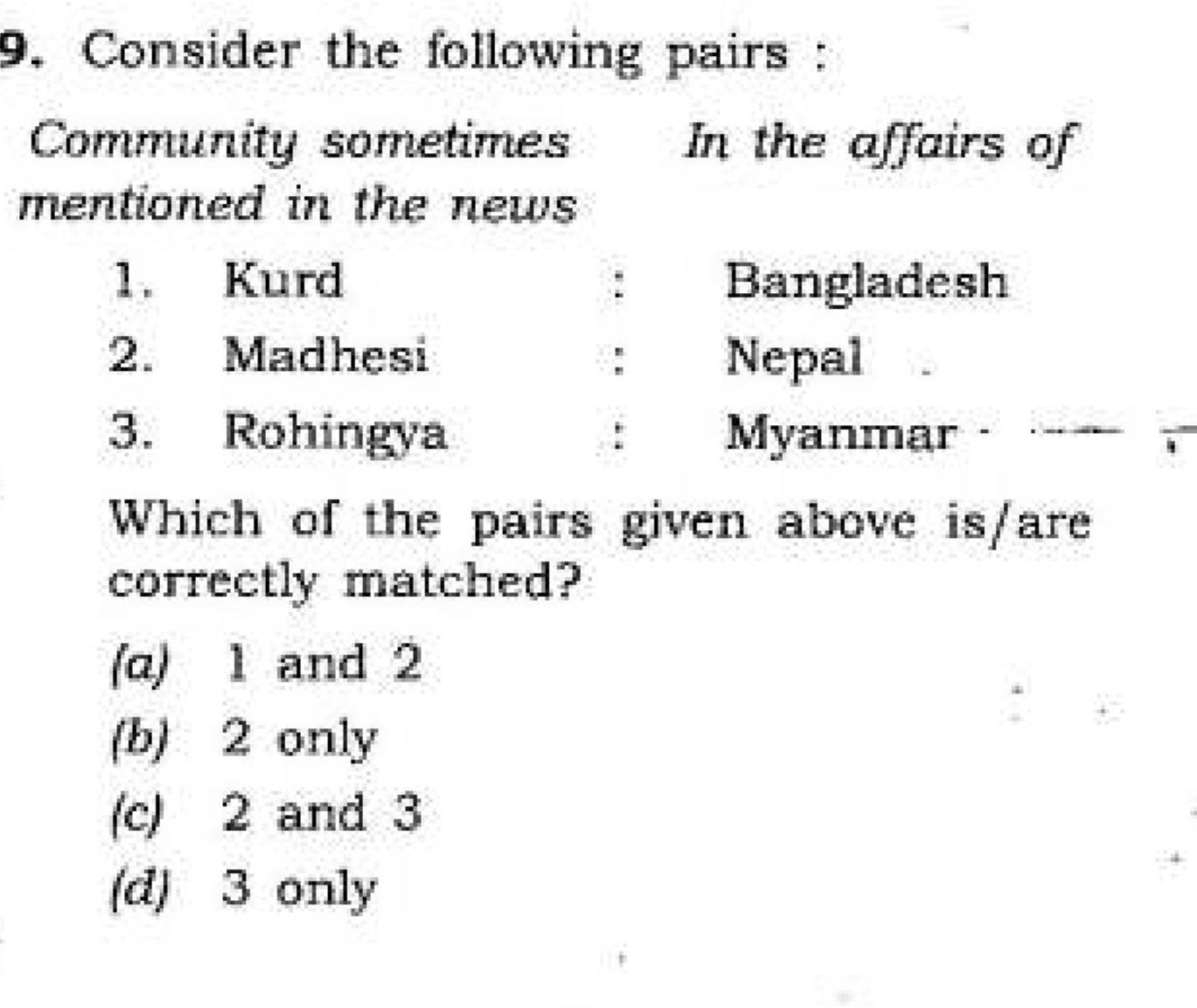
Kurds — Statelessness

• Among the largest stateless ethnic groups (~30–35 million).
• Post–World War I arrangements did not create a Kurdish state; homeland divided.

Where Kurds Live

• Turkey (largest population; southeast)
• Iran (northwest)
• Iraq (autonomous Kurdistan Region)
• Syria (north)

West Asia Conflict
West Asia Conflict
PYQ – 2016, Ans – C

India Iran Relations: Diplomacy, Strait of Hormuz Concerns and West Asia Tensions for UPSC

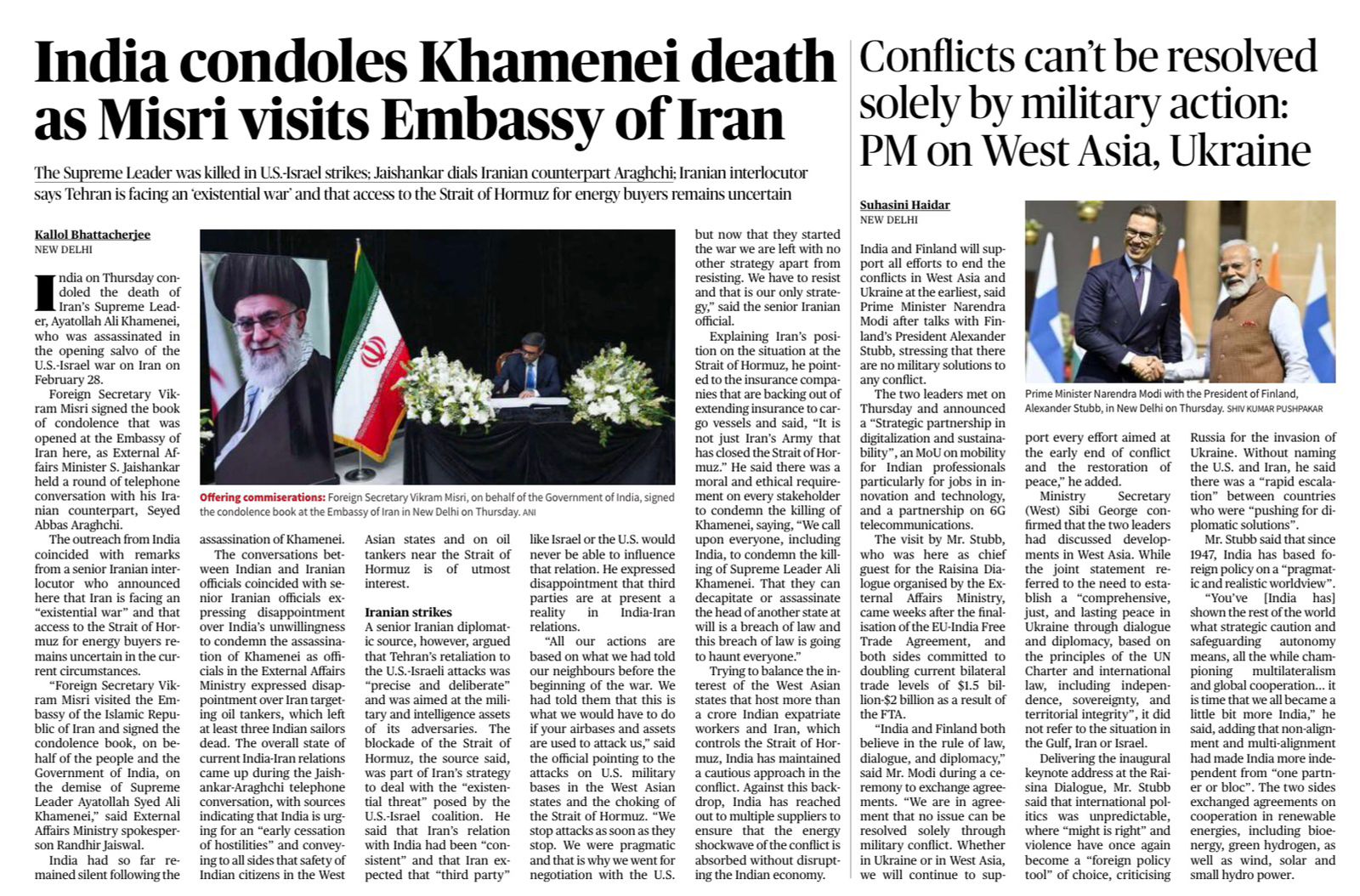
1. PM on West Asia & Ukraine

• Narendra Modi stressed no military solution to conflicts; called for dialogue, diplomacy and international law-based peace.
• Supported early end of wars in West Asia and Ukraine; backed multilateral efforts for lasting stability.
• Highlighted India’s pragmatic, independent foreign policy, strategic autonomy and balanced engagement.
• India–Finland talks: push for cooperation in technology, mobility, clean energy and trade expansion.

2. India–Iran Developments

• India condoled killing of Iran’s Supreme Leader Ayatollah Ali Khamenei; Vikram Misri visited Iran Embassy to sign condolence book.
• S. Jaishankar spoke with Iranian FM Abbas Araghchi; focus on de-escalation and safety of Indians.
• Iran termed the situation an “existential war”; warned disruptions at the Strait of Hormuz affecting global energy flows.
• India maintained cautious stance, balancing ties with West Asia states while monitoring oil, shipping and diaspora risks.

India Iran Relations

Total Fertility Rate in India: Andhra Pradesh Draft Population Policy and Demographic Trends for UPSC

Context:
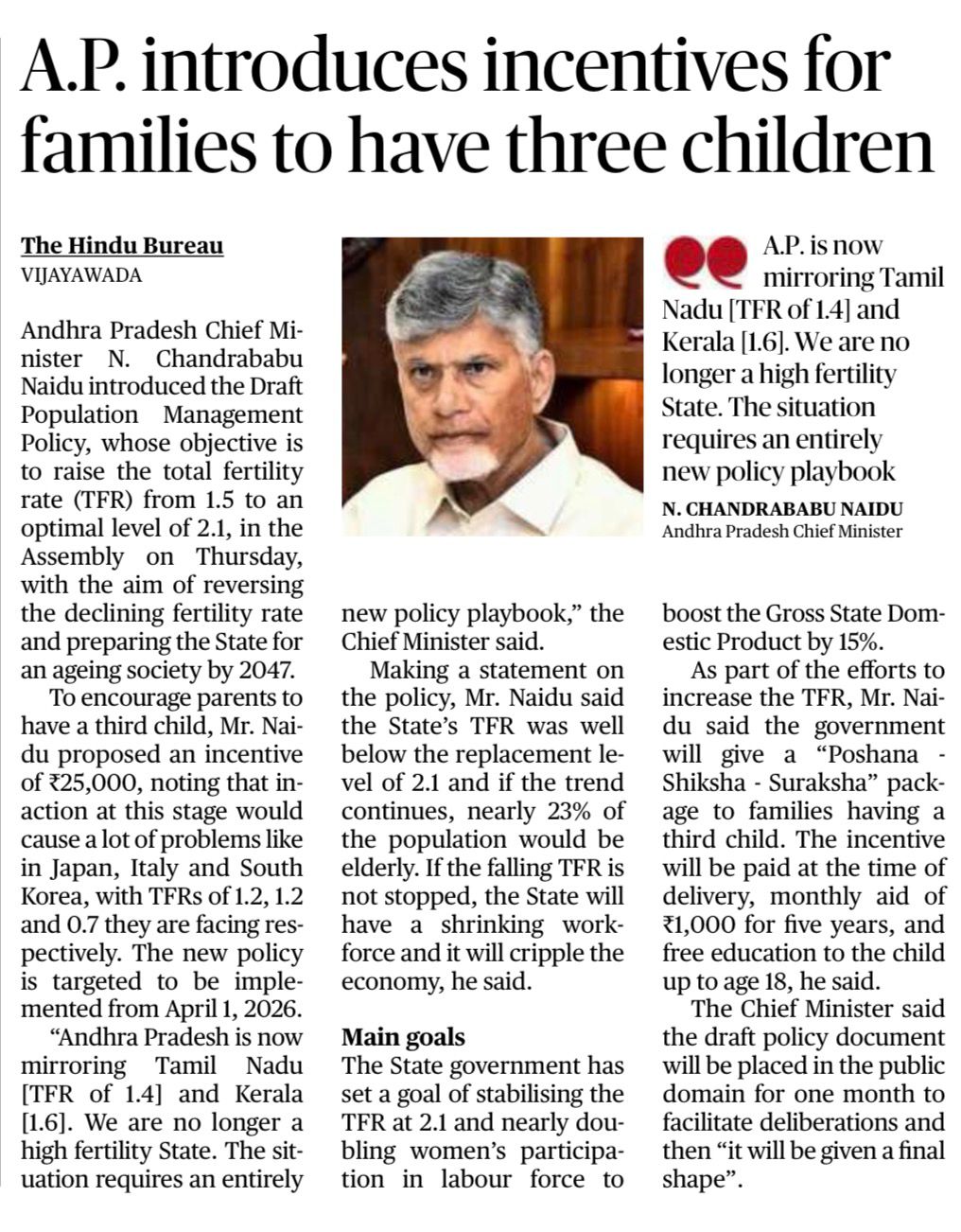
N. Chandrababu Naidu proposed incentives for a third child under A.P.’s draft population policy amid falling fertility and ageing concerns.

1. Trigger

• Low fertility (~1.5 in A.P.), ageing trend, shrinking workforce risk.

2. TFR (Total Fertility Rate) — Basics

Average children per woman | Replacement ≈ 2.1

3. TFR — NFHS-5

India: 2.0
A.P.: 1.7
Telangana: 1.8
Karnataka: 1.7
Tamil Nadu: 1.4
Kerala: 1.8

4. Incentives (Draft Policy)

• ₹25,000 at third-child birth
• ₹1,000/month for 5 yrs
• Free education till 18

Total Fertility Rate in India
About the UPSC Civil Services Examination (UPSC CSE)

The UPSC Civil Services Examination (CSE) is one of the most competitive and esteemed examinations in India, conducted by the Union Public Service Commission to recruit officers for services such as the Indian Administrative Service (IAS), Indian Police Service (IPS), Indian Foreign Service (IFS), and others. The exam comprises three stages — Prelims, Mains, and the Personality Test (Interview) — designed to test a candidate’s knowledge, aptitude, decision-making, and leadership skills.


How to Prepare Effectively for UPSC CSE

Cracking the UPSC CSE requires a deep understanding of the syllabus, consistent revision, structured answer writing, and smart test-taking strategies. The Prelims test analytical and conceptual clarity, the Mains focuses on critical thinking, articulation, and subject mastery, while the Interview assesses presence of mind, ethical judgment, and personality traits relevant to public service.

At UnderStand UPSC, we empower aspirants with a personalized and focused approach to each stage of the exam.


Why Choose UnderStand UPSC?

UnderStand UPSC is a mentorship-driven platform offering a clear, clutter-free strategy to tackle the Civil Services Examination. Our programs like Transform (for beginners and intermediate learners) and Conquer (for advanced mains preparation) provide structured study plans, syllabus-wise video content, interactive live sessions, and answer writing support.

We emphasize:

  • Concept clarity through topic-wise lectures

  • Test series designed around real UPSC standards

  • Personalized mentorship in small groups

  • Regular performance tracking and peer benchmarking

  • Doubt-clearing sessions, current affairs analysis, and monthly magazines


Join the UnderStand UPSC Learning Community

Our mission is to make UPSC preparation less overwhelming and more strategic. We combine mentorship, discipline, and academic rigor to help you clear CSE with confidence. Whether you’re preparing from Delhi, Mumbai, Bangalore, or a remote village — our online-first model ensures quality guidance reaches every corner of India.

Join the thousands of aspirants who trust UnderStand UPSC to guide their journey toward becoming civil servants.

Stay connected with us through our Telegram, YouTube, and Instagram channels for daily tips, strategies, and updates.

Copyright © 2026 USARAMBHA EDUCATION (UnderStand UPSC). All Rights Reserved.

Join the Success Journey!