13 August 2026 | UPSC Daily Current Affairs

13 August 2026 | UPSC Daily Current Affairs

India Retail Inflation July 2026: Causes and UPSC Impact

Context: India Retail Inflation July 2026
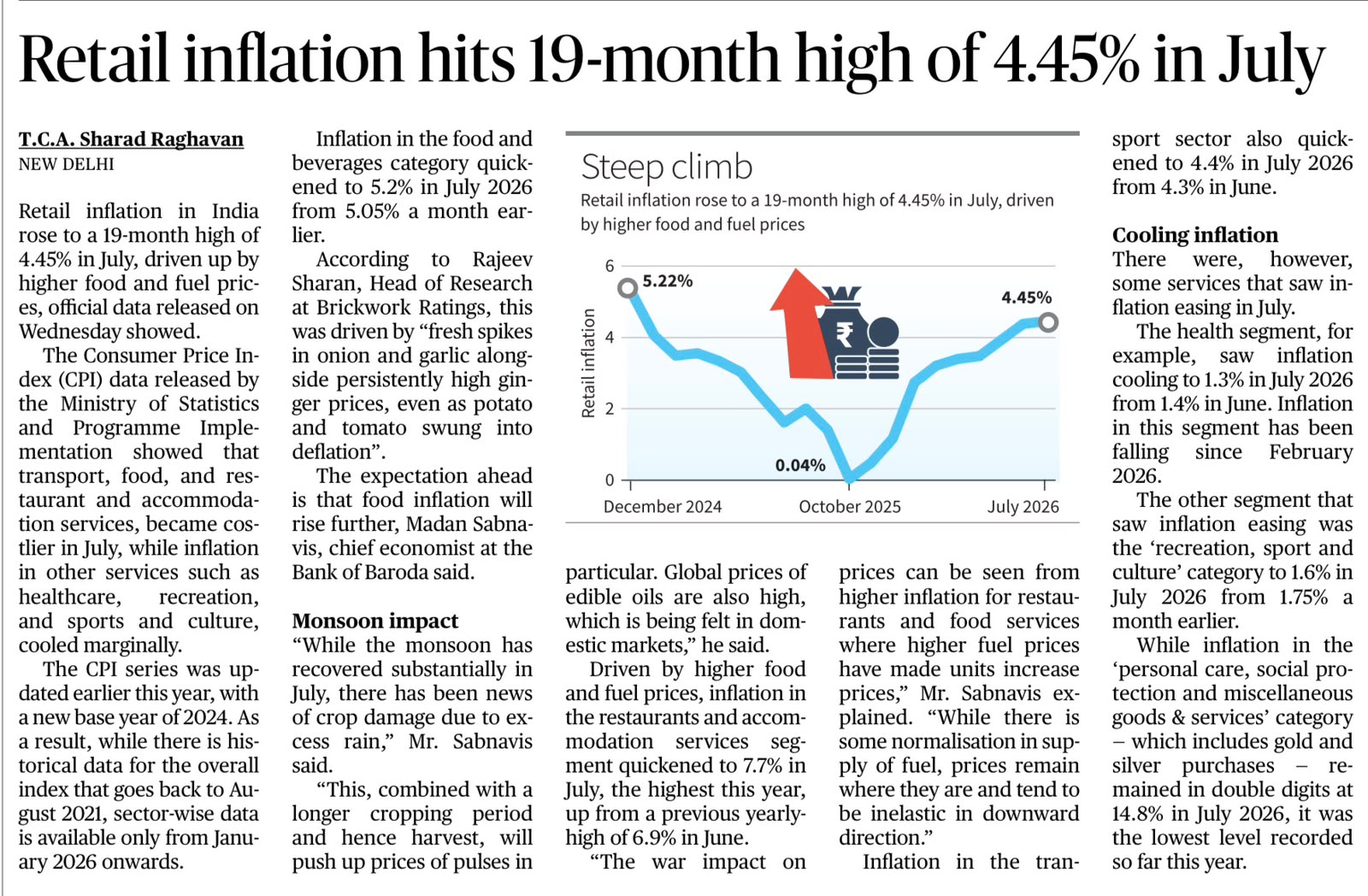
India’s retail inflation, measured through the Consumer Price Index, rose to 4.45% in July 2026, a 19-month high, mainly due to rising food and fuel-related prices.

CPI: Basics

Consumer Price Index measures the change in prices of a representative basket of goods and services purchased by households.

It is the principal measure of retail inflation in India.

CPI is compiled by the Ministry of Statistics and Programme Implementation through the National Statistical Office.

The latest CPI series uses 2024 = 100 as the base year.

It covers both rural and urban consumers.

The combined CPI is used for the national inflation rate.

Major CPI Components

CPI includes major components such as:

  • Food and beverages
  • Housing
  • Clothing and footwear
  • Fuel and light
  • Household goods
  • Health
  • Transport
  • Education
  • Recreation

Latest Inflation Data

CPI inflation rose to 4.45% in July 2026.

It was up from 4.38% in June 2026.

Food inflation stood at 5.52%, making food the major source of upward pressure.

Rural inflation was 4.84%.

Urban inflation was 3.96%.

The RBI’s inflation target is 4%, with a tolerance band of 2–6% under the flexible inflation-targeting framework.

Why Inflation Increased

Food Prices

Fresh increases in prices of onion, ginger and pulses pushed food inflation upward.

Global edible-oil prices also remained elevated.

Weather Impact

Excess rainfall and crop damage may reduce supply and push up prices, especially pulses.

Fuel Costs

Higher fuel prices increased transportation and food-service costs.

Restaurants and accommodation inflation rose to 7.7%.

Global Factors

West Asian geopolitical tensions and elevated global commodity prices added to domestic price pressures.

Key Takeaway

Retail inflation rose mainly because of food and fuel-related pressures. Although inflation remains within the RBI’s tolerance band, the rise shows the vulnerability of household prices to food supply, weather, fuel costs and global commodity shocks.
India Retail Inflation July 2026

Supreme Court Police Custody BNSS: Section 187 Explained

Context: Supreme Court Police Custody BNSS
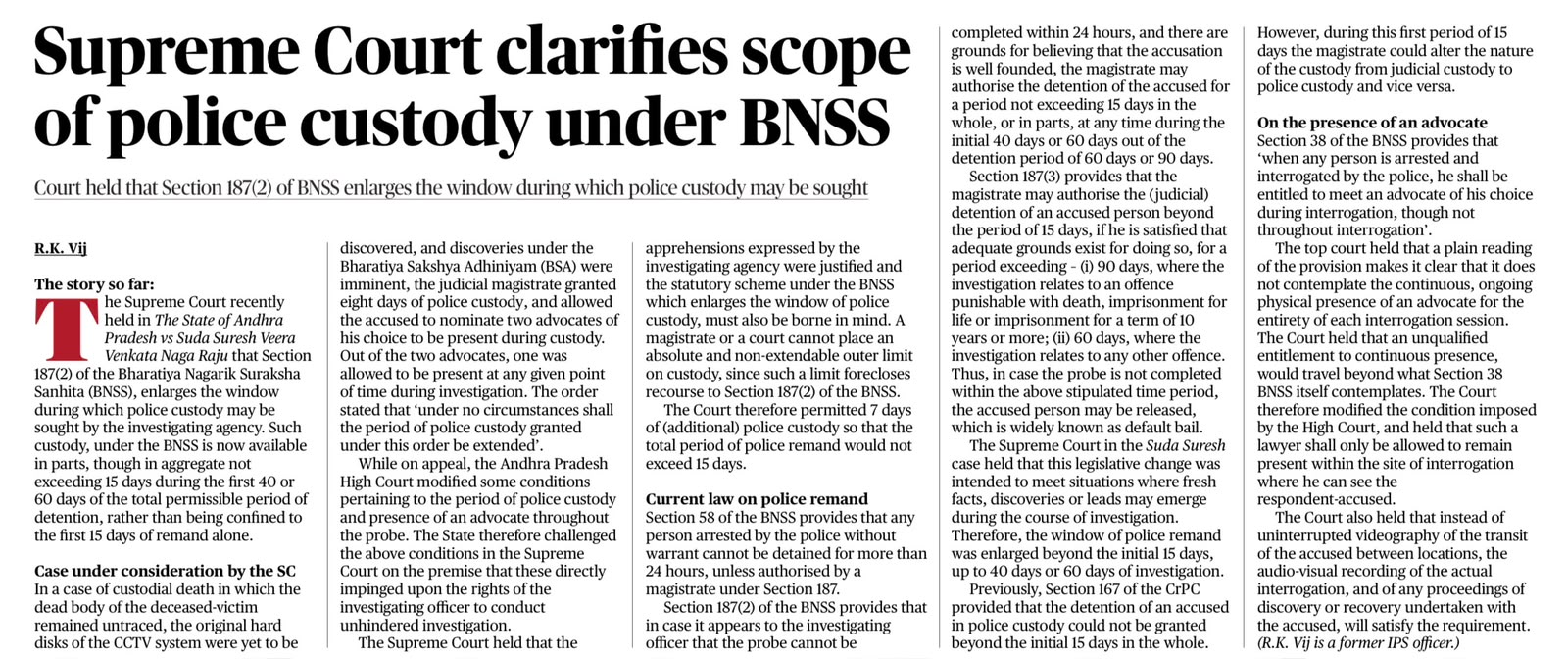
The Bharatiya Nagarik Suraksha Sanhita, 2023, which replaced the Code of Criminal Procedure, 1973, has altered the framework of arrest and remand. In The State of Andhra Pradesh v. Suda Suresh Veera Venkata Naga Raju, the Supreme Court clarified the scope of police custody and safeguards available to arrested persons.

Key BNSS Provisions

Section 58: 24-hour safeguard

An arrested person cannot ordinarily be detained beyond 24 hours, excluding journey time, without production before a Magistrate and further authorisation.

This provision protects individuals from arbitrary and prolonged detention without judicial oversight.

Section 187(2): Police custody

Police custody remains capped at 15 days in total.

However, under BNSS, this 15-day police custody can be taken in parts during:

  • The first 40 days of a 60-day detention period, or
  • The first 60 days of a 90-day detention period

This depends on the nature of the offence.

Section 38: Advocate

An arrested person can meet an advocate of their choice during interrogation.

However, this does not mean that the advocate has to remain continuously present throughout the interrogation.

Supreme Court’s Clarification

15-day limit unchanged

The Supreme Court clarified that BNSS has not increased the maximum police custody period.

The total police custody continues to remain capped at 15 days.

What has changed is the time window during which those 15 days may be used.

Separate spells permitted

Police can seek custody at different stages when fresh evidence or investigative requirements justify it.

However, this is subject to Magistrate approval.

Earlier Position

This differs from Central Bureau of Investigation v. Anupam J. Kulkarni, 1992.

Under the earlier Code of Criminal Procedure, police custody was confined to the first 15 days.

BNSS expands the window for using police custody, while keeping the overall 15-day cap intact.

Constitutional Balance

Investigation vs Liberty

Greater investigative flexibility must operate within constitutional safeguards.

This involves:

  • Article 21: Life and personal liberty
  • Article 22: Protection against arbitrary arrest and detention

Judicial Oversight

Magistrate authorisation remains the key safeguard against unnecessary or prolonged police custody.

The Magistrate must examine whether police custody is genuinely required and whether legal safeguards are being followed.

Key Takeaway

The Supreme Court clarified that BNSS does not increase the total police custody limit beyond 15 days. It only expands the window during which police may seek custody in separate spells, subject to judicial approval and constitutional safeguards.

Supreme Court Police Custody BNSS

India E20 Ethanol Sustainability: Key UPSC Issues Debate

Context: India E20 Ethanol Sustainability
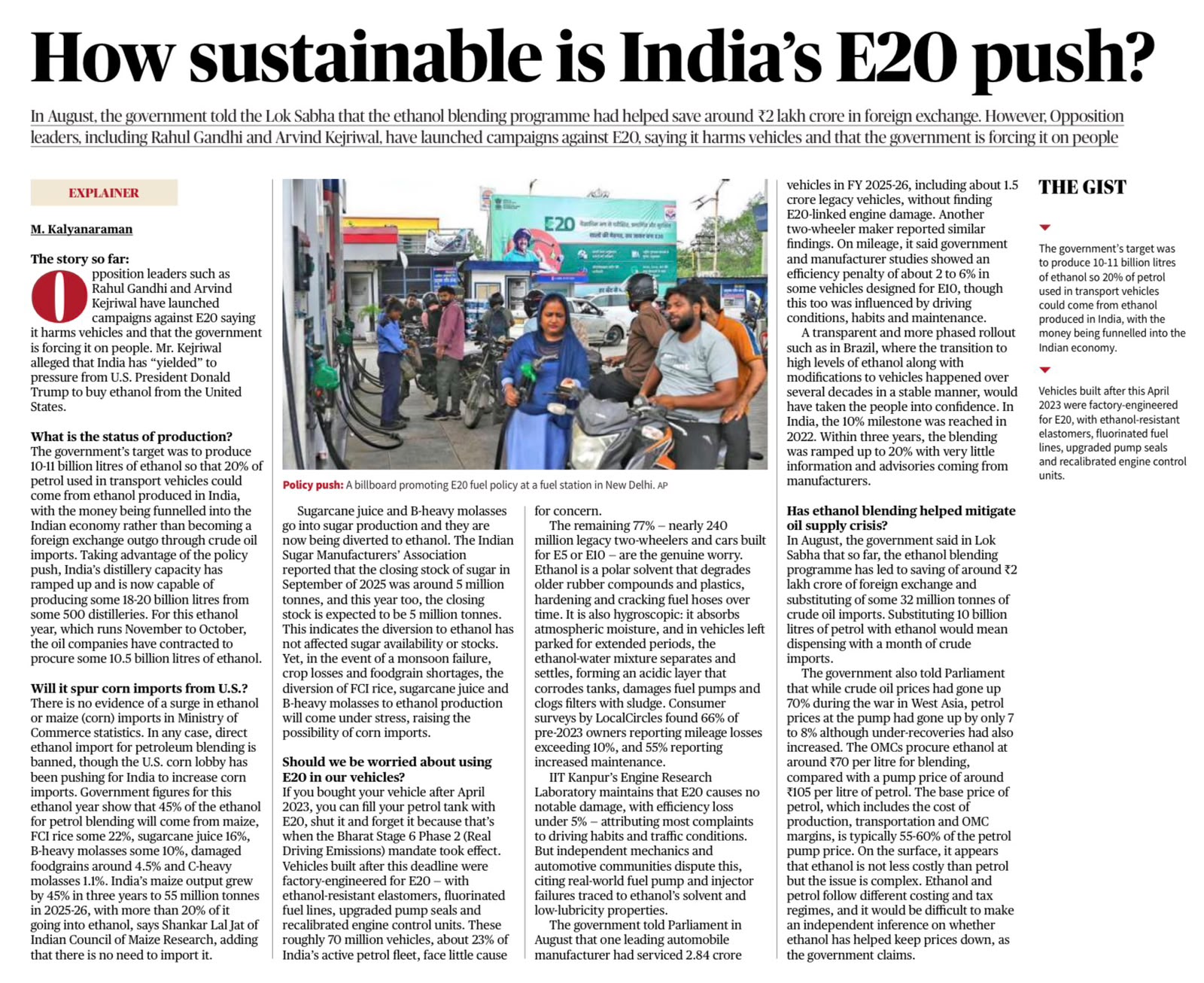
India has achieved 20% ethanol blending with petrol, or E20, in 2025–26, five years ahead of the earlier 2030 target. The Ethanol Blended Petrol Programme aims to reduce crude-oil dependence, save foreign exchange, support farmers and lower emissions. However, its long-term sustainability depends on balancing energy, food, water and consumer interests.

E20: Why India Is Pursuing It

Energy Security

India imports around 88.5% of its crude oil.

Ethanol substitutes a part of petroleum demand.

This reduces India’s exposure to global oil-price volatility and geopolitical shocks.

Economic Gains

Since Ethanol Supply Year 2014–15, ethanol blending has reportedly enabled:

  • More than ₹1.9 lakh crore in foreign-exchange savings
  • Substitution of about 310 lakh metric tonnes of crude oil
  • More than ₹1.6 lakh crore in farmer payments

Capacity Expansion

Ethanol production capacity increased from 421 crore litres in 2014 to nearly 2,000 crore litres in 2026.

This makes the E20 mandate technically more feasible.

The Core Challenge: Food, Water and Fuel

Feedstock

Ethanol is produced from sugarcane, maize, rice and other feedstocks.

Greater dependence on food crops can create a food-versus-fuel trade-off.

Cropping Pattern

Assured demand for maize can encourage farmers to shift land away from pulses and oilseeds.

This may increase future import dependence for these essential crops.

Water

Sugarcane is water-intensive.

Therefore, ethanol expansion needs to account for regional water stress and sustainable cropping patterns.

Diversification

Second-generation ethanol, or 2G ethanol, is produced from agricultural residues and other non-food biomass.

It can reduce competition with food production.

Vehicle and Consumer Dimension

Compatibility

Vehicles manufactured after April 2023 are designed for E20.

However, a large legacy E5/E10 fleet remains in use.

Mileage

Ethanol has lower energy density than petrol.

Studies indicate around 2–6% lower fuel efficiency in some vehicles designed for E10.

Transition

E20 requires a gradual vehicle transition.

Consumers need transparent information on:

  • Compatibility
  • Mileage
  • Maintenance
  • Testing of older vehicles

Economic and Global Dimension

Cost

Ethanol is not automatically cheaper than petrol.

For example, the government’s procurement price for maize-based ethanol is about ₹71.86 per litre, before taxes and logistics.

United States

The United States has a large corn-ethanol industry.

However, India has clarified that it has made no commitment to import U.S. ethanol for fuel blending under ongoing trade talks.

India’s E20 requirement is intended to be met through domestic production.

Energy Transition

E20 should complement, not replace:

  • Electric mobility
  • Public transport
  • Green hydrogen
  • Other low-carbon transport options

Making E20 Sustainable

Feedstock Diversification

India should expand 2G ethanol and agricultural-residue-based production instead of relying excessively on food crops.

Food-Energy Balance

Ethanol policy must not undermine pulses, oilseeds, food availability or water security.

Consumer Protection

India must ensure E20-compatible vehicles, transparent mileage information and safeguards for the legacy vehicle fleet.

Evidence-Based Expansion

Future increases beyond E20 should follow:

  • Scientific testing
  • Feedstock availability assessment
  • Lifecycle environmental assessment

Blending targets alone should not guide future expansion.

Key Takeaway

India’s E20 push supports energy security, farmer payments and foreign-exchange savings, but its sustainability depends on feedstock diversification, water management, consumer protection and evidence-based expansion.

India E20 Ethanol Sustainability

Sprite Tejas Express India: Railway Branding and PPP

Context: Sprite Tejas Express India
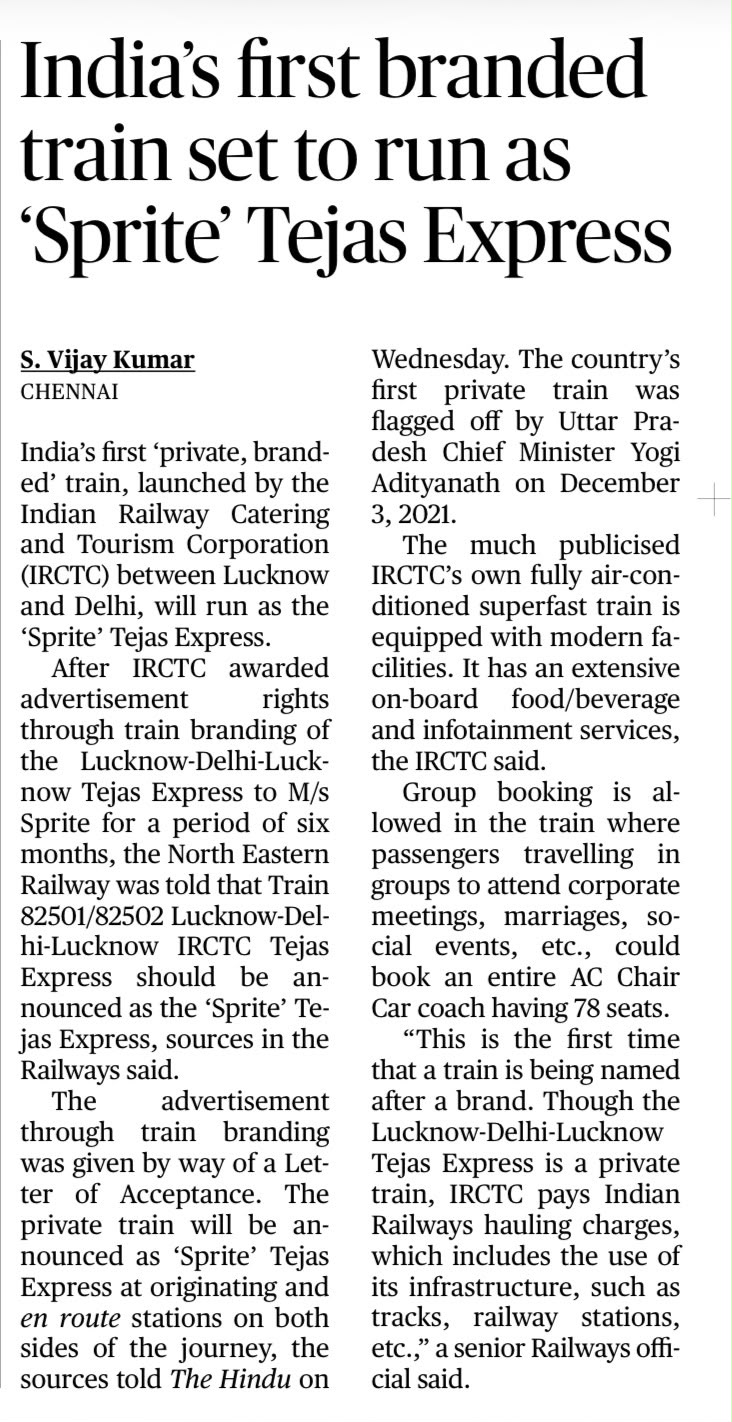
The Lucknow–Delhi–Lucknow Tejas Express will be branded as ‘Sprite Tejas Express’ after the Indian Railway Catering and Tourism Corporation awarded six-month train-branding rights to Sprite.

This is commercial branding, not privatisation of the train.

Key Points

First Branded Train

Train No. 82501/82502 will carry the Sprite brand at originating and en-route stations.

This makes it the first Indian train to be named after a commercial brand.

Non-Fare Revenue

The initiative allows IRCTC to generate additional revenue through advertising and branding.

This can reduce dependence on passenger fares.

Role of Indian Railways

The train continues to use Indian Railways’ tracks, stations and other infrastructure.

For this, IRCTC pays the applicable hauling charges.

Significance

The development represents greater commercialisation and non-fare revenue generation within the railway sector.

At the same time, railway infrastructure remains under Indian Railways.

Key Takeaway

The ‘Sprite Tejas Express’ is an example of railway commercial branding and non-fare revenue generation. It does not mean privatisation of the train or railway infrastructure.

Sprite Tejas Express India

Germany Green Hydrogen India: Energy Cooperation and Trade

Context: Germany Green Hydrogen India
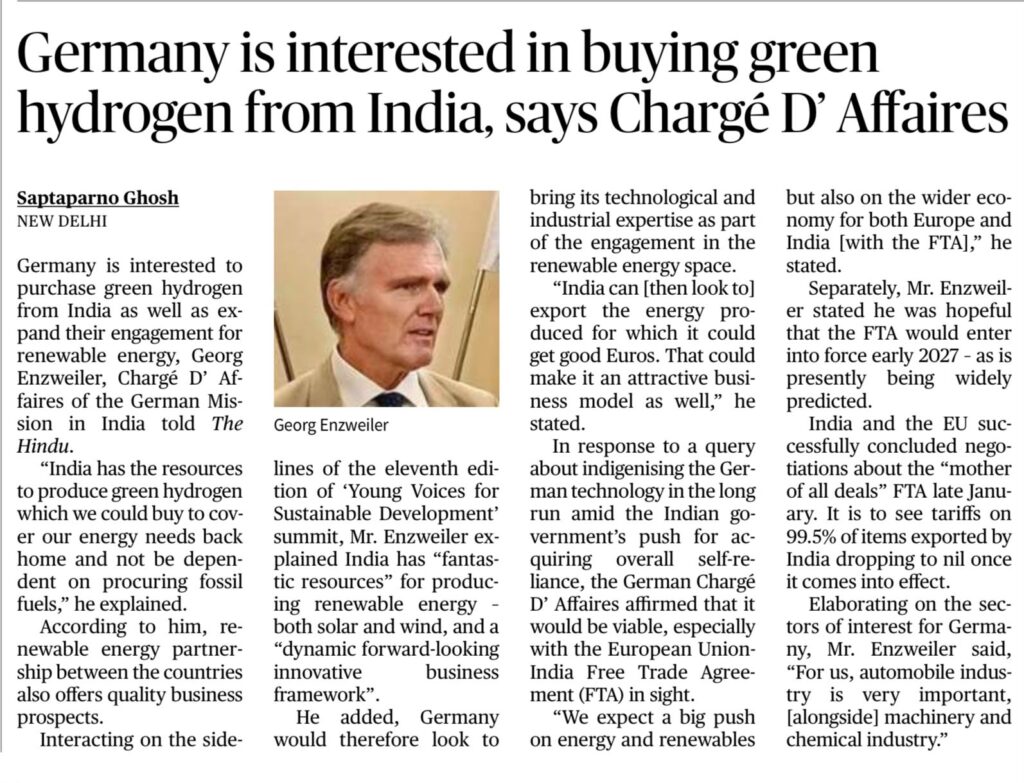
Germany has expressed interest in importing Green Hydrogen from India. This highlights India’s potential to use its renewable-energy resources for domestic decarbonisation and future clean-energy exports.

Green Hydrogen

Green Hydrogen is hydrogen produced by electrolysis of water using renewable electricity such as solar and wind.

It has very low emissions.

Uses of Green Hydrogen

Green Hydrogen is important for hard-to-abate sectors such as:

  • Steel
  • Fertilisers
  • Chemicals
  • Shipping
  • Heavy industry

These sectors are difficult to decarbonise through direct electrification alone.

National Green Hydrogen Mission

The National Green Hydrogen Mission was launched in 2023.

It has an outlay of ₹19,744 crore.

The mission aims to develop India’s domestic Green Hydrogen ecosystem and make India a global production, use and export hub.

2030 Targets

The mission targets annual Green Hydrogen production of 5 million metric tonnes by 2030.

It also envisages around 125 GW renewable-energy capacity, alongside investment, employment and emission-reduction gains.

Domestic Focus

India’s Green Hydrogen policy is not only export-oriented.

Its domestic objectives include:

  • Reducing fossil-fuel imports
  • Decarbonising industries
  • Creating domestic demand
  • Building a clean-energy ecosystem

Exports are an additional opportunity.

India–Germany Opportunity

India

India has renewable-energy potential and expanding Green Hydrogen production capacity.

Germany

Germany has industrial demand for clean hydrogen and technological expertise.

Cooperation Potential

India–Germany cooperation can combine:

  • Indian renewable resources
  • German technology
  • German investment
  • Market demand from Europe

Key Challenges

India must address several challenges before becoming a major Green Hydrogen exporter.

These include:

  • High production cost
  • Renewable-power requirements
  • Water availability
  • Storage infrastructure
  • Transport infrastructure
  • Port infrastructure
  • International certification standards

Key Takeaway

Germany’s interest in Indian Green Hydrogen shows India’s future potential as a clean-energy exporter. However, success will depend on lowering costs, scaling renewable power, ensuring water sustainability and building storage, transport and certification systems.

Germany Green Hydrogen India

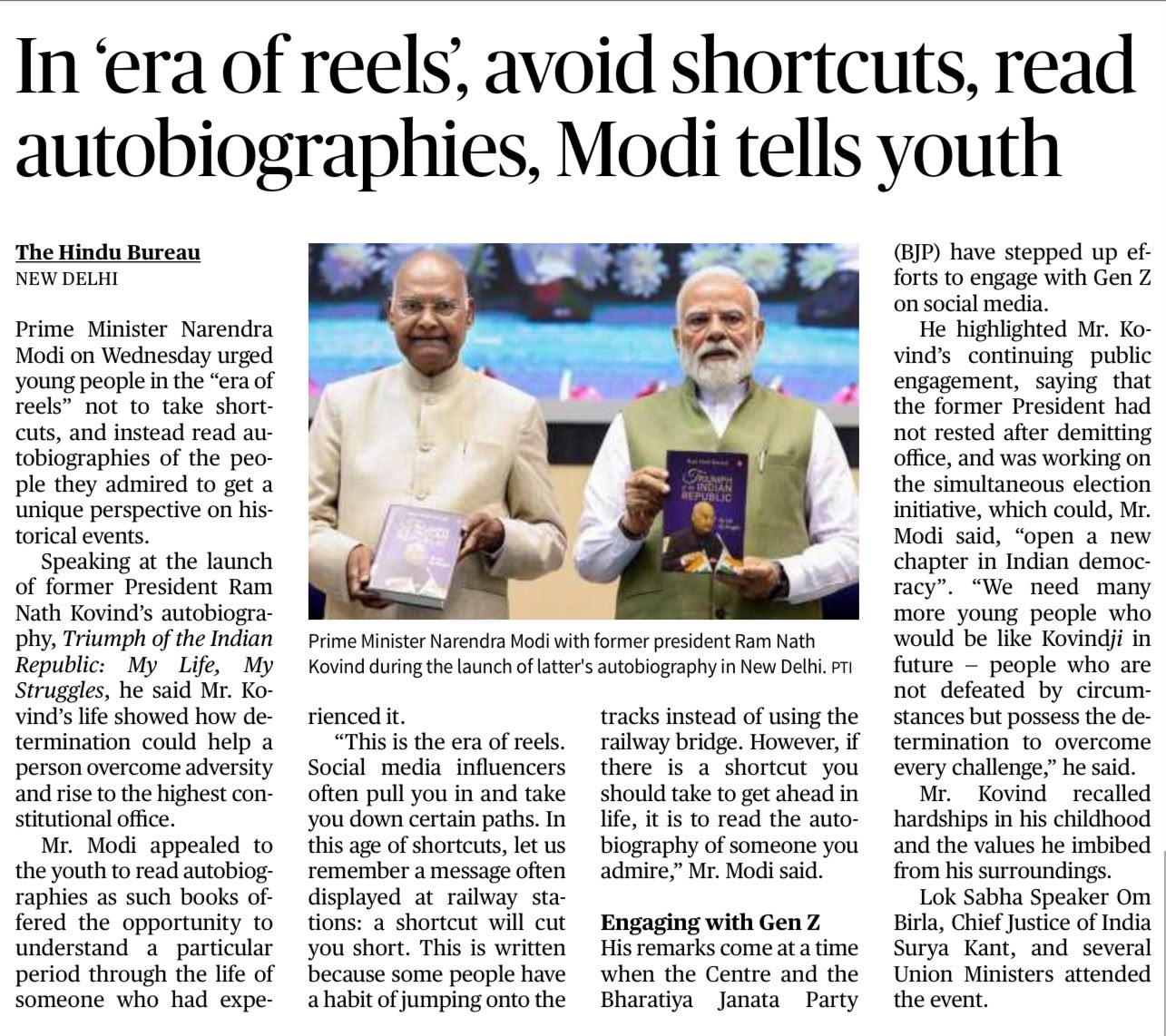
Modi Youth Autobiography Message: UPSC Lessons for Youth

Context: Modi Youth Autobiography Message
Prime Minister Narendra Modi, while launching former President Ram Nath Kovind’s autobiography, Triumph of the Indian Republic: My Life, My Struggles, encouraged young people to move beyond the culture of short-form digital content and engage with books and autobiographies.

Core Message

The Prime Minister urged the youth not to take shortcuts in the “era of reels”.

He said young people should read autobiographies of people they admire to gain a deeper understanding of history, struggle and public life.

The point is that short-form content may give quick information, but autobiographies provide lived experience, perspective and depth.

Ram Nath Kovind’s Life Journey

Ram Nath Kovind served as the President of India from 2017 to 2022.

His life journey, from humble beginnings to the highest constitutional office, offers insights into:

  • Perseverance
  • Public service
  • Constitutional values
  • Democratic institutions
  • Social mobility
  • India’s democratic journey

Youth and Digital Culture

The issue also highlights the impact of digital culture on young people.

Short-form content can be useful for quick awareness, but overdependence on it may weaken deeper reading, patience and historical understanding.

Books and autobiographies help young citizens understand public life through lived experiences rather than only viral summaries.

Governance and Society Angle

For democratic citizenship, youth need more than fast information.

They need:

  • Historical perspective
  • Institutional understanding
  • Constitutional awareness
  • Critical thinking
  • Patience for long-form reading
  • Awareness of public service values

Key Takeaway

In the digital age, informed youth engagement requires moving beyond shortcuts. Autobiographies and serious reading help young people understand history, institutions, leadership and democratic values more deeply.

Modi Youth Autobiography Message

Copyright © 2026 USARAMBHA EDUCATION (UnderStand UPSC). All Rights Reserved.

Inquiry form for
Takshila Residential Program