18 August 2026 | UPSC Daily Current Affairs

18 August 2026 | UPSC Daily Current Affairs

Critical Mineral Assets Abroad: India’s Key Challenges

Context: Critical mineral assets abroad
India is seeking secure access to critical minerals required for EVs, batteries, renewable energy, electronics and defence, but acquiring overseas assets remains difficult due to high valuations, competition and geopolitical risks.

1. National Critical Mineral Mission and KABIL

National Critical Mineral Mission:
The National Critical Mineral Mission was approved in January 2025.

It aims to secure the entire critical-mineral value chain:

  • Exploration
  • Mining
  • Beneficiation
  • Processing
  • Manufacturing
  • Recycling

The mission focuses on both domestic development and overseas sourcing.

Khanij Bidesh India Limited:
KABIL was established in 2019 by:

  • National Aluminium Company Limited
  • Hindustan Copper Limited
  • Mineral Exploration & Consultancy Limited

Its role is to identify, explore and acquire critical-mineral assets abroad.

KABIL’s role:
KABIL acts as India’s overseas mineral-acquisition arm, while NCMM provides the broader national framework for mineral security.

Progress:
KABIL has made progress in Argentina’s lithium sector, while attempts involving assets in Australia and Chile have faced commercial and strategic hurdles.

2. Why Overseas Acquisition Is Difficult

High valuations:
Rising global demand has made quality critical-mineral assets increasingly expensive.

High financial risk:
Mining requires large upfront capital, long gestation periods and uncertain returns, compounded by volatile mineral prices.

Global competition:
India competes with resource-rich countries and large corporations that have greater financial and technological capabilities.

Geopolitical and regulatory risks:
Resource nationalism, changing mining regulations and strategic control over minerals can complicate foreign investments.

Value-chain gap:
Acquiring a mine does not automatically secure supply.

India also needs:

  • Processing
  • Refining
  • Technology
  • Downstream manufacturing capacity

3. Way Forward

Diversify sources:
Build partnerships and acquire assets across multiple mineral-rich countries to reduce concentration risk.

Secure the entire chain:
Combine overseas mining rights with long-term offtake agreements, processing and refining arrangements.

Strengthen domestic ecosystem:
Use NCMM to accelerate exploration, beneficiation, processing, recycling and mineral substitution.

Leverage private capital:
Build PSU–private partnerships to combine strategic objectives with capital and technical expertise.

Strengthen mineral diplomacy:
Integrate critical minerals into India’s strategic partnerships, trade agreements and development cooperation.

Prelims Link

Which of the following statements about Rare Earth Elements and Critical Minerals is/are correct?

  1. Modern technological innovations including Artificial Intelligence, robotics and space exploration extensively utilise Rare Earth Elements.
  2. China has the highest share in mining of REEs followed by India.
  3. The Government of India launched the National Critical Mineral Mission in 2025 to establish a robust framework for self-reliance in the critical mineral sector.
  4. Rare Earth Elements are a set of 13 metallic elements.

Options:

(a) 1 and 3 only
(b) 3 only
(c) 1, 3 and 4
(d) 1, 2 and 4
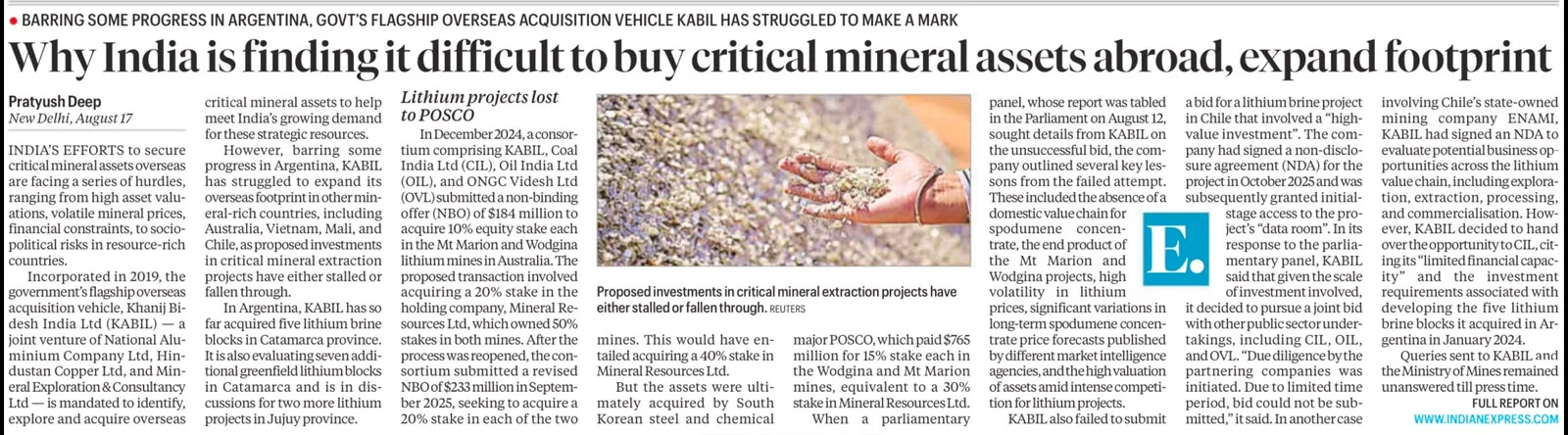
Critical mineral assets abroad

Vaishya Tekri Stupa: Ujjain’s Mauryan Buddhist Heritage

Context: Vaishya Tekri stupa Ujjain
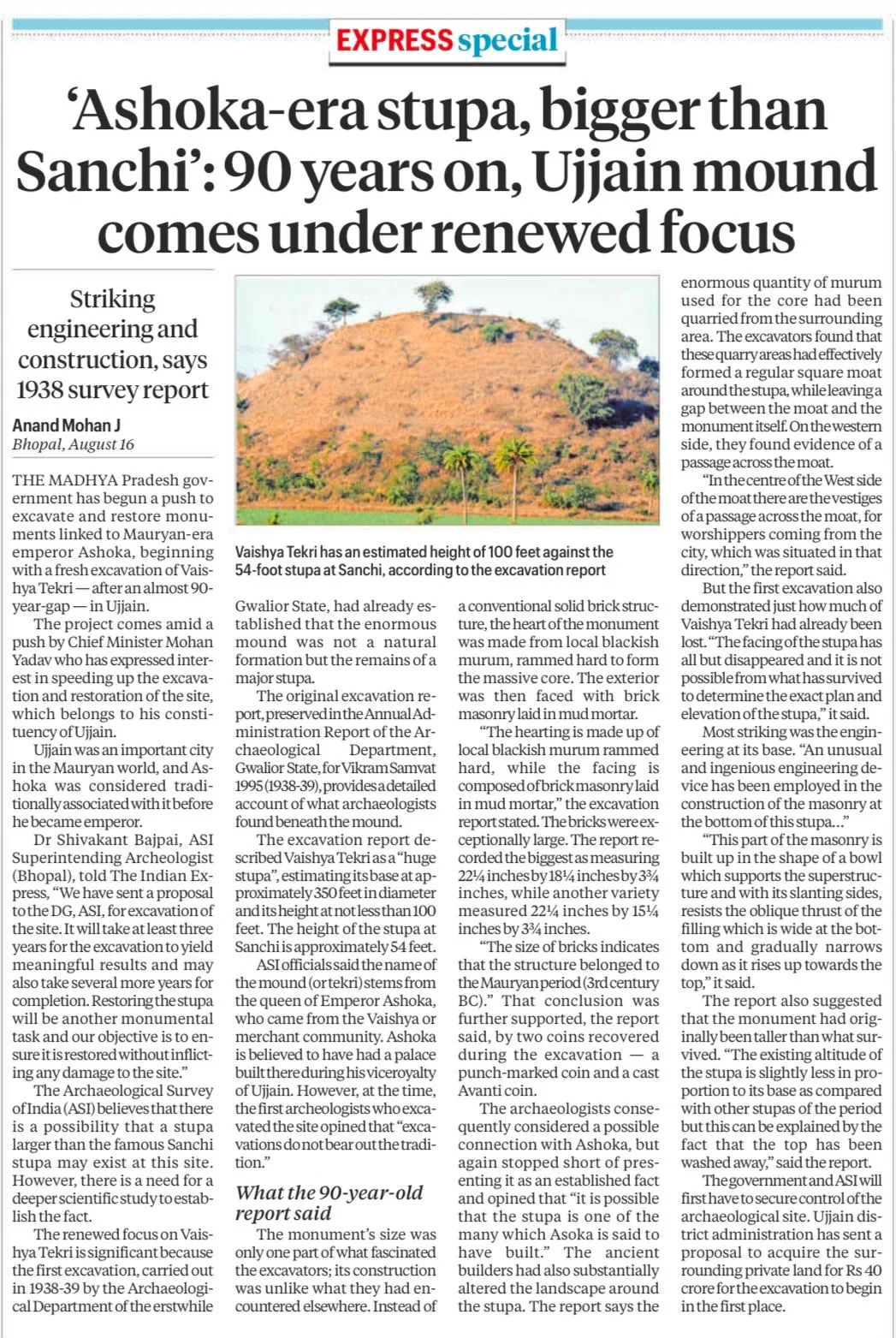
The Madhya Pradesh government and the Archaeological Survey of India are reviving excavation at Vaishya Tekri in Ujjain, where a 1938–39 excavation identified a massive Mauryan-period stupa that may have been larger than Sanchi.

1. Vaishya Tekri: What the 1938–39 Excavation Revealed

Location:
Vaishya Tekri is located in Ujjain, Madhya Pradesh.

Ujjain was an important city in the Mauryan period and is traditionally associated with Ashoka’s early career.

Scale:
The old report estimated the stupa at around 350 ft diameter and at least 100 ft high.

This is compared with the approximately 54-ft height of Sanchi’s Great Stupa.

Dating:
Large bricks and two recovered coins supported its attribution to the Mauryan period, around the 3rd century BCE.

The coins included:

  • A punch-marked coin
  • A cast Avanti coin

Engineering:
The stupa’s core used rammed blackish murum.

It was faced with brick masonry.

A bowl-shaped foundation helped resist the outward thrust of the massive superstructure.

Landscape planning:
Excavation revealed a square moat created from quarrying material for the stupa.

There was also evidence of a western passage for worshippers coming from the city.

2. Why the Site Matters

Mauryan architecture:
The site provides evidence of large-scale construction techniques and engineering during the 3rd century BCE.

Buddhist heritage:
It adds to the understanding of the spread of Buddhist architecture and patronage in central India.

Archaeological value:
The mound has survived despite the loss of much of its original brick facing.

This makes systematic excavation important.

Heritage conservation:
The renewed excavation is expected to take at least three years to yield meaningful results, followed by restoration.

Surrounding private land also needs to be acquired.

The district administration has proposed ₹40 crore for this purpose.

Prelims Link

Which of the following statements on the Amaravati Stupa and its relief sculpture is/are correct?

  1. It was located in the lower Krishna valley.
  2. In India, it was next only to the Sanchi Stupa in size.
  3. The Amaravati school of sculpture made a lasting impact on later South Indian sculpture, and its products were carried to Sri Lanka and South-east Asia.

Options:

(a) 1 only
(b) 1 and 3 only
(c) 2 and 3 only
(d) 1, 2 and 3

Vaishya Tekri stupa Ujjain

AI Wildlife Misinformation: Threats to Conservation

Context: AI wildlife misinformation
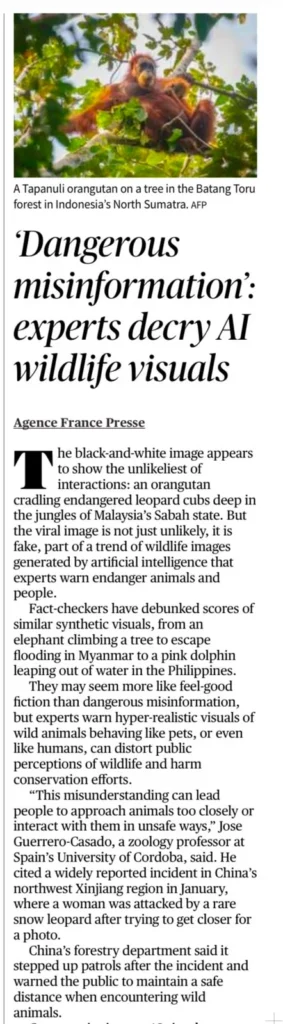
Hyper-realistic AI-generated wildlife images are blurring real and fake wildlife information, creating risks for conservation, scientific research and human–wildlife interaction.

1. Orangutan: Prelims Basics

Great ape:
Orangutans belong to the genus Pongo.

They are among the most intelligent primates and are known for:

  • Tool use
  • Problem-solving
  • Learning

Three species:

  • Bornean Orangutan — Pongo pygmaeus
  • Sumatran Orangutan — Pongo abelii
  • Tapanuli Orangutan — Pongo tapanuliensis

Tapanuli Orangutan:
It was recognised as a distinct species in 2017.

It is found only in Batang Toru, North Sumatra, Indonesia.

It is Critically Endangered and has fewer than 800 individuals.

PYQ Link:
Orangutans can use a stick to extract insects from holes in trees or logs.

2. AI Wildlife Visuals: Why They Are Dangerous

False behaviour:
AI images showing wild animals as pets, humans or unusually friendly distort understanding of natural behaviour.

Human–wildlife conflict:
Such imagery can encourage people to approach or interact with wild animals, creating danger for both people and animals.

Exploitation:
“Cute” portrayals may increase demand for wildlife as:

  • Pets
  • Tourism props
  • Social-media content

Research integrity:
Fake images can contaminate citizen-science and ecological datasets.

This can affect:

  • Species identification
  • Estimates of abundance
  • Estimates of distribution

Trust deficit:
Repeated exposure to fake content can make people doubt even genuine and extraordinary wildlife photographs.

3. Evidence and Broader Concern

A Conservation Biology study identified the rapid spread of AI misinformation and its potential harm to environmental efforts as a major societal threat.

Researchers also warn that AI-generated content can cause species misidentification and flawed ecological research.

The core concern is that AI can affect not only what people see, but also how they behave towards wildlife and how scientists understand ecosystems.

Prelims Link

Which one of the following makes a tool with a stick to scrape insects from a hole in a tree or a log of wood?

(a) Fishing cat
(b) Orangutan
(c) Otter
(d) Sloth bear

AI wildlife misinformation

Mines and Minerals Bill 2026 in India: Centre–State Tussle

Context: Mines and Minerals Bill 2026
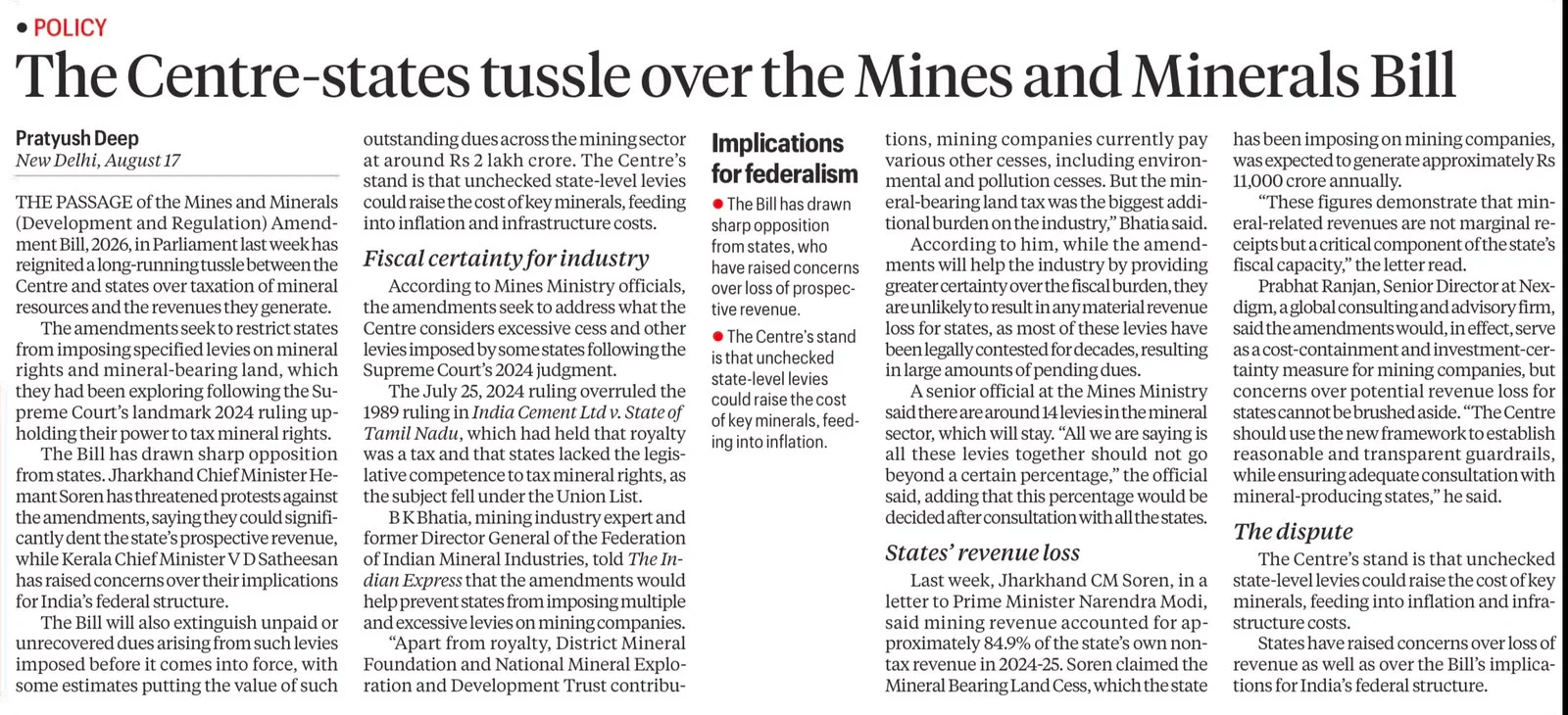
The Mines and Minerals (Development and Regulation) Amendment Bill, 2026 seeks to restrict specified State levies on mineral rights, following the Supreme Court’s 2024 ruling affirming States’ power to tax mineral rights.

1. Mines and Minerals (Development and Regulation) Act, 1957

The Mines and Minerals (Development and Regulation) Act, 1957 is the principal Central law governing the development and regulation of mines and minerals.

Entry 54, Union List:
Parliament can regulate mines and mineral development in the public interest.

Entry 23, State List:
States have a role in mines and mineral development, subject to Union control.

States administer mining leases and receive mineral-related revenues, including royalty under Section 9.

2. Mineral Area Development Authority v. Steel Authority of India Ltd. — Supreme Court, 2024

Royalty is not tax:
Royalty under the MMDR Act is not a tax.

State taxing power:
States can tax mineral rights under Entry 50, State List.

Parliamentary power:
Entry 50 allows Parliament to impose limitations on State taxation of mineral rights through a law relating to mineral development.

Core implication:
The judgment recognised State taxing power while simultaneously recognising Parliament’s constitutional power to limit it.

3. What Has Parliament Changed in 2026?

Restriction on State levies:
The amendment restricts specified taxes, cesses and other levies on mineral rights and mineral-bearing land, bringing them within a more uniform framework.

Past dues:
It provides for dealing with certain unpaid or unrecovered dues arising from such State-level levies.

Investment certainty:
By reducing multiple and unpredictable charges, the Centre seeks to make mining projects more financially predictable and investment-friendly.

National mineral market:
A uniform framework is intended to prevent different State levies from creating different mineral costs across India.

Strategic rationale:
Lower and predictable mineral costs are important for:

  • Manufacturing
  • Infrastructure
  • Energy transition
  • Critical-mineral security

4. Why Are States Concerned?

Fiscal autonomy:
States argue that taxation of mineral rights is a constitutionally recognised State power under Entry 50.

Revenue:
Mineral-rich States could lose an important source of potential own-source revenue.

Local externalities:
Mining States bear the costs of:

  • Displacement
  • Environmental degradation
  • Rehabilitation
  • Infrastructure pressure

Federal balance:
Extensive restrictions on State taxation may increase centralisation and weaken fiscal federalism.

5. Way Forward

Cooperative federalism:
Institutionalise Centre–State consultation before determining limits on State mineral levies.

Predictability with autonomy:
Create a uniform and investment-friendly regime while retaining a reasonable State fiscal role.

Benefit-sharing:
Ensure mineral-producing States and affected communities receive adequate benefits from resource extraction.

Strengthen District Mineral Foundation:
Use mining revenues effectively for local development and rehabilitation.

Balance:
National mineral security + investment certainty + State fiscal autonomy.

Editorial to Mains Answer Initiative — Day 9

GS2 / GS3 — 15 Marks — 250 Words

“The recent changes in the Mines and Minerals (Development and Regulation) framework have reignited the debate over Centre–State relations.” Discuss the key issues relating to State fiscal autonomy, national mineral security and investment certainty, and suggest a way forward based on cooperative federalism.

“खनिज एवं खनिज (विकास एवं विनियमन) व्यवस्था में हालिया बदलावों ने केंद्र–राज्य संबंधों पर बहस को फिर से तेज कर दिया है।” राज्य की राजकोषीय स्वायत्तता, राष्ट्रीय खनिज सुरक्षा और निवेश सुनिश्चितता से जुड़े प्रमुख मुद्दों की चर्चा करते हुए सहकारी संघवाद पर आधारित आगे की राह सुझाइए।

Mines and Minerals Bill 2026

MQ-9B SeaGuardian Navy: India Navy’s Maritime Surveillance

Context: MQ-9B SeaGuardian Navy
India has signed a ₹1,943-crore contract with General Atomics, USA, to lease two MQ-9B SeaGuardian HALE RPAS for 30 months, strengthening the Indian Navy’s Maritime Domain Awareness in the Indian Ocean Region.

1. What is MQ-9B SeaGuardian?

It is a High-Altitude Long-Endurance remotely piloted unmanned aircraft designed primarily for persistent maritime surveillance.

It provides long-duration Intelligence, Surveillance and Reconnaissance over vast ocean areas.

It is equipped with advanced maritime sensors, radar and electro-optical/infrared systems.

2. Key Capabilities

Persistent surveillance:
Monitors large maritime areas for prolonged periods.

Maritime ISR:
Tracks vessels and suspicious maritime activity.

Anti-Submarine Warfare:
Can support submarine detection using specialised sensors and sonobuoys.

Long-range coverage:
Enhances surveillance beyond the reach of conventional short-endurance platforms.

3. Why It Matters for India

It strengthens Maritime Domain Awareness across the Indian Ocean.

It helps monitor Sea Lines of Communication and maritime traffic.

It complements manned platforms such as the P-8I.

It provides additional surveillance capacity on India’s eastern and western maritime fronts.

It is useful against emerging sub-surface and maritime security threats.

4. India’s MQ-9B Programme

India signed a 2024 deal worth about $3.5 billion for 31 MQ-9B HALE RPAS for the armed forces.

The Navy currently operates two MQ-9A systems on lease.

The new lease will raise its HALE RPAS inventory to four during the transition.

A global Maintenance, Repair and Overhaul facility is planned in India, with some components to be sourced domestically.

Prelims Link

Which of the following items of defence hardware is/are manufactured in India?

  1. Su-30 MKI Fighter Jets
  2. T-90 MK-III Tanks
  3. Akula Class Submarine

Options:

(a) 1 and 2
(b) 1 and 3
(c) 1 only
(d) 2 only

MQ-9B SeaGuardian Navy

Criminal Cases Against MPs and MLAs in India: Pendency

Context: Criminal Cases Against MPs and MLAs
The Supreme Court is monitoring the long-pending criminal cases involving sitting and former MPs and MLAs. Despite special courts and repeated judicial directions, delays persist at both the investigation and trial stages, raising concerns over timely justice and institutional accountability.

1. Scale of Pendency — Key Data

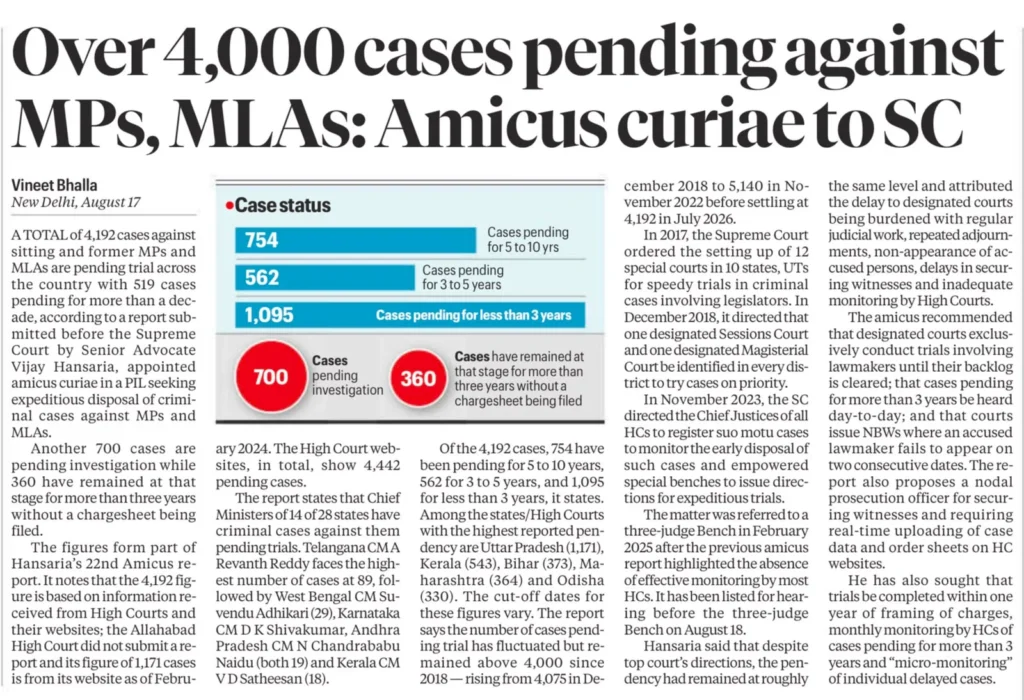
4,192 cases are pending against sitting and former MPs/MLAs across India.

519 cases have been pending for more than 10 years.

754 cases have been pending for 5–10 years.

562 cases have been pending for 3–5 years.

700 cases remain under investigation.

In 360 cases, no chargesheet has been filed even after more than 3 years.

Pendency trend:

  • 2018 — 4,075
  • 2022 — 5,140
  • 2026 — 4,192

This shows persistence despite judicial intervention.

Highest pendency:

  • Uttar Pradesh — 1,171
  • Bihar — 543
  • Maharashtra — 364
  • Odisha — 330

2. What the Data Reveals — Investigation to Trial Bottlenecks

The problem is not limited to court delays.

Prolonged investigation and delayed filing of chargesheets are major bottlenecks.

519 cases pending for over a decade indicate that criminal proceedings can extend across multiple electoral cycles.

360 cases without chargesheets for over three years point to weaknesses in:

  • Investigation
  • Prosecution
  • Case management

14 of 28 States have Chief Ministers facing pending criminal cases, highlighting the wider relevance of timely adjudication of cases involving political representatives.

A pending case does not establish guilt.

The concern is ensuring a timely determination of guilt or innocence.

3. Supreme Court Intervention

2017:
Directed establishment of 12 special courts across 10 States/UTs for speedy trials involving legislators.

2018:
Directed designated courts in every district to prioritise such cases.

2023:
High Courts directed to suo motu monitor cases involving legislators.

2025:
Matter referred to a 3-judge Bench amid concerns over inadequate implementation and monitoring.

4. Way Forward — From Judicial Directions to Implementation

Time-bound investigation:
Prevent cases from remaining at the investigation stage indefinitely.

Priority trials:
Cases pending for more than 3 years should receive focused, day-to-day hearings wherever feasible.

Judicial capacity:
Strengthen designated courts with adequate judges, prosecutors and court infrastructure.

Digital monitoring:
Real-time uploading of case status and orders can enable High Court-level supervision and transparency.

Micro-monitoring:
Track individual long-pending cases rather than relying only on aggregate pendency figures.

Criminal Cases Against MPs and MLAs

Copyright © 2026 USARAMBHA EDUCATION (UnderStand UPSC). All Rights Reserved.

Inquiry form for
Takshila Residential Program