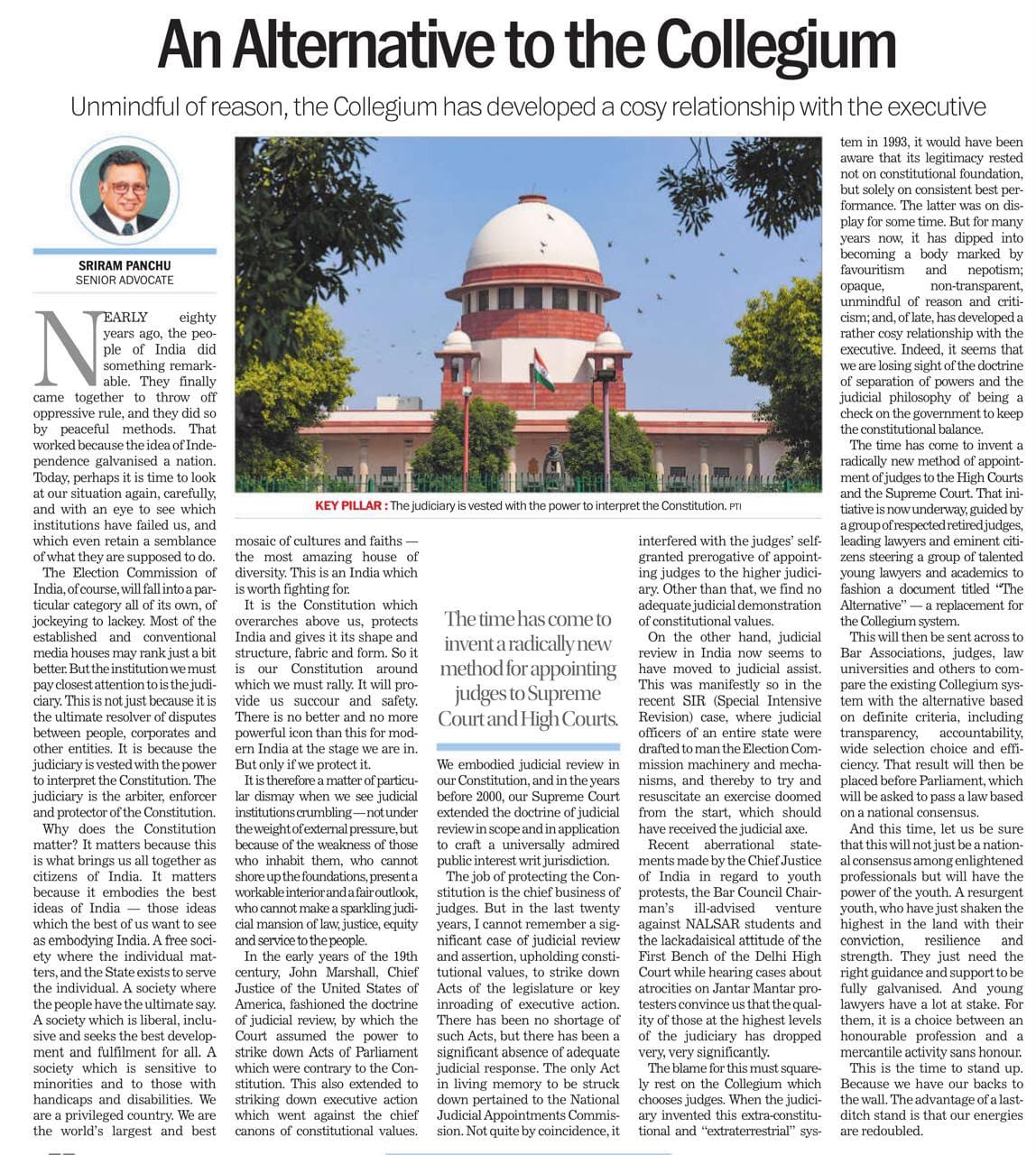
Context: Collegium reform in judicial appointments
The debate over judicial appointments is about how to preserve judicial independence while ensuring transparency, merit and accountability in the selection of judges.
Constitutional Basis — Article 124
Article 124(2) provides that Supreme Court judges are formally appointed by the President after consultation with constitutionally specified judges.
The Collegium system is not directly mentioned in the Constitution.
Judicial primacy in appointments emerged through the Second Judges Case and Third Judges Case.
Evolution of the Collegium
First Judges Case, 1981:
Executive primacy.
Second Judges Case, 1993:
Judicial primacy emerged and the Collegium system evolved.
Third Judges Case, 1998:
The composition and functioning of the Collegium were clarified.
NJAC Case, 2015:
The National Judicial Appointments Commission was struck down.
The Collegium was restored to protect judicial independence and the basic structure.
Why the Collegium is Criticised
Opacity:
The basis for choosing one candidate over another is not always sufficiently explained.
Justice Ujjal Bhuyan in 2026 called for greater transparency, noting that withholding reasons can harm deserving candidates.
Accountability deficit:
Since judges themselves recommend judges, there is limited independent scrutiny of the selection process.
Vacancies and delays:
As of March 2026, 312 of 1,122 sanctioned High Court posts were vacant.
132 appointment proposals were being processed.
Recommendations for 180 vacancies were still awaited from High Court Collegiums.
Diversity concerns:
There is no reservation in higher judicial appointments.
As of February 2026, only 1 of 33 working Supreme Court judges was a woman.
High Courts had 116 women judges out of 814.
Narrow talent networks:
A largely internal process can make it difficult to systematically identify strong candidates from the wider Bar and legal academia.
What Should the Alternative Look Like?
The alternative should retain judicial independence while making appointments more transparent, professional and accountable.
Independent search mechanism:
A professional secretariat should identify, screen and assess candidates beyond existing judicial networks.
Objective criteria:
Selection should be based on:
- Legal competence
- Integrity
- Experience
- Judicial temperament
- Constitutional values
Wider consultation:
Structured inputs from the judiciary, Bar and legal academia can broaden the talent pool.
Reasoned recommendations:
The broad basis for selection should be recorded, while protecting confidential personal information.
Balanced participation:
Neither the Executive nor the judiciary should have unchecked control over appointments.
Supporting Reforms
Time-bound process:
Adopt a fixed vacancy calendar and begin recommendations well before vacancies arise.
Diversity with merit:
The pool should be widened to include qualified women, regions and under-represented professional backgrounds.
Only 130 women were appointed to High Courts between 2018 and February 2026.
Digital transparency:
Build on the Supreme Court’s practice of publishing Collegium resolutions by progressively disclosing selection criteria and broad reasons.
Conflict-of-interest safeguards:
Require disclosure and recusal where selectors have significant personal or professional links with candidates.
Editorial to Mains Answer | Day 11
10 Marker | 150 Words
What are the main problems with the Collegium system of judicial appointments in India? Suggest suitable reforms.
भारत में न्यायाधीशों की नियुक्ति की कॉलेजियम प्रणाली की प्रमुख समस्याएँ क्या हैं? उपयुक्त सुधार सुझाइए।
Key Takeaway
Judicial appointments need independence from executive capture, but also greater transparency, diversity, accountability and professional evaluation.