MAD-X Webinar on 14th Nov | Limited Seats! Book Now
US
UnderStand UPSC Daily Current Affairs Practice
0.00Score / 14
0 / 7MCQs Attempted
0%Accuracy
8, 9 & 10 November 2026 • UPSC CSE

Read the news. Test the concept. Write the Mains answer.

This interactive edition converts each current-affairs item into one Prelims-level MCQ, one Mains-level question, and a compact value-addition section for revision.

+2 correct −0.66 incorrect Explanation after attempt Image/PDF answer upload
NEWS 1 GS2 • International Relations Source: The Hindu

U.S. Strikes Iran's Qeshm Island in the Strait of Hormuz

Context: U.S. strikes on Iran's Qeshm Island have highlighted the island's strategic importance, as it lies close to the Strait of Hormuz, one of the world's most critical maritime and energy chokepoints.
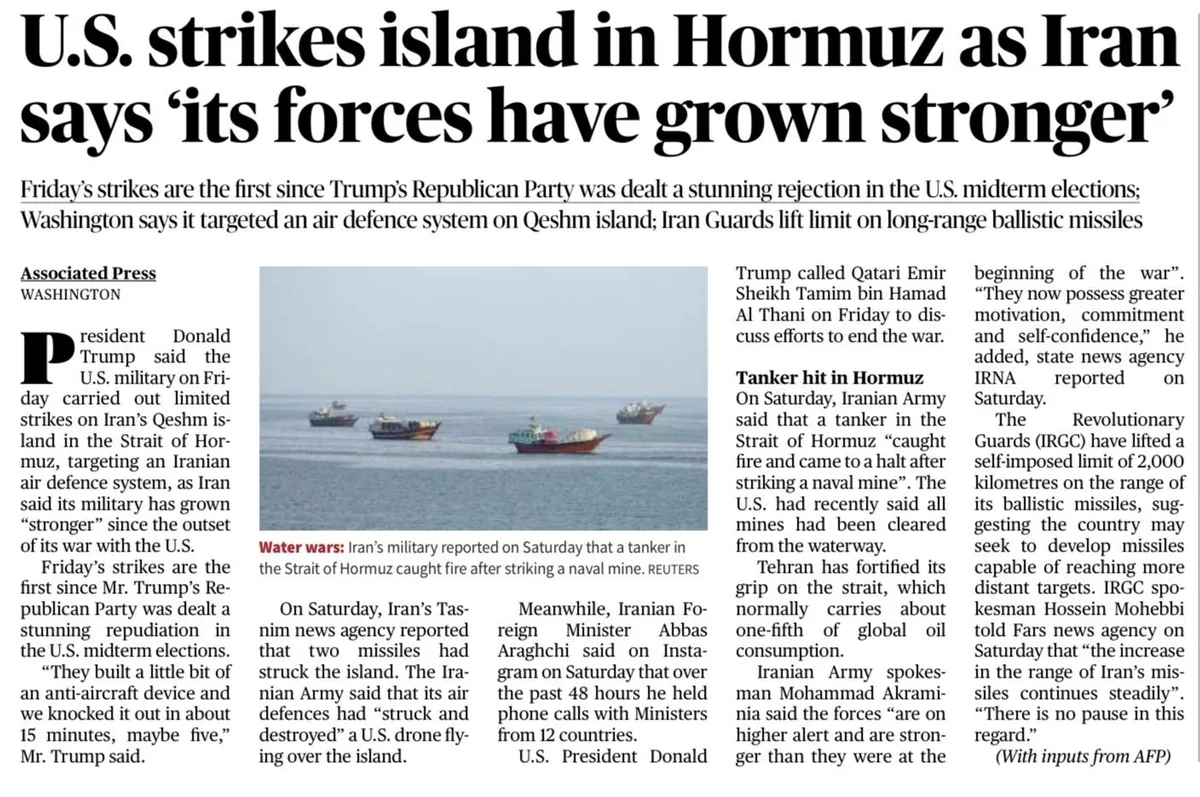
U.S. strikes island in Hormuz as Iran says its forces have grown stronger – Qeshm Island (The Hindu)
U.S. strikes on Qeshm Island near the Strait of Hormuz. Source: The Hindu
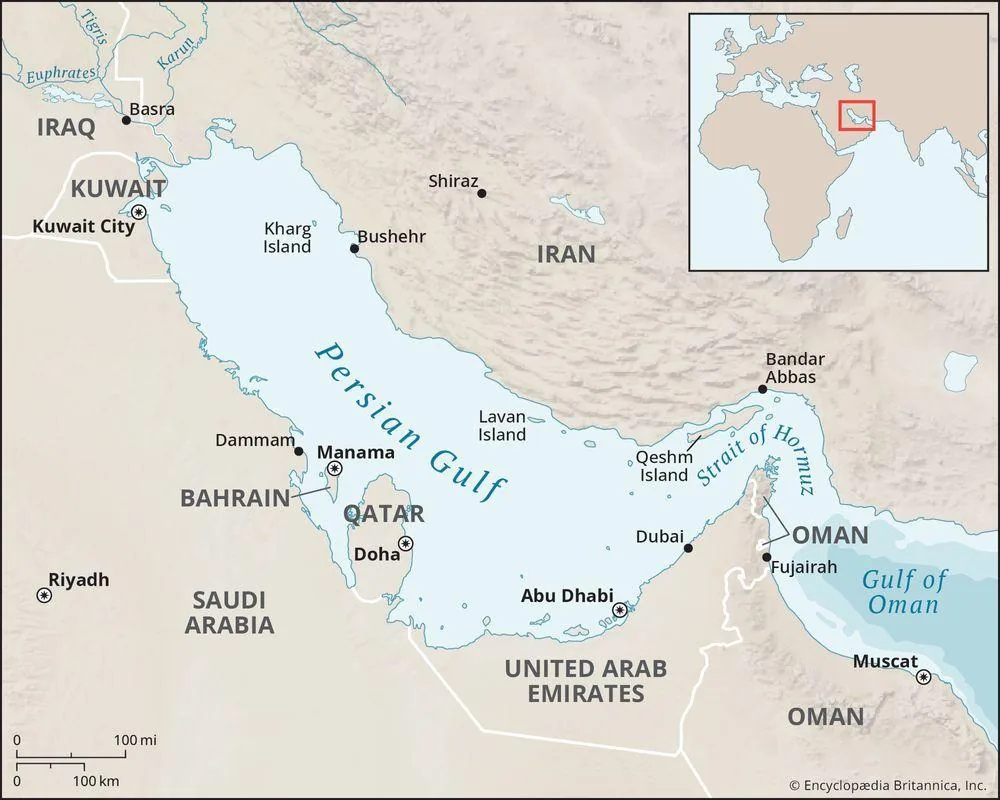
Map of the Persian Gulf, Strait of Hormuz, Qeshm Island and Bandar Abbas
Qeshm Island and the Strait of Hormuz between Iran and Oman's Musandam Peninsula. Map: Encyclopaedia Britannica

Geographical Location

Location
Iran's largest island, in the Persian Gulf off Iran's southern coast (Hormozgan Province).
Neighbourhood
Near Bandar Abbas, Iran's major port; opposite Oman's Musandam Peninsula.
Strait of Hormuz
Connects the Persian Gulf with the Gulf of Oman and the Arabian Sea.
Energy route
Carries roughly one-fifth of global oil consumption.

Strategic Importance for Iran

Military
Supports coastal defence, maritime surveillance and reported missile facilities.
Geopolitical leverage
Proximity to shipping lanes gives Iran influence over Hormuz traffic.
Energy security
Close to major oil and gas shipping routes.
Economy
The Qeshm Free Trade Zone, ports and industry support trade and connectivity.

Why It Matters for India

Oil imports
A large share of India's crude oil and LPG imports passes through Hormuz.
Diaspora
Millions of Indians live and work in the Gulf region.
Connectivity
Tensions affect India's interests in Chabahar port and INSTC.
Key Takeaway: Qeshm is small on the map but big in strategy: whoever can influence the Strait of Hormuz can influence global oil prices — and India's energy bill.

Prelims Practice MCQ

+2 correct • −0.66 wrong

The Strait of Hormuz connects which of the following water bodies?

Explanation: The Strait of Hormuz lies between Iran and Oman's Musandam Peninsula and connects the Persian Gulf with the Gulf of Oman, which opens into the Arabian Sea. Bab-el-Mandeb connects the Red Sea and the Gulf of Aden.

UPSC Mains Question

15 Marks • 250 Words

Maritime chokepoints like the Strait of Hormuz are critical to India's energy security. Discuss the implications of instability in the Persian Gulf for India and suggest measures to reduce the risks.

Attempt before opening the value-addition tab.
Accepted: JPG, JPEG, PNG, WEBP or PDF. The standalone file previews your answer locally; connect the API hook for real server submission.
Use after attempting the Mains answer
  • Chokepoints — Hormuz, Bab-el-Mandeb, Malacca, Suez Canal; Map: Qeshm, Bandar Abbas, Musandam.
  • India's response — Strategic Petroleum Reserves (Visakhapatnam, Mangaluru, Padur); diversified crude sourcing.
  • Navy — Operation Sankalp (2019) to escort Indian-flagged ships in the Gulf.
  • Connectivity — Chabahar port, INSTC; IMEC as an alternative corridor.
  • Keywords — energy security, freedom of navigation, maritime chokepoint.
NEWS 2 GS3 • Defence & Security Source: The Hindu

History at 13,600 Feet: IL-76 Gajraj Lands at Nyoma Airbase

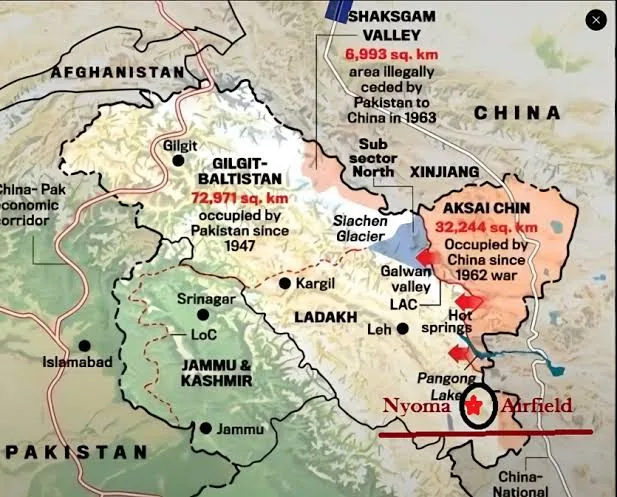
Context: The Indian Air Force's IL-76MD Gajraj landed at the Mudh-Nyoma airbase in eastern Ladakh at 13,629 feet, showing India's improved strategic airlift and logistics capability near the China border.

History at 13,600 feet: Heavy-lift aircraft lands at Nyoma airbase (The Hindu)
IL-76MD Gajraj at Mudh-Nyoma airbase, eastern Ladakh. Source: The Hindu
Map of eastern Ladakh showing Nyoma airfield near the LAC, Leh, Kargil and Aksai Chin
Nyoma lies close to the Line of Actual Control in eastern Ladakh.

Nyoma Airbase: Location & Importance

Location
Eastern Ladakh at 13,629 feet, about 25 km from the Line of Actual Control (LAC).
Infrastructure
Built by the Border Roads Organisation; 2.7-km runway at about ₹218 crore.
Border security
Faster deployment of troops, heavy equipment and supplies along the China border.
Context
Work sped up after the 2020 India–China standoff in eastern Ladakh.
Network
Complements airbases at Leh, Thoise and Kargil.

IL-76MD Gajraj: Basic Features

Origin
Russian-origin, four-engine strategic military transport aircraft.
Payload
About 40–45 tonnes of cargo, depending on configuration.
Role
Carries troops, tanks, BMP infantry combat vehicles and heavy equipment.
Fleet
India acquired 17 IL-76 aircraft between 1985 and 1989.
Replacement
IAF's Medium Transport Aircraft programme to replace IL-76 and AN-32.
Key Takeaway: Airfields at high altitude turn days of road movement into hours of airlift — a key edge in a two-front border environment.

Prelims Practice MCQ

+2 correct • −0.66 wrong

With reference to the Nyoma (Mudh-Nyoma) airbase, consider the following statements:
1. It is located in eastern Ladakh close to the Line of Actual Control.
2. It has been developed by the Border Roads Organisation.
3. It is located at an altitude of more than 13,000 feet.
Which of the statements given above are correct?

Explanation: Nyoma is in eastern Ladakh, about 25 km from the LAC, at around 13,629 feet. Its new 2.7-km runway has been built by the Border Roads Organisation. All three statements are correct.

UPSC Mains Question

10 Marks • 150 Words

Border infrastructure is as important as military capability for national security. Discuss with reference to recent developments in eastern Ladakh.

Attempt before opening the value-addition tab.
Accepted: JPG, JPEG, PNG, WEBP or PDF. The standalone file previews your answer locally; connect the API hook for real server submission.
Use after attempting the Mains answer
  • Advanced Landing Grounds (ALGs) — Nyoma, Daulat Beg Oldi (DBO, ~16,600 ft), Fukche.
  • Projects — Vibrant Villages Programme, BRO roads and tunnels (Sela, Shinku La), DS-DBO road.
  • Airlift fleet — C-17 Globemaster III, C-130J, IL-76, AN-32; MTA programme.
  • Galwan clash (June 2020) — trigger for faster LAC infrastructure.
  • Keywords — dual-use infrastructure, rapid deployment, deterrence.
NEWS 3 GS3 • Indian Economy Source: The Hindu

A Decade of Demonetisation: Cash Use Steady, Counterfeit Notes Rising

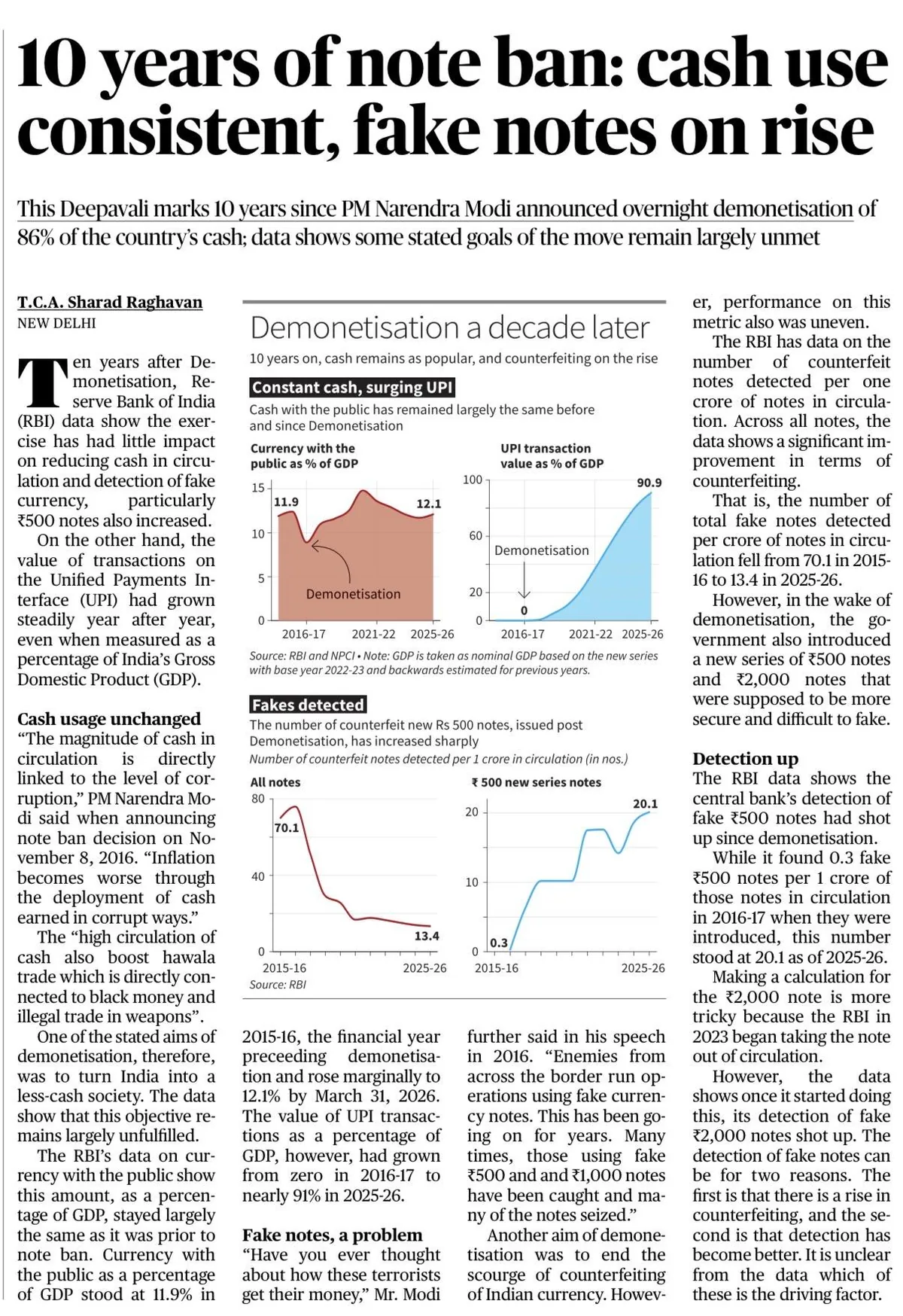
Context: Ten years after demonetisation, RBI data show that cash held by the public as a share of GDP is broadly unchanged despite the rapid growth of digital payments, while counterfeiting of new-series ₹500 notes is rising.

10 years of note ban: cash use consistent, fake notes on rise – RBI data on demonetisation (The Hindu)
Cash-to-GDP, UPI growth and counterfeit-note trends a decade after demonetisation. Source: The Hindu

Demonetisation 2016: The Basics

Meaning
Withdrawal of legal tender status of a currency denomination.
Announced
8 November 2016; ₹500 and ₹1,000 notes withdrawn.
Scale
About 86% of the currency in circulation by value.
New notes
New ₹500 and ₹2,000 notes introduced.
Legal basis
Section 26(2), RBI Act, 1934.
Objectives
Curb black money, fake currency and terror funding; push digital payments and formalisation.

RBI Data: Ten Years Later

Cash with public
11.9% of GDP (2015–16) → 12.1% (2025–26).
UPI
From almost zero (2016–17) to about 90.9% of GDP in transaction value (2025–26).
All fake notes
70.1 per crore notes (2015–16) → 13.4 (2025–26).
New ₹500 fakes
0.3 per crore notes (2016–17) → 20.1 (2025–26).
Overall
Digital payments grew, but cash remains important.

Implications

Disruption
Cash shortage hit farmers, small businesses and daily-wage workers.
Formalisation
More bank deposits and traceable transactions.
Black money
Also held in real estate, gold, benami assets and offshore — needs structural reform.
Inclusion gaps
Digital divide, connectivity, literacy and cyber fraud.
Security
Fake currency feeds organised crime and terror financing.

Way Forward

Black money
Stronger tax administration, anti-benami and anti-money-laundering action.
Currency security
Better security features and detection; RBI–bank–agency coordination.
Digital inclusion
Affordable connectivity, financial literacy and cybersecurity.
Policy
Big monetary moves need preparedness and impact assessment.
Key Takeaway: Demonetisation changed how India pays, not how much cash it holds. Black money and fake notes need lasting institutional fixes, not one-time shocks.

Prelims Practice MCQ

+2 correct • −0.66 wrong

Under which of the following provisions did the Government of India withdraw the legal tender character of ₹500 and ₹1,000 banknotes in November 2016?

Explanation: Section 26(2) of the RBI Act, 1934 allows the Central Government, on the recommendation of the RBI Central Board, to declare that a series of banknotes of any denomination shall cease to be legal tender.

UPSC Mains Question

15 Marks • 250 Words

Ten years after demonetisation, cash remains central to India's economy even as digital payments have grown rapidly. Critically evaluate the outcomes of demonetisation against its stated objectives.

Attempt before opening the value-addition tab.
Accepted: JPG, JPEG, PNG, WEBP or PDF. The standalone file previews your answer locally; connect the API hook for real server submission.
Use after attempting the Mains answer
  • Mains PYQs (GS3) — 2013 (money laundering & economic sovereignty); 2021 (technology, globalisation & money laundering); 2023 (sources of terror funding).
  • Data — RBI Annual Report 2025–26 (Currency Management; Payment and Settlement Systems); NPCI data.
  • Related — Jan Dhan–Aadhaar–Mobile (JAM), UPI, PMLA 2002, Benami Transactions (Prohibition) Amendment Act 2016.
  • ₹2,000 notes — withdrawn from circulation in 2023 (remain legal tender).
  • Keywords — cash-to-GDP ratio, formalisation, currency integrity.
NEWS 4 GS2 • Governance & Accountability Source: The Hindu

Enforcement Directorate Is Not a 'Super Cop': Karnataka High Court

Context: The Karnataka High Court held that the Enforcement Directorate (ED) cannot assume investigative powers beyond those given to it by the Prevention of Money Laundering Act (PMLA), underlining the balance between effective investigation and the rule of law.

ED not a 'super cop', can't file private complaint: Karnataka High Court on PMLA powers (The Hindu)
ED's power under PMLA is derivative, not original. Source: The Hindu

Enforcement Directorate: Basics

Set up
1956 as the Enforcement Unit; renamed ED in 1957.
Works under
Department of Revenue, Ministry of Finance.
Nature
Executive investigative agency — not a constitutional body or a body created by its own Act.
Laws enforced
PMLA 2002, FEMA 1999 and the Fugitive Economic Offenders Act 2018.
Powers
Search, seizure, provisional attachment, arrest under PMLA and prosecution.

The Ruling: Y.B. Ashwathanarayan v. Union of India (2026)

Private complaint
ED cannot file a private complaint under Sec. 200 CrPC (now Sec. 223 BNSS) for a separate scheduled offence.
Section 66(2), PMLA
ED must share information with the competent agency — not take over its investigation.
Limits
ED's powers are derivative, not original; they stay within the statute.
Principles
Upholds federalism, separation of powers and checks and balances.

Key Concerns about ED

Liberty
Wide powers of arrest and attachment need procedural safeguards.
Due process
Grounds of arrest, access to case documents, long detention.
Neutrality
Allegations of selective investigation hurt public trust.
Federalism
Friction between central and State agencies.
Delays
Slow trials undermine the presumption of innocence.

Important Supreme Court Judgments

Vijay Madanlal Choudhary (2022)
Upheld key PMLA provisions; ECIR is not an FIR and need not be routinely supplied.
Pankaj Bansal (2023)
Written grounds of arrest must be given under Section 19, PMLA.
Manish Sisodia (2024)
Long incarceration and trial delay engage Article 21; bail cannot be denied only because the offence is serious.

Way Forward

Safeguards
Transparent arrests, recorded reasons and effective legal remedies.
Oversight
Independent review and public reporting of outcomes.
Coordination
Cooperation with State police while respecting jurisdiction.
Speed
Stronger Special Courts; time-bound investigation and trial.
Key Takeaway: A strong agency is useful only when it stays within its law. Powers that are 'derivative, not original' must not become a shortcut around other agencies or the courts.

Prelims Practice MCQ

+2 correct • −0.66 wrong

UPSC CSE Prelims 2025: With reference to the Government of India, consider the following information:
I. Directorate of Enforcement — Enforcement of the Fugitive Economic Offenders Act, 2018 — Internal Security Division-I, Ministry of Home Affairs
II. Directorate of Revenue Intelligence — Enforces provisions of the Customs Act, 1962 — Department of Revenue, Ministry of Finance
III. Directorate General of Systems and Data Management — Big data analytics to assist tax officers in policy-making and identifying tax evaders — Department of Revenue, Ministry of Finance
In how many of the above rows is the information correctly matched?

Explanation: Row I is wrong: the ED works under the Department of Revenue, Ministry of Finance, not the Ministry of Home Affairs. Rows II and III are correctly matched.

UPSC Mains Question

15 Marks • 250 Words

"Effective investigation and individual liberty are not opposites." In the light of recent judicial observations on the Enforcement Directorate, discuss the need for safeguards in the use of powers under the Prevention of Money Laundering Act.

Attempt before opening the value-addition tab.
Accepted: JPG, JPEG, PNG, WEBP or PDF. The standalone file previews your answer locally; connect the API hook for real server submission.
Use after attempting the Mains answer
  • Mains PYQs (GS3) — 2013, 2018 (drug trafficking & money laundering), 2021, 2023 (terror funding; 'No Money for Terror' conference, Nov 2022).
  • PMLA — Sec. 3 (offence), Sec. 5 (attachment), Sec. 19 (arrest), Sec. 45 (twin bail conditions), Sec. 66(2) (sharing information).
  • Global — FATF; India's mutual evaluation (2024) placed it in 'regular follow-up'.
  • Other agencies — CBI (DSPE Act 1946, needs State consent), NIA (NIA Act 2008), DRI, SFIO.
  • Keywords — derivative power, due process, cooperative federalism.
NEWS 5 GS3 • Environment Source: The Hindu

Delhi Air Pollution: PM2.5 Nearly 200 Times the WHO Guideline After Deepawali

Context: After Deepawali, some Delhi monitoring stations recorded extreme PM2.5 levels, while missing data from several stations during peak hours raised concerns about air-quality monitoring and transparency.

Air pollution spikes 200 times above WHO limits in Delhi during Deepavali (The Hindu)
Data missing from several monitoring stations at peak pollution hours. Source: The Hindu

WHO Air Quality Guidelines (2021)

PM2.5
Annual 5 µg/m³ | 24-hour 15 µg/m³.
PM10
Annual 15 µg/m³ | 24-hour 45 µg/m³.
PM2.5 health
Tiny particles go deep into the lungs and can enter the bloodstream.
Status
Health-based recommendations, not legally binding national standards.

How Bad Was It?

Peak PM2.5
2,597 µg/m³ at Patparganj and 3,008.4 µg/m³ at NSUT West Campus — about 173 and 201 times the WHO 24-hour limit.
AQI
Delhi's overall AQI was 370 (Very Poor), easing to 344 later in the day.
Sources
Firecrackers, vehicles, construction dust, industry and crop-residue burning.
Weather
Low wind and falling temperatures trapped pollutants.
Data gaps
Missing station data at peak hours raised transparency concerns.

Way Forward

Regional action
Joint action across Delhi-NCR, Punjab and Haryana.
Agriculture
Crop-residue machinery and alternatives to stubble burning.
Urban
Cut vehicle and industrial emissions; better public transport.
Monitoring
Continuous, transparent and independently verifiable data.
Health
Alerts and protection for vulnerable groups.
Key Takeaway: Clean air needs trustworthy data first. If monitors go silent at the worst hours, policy is flying blind exactly when it matters most.

Prelims Practice MCQ

+2 correct • −0.66 wrong

UPSC CSE Prelims 2022: In the context of WHO Air Quality Guidelines, consider the following statements:
1. The 24-hour mean of PM2.5 should not exceed 15 µg/m³ and the annual mean of PM2.5 should not exceed 5 µg/m³.
2. In a year, the highest levels of ozone pollution occur during the periods of inclement weather.
3. PM10 can penetrate the lung barrier and enter the bloodstream.
4. Excessive ozone in the air can trigger asthma.
Which of the statements given above are correct?

Explanation: Statements 1 and 4 are correct. Ozone peaks in sunny, hot weather, not inclement weather (2 is wrong). It is PM2.5, not PM10, that can cross the lung barrier into the bloodstream (3 is wrong).

UPSC Mains Question

15 Marks • 250 Words

UPSC CSE Mains 2021 (GS3): Describe the key points of the revised Global Air Quality Guidelines (AQGs) recently released by the World Health Organisation (WHO). How are these different from its last update in 2005? What changes in India's National Clean Air Programme are required to achieve these revised standards?

Attempt before opening the value-addition tab.
Accepted: JPG, JPEG, PNG, WEBP or PDF. The standalone file previews your answer locally; connect the API hook for real server submission.
Use after attempting the Mains answer
  • India's NAAQS (CPCB, 2009) — PM2.5: 40 annual, 60 (24-hr); PM10: 60 annual, 100 (24-hr) µg/m³.
  • WHO 2005 vs 2021 — PM2.5 annual 10 → 5; PM10 annual 20 → 15 µg/m³.
  • Institutions — CAQM (2021), GRAP, NCAP (2019), SAFAR, CPCB's CAAQMS stations.
  • Courts — M.C. Mehta cases; SC firecracker orders (green crackers).
  • Keywords — airshed, data transparency, PM2.5 exposure, public health emergency.
NEWS 6 GS2 • Tribal Rights | GS3 • Forest Conservation Source: The Hindu

Commercial Cultivation in Forest Areas Not Protected Under FRA: Supreme Court

Context: The Supreme Court made it clear that commercial crop cultivation in reserved forests cannot automatically claim protection under the Forest Rights Act (FRA), 2006, in a case about silk-cotton cultivation in Tamil Nadu.

Commercial farming in forest land is not protected by FRA: Supreme Court (The Hindu)
The Bench of Justices Vikram Nath and Sandeep Mehta, order of 6 November 2026. Source: The Hindu

Forest Rights Act (FRA), 2006

Objective
Recognise the historical rights of forest-dwelling communities and protect traditional livelihoods.
Beneficiaries
Forest-Dwelling Scheduled Tribes and Other Traditional Forest Dwellers (OTFDs).
OTFD condition
Residence and dependence for three generations (75 years) before 13 December 2005.
Individual rights
Forest land for habitation and self-cultivation for livelihood.
Community rights
Grazing, fishing, water bodies, community forest resources.
Minor Forest Produce
Ownership of non-timber produce like bamboo, tendu leaves, honey.
Process (Sec. 6)
Gram Sabha → Sub-Divisional Committee → District Level Committee.

The Ruling: A. John Kennedy v. State of Tamil Nadu

Bench & date
Justices Vikram Nath and Sandeep Mehta; order of 6 November 2026.
Background
Extensive silk-cotton cultivation in reserve forests of the Agasthyamalai landscape, Tamil Nadu.
Key point
Commercial cultivation is not automatically a forest right under FRA.
MFP
Questioned treating commercially grown silk cotton as Minor Forest Produce.
Next step
Central Empowered Committee (CEC) to examine the State's claim.

Significance & Way Forward

Conservation
Checks the conversion of natural forests into plantations.
Tribal rights
Protects genuine customary rights, separate from commercial interests.
Gram Sabha
Stronger role in community forest management.
Balance
Tribal welfare with biodiversity and ecological restoration.
Key Takeaway: FRA protects a way of life, not a business model. Separating customary use from commercial plantations protects both forests and genuine forest dwellers.

Prelims Practice MCQ

+2 correct • −0.66 wrong

UPSC CSE Prelims 2019: Consider the following statements:
1. As per recent amendment to the Indian Forest Act, 1927, forest dwellers have the right to fell the bamboos grown on forest areas.
2. As per the Scheduled Tribes and Other Traditional Forest Dwellers (Recognition of Forest Rights) Act, 2006, bamboo is a minor forest produce.
3. The Scheduled Tribes and Other Traditional Forest Dwellers (Recognition of Forest Rights) Act, 2006 allows ownership of minor forest produce to forest dwellers.
Which of the statements given above is/are correct?

Explanation: Under FRA, bamboo is a minor forest produce and forest dwellers get ownership of MFP. The 2017 amendment to the Indian Forest Act removed bamboo grown in non-forest areas from the definition of 'tree'; it did not give a right to fell bamboo in forest areas.

UPSC Mains Question

15 Marks • 250 Words

The Forest Rights Act, 2006 seeks to undo a 'historical injustice' to forest dwellers. Discuss the challenges in its implementation and how a balance can be struck between forest rights and conservation.

Attempt before opening the value-addition tab.
Accepted: JPG, JPEG, PNG, WEBP or PDF. The standalone file previews your answer locally; connect the API hook for real server submission.
Use after attempting the Mains answer
  • Nodal ministry — Ministry of Tribal Affairs (FRA); MoEFCC (Forest Conservation).
  • Cases — Orissa Mining Corporation v. MoEF (2013, Niyamgiri — Gram Sabha consent); Wildlife First v. MoEF (rejected claims).
  • Related laws — PESA 1996, Indian Forest Act 1927, Van (Sanrakshan Evam Samvardhan) Adhiniyam 1980 (amended 2023).
  • Schemes — PM Van Dhan Yojana, MSP for MFP (TRIFED).
  • Keywords — historical injustice, Community Forest Resource (CFR) rights, Gram Sabha.
NEWS 7 GS4 • Ethics Source: The Hindu

Ethics Example: Nvidia — Organisational Ethics and National Security

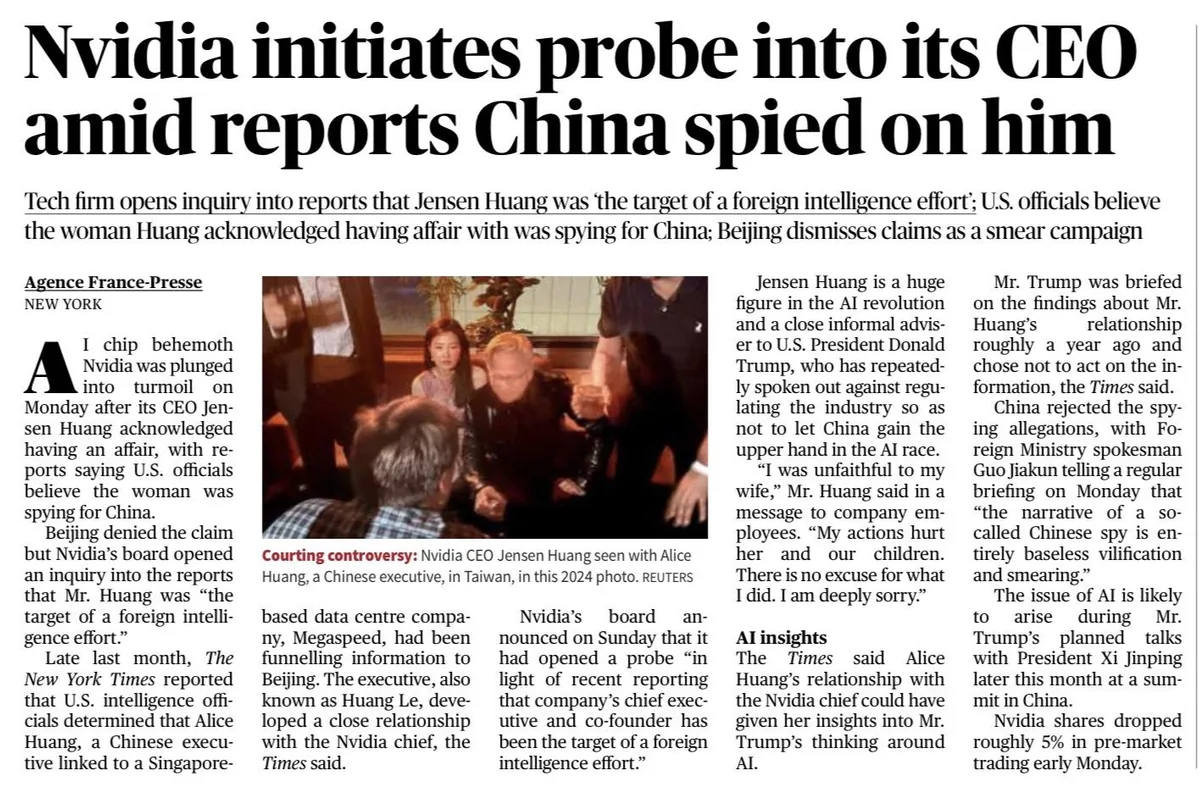
Context: Nvidia began an internal inquiry after reports that its CEO, Jensen Huang, may have been targeted in an alleged Chinese intelligence operation — a useful case for the meeting point of corporate ethics and national security.

Nvidia initiates probe into its CEO amid reports China spied on him (The Hindu)
Tech firm opens inquiry into reports that Jensen Huang was the target of a foreign intelligence effort. Source: The Hindu

Organisational Ethics (Company Perspective)

Corporate governance
Protect institutional interests and stakeholder trust.
Confidentiality
Safeguard intellectual property and sensitive information.
Accountability
Responsible leadership and transparent investigation — even of the CEO.
Professional integrity
Personal vulnerabilities must not compromise organisational duties.

National Security (Country Perspective)

National interest
Protect strategic technologies from foreign espionage.
Tech sovereignty
Safeguard critical AI and semiconductor capabilities.
Economic security
Prevent unauthorised transfer of strategic knowledge.
Rule of law
Allegations handled through impartial inquiry and due process.

GS Paper IV Integration

The case shows integrity, probity, accountability, confidentiality and ethical leadership at work. Institutional loyalty and national interest must be protected — but only through ethical means, such as a fair internal inquiry rather than cover-up or witch-hunt.

Key Takeaway: No one is above scrutiny in an ethical organisation — not even the founder. An honest inquiry protects both the company's trust and the nation's security.

Prelims Practice MCQ

+2 correct • −0.66 wrong

A company starts an impartial internal inquiry when its own chief executive may have been the target of a foreign intelligence operation. Which ethical principle does this action best reflect?

Explanation: Investigating the top leader in the same way as any employee shows accountability — no one in the organisation is above scrutiny. It also protects stakeholder trust and confidentiality.

UPSC Mains Question

10 Marks • 150 Words

"Corporate leaders today handle information that is vital to national security." Discuss the ethical responsibilities of business leaders in protecting strategic technologies, with reference to integrity, confidentiality and accountability.

Attempt before opening the value-addition tab.
Accepted: JPG, JPEG, PNG, WEBP or PDF. The standalone file previews your answer locally; connect the API hook for real server submission.
Use after attempting the Mains answer
  • Ethics terms — probity, integrity, conflict of interest, fiduciary duty, whistle-blowing.
  • Thinkers — Kautilya (security of the state and its economy); Gandhi's trusteeship for business.
  • Laws (India) — Official Secrets Act 1923, DPDP Act 2023, Companies Act 2013 (CSR, independent directors).
  • Case-study use — conflict between personal relationships and professional duty.
  • Keywords — technological sovereignty, insider threat, ethical leadership.

Copyright © 2026 USARAMBHA EDUCATION (UnderStand UPSC). All Rights Reserved.

Antim Pag 6.0 – UPSC Interview Guidance Program 2026 by UnderStand UPSC