New Batch Starts 30 Nov: UPSC GS Foundation 2028/29 Enroll Now
US
UnderStand UPSC Daily Current Affairs Practice
0.00Score / 14
0 / 6MCQs Attempted
0%Accuracy
26 November 2026 • UPSC CSE

Read the news. Test the concept. Write the Mains answer.

This interactive edition converts each current-affairs item into one Prelims-level MCQ, one Mains-level question, and a compact value-addition section for revision.

+2 correct −0.66 incorrect Explanation after attempt Image/PDF answer upload
NEWS 1 GS2 • India–US Relations | GS3 • International Trade and WTO Source: The Hindu

US Unveils 25% Tariff on India for ‘Harmful Trade’ under Section 301

Context: Following its Section 301 investigation, the US has announced a 25% tariff on Indian goods, alleging that India’s trade policies contribute to structural excess capacity and unfair competition. India has rejected the charge.
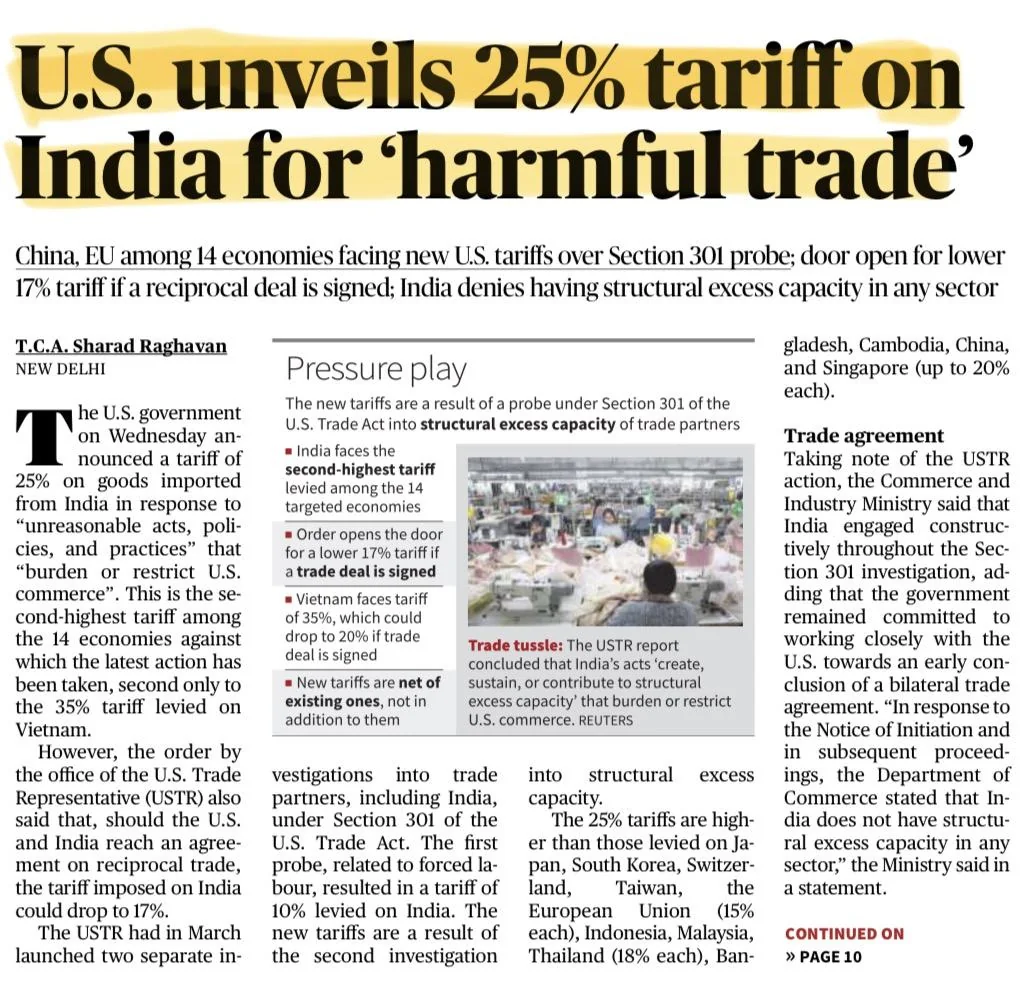
US unveils 25% tariff on India for ‘harmful trade’ – China, EU among 14 economies facing new Section 301 tariffs (The Hindu)
US unveils 25% tariff on India for ‘harmful trade’. Source: The Hindu
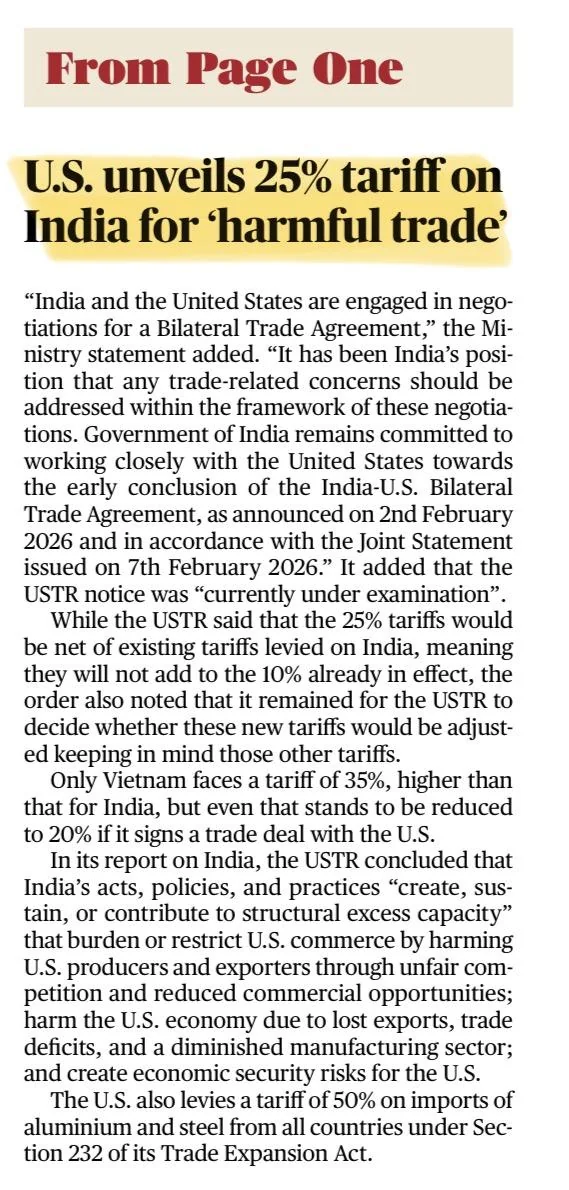
US tariff on India could fall to 17% if a bilateral trade agreement is signed (The Hindu)
Tariff may fall to 17% if a trade deal is signed. Source: The Hindu

Key Developments

Tariff on India
25% – the second-highest among the 14 targeted economies; Vietnam faces the highest at 35%.
How it applies
Stated to be net of existing tariffs, not an automatic addition to the current 10%.
Deal discount
May fall to 17% if India and the US conclude a trade agreement.
Steel & aluminium
Separately, a 50% tariff applies to all countries under Section 232 of the Trade Expansion Act.

Section 301: Basis of US Action

Legal basis
Section 301 of the US Trade Act, 1974, administered by the USTR.
Purpose
Investigates foreign practices considered unfair or harmful to US commerce.
US allegation
India’s policies create or sustain structural excess capacity, hurting US producers and exporters.
Other concerns cited
Lost exports, trade deficits, a weakened manufacturing base and economic-security risks.

India’s Response

Rejection
India says it has no structural excess capacity in any sector.
Engagement
The Commerce Ministry says it engaged constructively throughout the probe.
Preferred route
Concerns to be settled through the India–US Bilateral Trade Agreement talks, already underway.

Implications for India

Exports
Higher tariffs reduce the price competitiveness of Indian goods in the US.
Manufacturing
Export-oriented industries face uncertainty in production and investment plans.
Bilateral ties
Tariff pressure may complicate trade negotiations.
Global trade
Unilateral measures intensify protectionism and disrupt supply chains.

Way Forward

Trade deal
Expedite a mutually beneficial BTA.
Diversification
Reduce dependence on any single market through new export destinations.
Competitiveness
Improve productivity, quality and logistics.
Dispute settlement
Use bilateral dialogue and, where suitable, multilateral mechanisms.
Key Takeaway: Tariffs are increasingly used as tools of economic and geopolitical pressure; India must protect its exporters while keeping its strategic partnership with the US and its commitment to rules-based trade.

Prelims Practice MCQ

+2 correct • −0.66 wrong

Consider the following statements:
1. Section 301 of the US Trade Act, 1974 is administered by the United States Trade Representative (USTR).
2. Section 232 of the US Trade Expansion Act allows tariffs on imports considered a threat to national security.
3. Under WTO rules, the Most-Favoured-Nation principle allows a member to impose higher tariffs on one member without justification.
Which of the statements given above are correct?

Explanation: Section 301 is administered by the USTR, and Section 232 permits tariffs on national-security grounds (used for steel and aluminium). The MFN principle requires equal treatment of all WTO members, so statement 3 is wrong.

UPSC Mains Question

GS2/GS3 • 15 Marks • 250 Words

The growing use of tariffs as instruments of geopolitical pressure challenges the rules-based multilateral trading system. Discuss in the context of recent US tariffs on India and suggest a strategy for India.

Attempt before opening the value-addition tab.
Accepted: JPG, JPEG, PNG, WEBP or PDF. The standalone file previews your answer locally; connect the API hook for real server submission.
Use after attempting the Mains answer
  • Laws — Section 301 (Trade Act, 1974), Section 232 (Trade Expansion Act, 1962).
  • Concepts — structural excess capacity, MFN, tariff stacking, trade diversion, ‘friend-shoring’.
  • Institutions — USTR, WTO Dispute Settlement Body (Appellate Body non-functional since 2019).
  • India’s tools — BTA negotiations, PLI schemes, FTAs with UK/EFTA/UAE/Australia, export diversification.
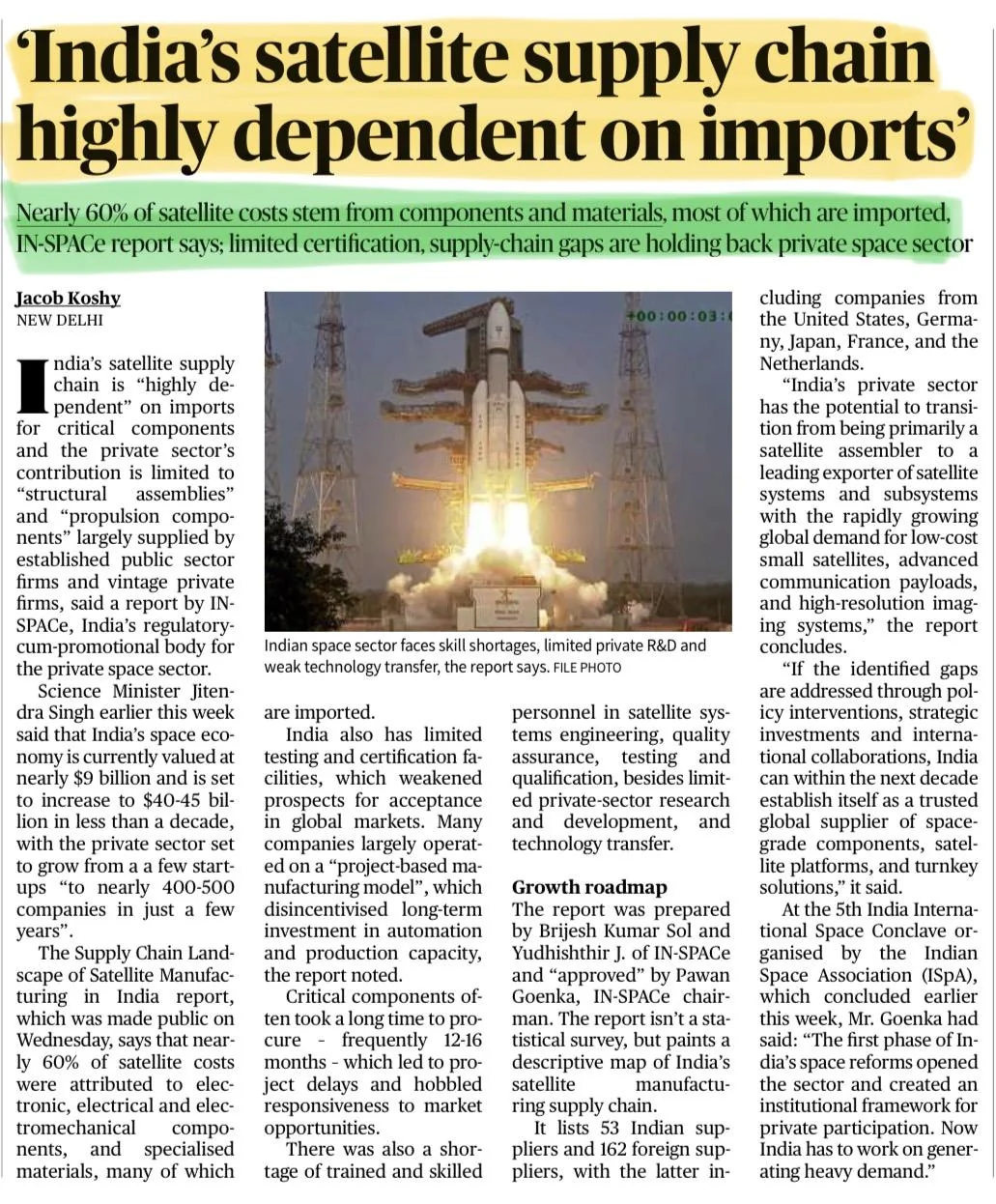
NEWS 2 GS3 • Space Technology and Industrial Development Source: The Hindu

India’s Satellite Supply Chain Highly Dependent on Imports: IN-SPACe Report

Context: An IN-SPACe report highlights India’s heavy dependence on imported satellite components and materials, identifying supply-chain gaps that hold back the domestic private space industry.

India’s satellite supply chain highly dependent on imports – IN-SPACe report (The Hindu)
India’s satellite supply chain highly dependent on imports. Source: The Hindu

Key Findings of the Report

Cost share
Nearly 60% of satellite costs come from electronic, electrical, electromechanical parts and specialised materials – mostly imported.
Private role
Concentrated in structural assemblies and propulsion components.
Suppliers mapped
53 Indian and 162 foreign suppliers (US, Germany, Japan, France, Netherlands).
Space economy
About $9 billion today; projected at $40–45 billion in under a decade.
Private firms
Grown from a few start-ups to 400–500 companies.

Major Challenges

Import dependence
Little domestic manufacturing of critical, high-value components.
Testing & certification
Inadequate facilities limit global acceptance of Indian components.
Project-based orders
Short-term contracts discourage investment in automation and capacity.
Long procurement
Critical parts take 12–16 months to procure.
Skills & R&D
Shortage of experts in systems engineering and quality assurance; weak technology transfer.

Opportunities and Way Forward

Assembler → supplier
Become a global supplier of satellite systems and subsystems.
Demand
Rising need for low-cost small satellites, communication payloads and high-resolution imaging.
Indigenisation
Build domestic capacity in space-grade components and materials.
Infrastructure
Set up advanced testing, certification and qualification facilities.
Stable demand
Long-term procurement commitments to encourage investment.
Key Takeaway: Space reforms have opened the sector to private players, but real self-reliance needs the shift from assembly-led growth to indigenous manufacturing of high-value components.

Prelims Practice MCQ

+2 correct • −0.66 wrong

With reference to the Indian National Space Promotion and Authorization Centre (IN-SPACe), consider the following statements:
1. It is a single-window autonomous agency under the Department of Space.
2. It authorises and promotes space activities of non-governmental entities.
3. It is the commercial arm of ISRO that markets ISRO’s satellites and launch services.
Which of the statements given above are correct?

Explanation: IN-SPACe (2020) is an autonomous single-window agency under the Department of Space that authorises and promotes private space activities. ISRO’s commercial arms are NewSpace India Limited (NSIL) and Antrix – not IN-SPACe.

UPSC Mains Question

GS3 • 15 Marks • 250 Words

India’s private space sector has grown rapidly, but the supply chain remains import-dependent. Examine the challenges and suggest measures to make India a global supplier of space hardware.

Attempt before opening the value-addition tab.
Accepted: JPG, JPEG, PNG, WEBP or PDF. The standalone file previews your answer locally; connect the API hook for real server submission.
Use after attempting the Mains answer
  • Policy — Indian Space Policy 2023, 100% FDI liberalisation in space (2024), ₹1,000 crore space VC fund.
  • Institutions — IN-SPACe (regulator/promoter), NSIL (commercial arm), ISRO (R&D).
  • Concepts — space-grade components, qualification testing, turnkey satellite solutions.
  • Keywords — Atmanirbhar Bharat in space, supply-chain resilience, ‘assembler to supplier’.
NEWS 3 GS2 • India’s Neighbourhood | GS3 • Space Technology Source: The Hindu

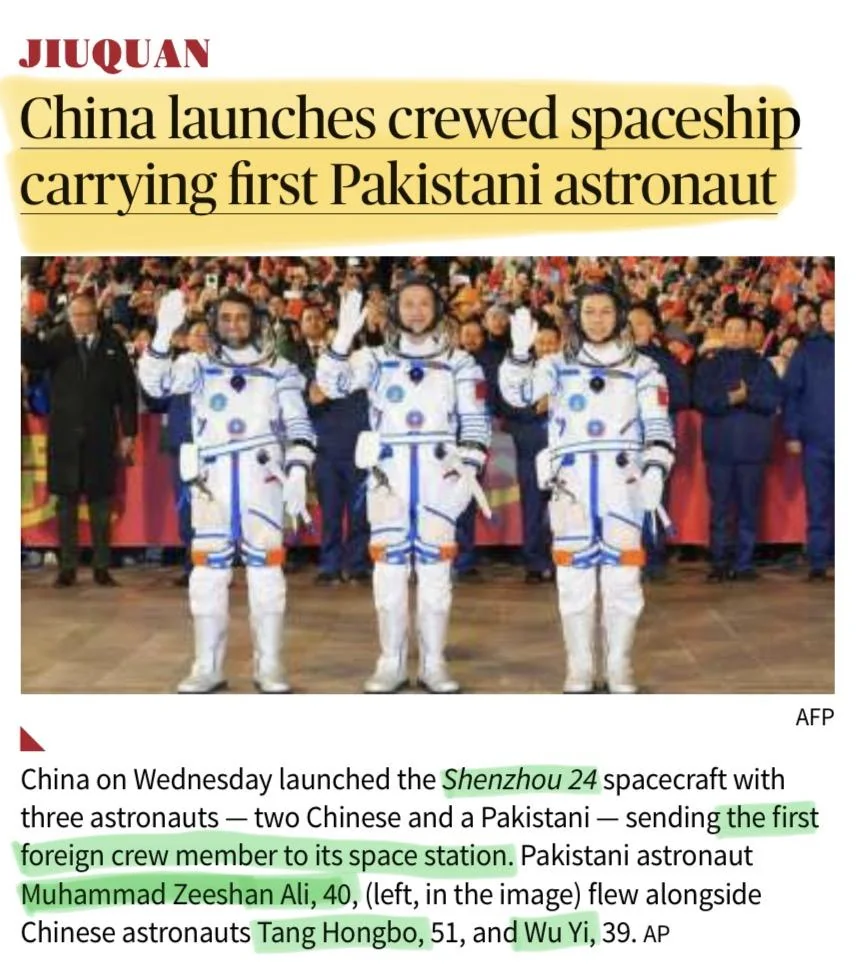
China Launches Crewed Spacecraft Carrying First Pakistani Astronaut

Context: China’s Shenzhou-24 mission has carried the first Pakistani astronaut to its Tiangong space station, underlining China–Pakistan cooperation in human spaceflight.

China launches crewed spaceship carrying first Pakistani astronaut – Shenzhou-24 (The Hindu/AFP)
China launches crewed spaceship carrying first Pakistani astronaut. Source: The Hindu

Shenzhou-24 Mission

Launch site
Jiuquan Satellite Launch Centre, China.
Crew
Muhammad Zeeshan Ali (Pakistan) with Tang Hongbo and Wu Yi (China).
Significance
First foreign crew member to visit China’s space station.

Tiangong Space Station

Meaning
“Heavenly Palace”.
Orbit
Low Earth Orbit (LEO).
Purpose
Scientific research, microgravity experiments and long-duration spaceflight.
Nature
Built and run by China alone; separate from the ISS.

India’s Human Spaceflight Programme

Gaganyaan
ISRO mission to send three astronauts to about 400 km LEO for up to three days and return them safely.
Uncrewed flights
First uncrewed mission targeted for Q4 2026 with the half-humanoid robot Vyommitra; two more uncrewed flights to follow.
First crewed flight
Targeted by 2027, subject to successful earlier missions.
Bharatiya Antariksh Station
First module BAS-01 by 2028; five modules, fully operational by 2035.

Comparison of Space Stations

ISS
Multinational partnership • Operational since 2000 • LEO.
Tiangong
Chinese • Operational since 2022 • LEO.
Bharatiya Antariksh Station
Indian (ISRO) • Under development • Planned in LEO • Full station by 2035.
Key Takeaway: Space is becoming a domain of strategic partnerships; China–Pakistan cooperation in human spaceflight raises the stakes for India to deliver Gaganyaan and the Bharatiya Antariksh Station on time.

Prelims Practice MCQ

+2 correct • −0.66 wrong

With reference to space stations, consider the following statements:
1. China’s Tiangong space station is a part of the International Space Station (ISS) partnership.
2. Both the ISS and Tiangong operate in Low Earth Orbit.
3. India plans to launch the first module of the Bharatiya Antariksh Station by 2028.
Which of the statements given above are correct?

Explanation: Tiangong is independently built and operated by China and is not part of the ISS. Both stations are in Low Earth Orbit, and BAS-01 is targeted for 2028.

UPSC Mains Question

GS2/GS3 • 15 Marks • 250 Words

Human spaceflight is emerging as a tool of strategic influence. In the light of China–Pakistan space cooperation, discuss the significance of the Gaganyaan mission and the Bharatiya Antariksh Station for India.

Attempt before opening the value-addition tab.
Accepted: JPG, JPEG, PNG, WEBP or PDF. The standalone file previews your answer locally; connect the API hook for real server submission.
Use after attempting the Mains answer
  • Missions — Gaganyaan (G1 uncrewed with Vyommitra), BAS-01, Chandrayaan-4, Space Vision 2047.
  • Facts — Indian astronaut Shubhanshu Shukla flew to the ISS on Axiom-4 (2025).
  • Concepts — LEO, microgravity research, crew escape system, space diplomacy.
  • Keywords — strategic signalling, China–Pakistan ‘all-weather’ partnership, space as a strategic domain.
NEWS 4 GS3 • Indian Economy and Foreign Exchange Management Source: The Indian Express

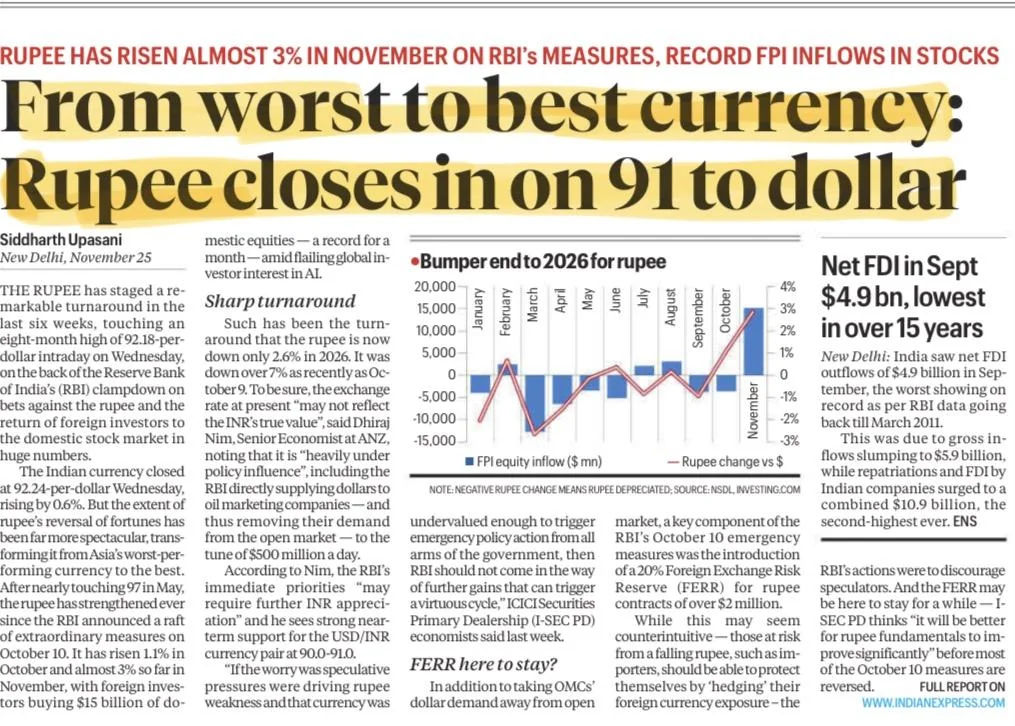
From Worst to Best Currency: Rupee Closes In on 91 to the Dollar

Context: The rupee has staged a sharp turnaround – from Asia’s worst-performing currency to its best – rising almost 3% in November on RBI’s measures against speculative bets and record foreign portfolio inflows into equities.

From worst to best currency: rupee closes in on 91 to the dollar – RBI measures and record FPI inflows (The Indian Express)
From worst to best currency: rupee closes in on 91 to the dollar. Source: The Indian Express

Recent Movement of the Rupee

Eight-month high
Touched ₹92.18 per dollar intraday; closed at ₹92.24 (up 0.6%).
Turnaround
After nearly touching ₹97 in May, it rose 1.1% in October and almost 3% in November.
Year so far
Now down only about 2.6% in 2026, against over 7% in early October.

Factors Behind the Recovery

RBI intervention
Supplies dollars directly to oil marketing companies, cutting their demand in the open market.
FPI inflows
About $15 billion of equity purchases in November – a record for a month.
Curbs on speculation
RBI’s measures since 10 October discouraged bets against the rupee.
FERR
A 20% Foreign Exchange Reserve Requirement on certain rupee-related contracts above $2 million.

FDI Trends: A Note of Caution

Net FDI
Outflow of $4.9 billion in September 2026 – the weakest in over 15 years.
Gross inflows
Fell to $5.9 billion.
Outflows
Repatriation and outward investment rose to $10.9 billion.

Effects of a Weaker Rupee

Imports & inflation
Costlier crude and electronics raise imported inflation.
External debt
Higher rupee cost of servicing foreign-currency debt.
Exports
May become more competitive, but gains depend on import content and global demand.
Students & travel
Foreign education and travel become more expensive.

Way Forward

Stable capital
Attract long-term FDI rather than relying on volatile portfolio flows.
Reserves
Maintain adequate forex reserves and use interventions judiciously.
Energy
Cut import dependence through diversification and domestic production.
Market fundamentals
Allow the exchange rate to reflect fundamentals while curbing excess volatility.
Key Takeaway: The rupee’s recovery rests largely on RBI action and hot-money inflows; weak FDI shows that lasting currency stability needs long-term investor confidence.

Prelims Practice MCQ

+2 correct • −0.66 wrong

UPSC Prelims PYQ 2019: Which one of the following is not the most likely measure the Government/RBI takes to stop the slide of the Indian rupee?

Explanation: An expansionary monetary policy lowers interest rates and increases money supply, which tends to push capital out and weaken the rupee further. The other three bring in or save foreign exchange.

UPSC Mains Question

GS3 • Mains PYQ 2018

UPSC Mains PYQ 2018: How would the recent phenomena of protectionism and currency manipulations in world trade affect macroeconomic stability of India?

Attempt before opening the value-addition tab.
Accepted: JPG, JPEG, PNG, WEBP or PDF. The standalone file previews your answer locally; connect the API hook for real server submission.
Use after attempting the Mains answer
  • Concepts — NEER vs REER, depreciation vs devaluation, imported inflation, hot money.
  • PYQs — Prelims 2022 (NEER/REER: 1 and 3 correct), Prelims 2021 (devaluation only ‘necessarily’ improves export competitiveness).
  • RBI tools — forex market intervention, FERR, swap windows, Masala Bonds, ECB norms.
  • Data — record $15 billion FPI equity inflow (Nov 2026); net FDI outflow of $4.9 billion (Sep 2026).
NEWS 5 GS3 • Environment and Biodiversity Conservation Source: The Indian Express

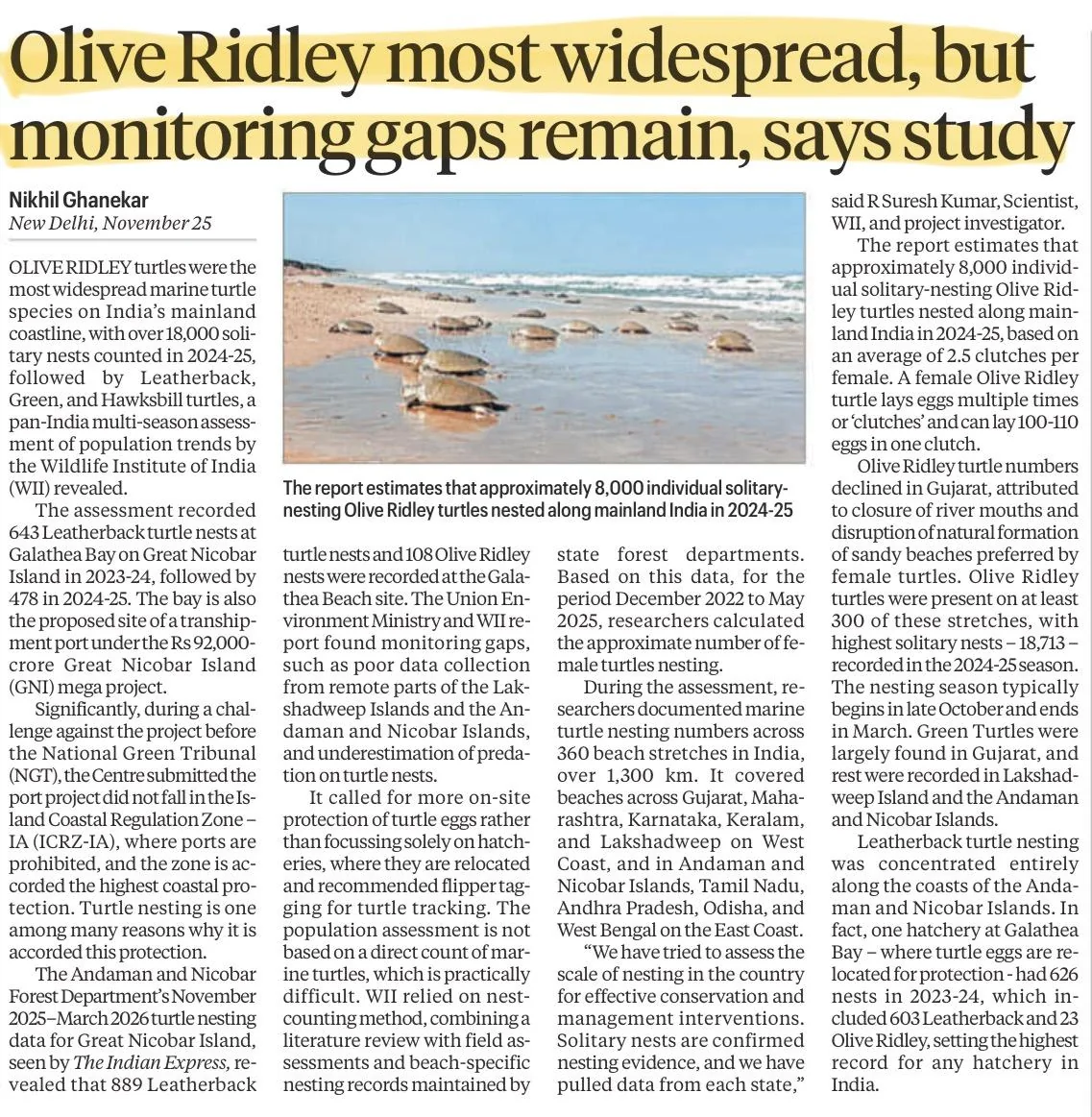
Olive Ridley Most Widespread Marine Turtle, but Monitoring Gaps Remain

Context: A pan-India assessment by the Wildlife Institute of India (WII) finds the Olive Ridley to be the most widespread marine turtle along India’s mainland coast, while flagging gaps in nest monitoring and conservation.

Olive Ridley most widespread, but monitoring gaps remain, says WII study (The Indian Express)
Olive Ridley most widespread, but monitoring gaps remain. Source: The Indian Express

Key Findings of the WII Assessment

Solitary nests
18,713 recorded in the 2024–25 nesting season along the mainland coast.
Nesting turtles
About 8,000 individual Olive Ridleys nested on the mainland.
Survey coverage
360 beach stretches across over 1,300 km of coastline.
Highest nests
Gujarat recorded the most solitary nests.

Olive Ridley: Important Facts

Scientific name
Lepidochelys olivacea.
IUCN status
Vulnerable; listed in Schedule I of the Wild Life (Protection) Act, 1972.
Arribada
Mass nesting where thousands of females nest on the same beach together.
Key sites (Odisha)
Gahirmatha, Rushikulya and the Devi river mouth.
Clutch
About 100–110 eggs; a female may nest more than once a season.

Conservation Challenges

Monitoring gaps
Poor data from remote coastal stretches.
Habitat loss
Beach erosion, river-mouth closure and coastal infrastructure such as ports.
Predation
Loss of eggs and nests is likely underestimated.
Fishing
Accidental capture in nets (bycatch); Turtle Excluder Devices are under-used.

Way Forward

Data
Systematic monitoring by State Forest Departments.
In-situ protection
Protect eggs on site rather than over-relying on hatcheries and relocation.
Tracking
Use flipper tagging to improve population estimates.
Coastal regulation
Shield nesting beaches under CRZ norms; promote sustainable fishing.
Key Takeaway: Olive Ridleys are widespread beyond Odisha’s famous arribada beaches, but solitary nesting sites need systematic monitoring and on-site protection.

Prelims Practice MCQ

+2 correct • −0.66 wrong

UPSC Prelims PYQ 2002: The sea coast of which one of the following States has become famous as a nesting place for the giant Olive Ridley turtles from South America?

Explanation: Odisha (formerly Orissa) hosts Gahirmatha, Rushikulya and the Devi river mouth – the major Olive Ridley mass-nesting (arribada) sites. Note: the new WII study found Gujarat has the most solitary nests.

UPSC Mains Question

GS3 • 10 Marks • 150 Words

India is home to one of the world’s largest Olive Ridley nesting populations, yet conservation efforts remain uneven. Examine the threats to marine turtles and suggest measures for their protection.

Attempt before opening the value-addition tab.
Accepted: JPG, JPEG, PNG, WEBP or PDF. The standalone file previews your answer locally; connect the API hook for real server submission.
Use after attempting the Mains answer
  • Species in India — Olive Ridley, Green, Hawksbill, Leatherback (Great Nicobar) and Loggerhead turtles.
  • Protection — Schedule I (WPA 1972), CMS & CITES Appendix I, Operation Olivia (Indian Coast Guard).
  • Concepts — arribada vs solitary nesting, Turtle Excluder Devices (TEDs), temperature-dependent sex determination.
  • PYQ link — Prelims 2002 (Olive Ridley nesting in Odisha).
NEWS 6 GS3 • Agriculture and Intellectual Property Rights Source: The Indian Express

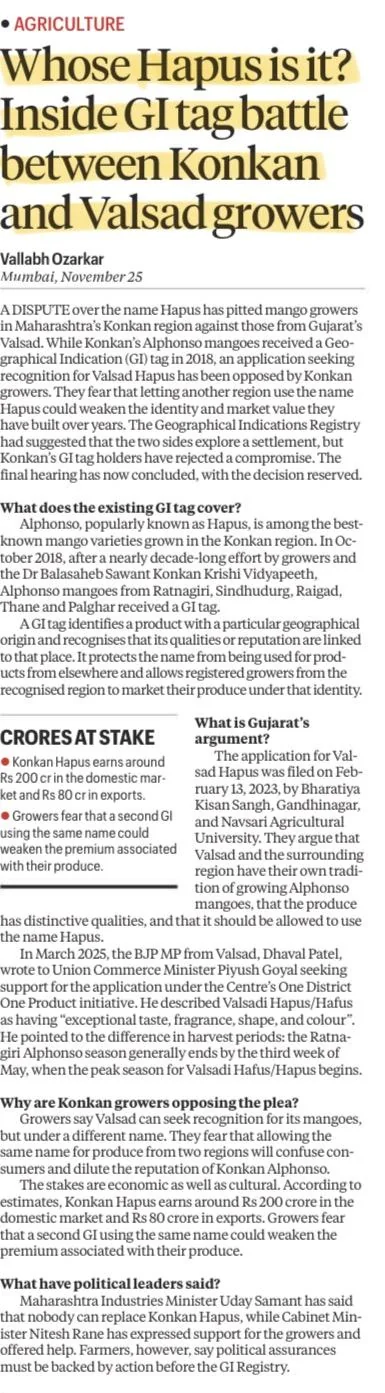
Whose Hapus Is It? GI Tag Dispute Between Konkan and Valsad Growers

Context: Mango growers of Maharashtra’s Konkan region and Gujarat’s Valsad are locked in a dispute over the use of the name ‘Hapus’ (Alphonso), bringing the protection of geographical identity into focus.

Whose Hapus is it? Inside GI tag battle between Konkan and Valsad growers (The Indian Express)
Whose Hapus is it? GI battle between Konkan and Valsad growers. Source: The Indian Express

Background of the Dispute

Konkan Alphonso
GI tag in October 2018 for Ratnagiri, Sindhudurg, Raigad, Thane and Palghar.
Valsad application
Filed in February 2023 by Bharatiya Kisan Sangh and Navsari Agricultural University.
Valsad’s claim
Distinct taste, fragrance, shape and colour.
Konkan’s fear
Dilution of identity and its premium market value.

Geographical Indication: Basics

Meaning
An IPR identifying a product from a specific area whose quality or reputation is linked to that origin.
Law
GI of Goods (Registration and Protection) Act, 1999, in force since 2003.
First Indian GI
Darjeeling Tea.
Administration
Under DPIIT; the GI Registry is in Chennai.
Validity
10 years, renewable.
Global link
Protected under the WTO’s TRIPS Agreement.

Why GI Matters

Economic value
Premium prices; Konkan Hapus earns about ₹200 crore domestically and ₹80 crore from exports.
Prevents misuse
Stops unauthorised use of registered names.
Livelihoods
Better branding and bargaining power for farmers.
Culture
Protects traditional knowledge and region-specific practices.

Way Forward

Scientific verification
The GI Registry should assess competing claims transparently.
Traceability
Strengthen quality standards and traceability to curb mislabelling.
Producer benefit
Ensure gains reach actual growers, not just traders.
Key Takeaway: A GI tag turns geographical identity into economic value – but only credible registration, enforcement and fair benefit-sharing make it work for farmers.

Prelims Practice MCQ

+2 correct • −0.66 wrong

With reference to Geographical Indications (GI) in India, consider the following statements:
1. GI registration is governed by the Geographical Indications of Goods (Registration and Protection) Act, 1999.
2. A GI registration is valid for 10 years and can be renewed.
3. The GI Registry functions under the Ministry of Agriculture and Farmers’ Welfare.
Which of the statements given above are correct?

Explanation: The GI Act, 1999 came into force in 2003, and a registration is valid for 10 years and renewable. The GI Registry (Chennai) works under DPIIT, Ministry of Commerce and Industry – not the Agriculture Ministry.

UPSC Mains Question

GS3 • 15 Marks • 250 Words

Geographical Indication tags can be a powerful tool for rural prosperity, yet disputes over them are rising. Discuss the significance of GI tags and the challenges in their implementation in India.

Attempt before opening the value-addition tab.
Accepted: JPG, JPEG, PNG, WEBP or PDF. The standalone file previews your answer locally; connect the API hook for real server submission.
Use after attempting the Mains answer
  • Facts — Darjeeling Tea first GI (2004–05); India has 600+ registered GIs.
  • Global — TRIPS Articles 22–24; higher protection for wines and spirits.
  • Examples of GI disputes — Basmati (India–Pakistan), Rasgulla (Odisha–West Bengal).
  • Keywords — origin-linked quality, collective IPR, authorised users, ODOP, GI-based exports.
NEWS 7 GS3 • Indian Economy and Capital Markets Source: The Indian Express

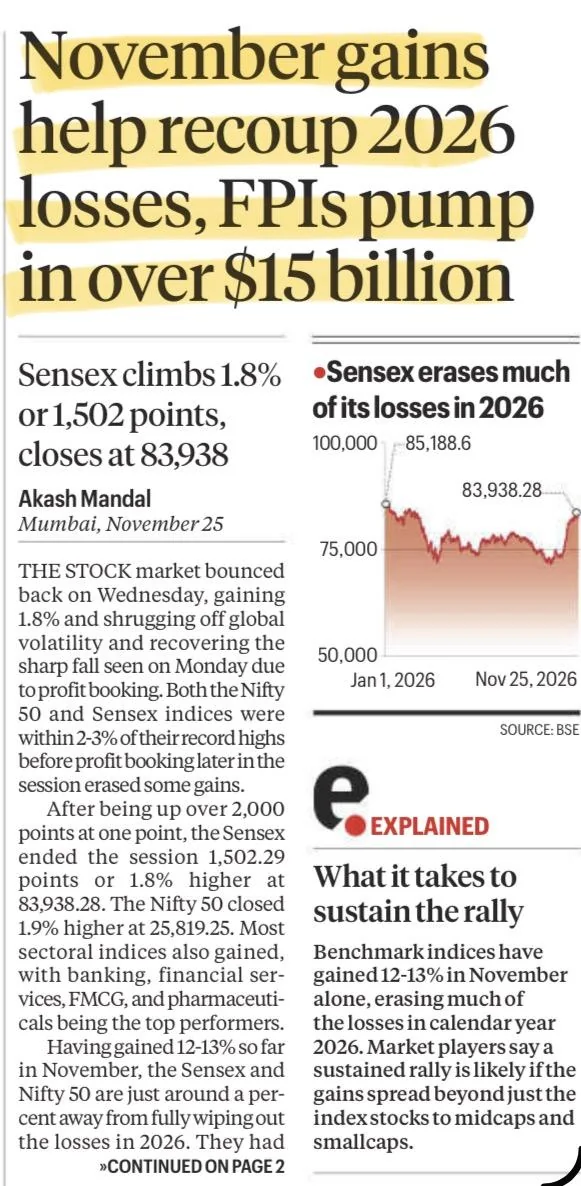
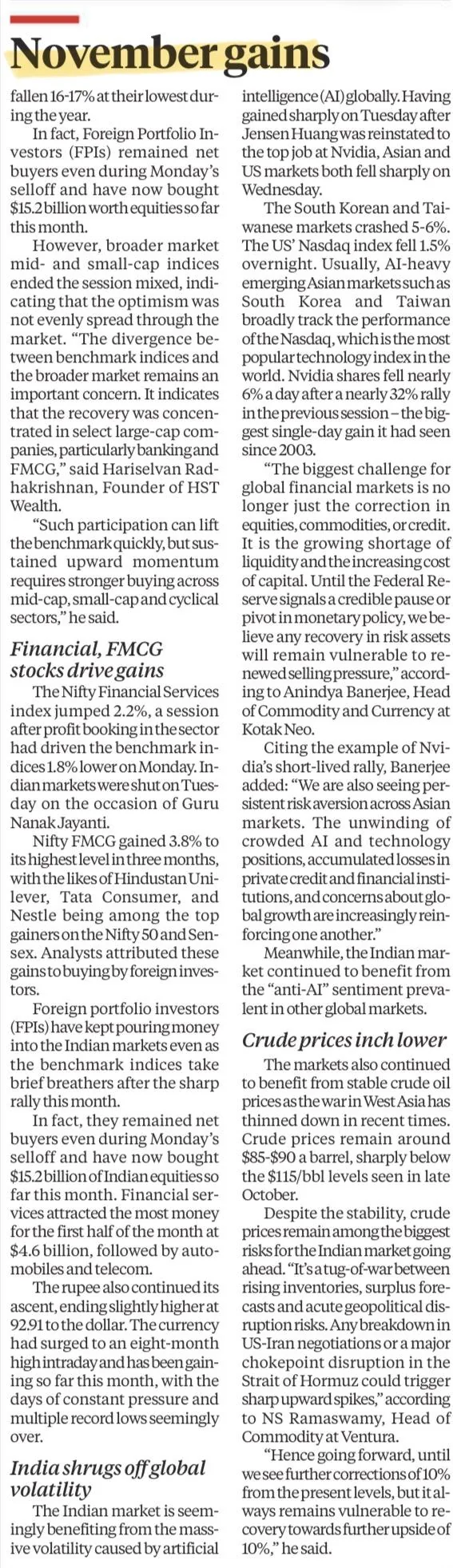
November Gains Help Recoup 2026 Losses; FPIs Invest Over $15 Billion

Context: Indian stock markets recovered sharply in November 2026, powered by record Foreign Portfolio Investment (FPI) inflows, gains in banking and FMCG stocks, and softer crude oil prices.

November gains help recoup 2026 losses, FPIs pump in over $15 billion – Sensex climbs 1.8% (The Indian Express)
November gains help recoup 2026 losses; FPIs pump in over $15 billion. Source: The Indian Express
November gains: drivers of the Sensex–Nifty rally, FPI inflows and crude prices (The Indian Express)
What drove the November market rally. Source: The Indian Express

Market Performance

Sensex
Rose 1.8% (1,502 points) to close at 83,938.28.
Nifty 50
Gained 1.9% to close at 25,819.25.
November
Indices gained about 12–13%, erasing most 2026 losses.

Drivers of the Rally

FPI inflows
About $15.2 billion into Indian equities in November.
Sectors
Banking, financial services, FMCG and pharma led the gains.
Crude oil
Around $85–90 a barrel, down from about $115 in late October.
Relative sentiment
India gained as investors turned cautious on AI-heavy Asian tech markets.

FDI vs FPI

Meaning
FDI: stake in an enterprise with lasting interest • FPI: investment in shares and bonds.
Control
FDI may involve management control • FPI generally has none.
Nature
FDI is stable, long-term • FPI is liquid and volatile (‘hot money’).
Contribution
FDI brings capital, technology, skills, jobs • FPI adds market liquidity.
Example
A foreign firm setting up a factory • A foreign fund buying Indian shares.

Risks Ahead

Narrow rally
Gains concentrated in large caps; mid- and small-caps mixed.
Global volatility
Concerns over AI valuations and rising cost of capital.
Crude vulnerability
Escalation in West Asia or the Strait of Hormuz could raise oil import bills and inflation.

Way Forward

Domestic investors
Broaden retail and institutional participation.
Stable capital
Attract long-term FDI for productive capacity and jobs.
Deeper markets
Reduce dependence on volatile portfolio flows.
Key Takeaway: FPI money can lift markets quickly but can leave just as fast; deep domestic markets and stable FDI are what make growth resilient.

Prelims Practice MCQ

+2 correct • −0.66 wrong

UPSC Prelims PYQ 2020: With reference to Foreign Direct Investment in India, which one of the following is considered its major characteristic?

Explanation: FDI is largely a non-debt-creating capital flow – it does not create a repayment obligation like loans. It can be in listed or unlisted companies, and investment by FIIs in government securities is portfolio investment.

UPSC Mains Question

GS3 • 15 Marks • 250 Words

Foreign portfolio flows have become a major driver of India’s stock markets and exchange rate. Analyse the benefits and risks of relying on FPI and suggest measures to attract stable long-term capital.

Attempt before opening the value-addition tab.
Accepted: JPG, JPEG, PNG, WEBP or PDF. The standalone file previews your answer locally; connect the API hook for real server submission.
Use after attempting the Mains answer
  • Thresholds — investment of 10% or more in a listed company is treated as FDI; below 10% is FPI.
  • PYQs — Prelims 2011 (FDI vs FII: answer b), Prelims 2021 (FCCBs, conditional FII and GDRs count as FDI).
  • Concepts — hot money, sudden stops, market breadth, large-cap vs mid-cap rally.
  • Link — FPI inflows also supported the rupee’s November recovery (see News 4).

Copyright © 2026 USARAMBHA EDUCATION (UnderStand UPSC). All Rights Reserved.

MAD-X for UPSC Prelims 2027 – Batch 3 starts 7th December 2026
Batch 3 · Starts 7th Dec 2026

MAD-X for UPSC Prelims 2027

Online & Offline · Fee details + free counselling

Preferred Medium

🔒 Your details are kept confidential.

Call Now · 83770 72252