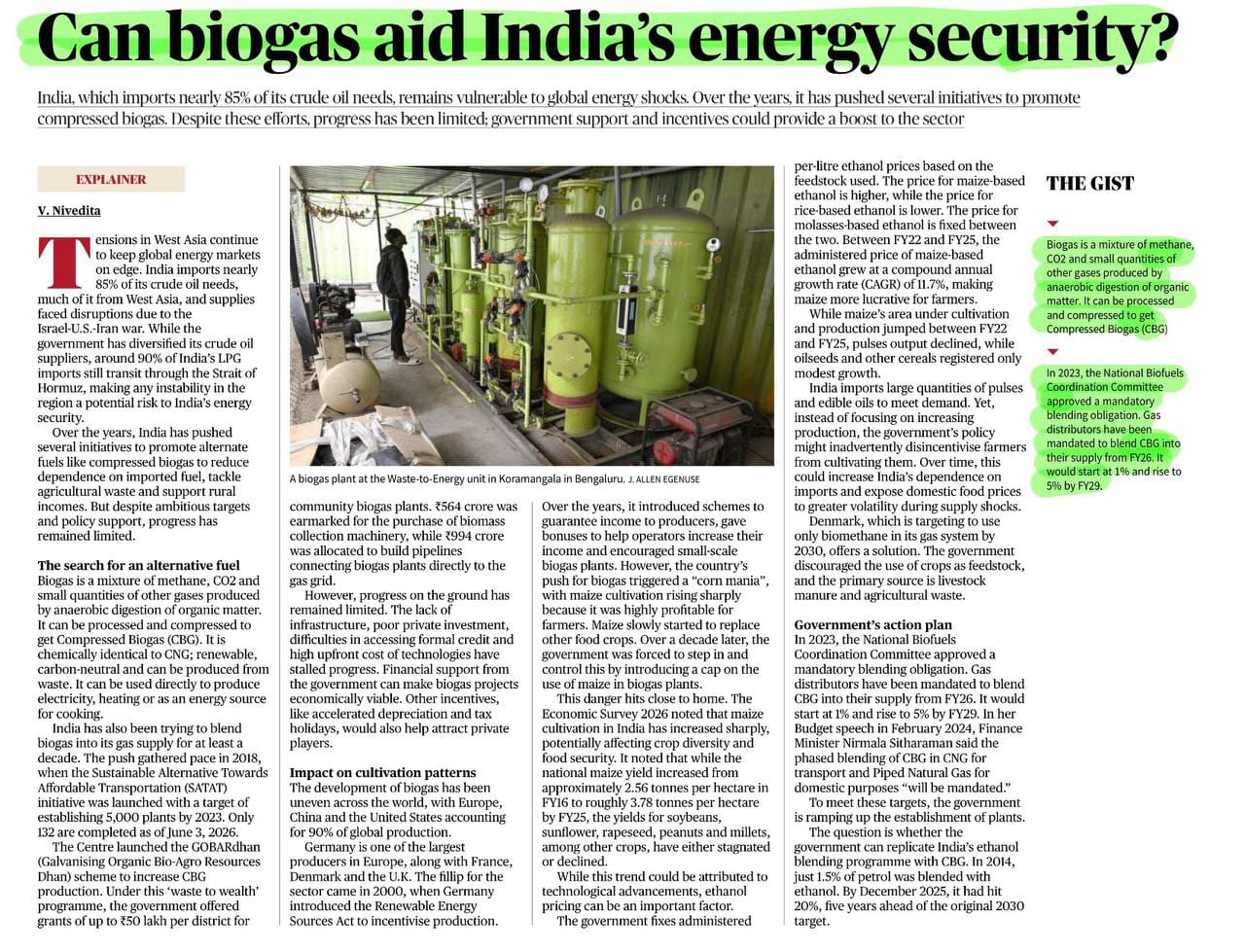
Context: Compressed Biogas Energy Security
India imports nearly 85% of its crude oil requirement. Compressed Biogas is being promoted to enhance energy security, reduce fossil-fuel imports and utilise organic waste.
Biogas
Biogas is produced through anaerobic digestion of biodegradable waste.
It primarily contains:
- Methane
- Carbon Dioxide
Compressed Biogas
Compressed Biogas is purified and compressed biogas with properties comparable to Compressed Natural Gas.
Sources of Biogas
Biogas can be produced from:
- Cattle dung
- Agricultural residue
- Municipal solid waste
- Press mud
- Food waste
- Sewage sludge
- Organic industrial waste
Government Initiatives
1. SATAT Scheme, 2018
Full Form
Objective
Promotes production and marketing of Compressed Biogas.
2. GOBARdhan
Full Form
- Galvanising Organic Bio-Agro Resources Dhan
Objective
Supports:
- Waste-to-wealth
- Rural bioenergy
- Organic waste management
- Circular economy
3. Mandatory CBG Blending
Compressed Biogas blending in City Gas Distribution network:
- 1% in FY26
- Gradually rising to 5% by FY29
Significance
1. Energy Security
CBG can reduce dependence on crude oil and natural gas imports.
2. Circular Economy
Organic waste is converted into useful fuel.
3. Methane Reduction
Capturing methane from waste reduces greenhouse gas emissions.
4. Stubble Burning Reduction
Agricultural residue can be used as feedstock.
5. Rural Income
Farmers can earn additional income from biomass and waste supply.
6. Employment
CBG plants can generate rural jobs in collection, transport, processing and distribution.
Challenges
- High capital cost.
- Inadequate infrastructure.
- Weak biomass supply chain.
- Limited private investment.
- Difficulty in feedstock aggregation.
- Excessive use of maize as feedstock may affect crop diversification and food security.
- Need for assured offtake and pricing support.
Way Forward
- Build reliable biomass supply chains.
- Provide viability-gap support for CBG plants.
- Promote decentralised waste-to-energy models.
- Integrate CBG with city gas networks.
- Encourage crop-residue-based CBG instead of food-grain diversion.
- Strengthen local government and private-sector participation.
Key Takeaway
Compressed Biogas can strengthen India’s energy security, but its success depends on feedstock management, infrastructure, pricing support and sustainable biomass use.