Read the news. Test the concept. Write the Mains answer.
This interactive edition converts each current-affairs item into one Prelims-level MCQ, one Mains-level question, and a compact value-addition section for revision.
+2 correct−0.66 incorrectExplanation after attemptImage/PDF answer upload
NEWS 1GS2 • International Relations | Regional GroupingsSource: The Indian Express
Quad Summit Likely in Manila
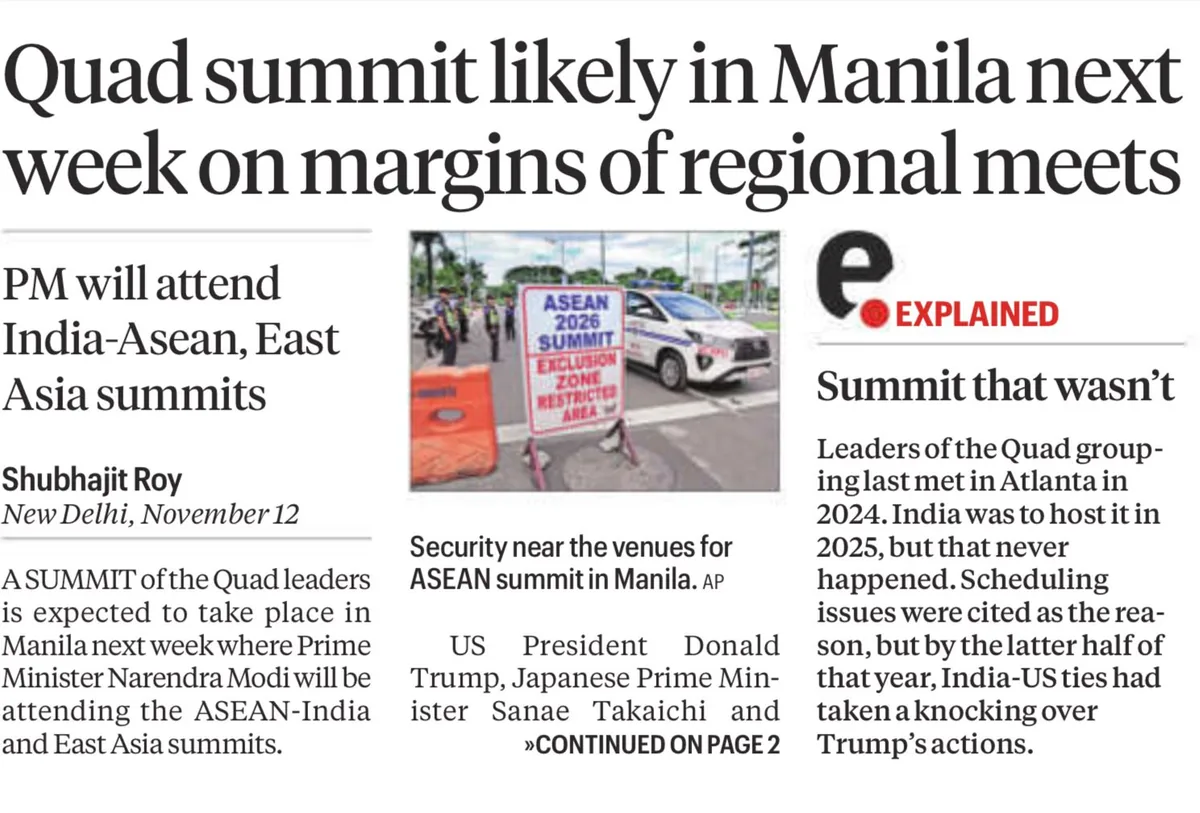
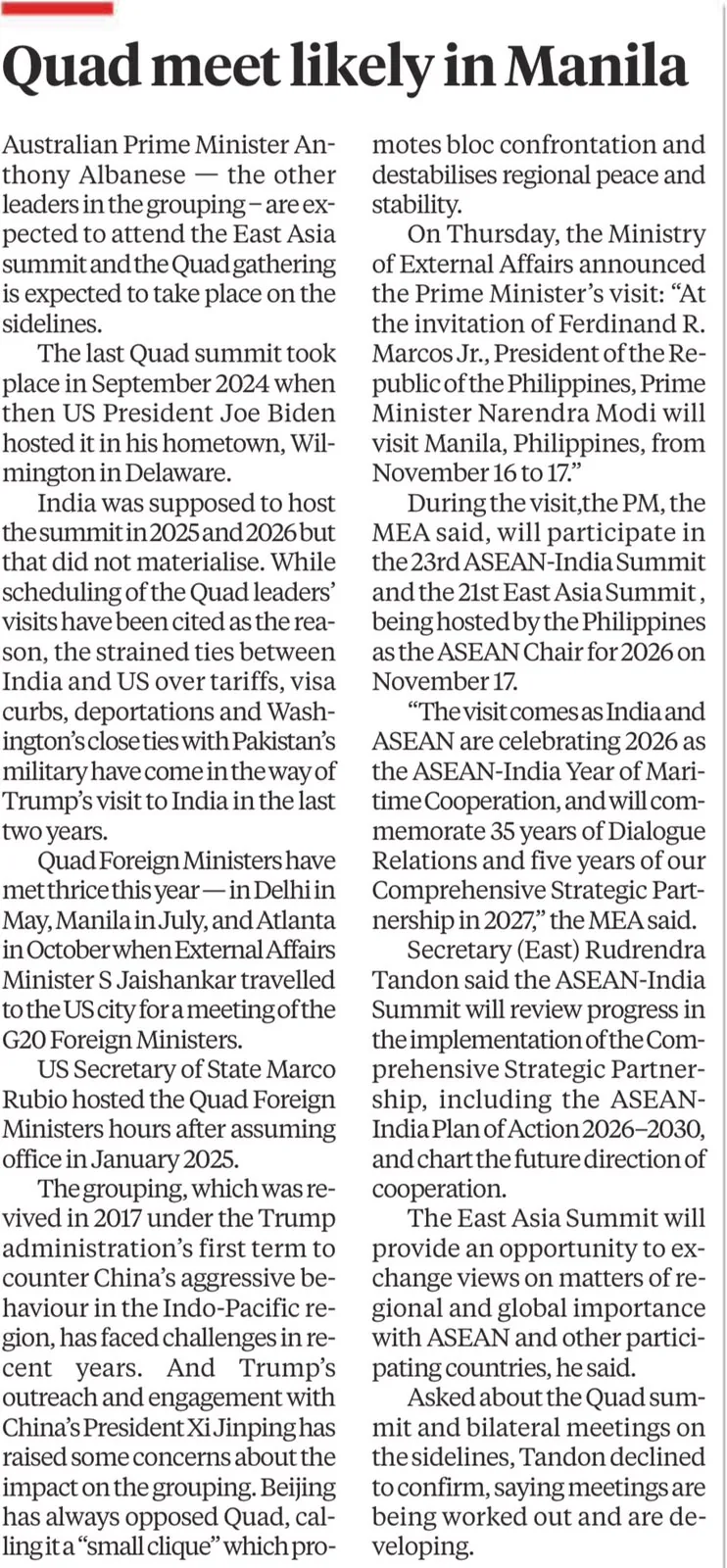
Context: PM Narendra Modi will visit Manila on 16–17 November 2026 for the 23rd ASEAN–India Summit and the 21st East Asia Summit. A Quad leaders' meeting is expected on the sidelines, though it has not been officially confirmed.
Quad summit likely in Manila on the margins of the ASEAN–India and East Asia summits. Source: The Indian ExpressPM Modi's Manila visit, 16–17 November 2026. Source: The Indian Express
Understanding the Quad
Members India, USA, Japan, Australia.
Revived 2017, for a free, open and rules-based Indo-Pacific.
Nature Informal partnership; not a military alliance.
Areas Maritime security, critical technologies, health, infrastructure, disaster response.
Last summit September 2024, Wilmington (USA); India was to host in 2025 and 2026.
The Manila Visit
ASEAN–India 23rd ASEAN–India Summit, 17 November.
EAS 21st East Asia Summit; Philippines is ASEAN Chair 2026.
Theme year 2026 = ASEAN–India Year of Maritime Cooperation.
2027 35 years of Dialogue Relations, 5 years of Comprehensive Strategic Partnership.
Plan ASEAN–India Plan of Action 2026–2030.
Significance for India
Strategic balance Platform to address China's growing influence.
Maritime Freedom of navigation and maritime domain awareness.
Public goods Position Quad as a provider of regional public goods, not an anti-China bloc.
Follow-up Better coordination on announced commitments.
Key Takeaway: The Quad is valuable to India as a flexible, issue-based partnership. Its credibility now depends on delivering results while keeping ASEAN at the centre.
Prelims Practice MCQ
+2 correct • −0.66 wrong
With reference to the Quad, consider the following statements: 1. It is a treaty-based military alliance with a permanent secretariat. 2. It was revived in 2017. 3. Its members are India, the USA, Japan and Australia. Which of the statements given above are correct?
Explanation: The Quad was revived in 2017 and has four members: India, the USA, Japan and Australia. It is an informal strategic partnership with no treaty, no permanent secretariat and no collective defence clause, so Statement 1 is wrong.
UPSC Mains Question
GS2 • PYQ 2026 • 10 Marks
"IPMDA (Indo-Pacific Partnership for Maritime Domain Awareness) bridges the gap between India's SAGAR vision and the Quad's collective Indo-Pacific strategy." Make a critical assessment of the statement focusing on IPMDA.
Attempt before opening the value-addition tab.
Accepted: JPG, JPEG, PNG, WEBP or PDF. The standalone file previews your answer locally; connect the API hook for real server submission.
Use after attempting the Mains answer
PYQ 2020 (15 marks) — "Quad is transforming itself into a trade bloc from a military alliance" – Discuss.
Quad initiatives — IPMDA, Quad Vaccine Partnership, Critical and Emerging Technology Working Group.
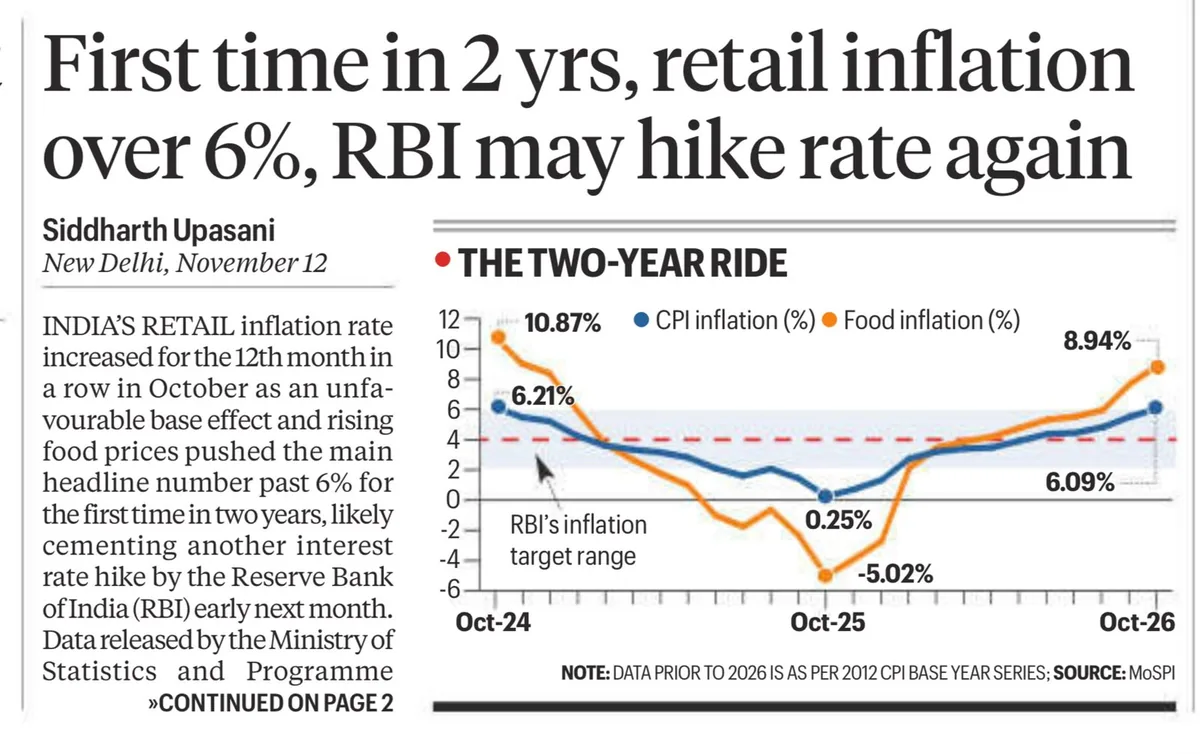
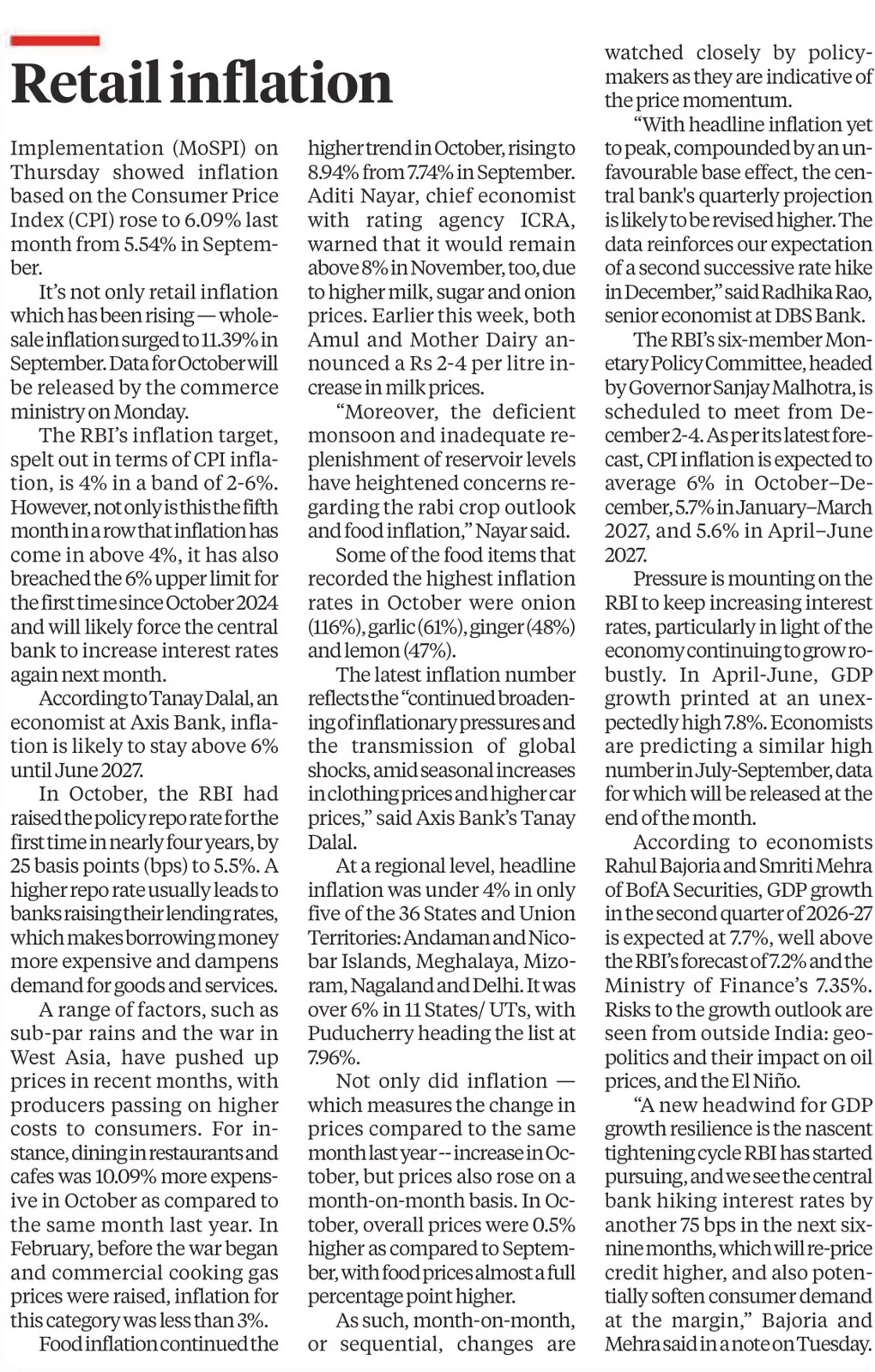
Context: Retail (CPI) inflation rose to 6.09% in October 2026, crossing the RBI's upper tolerance limit of 6% for the first time since October 2024. Food inflation rose to 8.94%, raising the chance of another rate hike.
CPI and food inflation, October 2024 – October 2026. Source: The Indian Express / MoSPIRetail inflation details and RBI outlook. Source: The Indian Express
October 2026 Data
CPI inflation 5.54% (Sept) → 6.09% (Oct).
Food inflation 7.74% → 8.94%.
Rural vs urban 6.63% rural; 5.41% urban.
Top rises Onion 116%, garlic 61%, ginger 48%, lemon 47%.
States Above 6% in 11 States/UTs; Puducherry highest (7.96%).
CPI: Meaning and New Series
Meaning Measures change in retail prices paid by households.
Base effect Low inflation a year ago (0.25% in Oct 2025) pushes up the yearly rate.
RBI's Response
Target 4% CPI inflation with a 2–6% band.
October 2026 Repo rate raised by 25 bps to 5.5%, first hike in nearly 4 years.
Next MPC Six-member MPC, headed by Governor Sanjay Malhotra, meets 2–4 December.
Tools Repo rate, liquidity absorption.
Government Buffer stock release, imports, better storage.
Economic Implications
Households Lower real income and savings.
Investment Higher borrowing costs.
Fiscal Higher food and fertiliser subsidies.
Growth Growth–inflation trade-off for the RBI.
Key Takeaway: When food prices drive inflation, rate hikes alone cannot fix it. Monetary tightening must go with supply-side steps like storage, buffer stocks and timely imports.
Prelims Practice MCQ
+2 correct • −0.66 wrong
With reference to inflation measurement in India, consider the following statements: 1. The Consumer Price Index covers both goods and services, while the Wholesale Price Index covers only goods. 2. The Wholesale Price Index is released by the National Statistical Office. 3. The RBI's inflation target is defined in terms of CPI inflation. Which of the statements given above are correct?
Explanation: CPI covers goods and services, while WPI covers only goods. WPI is released by the Office of the Economic Adviser, DPIIT, not the NSO, so Statement 2 is wrong. The RBI's target is 4% CPI inflation within a 2–6% band.
UPSC Mains Question
GS3 • 15 Marks • 250 Words
Food inflation has emerged as the main driver of retail inflation in India. Examine the limits of monetary policy in controlling it and suggest supply-side measures.
Attempt before opening the value-addition tab.
Accepted: JPG, JPEG, PNG, WEBP or PDF. The standalone file previews your answer locally; connect the API hook for real server submission.
Use after attempting the Mains answer
Framework — Flexible Inflation Targeting under the RBI Act, 1934 (amended 2016): 4% ± 2%.
Concept — base effect: a low base last year makes this year's yearly inflation look higher.
Data — GDP growth 7.8% in April–June 2026; RBI faces a growth–inflation trade-off.
NEWS 3GS2 • Indian Polity | Parliament | FederalismSource: The Hindu
Government Considers Special Parliament Session for Delimitation Bill
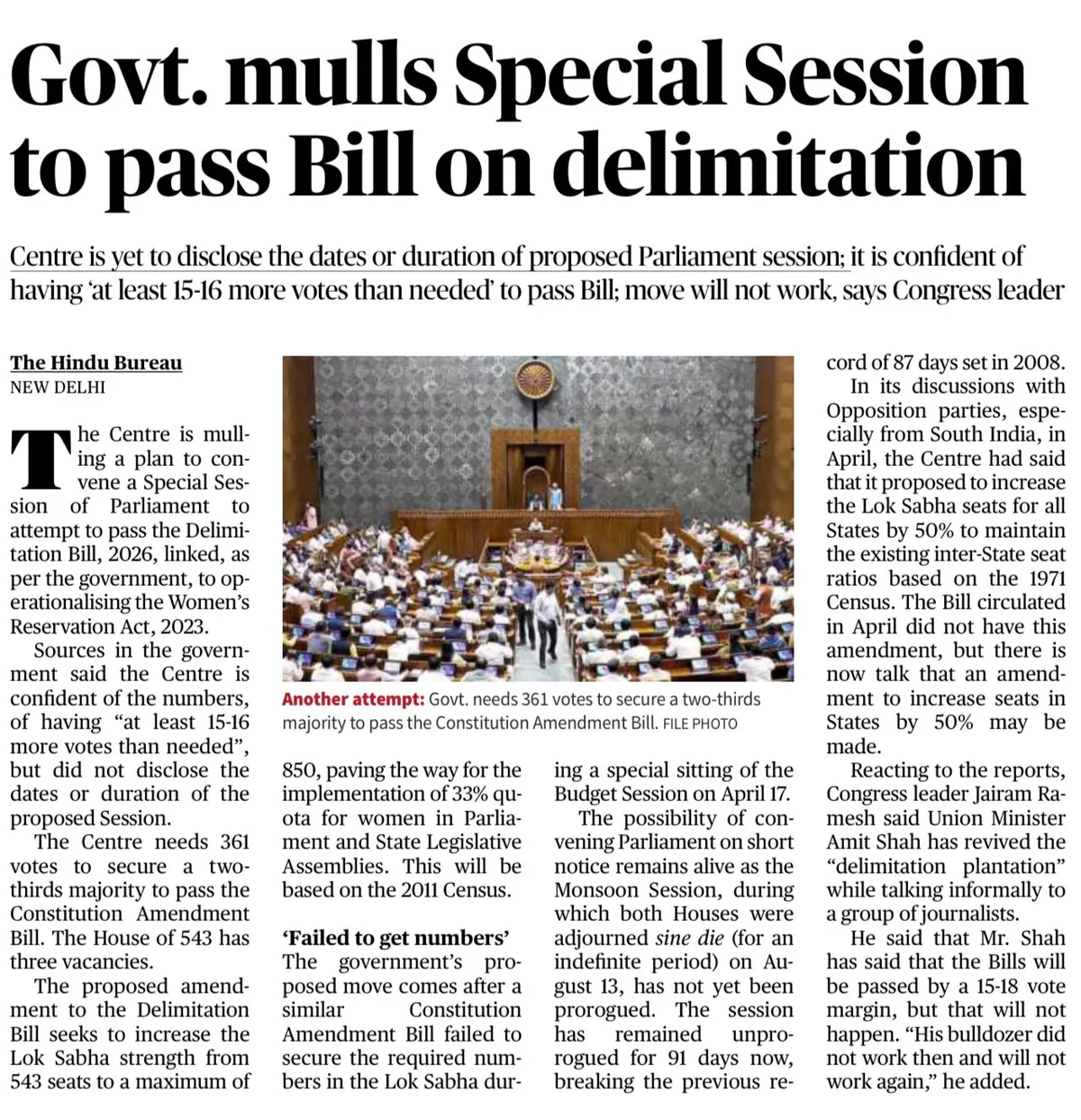
Context: After the Constitution (131st Amendment) Bill, 2026 was defeated in the Lok Sabha in April, the Centre is considering a special session of Parliament to pass the Delimitation Bill, which it links to implementing women's reservation.
The Centre needs 361 votes for a two-thirds majority in the Lok Sabha. Source: The Hindu
Special Session: Key Provisions
Who summons The President under Article 85, on the Cabinet's advice.
Who can demand Government decides; the Opposition cannot summon Parliament.
Procedure Same rules as an ordinary session.
Sine die vs prorogation Sine die ends a sitting without a next date; prorogation ends the session.
16 April Three Bills: 131st Amendment, Delimitation Bill, UT Laws (Amendment) Bill.
Aim Lok Sabha up to 850 seats; delimitation on 2011 Census; 33% women's quota.
17 April 298 for, 230 against: special majority not reached.
Now needed 361 votes for two-thirds; House of 543 has 3 vacancies.
Record Monsoon Session adjourned sine die on 13 Aug, unprorogued for 91 days (earlier record 87 days, 2008).
Major Challenges
North–South Population-based seats may cut the share of southern States.
Federal balance States that controlled population fear losing influence.
Census basis Using 2011 data while a new Census is under way.
Women's quota Linking it to delimitation may delay it.
Possible fix Talk of raising every State's seats by 50% to keep 1971 ratios.
Way Forward
Consensus Consult all States and parties.
Fairness Balance population with population stabilisation success.
Transparency Clear Census basis and seat formula.
Women first Delimitation must not indefinitely delay the 33% quota.
Key Takeaway: Delimitation is about both numbers and federal trust. A fair formula, built on consensus, matters as much as the two-thirds majority.
Prelims Practice MCQ
+2 correct • −0.66 wrong
With reference to the sessions of Parliament, consider the following statements: 1. The President summons each House of Parliament under Article 85. 2. Adjournment sine die terminates a session of Parliament. 3. Opposition parties can independently summon a special session of Parliament. Which of the statements given above is/are correct?
Explanation: The President summons Parliament under Article 85, on the advice of the Council of Ministers. Adjournment sine die only ends a sitting without fixing the next date; prorogation terminates the session. The Opposition can demand, but not summon, a session.
UPSC Mains Question
GS2 • 15 Marks • 250 Words
Population-based delimitation may reward States with higher population growth and penalise those that controlled it. Discuss the federal concerns and suggest a balanced approach.
Attempt before opening the value-addition tab.
Accepted: JPG, JPEG, PNG, WEBP or PDF. The standalone file previews your answer locally; connect the API hook for real server submission.
Keywords — special majority, cooperative federalism, representation vs population.
NEWS 4GS2 • International Relations | ChinaSource: Reuters
Taiwan Reunification Must Happen, Says Xi Jinping
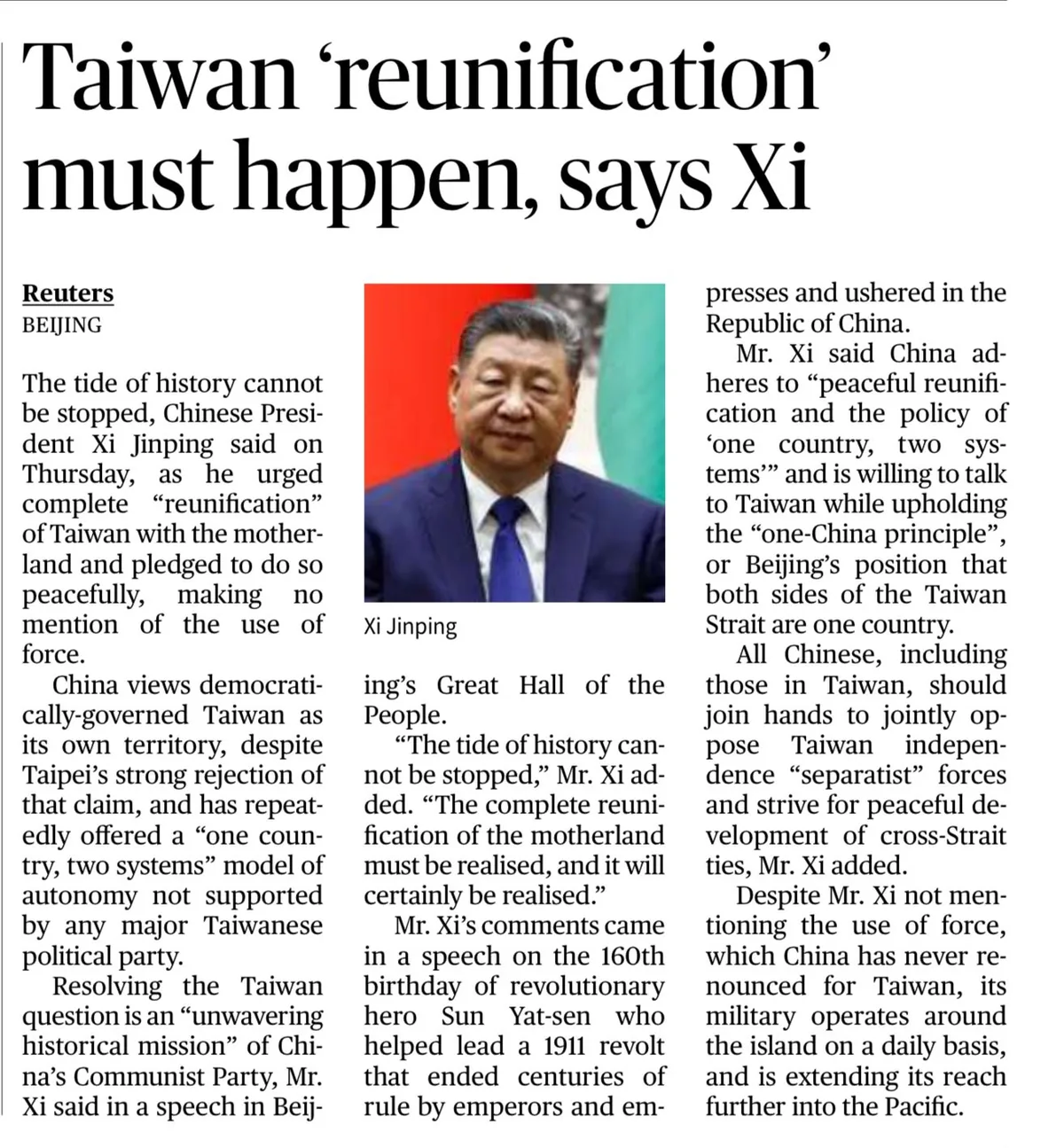
Context: In a speech on Sun Yat-sen's 160th birth anniversary, Chinese President Xi Jinping said Taiwan's 'reunification' must and will be realised, and pledged to pursue it peacefully. Taiwan rejects Beijing's claim of sovereignty.
Xi Jinping's speech on Sun Yat-sen's 160th birth anniversary. Source: Reuters
How China and Taiwan Separated
1895 Taiwan ceded to Japan; Japanese rule until 1945.
1911–12 Revolution ends Qing rule; Republic of China (ROC) set up under Sun Yat-sen.
Civil war Communists (Mao) vs Kuomintang (Chiang Kai-shek).
1949 PRC on the mainland (1 Oct); ROC government moves to Taiwan.
Since then Separate governments on each side of the Strait.
The Taiwan Question
China Taiwan is part of China; reunification is a national goal.
Taiwan Elected government rejects Beijing's claim.
One-China Principle Beijing: only one China, and Taiwan is part of it.
One Country, Two Systems Offered by China; rejected by major Taiwanese parties.
Use of force Not mentioned by Xi, but never renounced.
Strategic Importance of Taiwan
Location On the First Island Chain in the western Pacific.
Chips Major producer of advanced semiconductors.
Trade Near sea lanes linking the East and South China Seas.
Rivalry A key US–China flashpoint.
India's Stand
Diplomacy Recognises the PRC; no formal ties with Taiwan.
Engagement Trade, technology, education and culture.
Offices India-Taipei Association (1995); Taipei Economic and Cultural Centre, New Delhi.
Position Supports peace and stability in the Taiwan Strait.
Way Forward
Dialogue Resolve differences peacefully.
Status quo Avoid unilateral moves.
Supply chains Diversify semiconductor sources.
Region Indo-Pacific mechanisms to prevent miscalculation.
Key Takeaway: Taiwan matters to India through chips, trade and Indo-Pacific stability. India's approach is pragmatic: recognise the PRC, engage Taiwan economically, and back peace in the Strait.
Prelims Practice MCQ
+2 correct • −0.66 wrong
With reference to Taiwan, consider the following statements: 1. The Taiwan Strait separates Taiwan from mainland China. 2. Taiwan was under Japanese colonial rule from 1895 to 1945. 3. India maintains formal diplomatic relations with Taiwan. Which of the statements given above are correct?
Explanation: The Taiwan Strait lies between Taiwan and China's Fujian coast, and Japan ruled Taiwan from 1895 to 1945. India recognises the PRC and has no formal diplomatic ties with Taiwan; it engages through the India-Taipei Association, so Statement 3 is wrong.
UPSC Mains Question
GS2 • 10 Marks • 150 Words
Stability in the Taiwan Strait is important for India's economic and strategic interests. Discuss India's approach towards Taiwan in the context of its relations with China.
Attempt before opening the value-addition tab.
Accepted: JPG, JPEG, PNG, WEBP or PDF. The standalone file previews your answer locally; connect the API hook for real server submission.
Use after attempting the Mains answer
Map — Taiwan Strait links the East China Sea and the South China Sea.
Data — Taiwan produces most of the world's most advanced chips (TSMC).
Link — India's Semicon India Mission and partnerships with Taiwanese firms.
Keywords — One-China policy, status quo, grey-zone pressure, First Island Chain.
NEWS 5GS2 • International Relations | NeighbourhoodSource: The Hindu
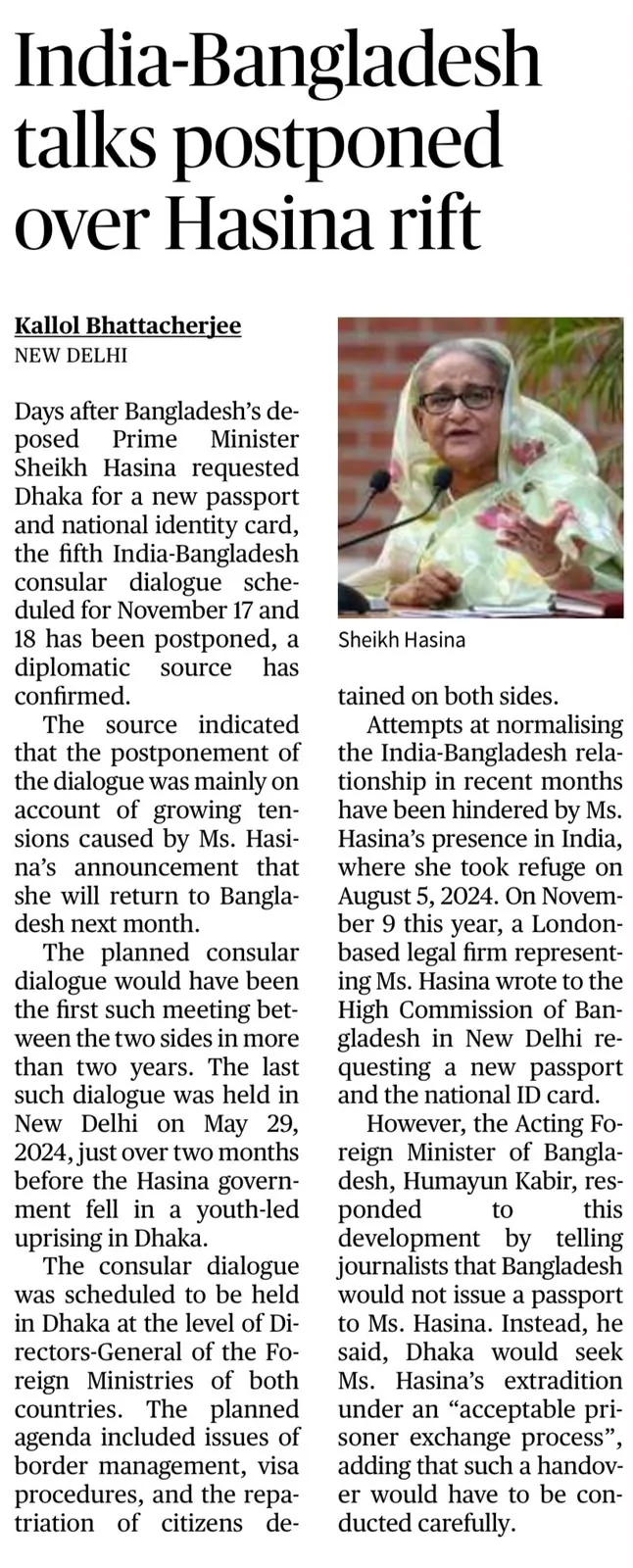
Context: The fifth India–Bangladesh consular dialogue, set for 17–18 November 2026 in Dhaka, has been postponed amid tensions over former Prime Minister Sheikh Hasina, who has said she will return to Bangladesh next month.
India–Bangladesh consular dialogue postponed. Source: The Hindu
Recent Developments
5 Aug 2024 Hasina left after a youth-led uprising; took refuge in India.
9 Nov 2026 Her lawyers sought a new passport and National ID.
Dhaka's reply Acting FM Humayun Kabir: no passport; will seek extradition.
Dialogue Would have been the first since May 2024.
Agenda Border management, visas, repatriation of detained citizens.
Key Issues
Extradition Request under the 2013 Extradition Treaty.
Talk Resume consular dialogue and Foreign Office Consultations.
Legal process Handle extradition under the treaty with legal safeguards.
Border BSF–BGB cooperation; Coordinated Border Management Plan (2011).
Water Revive the Joint Rivers Commission (1972); Teesta deal.
People Medical visas, education, Maitree Express.
Broad base Engage all political stakeholders, not one leader.
Key Takeaway: India's ties with Bangladesh must outlast any single government in Dhaka. Steady engagement on borders, water and people-to-people links is the way to rebuild trust.
Prelims Practice MCQ
+2 correct • −0.66 wrong
With reference to India–Bangladesh relations, consider the following statements: 1. India and Bangladesh signed an extradition treaty in 2013. 2. The Joint Rivers Commission was set up in 1972. 3. The Teesta water-sharing agreement was signed in 2011. Which of the statements given above are correct?
Explanation: The extradition treaty was signed in 2013 and the Joint Rivers Commission was set up in 1972. A Teesta agreement was planned in 2011 but was never signed, so Statement 3 is wrong.
UPSC Mains Question
GS2 • 15 Marks • 250 Words
Political changes in Bangladesh have tested India's Neighbourhood First policy. Examine the key irritants in India–Bangladesh relations and suggest measures to rebuild trust.
Attempt before opening the value-addition tab.
Accepted: JPG, JPEG, PNG, WEBP or PDF. The standalone file previews your answer locally; connect the API hook for real server submission.
Use after attempting the Mains answer
Agreements — Land Boundary Agreement (2015, 100th Amendment); Ganga Water Treaty (1996).
Connectivity — Maitree Express, Akhaura–Agartala rail link, Chittagong and Mongla port access.
Data — India–Bangladesh border about 4,096 km, touching 5 States.
NEWS 6GS2 • Indian Polity | Indian DiasporaSource: The Indian Express
Should India Allow Dual Citizenship?
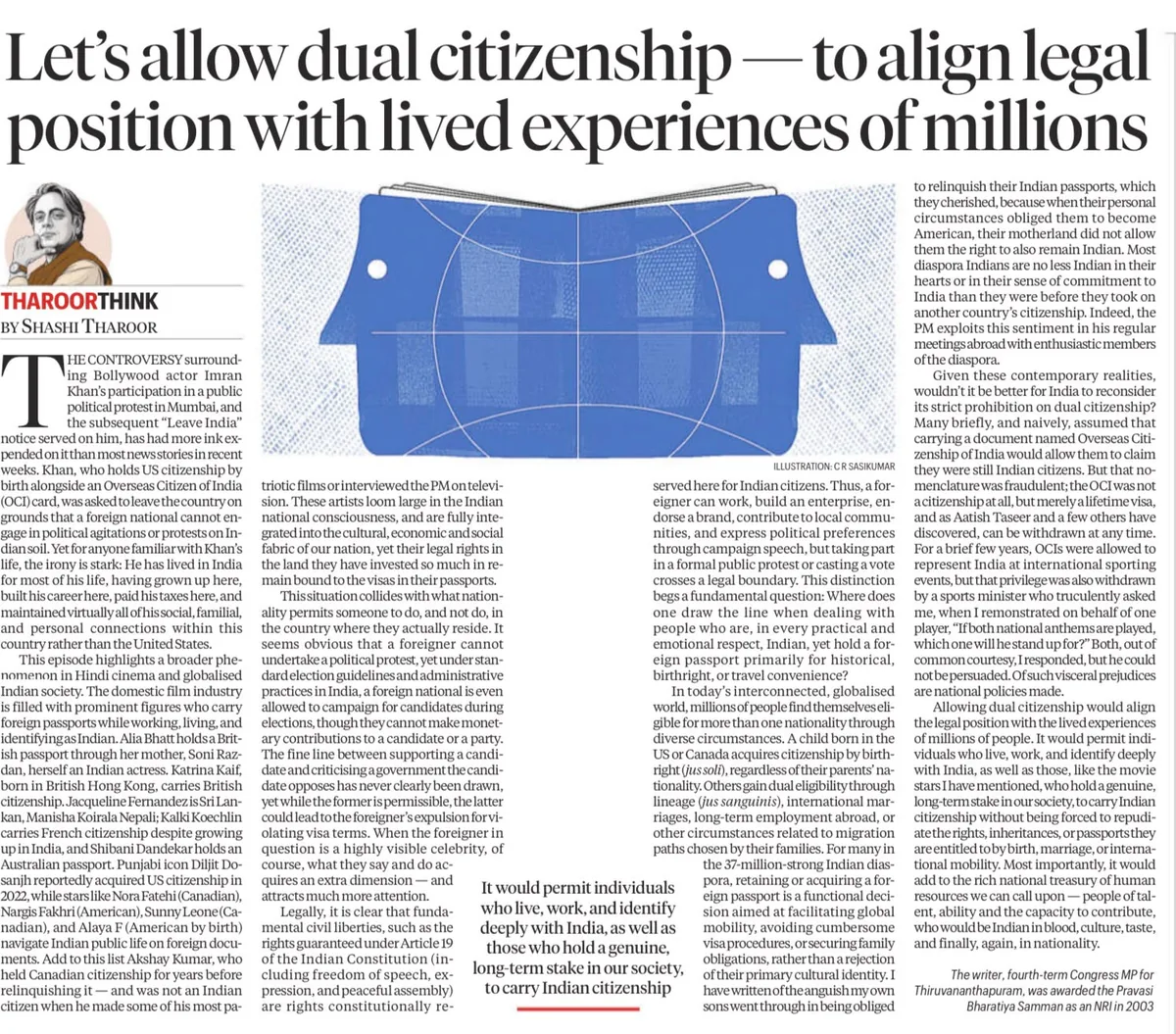
Context: The debate on dual citizenship has returned after a foreign national holding an OCI card was asked to leave India for joining a political protest. The question is whether India should relax its strict ban on dual citizenship.
Op-ed on dual citizenship and the OCI. Source: The Indian Express
India's Legal Position
Article 9 Voluntarily taking foreign citizenship ends Indian citizenship.
Citizenship Act, 1955 Section 9: termination on acquiring foreign citizenship.
OCI A lifetime visa with some rights; not citizenship.
OCI limits No voting, contesting elections or constitutional posts; can be cancelled.
Article 19 Freedoms here are for citizens only.
Why the Debate Matters
Diaspora About 37 million overseas Indians.
Realities Foreign passports taken for work, travel and family.
Identity Foreign citizenship need not end attachment to India.
Talent Could draw skills and investment.
Jus soli / sanguinis Citizenship by birthplace vs by parentage.
Concerns
Security Conflicting loyalties and obligations.
Politics Questions over voting and political influence.
Administration Tax, inheritance, property across countries.
Constitution Needs change to Article 9 and the Citizenship Act.
Way Forward
Calibrated reform Study a regulated dual citizenship model.
Safeguards Bar dual citizens from sensitive and constitutional posts.
Clear rules On tax, property and legal obligations.
Global models Learn from the USA, UK and Canada.
Key Takeaway: Dual citizenship could deepen India's bond with its diaspora, but it needs safeguards. A calibrated model can balance belonging with national security.
Prelims Practice MCQ
+2 correct • −0.66 wrong
With reference to the Overseas Citizenship of India (OCI), consider the following statements: 1. OCI cardholders can vote in Lok Sabha elections. 2. OCI registration does not confer dual citizenship. 3. Under Article 9 of the Constitution, a person who voluntarily acquires the citizenship of a foreign State ceases to be an Indian citizen. Which of the statements given above are correct?
Explanation: OCI is not dual citizenship; it is a lifetime visa with specified privileges, and OCI cardholders cannot vote, so Statement 1 is wrong. Article 9 says that voluntarily acquiring foreign citizenship ends Indian citizenship.
UPSC Mains Question
GS2 • 15 Marks • 250 Words
Should India reconsider its prohibition on dual citizenship? Examine the arguments for and against, and suggest safeguards for a calibrated approach.
Attempt before opening the value-addition tab.
Accepted: JPG, JPEG, PNG, WEBP or PDF. The standalone file previews your answer locally; connect the API hook for real server submission.
Use after attempting the Mains answer
Committee — L.M. Singhvi High Level Committee on the Indian Diaspora (2000–01) recommended dual citizenship.
History — PIO and OCI schemes merged into OCI in 2015.
Constitution — Articles 5–11 (Part II) on citizenship; Article 11 gives Parliament power to regulate it.
Keywords — single citizenship, diaspora diplomacy, jus soli, jus sanguinis.
NEWS 7GS2 • International Relations | GS3 • Science & Tech, Internal SecuritySource: The Financial Express
The Personal Is Geopolitical: Technology and National Security
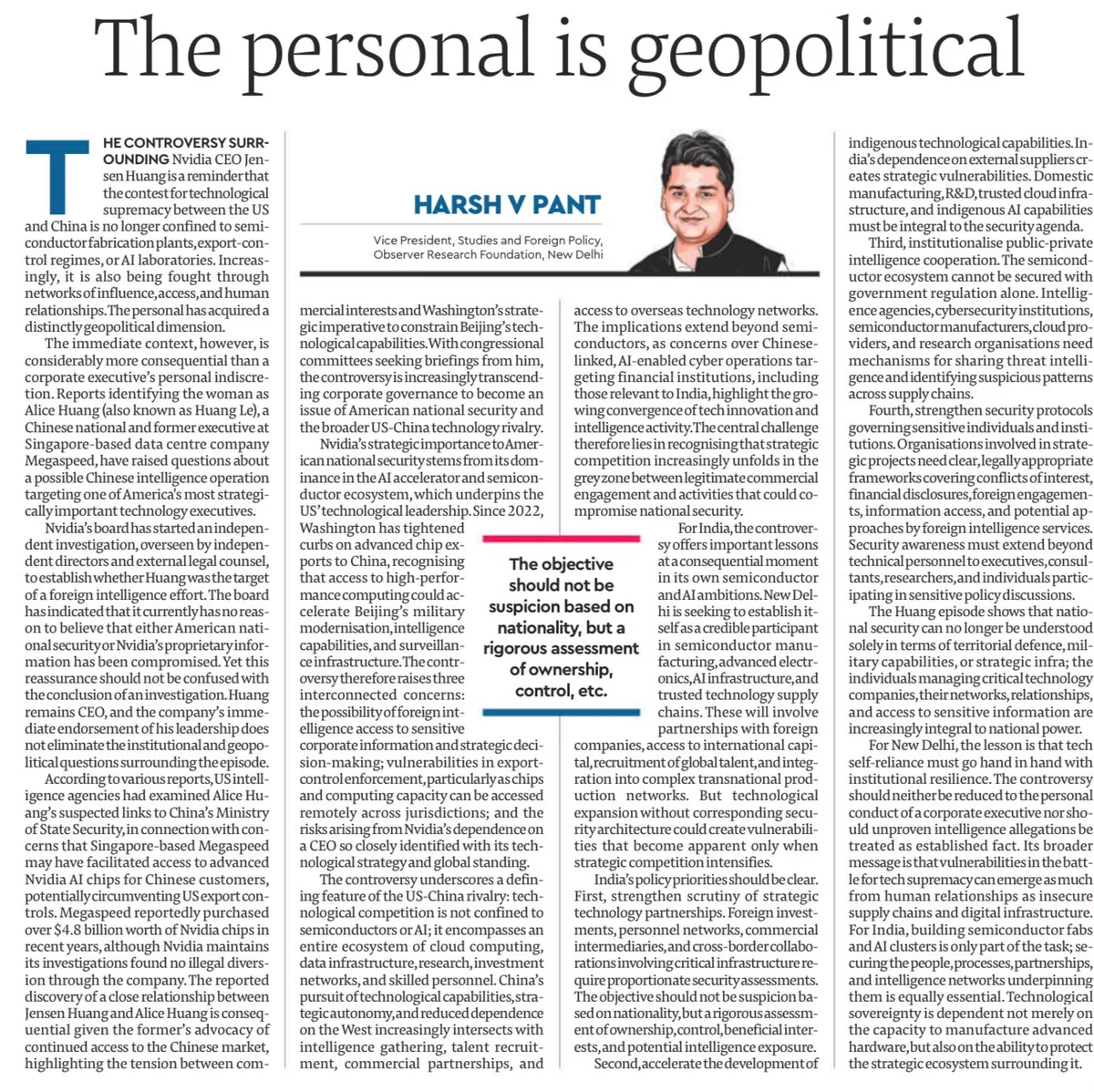
Context: Reports linking Nvidia CEO Jensen Huang to a person suspected of Chinese intelligence links show that the US–China tech rivalry now extends beyond chips to people, networks and access to sensitive information. Nvidia's board has ordered an independent investigation.
Op-ed by Harsh V Pant, Observer Research Foundation. Source: The Financial Express
The Issue
Tech as power Chips, AI, cloud, data drive economic and military strength.
US curbs Since 2022, limits on advanced chip exports to China.
The case Concern that a Singapore firm may have helped bypass export controls; Nvidia says it found no illegal diversion.
Grey zone Risks through people, investments and business networks.
Implications for India
Dependence Reliance on foreign chips, AI and cloud.
Security Foreign access to sensitive data and infrastructure.
Ambitions Becoming a semiconductor and AI hub needs secure systems.
Balance Attract investment while protecting strategic interests.
Challenges
Openness Too much scrutiny may deter investment and talent.
Attribution Hard to separate business from espionage.
Concentration Few countries control critical technologies.
Regulation Gaps in rules for cross-border networks.
Way Forward
Risk-based checks Judge ownership and control, not nationality.
Public–private Threat-intelligence sharing with industry.
Protocols Rules on conflicts of interest and disclosures.
Partners Diversify supply chains with trusted countries.
Key Takeaway: National security now depends on who controls technology and who can access sensitive information. For India, building fabs is only half the task; securing the people and networks around them matters as much.
Prelims Practice MCQ
+2 correct • −0.66 wrong
With reference to India's semiconductor ecosystem, consider the following statements: 1. The India Semiconductor Mission (ISM) functions under the Ministry of Electronics and Information Technology. 2. India has no approved semiconductor fabrication or assembly units yet. Which of the statements given above is/are correct?
Explanation: The India Semiconductor Mission works under MeitY. Several projects have been approved, including the Tata–PSMC fab at Dholera and assembly and testing units such as Micron's at Sanand, so Statement 2 is wrong.
UPSC Mains Question
GS3 • 15 Marks • 250 Words
Technological competition increasingly unfolds in the grey zone between commerce and espionage. Discuss the implications for India's semiconductor and AI ambitions and suggest safeguards.
Attempt before opening the value-addition tab.
Accepted: JPG, JPEG, PNG, WEBP or PDF. The standalone file previews your answer locally; connect the API hook for real server submission.