Batch 1 Starts 23 Nov: UPSC GS Foundation 2028/29 Enroll Now
US
UnderStand UPSC Daily Current Affairs Practice
0.00Score / 14
0 / 7MCQs Attempted
0%Accuracy
20 November 2026 • UPSC CSE

Read the news. Test the concept. Write the Mains answer.

This interactive edition converts each current-affairs item into one Prelims-level MCQ, one Mains-level question, and a compact value-addition section for revision.

+2 correct −0.66 incorrect Explanation after attempt Image/PDF answer upload
NEWS 1 GS3 • Economy | Manufacturing & Employment Source: The Hindu

PM Urges Industry: Raise Wages, Jobs and Product Quality

Context: At FICCI's Annual General Meeting, PM Modi urged industry to turn India's growth, tax cuts and new trade deals into higher wages, more jobs, better product quality and stronger manufacturing.
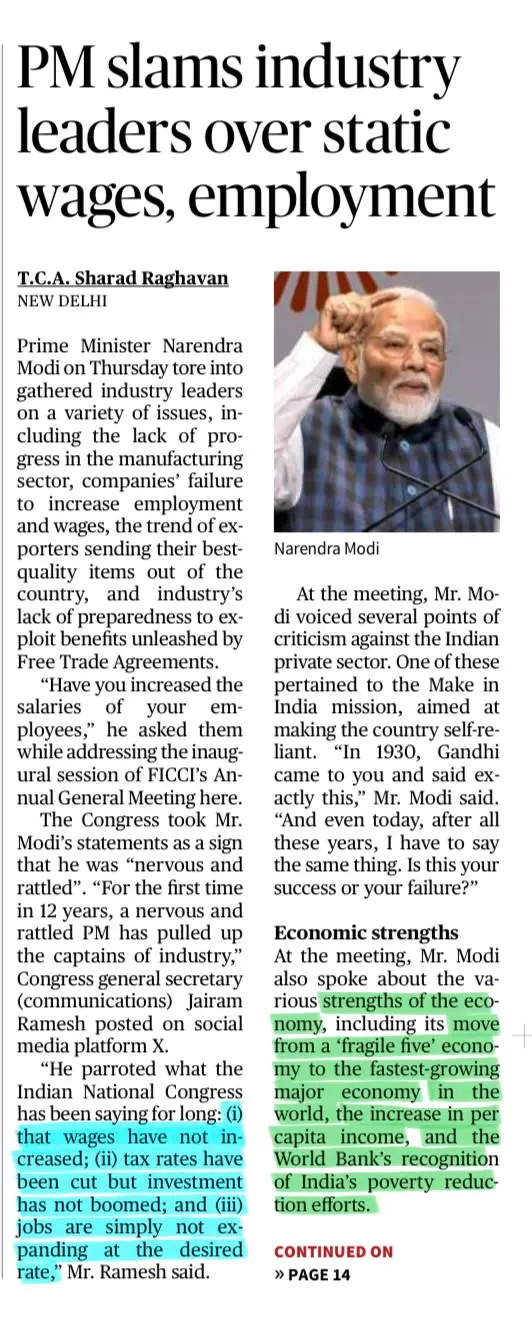
PM slams industry leaders over static wages and employment (The Hindu)
PM slams industry leaders over static wages, employment. Source: The Hindu
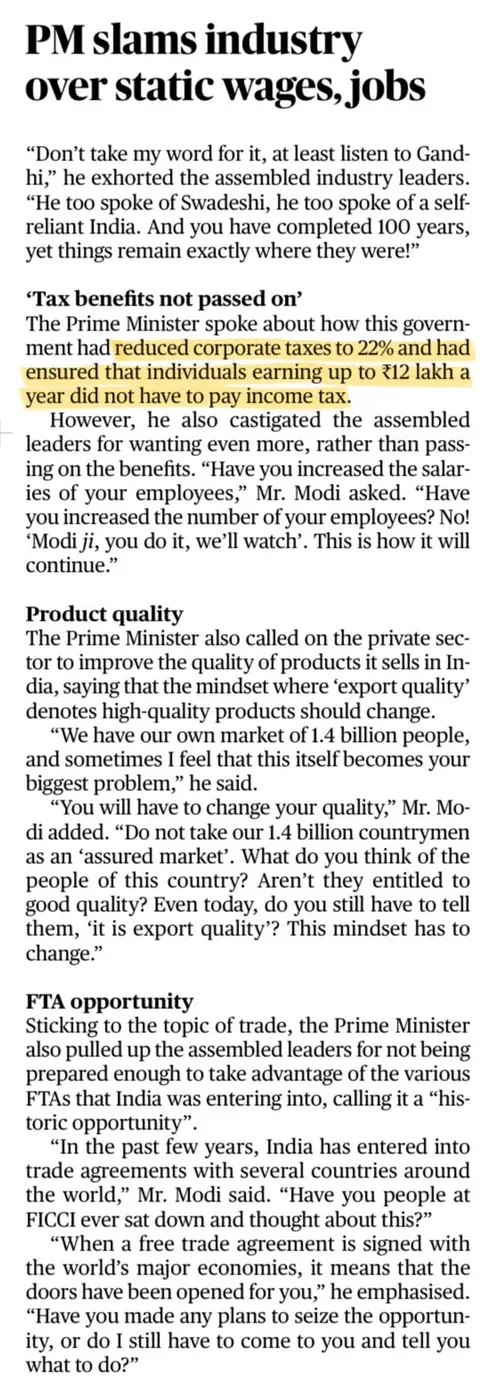
PM on tax benefits not passed on, product quality and FTA opportunity (The Hindu)
Tax benefits, product quality and FTAs. Source: The Hindu

Strengths of the Economy

Transformation
From the Fragile Five to one of the fastest-growing major economies.
Growth
Real GDP growth estimated at 7.4% in FY 2025–26 (First Advance Estimates).
Poverty (World Bank)
~49.6 crore people moved out of poverty (2011–2023); extreme poverty ($3/day) fell from 27.1% to 2.6%.
Exports
About $825.3 billion in FY 2024–25.
Tax reforms
Corporate tax cut to 22% (15% for new manufacturing firms); no income tax up to ₹12 lakh.

Key Concerns Raised

Stagnant wages
Real urban wages grew only ~0.5% a year (2019–24, ICRIER).
Jobs
Employment not growing at the desired scale; unemployment 3.1% (PLFS 2025), plus underemployment.
Manufacturing
Only ~13–15% of GDP vs the 25% target.
Tax pass-through
Corporate tax cuts not converted into salaries and jobs.
Quality gap
Domestic buyers deserve 'export quality' products too.
FTAs
Industry not ready to use new trade agreements.

Way Forward

Jobs
Labour-intensive manufacturing, MSMEs, export sectors.
Wages
Link incentives and productivity to better wages.
Competitiveness
Technology, R&D and domestic value addition.
Quality
International quality standards at home.
Trade
Export readiness and global value chains.

Term: Fragile Five

Coined by
Morgan Stanley in 2013.
Countries
India, Brazil, Indonesia, Turkey, South Africa.
Why fragile
Large current account deficits and reliance on foreign capital.
Key Takeaway: Growth must show up in pay slips and jobs. The PM's message: tax cuts and FTAs are opportunities industry must convert into wages, employment and quality.

Prelims Practice MCQ

+2 correct • −0.66 wrong

With reference to the term 'Fragile Five', consider the following statements:
1. It was coined by Morgan Stanley in 2013.
2. It referred to economies with large current account deficits dependent on foreign capital.
3. China was one of the Fragile Five economies.
Which of the statements given above are correct?

Explanation: Morgan Stanley coined the term in 2013 for India, Brazil, Indonesia, Turkey and South Africa – economies with large current account deficits dependent on foreign capital. China was not included.

UPSC Mains Question

GS3 • 15 Marks • 250 Words

India's high growth has not translated into proportionate gains in wages and employment. Examine the reasons and suggest measures for employment-intensive growth.

Attempt before opening the value-addition tab.
Accepted: JPG, JPEG, PNG, WEBP or PDF. The standalone file previews your answer locally; connect the API hook for real server submission.
Use after attempting the Mains answer
  • Schemes — PLI, Make in India, Employment Linked Incentive (ELI), PM Vishwakarma.
  • Data — manufacturing ~13–15% of GDP; unemployment 3.1% (PLFS 2025).
  • Concepts — jobless growth, real wages, Lewis model, global value chains.
  • Keywords — wage stagnation, labour-intensive manufacturing, FTA utilisation.
NEWS 2 GS3 • Environment | Waste Management Source: The Hindu

Wayanad: India's First E-Waste-Free District

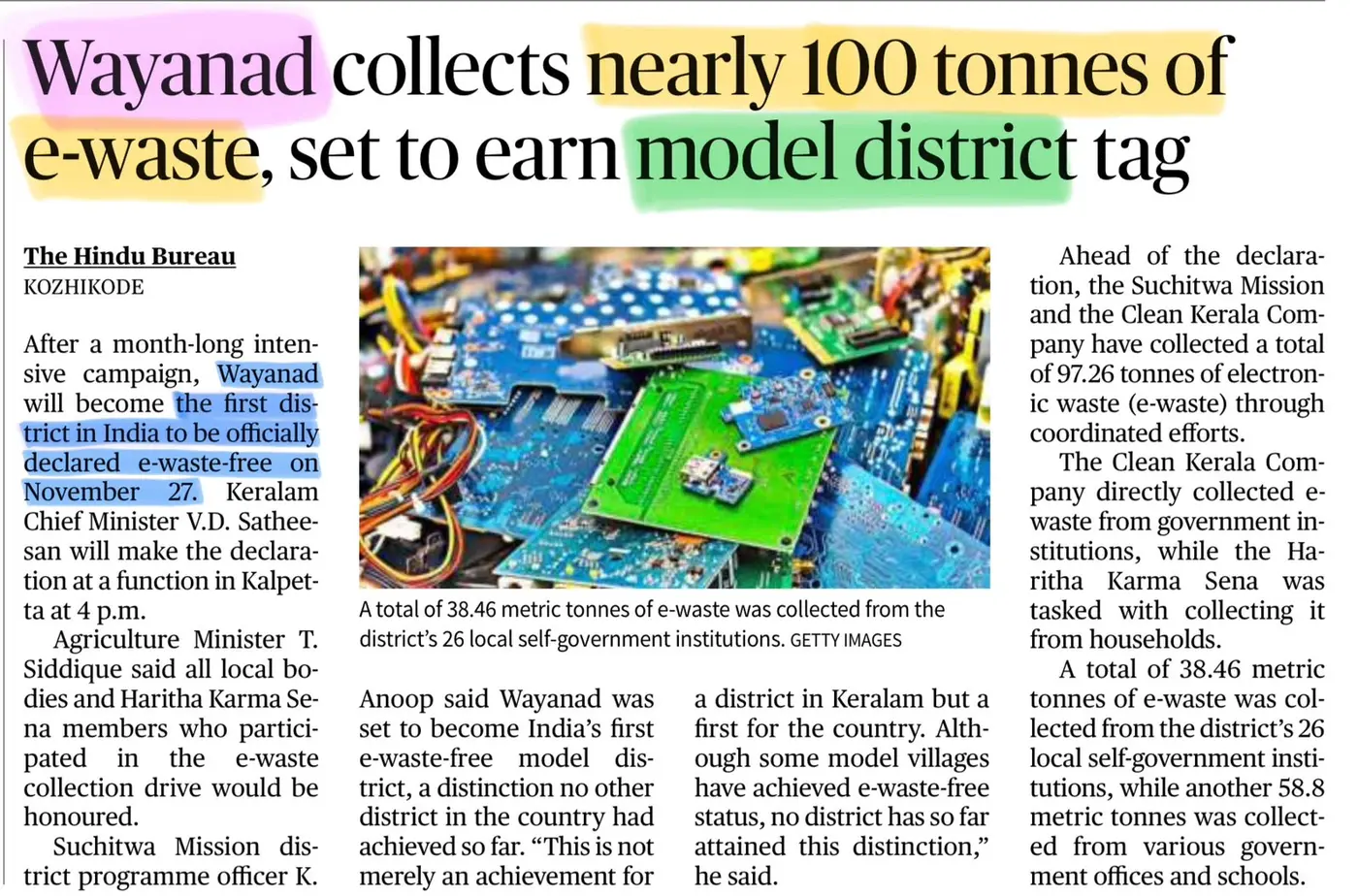
Context: Wayanad, Kerala, will be declared India's first e-waste-free district on 27 November after a month-long drive collected 97.26 tonnes of electronic waste.

Wayanad collects nearly 100 tonnes of e-waste, set to earn model district tag (The Hindu)
Wayanad set to earn model district tag. Source: The Hindu

The Wayanad Model

Total collected
97.26 tonnes of e-waste.
Households
Door-to-door by Haritha Karma Sena.
Institutions
Clean Kerala Company for offices and schools.
Split
38.46 t from 26 local bodies; 58.8 t from offices and schools.
Coordination
Suchitwa Mission with Clean Kerala Company.

India's E-Waste Picture

Global rank
3rd largest generator after China and USA (Global E-waste Monitor 2024).
India
~13.98 lakh tonnes in FY 2024–25 (CPCB).
World
62 million tonnes (2022); only 22.3% formally recycled.

Concerns

Pollution
Lead, mercury, cadmium contaminate soil and water.
Air
Open burning releases toxic fumes.
Health
Informal dismantling harms workers' nerves, kidneys, lungs.
Resources
Loss of copper, gold and rare earths.

Regulatory Framework

E-Waste Rules 2022
In force from 1 April 2023.
EPR
Extended Producer Responsibility – producers meet recycling targets.
CPCB
Online portal for registration and monitoring.

Way Forward

Replicate
District drives with local-body participation.
Infrastructure
More authorised collection and recycling centres.
Inclusion
Bring informal workers into the formal system.
Circularity
Repair, refurbish, reuse, recycle.
Key Takeaway: Wayanad shows that local bodies plus community workers can make e-waste collection work – a district-level template for India's circular economy.

Prelims Practice MCQ

+2 correct • −0.66 wrong

UPSC Prelims PYQ 2025: Consider the following statements:
Statement I: Circular economy reduces the emissions of greenhouse gases.
Statement II: Circular economy reduces the use of raw materials as inputs.
Statement III: Circular economy reduces wastage in the production process.
Which one of the following is correct in respect of the above statements?

Explanation: A circular economy cuts demand for virgin raw materials and reduces production waste. Both lower resource extraction and energy use, and therefore greenhouse gas emissions.

UPSC Mains Question

GS3 • 10 Marks • 150 Words

E-waste is both an environmental hazard and a resource opportunity. Discuss with reference to India's regulatory framework and the Wayanad model.

Attempt before opening the value-addition tab.
Accepted: JPG, JPEG, PNG, WEBP or PDF. The standalone file previews your answer locally; connect the API hook for real server submission.
Use after attempting the Mains answer
  • Rules — E-Waste (Management) Rules 2022, Battery Waste Management Rules 2022.
  • Concepts — EPR, circular economy, urban mining, informal recycling.
  • Data — India 3rd largest e-waste generator; 13.98 lakh tonnes (FY 2024–25).
  • PYQ link — Prelims 2025 (circular economy).
NEWS 3 GS2 • International Relations | International Law Source: Associated Press

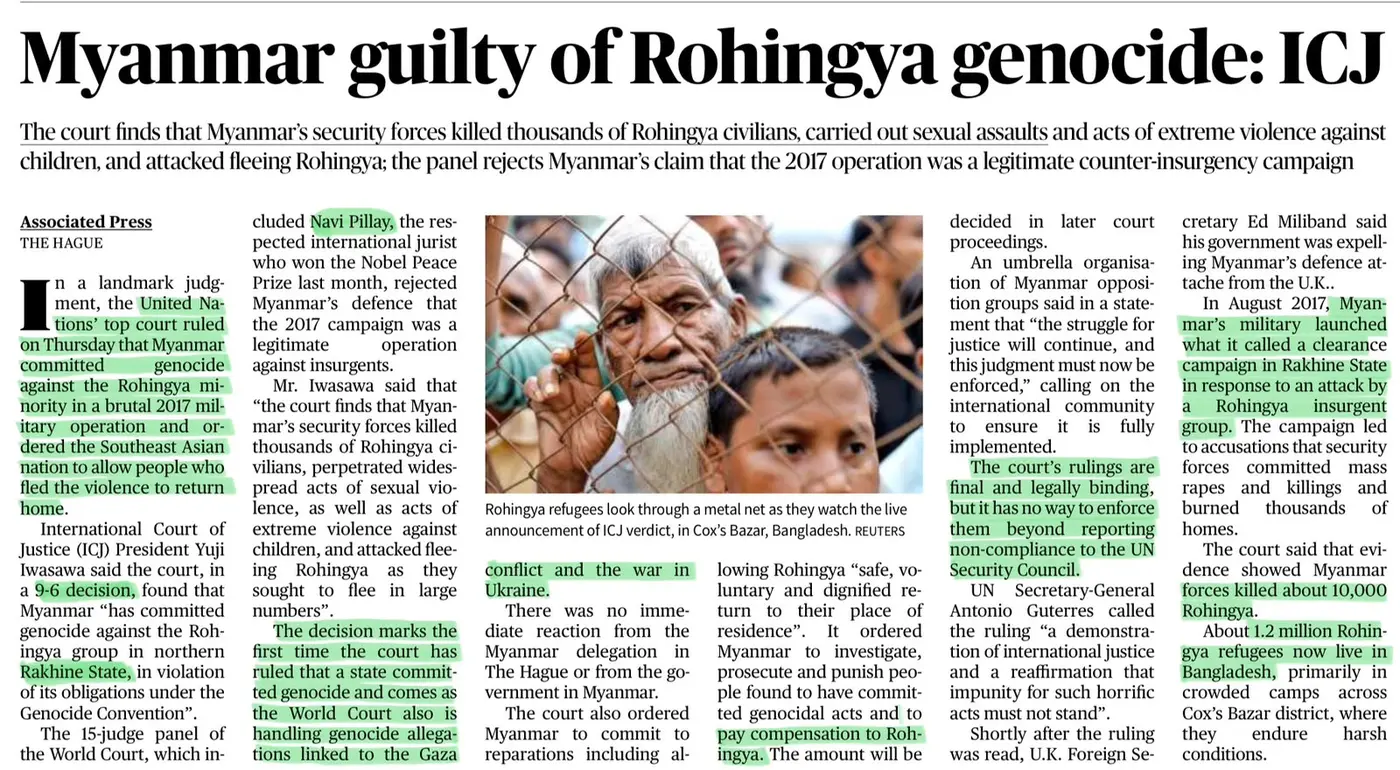
ICJ Holds Myanmar Responsible for Rohingya Genocide

Context: By a 9–6 majority, the International Court of Justice ruled that Myanmar committed genocide against the Rohingya in Rakhine State during the 2017 military operation, violating the Genocide Convention.

Myanmar guilty of Rohingya genocide: ICJ (Associated Press)
Myanmar guilty of Rohingya genocide: ICJ. Source: Associated Press

Background

Rohingya
Muslim minority, mainly in Myanmar's Rakhine State.
2017
Military 'clearance operation' after insurgent attacks.
Impact
~10,000 killed; ~1.2 million refugees in Bangladesh (Cox's Bazar).

ICJ Judgment

Verdict
Myanmar responsible for genocide – first time the court has found a state guilty.
Defence rejected
Not a legitimate counter-insurgency operation.
Orders
Investigate, prosecute, punish; reparations and safe return of refugees.
Binding
Final and legally binding; no direct enforcement power.

Genocide Convention, 1948

Adopted
1948; in force from 1951.
Definition
Acts intended to destroy a national, ethnic, racial or religious group, wholly or partly.
Duty
States must prevent and punish genocide. Myanmar is a party.

About the ICJ

Set up
1945, UN Charter; principal judicial organ of the UN.
Seat
The Hague, Netherlands.
Judges
15, nine-year terms, elected by UNGA and UNSC.
Jurisdiction
Disputes between states only; advisory opinions.
Enforcement
Article 94: non-compliance can go to the UN Security Council.

Significance

Accountability
States can be held responsible for genocide.
Minorities
Strengthens minority protection norms.
Refugees
Supports safe, voluntary, dignified return.
Key Takeaway: A landmark ruling: for the first time the World Court has held a state guilty of genocide – but enforcement still depends on the UN Security Council.

Prelims Practice MCQ

+2 correct • −0.66 wrong

Consider the following statements about the International Court of Justice (ICJ):
1. It is headquartered at The Hague, Netherlands.
2. It has 15 judges elected for nine-year terms.
3. It can try individuals for war crimes and genocide.
Which of the statements given above are correct?

Explanation: The ICJ sits at The Hague and has 15 judges with nine-year terms. It settles disputes between states only. Individuals are tried by the International Criminal Court (ICC), so Statement 3 is wrong.

UPSC Mains Question

GS2 • 15 Marks • 250 Words

Discuss the significance of the ICJ ruling on the Rohingya genocide for international justice. What are the limits of international courts in enforcing their judgments?

Attempt before opening the value-addition tab.
Accepted: JPG, JPEG, PNG, WEBP or PDF. The standalone file previews your answer locally; connect the API hook for real server submission.
Use after attempting the Mains answer
  • ICJ vs ICC — ICJ: disputes between states (UN organ); ICC: individuals (Rome Statute, 2002). India is not a party to the Rome Statute.
  • Law — Genocide Convention 1948, UN Charter Article 94, Responsibility to Protect (R2P).
  • India link — Rohingya refugees in India; India is not a party to the 1951 Refugee Convention.
  • Keywords — state responsibility, non-refoulement, reparations.
NEWS 4 GS2 • International Relations | GS3 • Defence Source: The Hindu

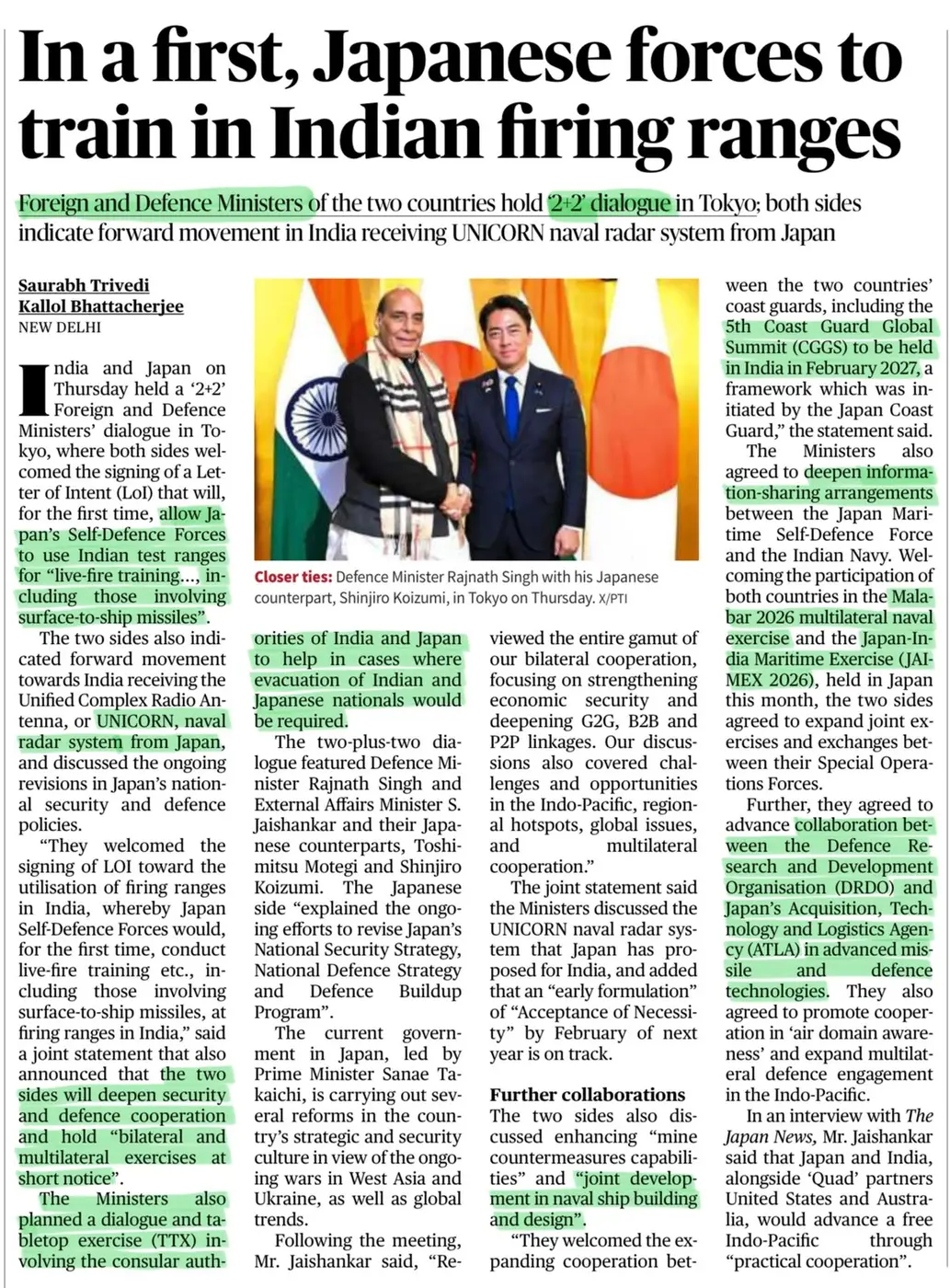
India–Japan 2+2: Japanese Forces to Train in India

Context: At the India–Japan 2+2 Foreign and Defence Ministers' Dialogue in Tokyo, both sides agreed to deepen defence cooperation, exercises, technology sharing and Indo-Pacific security.

In a first, Japanese forces to train in Indian firing ranges – India-Japan 2+2 (The Hindu)
Japanese forces to train in Indian firing ranges. Source: The Hindu

Major Outcomes

Live-fire training
Japan's Self-Defence Forces to use Indian firing ranges for the first time, incl. surface-to-ship missiles.
UNICORN
Progress on Japan's Unified Complex Radio Antenna naval radar for India.
Defence tech
DRDO–ATLA cooperation in missiles and advanced technology.
Maritime
Information-sharing between Indian Navy and JMSDF.
Exercises
Malabar 2026 and JIMEX 2026; more special-forces exchanges.
Coast Guard
5th Coast Guard Global Summit in India, Feb 2027.

Other Areas

Navy
Mine countermeasures; joint shipbuilding and design.
Air
Air domain awareness.
Consular
Joint planning for evacuation of nationals.

Significance for India

Indo-Pacific
Free, open, rules-based order.
Modernisation
Access to Japanese defence technology.
Sea lanes
Better surveillance and interoperability.
Quad
Strengthens ties with Japan, U.S. and Australia.
Self-reliance
Joint R&D supports Aatmanirbhar defence.

Key Frameworks

2+2 Dialogue
Foreign + Defence Ministers; first held November 2019, New Delhi.
Partnership
Special Strategic and Global Partnership since 2014.
Key Takeaway: India–Japan ties are moving from dialogue to hard defence cooperation – live-fire training, radars and joint technology – anchoring both in the Indo-Pacific.

Prelims Practice MCQ

+2 correct • −0.66 wrong

Consider the following pairs (Exercise : Participants):
1. JIMEX : India and Japan
2. Malabar : India, U.S., Japan and Australia
3. Dharma Guardian : India and Japan
How many of the pairs given above are correctly matched?

Explanation: JIMEX is the India–Japan maritime exercise, Malabar includes all four Quad navies, and Dharma Guardian is the India–Japan army exercise. All three pairs are correct.

UPSC Mains Question

GS2 • 15 Marks • 250 Words

India–Japan defence cooperation has deepened significantly in recent years. Discuss its strategic significance for India in the Indo-Pacific.

Attempt before opening the value-addition tab.
Accepted: JPG, JPEG, PNG, WEBP or PDF. The standalone file previews your answer locally; connect the API hook for real server submission.
Use after attempting the Mains answer
  • Exercises — JIMEX (navy), Dharma Guardian (army), Shinyuu Maitri / Veer Guardian (air), Malabar (Quad).
  • Agreements — ACSA (2020), Defence Equipment & Technology Transfer Agreement (2015).
  • India links — India's 2+2 dialogues also with U.S., Australia, Russia.
  • Keywords — interoperability, strategic convergence, Act East, Indo-Pacific.
NEWS 5 GS3 • Economy | Mining & Energy Security Source: The Hindu – Opinion

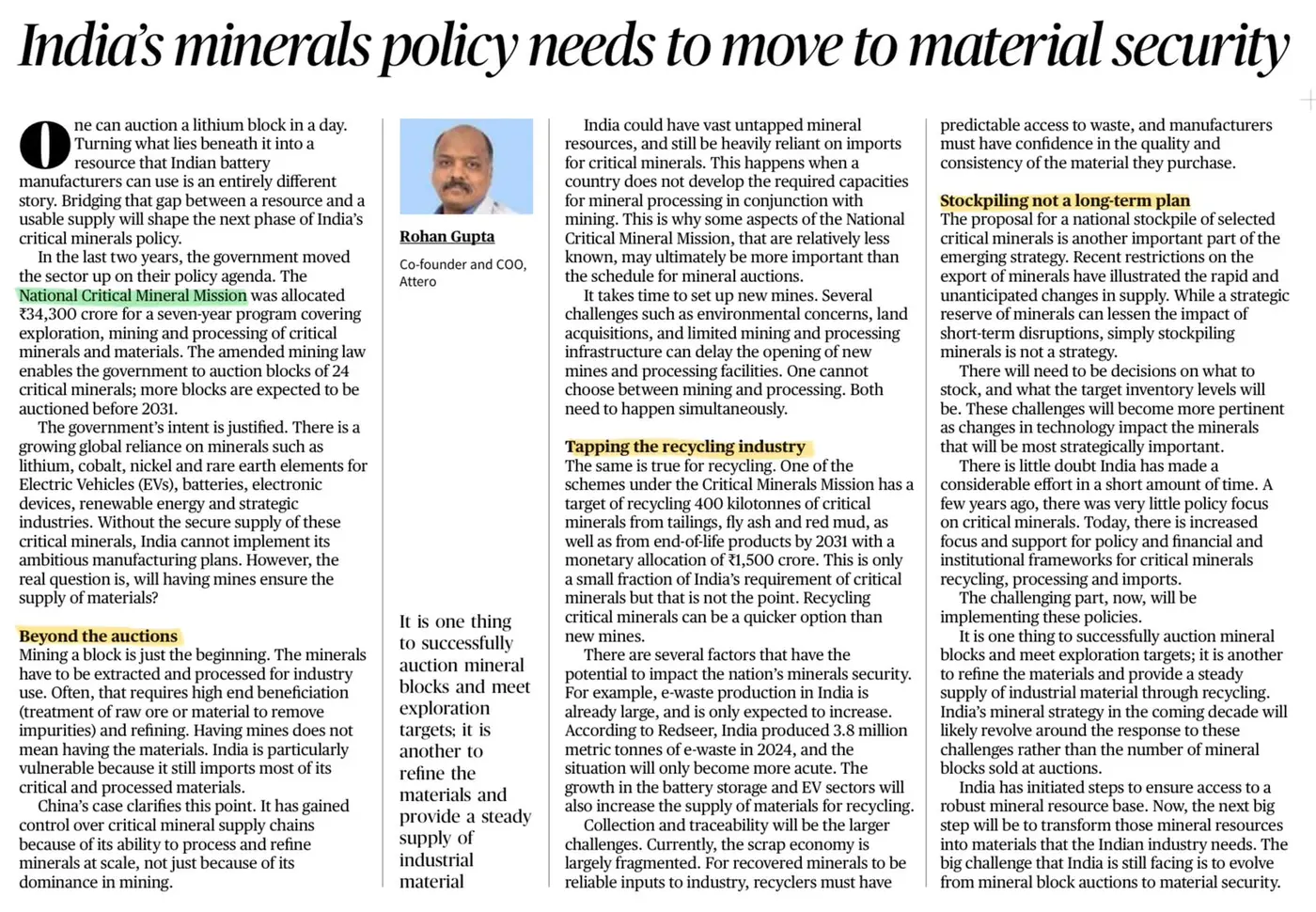
Critical Minerals: From Auctions to Material Security

Context: India's critical minerals policy must go beyond auctioning blocks to building the full supply chain – exploration, mining, processing, refining and recycling – to secure usable industrial materials.

India's minerals policy needs to move to material security (Opinion)
India's minerals policy needs to move to material security. Source: The Hindu

India's Strategy

NCMM
National Critical Mineral Mission – ₹34,300 crore over 7 years.
Auctions
Centre can auction blocks of 24 critical and strategic minerals (amended law).
Uses
Lithium, cobalt, nickel, rare earths for EVs, batteries, electronics, defence.

Challenges Beyond Auctions

Processing gap
Mining ≠ usable material; India imports most processed minerals.
Delays
Land, environmental clearances, weak infrastructure.
Recycling
Fragmented scrap sector; target 4 lakh tonnes by 2031 (₹1,500 crore).
E-waste
~3.8 million tonnes (2024 estimate) – untapped secondary source.
China
Dominates processing and refining – export-curb risk.

Priorities for Material Security

Processing
Build refining alongside mining.
Recycling
Recover minerals from e-waste, tailings, fly ash, red mud.
Quality
Reliable, consistent supply for manufacturers.
Stockpiling
Strategic reserves for short-term shocks – not a long-term fix.
Partnerships
Overseas assets (KABIL) and diversified imports.

Significance

Energy transition
EVs, batteries, renewables.
Self-reliance
Less import dependence.
Strategic autonomy
Shield from geopolitical supply curbs.
Key Takeaway: Owning mines is not the same as owning materials. India's next step is processing, refining and recycling – turning resources into supply.

Prelims Practice MCQ

+2 correct • −0.66 wrong

UPSC Prelims PYQ 2025: Consider the following statements:
I. India has joined the Minerals Security Partnership as a member.
II. India is a resource-rich country in all the 30 critical minerals that it has identified.
III. Parliament in 2023 amended the MMDR Act, 1957, empowering the Central Government to exclusively auction mining leases and composite licences for certain critical minerals.
Which of the statements given above are correct?

Explanation: India joined the Minerals Security Partnership in June 2023, and the 2023 MMDR amendment empowered the Centre to auction specified critical minerals. India is not resource-rich in all 30 critical minerals, so II is wrong.

UPSC Mains Question

GS3 • 15 Marks • 250 Words

Securing critical minerals requires more than auctioning mineral blocks. Discuss the challenges India faces in building a critical mineral supply chain and suggest measures.

Attempt before opening the value-addition tab.
Accepted: JPG, JPEG, PNG, WEBP or PDF. The standalone file previews your answer locally; connect the API hook for real server submission.
Use after attempting the Mains answer
  • Institutions — KABIL (Khanij Bidesh India Ltd), NCMM (2025), MMDR Amendment 2023.
  • Partnerships — Minerals Security Partnership (India joined 2023), Quad critical minerals initiative.
  • Data — 30 critical minerals identified (2023); NCMM ₹34,300 crore.
  • PYQ link — Prelims 2025 (MSP, MMDR amendment).
NEWS 6 GS2 • International Relations | Awards Source: The Hindu

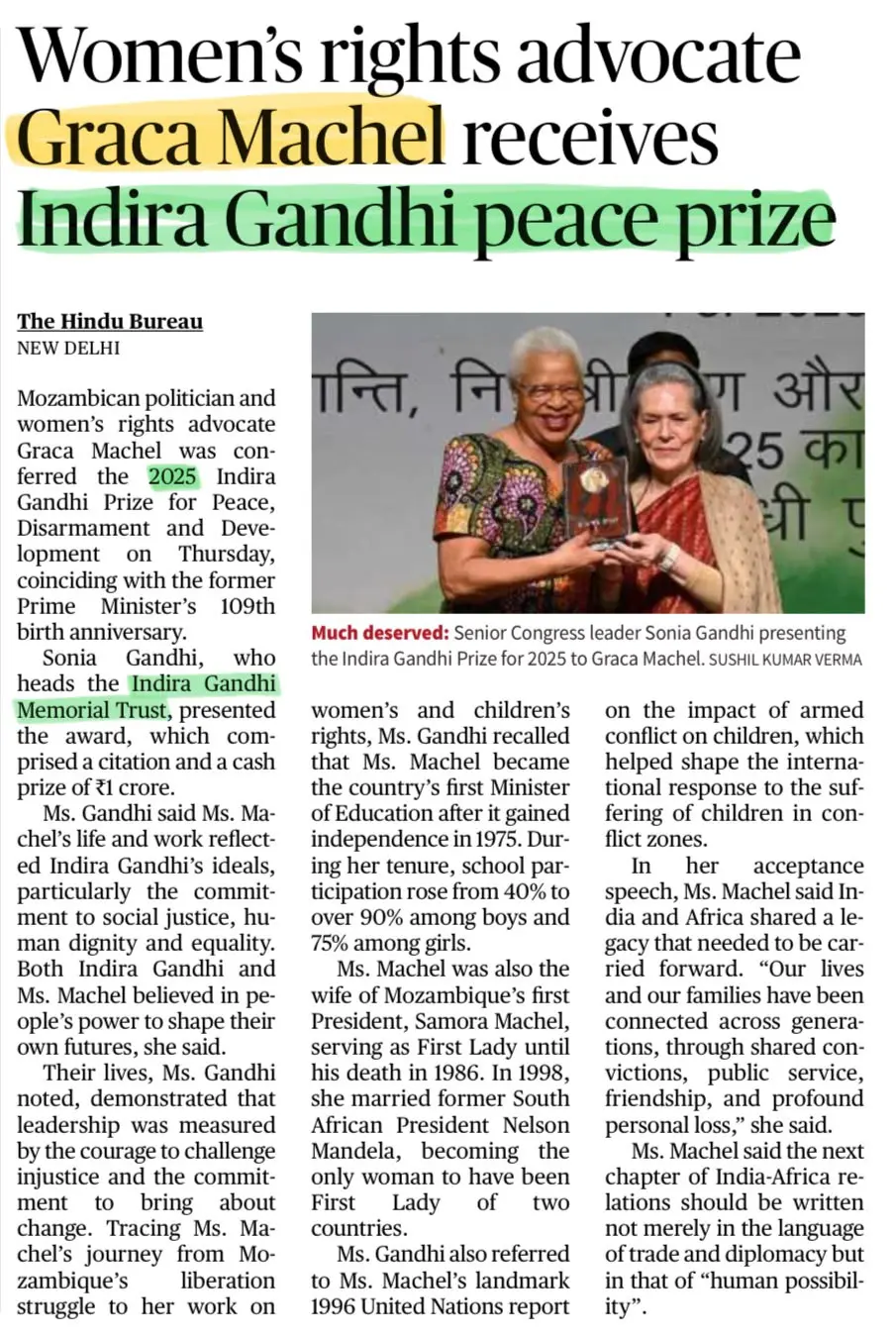
Graça Machel Receives Indira Gandhi Prize 2025

Context: Mozambican politician and women's rights advocate Graça Machel received the 2025 Indira Gandhi Prize for Peace, Disarmament and Development for her work on education, women's empowerment and children's rights.

Women's rights advocate Graca Machel receives Indira Gandhi peace prize (The Hindu)
Graça Machel receives Indira Gandhi Prize. Source: The Hindu

About Graça Machel

Mozambique
First Minister of Education after independence (1975).
Children
Landmark 1996 UN report on the impact of armed conflict on children.
First Lady twice
Wife of Samora Machel (Mozambique) and Nelson Mandela (South Africa).

Indira Gandhi Prize

Established
1985.
For
Peace, disarmament and development.
Award
₹1 crore and a citation.

Indira Gandhi Prize vs Gandhi Peace Prize

Established
1985 vs 1995.
Given by
Indira Gandhi Memorial Trust vs Government of India.
Focus
Peace & development vs Gandhian ideals, non-violence.
Recent
Graça Machel (2025) vs Gita Press (2021 award).
Key Takeaway: Graça Machel's work on education and children in conflict reflects India–Africa ties built on shared struggles and people-centred development.

Prelims Practice MCQ

+2 correct • −0.66 wrong

UPSC Prelims PYQ 2025: Who among the following are members of the jury to select the recipient of the Gandhi Peace Prize?
I. President of India
II. Prime Minister of India
III. Chief Justice of India
IV. Leader of Opposition in the Lok Sabha

Explanation: The Gandhi Peace Prize jury is chaired by the Prime Minister and includes the Chief Justice of India and the Leader of the Opposition (single largest opposition party) in the Lok Sabha. The President is not a member.

UPSC Mains Question

GS2 • 10 Marks • 150 Words

India–Africa relations should be built on human development, not just trade and diplomacy. Discuss.

Attempt before opening the value-addition tab.
Accepted: JPG, JPEG, PNG, WEBP or PDF. The standalone file previews your answer locally; connect the API hook for real server submission.
Use after attempting the Mains answer
  • India–Africa — India-Africa Forum Summit, Pan-African e-Network, African Union in G20 (2023).
  • Awards — Gandhi Peace Prize (1995), Indira Gandhi Prize (1985).
  • Concepts — women's empowerment, children in armed conflict, South-South cooperation.
  • PYQ link — Prelims 2025 (Gandhi Peace Prize jury).
NEWS 7 GS2 • Education | Health Source: The Hindu

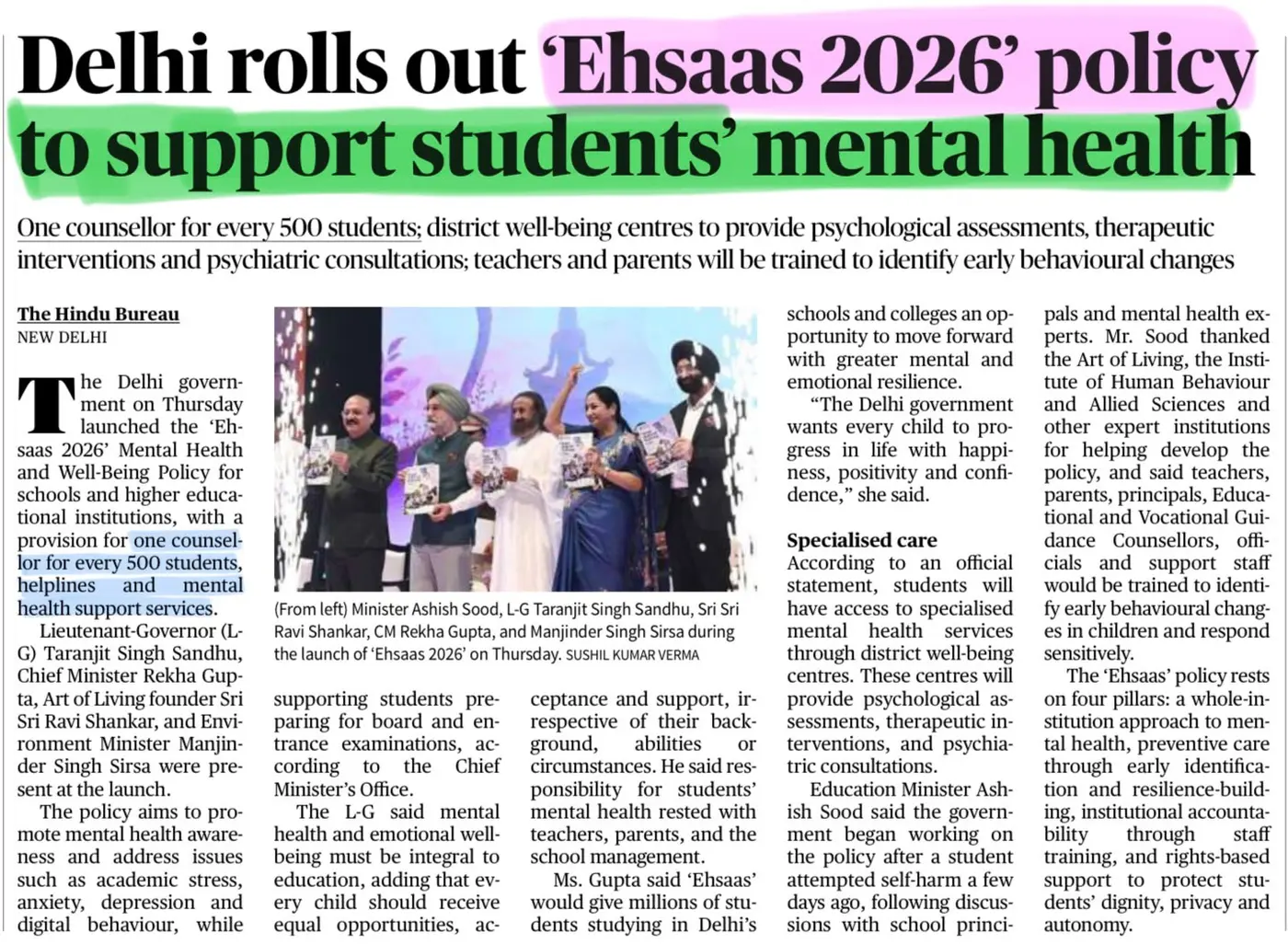
Delhi's 'Ehsaas 2026' Policy for Student Mental Health

Context: The Delhi Government launched the Ehsaas 2026 Mental Health and Well-Being Policy for schools and higher educational institutions to tackle academic stress, anxiety and depression.

Delhi rolls out Ehsaas 2026 policy to support students' mental health (The Hindu)
Delhi rolls out Ehsaas 2026 policy. Source: The Hindu

Key Provisions

Counsellors
One counsellor per 500 students.
District centres
Psychological assessment, therapy and psychiatric consultation.
Early signs
Teachers, parents and staff trained to spot behavioural changes.
Helplines
Mental health support services.
Exams
Support for board and entrance exam stress.

Four Pillars

Whole institution
Mental health built into schools and colleges.
Preventive care
Early identification and resilience.
Accountability
Trained staff, shared responsibility.
Rights-based
Students' dignity, privacy, autonomy.

Significance

Well-being
Addresses stress, anxiety, depression.
Early help
Problems caught before they worsen.
Inclusion
Support regardless of background.
Learning
Safer, more confident classrooms.
Key Takeaway: Ehsaas treats student mental health as part of education itself – with counsellors, trained teachers and district centres working together.

Prelims Practice MCQ

+2 correct • −0.66 wrong

With reference to mental health in India, consider the following statements:
1. The Mental Healthcare Act, 2017 recognises the right to access mental healthcare.
2. Tele-MANAS is a national tele-mental health programme.
3. Delhi's Ehsaas 2026 policy provides one counsellor for every 500 students.
How many of the above statements are correct?

Explanation: The Mental Healthcare Act, 2017 gives a right to access mental healthcare, Tele-MANAS (2022) is the national tele-mental health helpline, and Ehsaas 2026 sets one counsellor per 500 students. All three are correct.

UPSC Mains Question

GS2 • 10 Marks • 150 Words

Rising academic pressure has made student mental health a public policy concern. Discuss the role of educational institutions in addressing it.

Attempt before opening the value-addition tab.
Accepted: JPG, JPEG, PNG, WEBP or PDF. The standalone file previews your answer locally; connect the API hook for real server submission.
Use after attempting the Mains answer
  • Law & schemes — Mental Healthcare Act 2017, National Mental Health Programme, Tele-MANAS (14416), Manodarpan (NEP 2020).
  • Guidelines — UMMEED draft guidelines for schools (2023).
  • Concepts — whole-school approach, psychosocial support, resilience.
  • Keywords — academic stress, early identification, rights-based care.

Copyright © 2026 USARAMBHA EDUCATION (UnderStand UPSC). All Rights Reserved.

Call Now · 83770 72252