US Unveils 25% Tariff on India for ‘Harmful Trade’ under Section 301
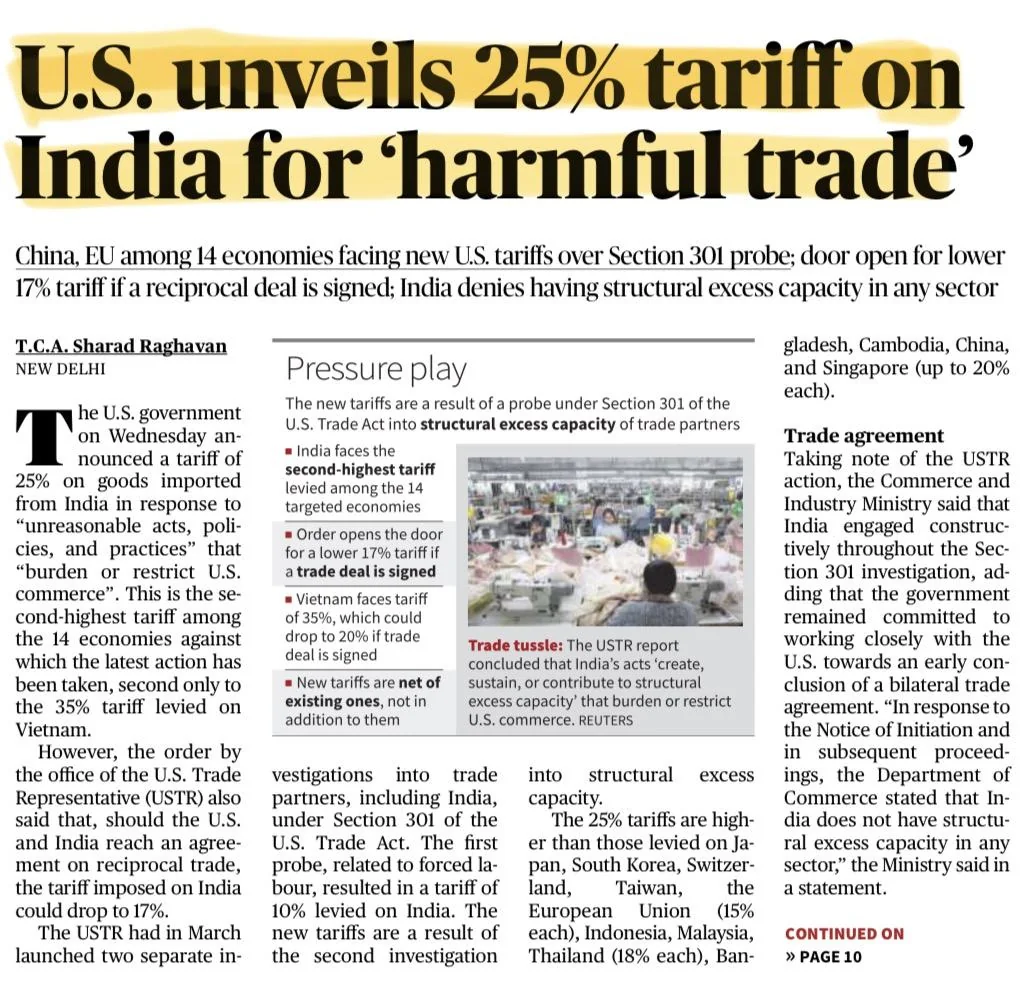
Context: Following its Section 301 investigation, the US has announced a 25% tariff on Indian goods, alleging that India’s trade policies contribute to structural excess capacity and unfair competition. India has rejected the charge.
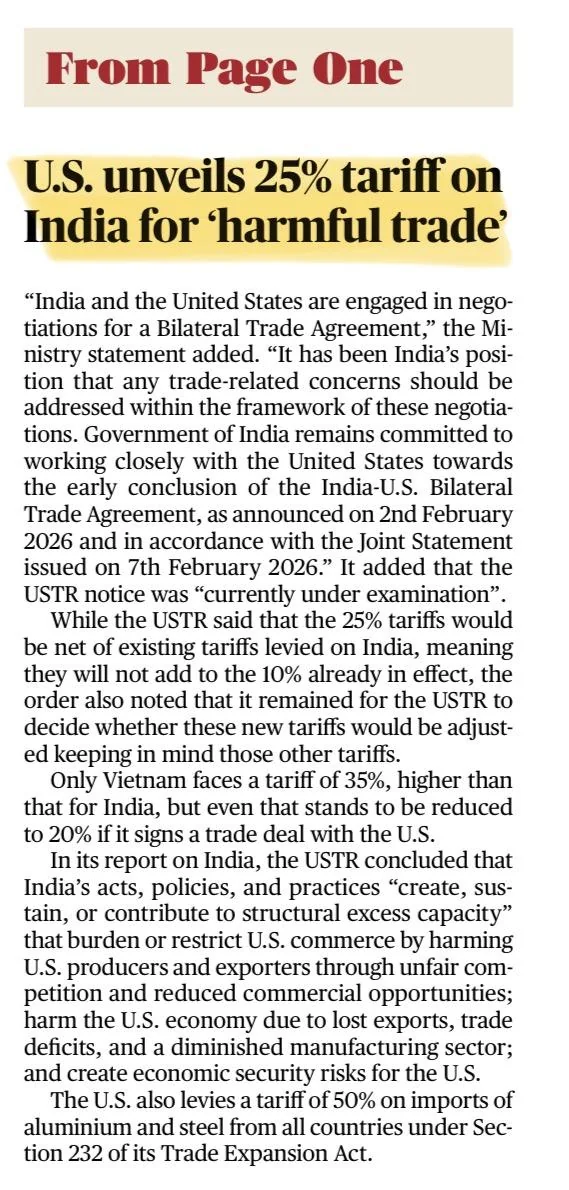
Key Developments
25% – the second-highest among the 14 targeted economies; Vietnam faces the highest at 35%.
Stated to be net of existing tariffs, not an automatic addition to the current 10%.
May fall to 17% if India and the US conclude a trade agreement.
Separately, a 50% tariff applies to all countries under Section 232 of the Trade Expansion Act.
Section 301: Basis of US Action
Section 301 of the US Trade Act, 1974, administered by the USTR.
Investigates foreign practices considered unfair or harmful to US commerce.
India’s policies create or sustain structural excess capacity, hurting US producers and exporters.
Lost exports, trade deficits, a weakened manufacturing base and economic-security risks.
India’s Response
India says it has no structural excess capacity in any sector.
The Commerce Ministry says it engaged constructively throughout the probe.
Concerns to be settled through the India–US Bilateral Trade Agreement talks, already underway.
Implications for India
Higher tariffs reduce the price competitiveness of Indian goods in the US.
Export-oriented industries face uncertainty in production and investment plans.
Tariff pressure may complicate trade negotiations.
Unilateral measures intensify protectionism and disrupt supply chains.
Way Forward
Expedite a mutually beneficial BTA.
Reduce dependence on any single market through new export destinations.
Improve productivity, quality and logistics.
Use bilateral dialogue and, where suitable, multilateral mechanisms.
Prelims Practice MCQ
+2 correct • −0.66 wrongConsider the following statements:
1. Section 301 of the US Trade Act, 1974 is administered by the United States Trade Representative (USTR).
2. Section 232 of the US Trade Expansion Act allows tariffs on imports considered a threat to national security.
3. Under WTO rules, the Most-Favoured-Nation principle allows a member to impose higher tariffs on one member without justification.
Which of the statements given above are correct?
UPSC Mains Question
GS2/GS3 • 15 Marks • 250 WordsThe growing use of tariffs as instruments of geopolitical pressure challenges the rules-based multilateral trading system. Discuss in the context of recent US tariffs on India and suggest a strategy for India.
- Laws — Section 301 (Trade Act, 1974), Section 232 (Trade Expansion Act, 1962).
- Concepts — structural excess capacity, MFN, tariff stacking, trade diversion, ‘friend-shoring’.
- Institutions — USTR, WTO Dispute Settlement Body (Appellate Body non-functional since 2019).
- India’s tools — BTA negotiations, PLI schemes, FTAs with UK/EFTA/UAE/Australia, export diversification.